| QUICK ANSWER
Odoo ERP implementation in Saudi Arabia usually costs SAR 20,000 to SAR 250,000+ as a one-time project, plus per-user licence fees. A focused go-live takes 6 to 12 weeks. Larger multi-entity rollouts run longer. The 2026 driver is compliance. ZATCA Phase 2 e-invoicing Wave 24 pulls businesses with VAT-taxable revenue above SAR 375,000 into mandatory Fatoora integration by 30 June 2026, when the penalty waiver ends. Odoo, correctly localised, keeps you clear of that line. |
Why Saudi businesses are choosing Odoo in 2026
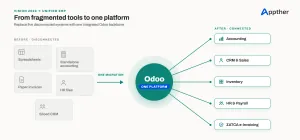
Saudi Arabia is rewriting how it does business. Vision 2030 pushes every sector toward digital, paperless and transparent operations. Spreadsheets and disconnected accounting tools cannot keep up.
ERP is now the baseline, not a luxury. And among ERP options, Odoo has become the practical favourite for Saudi companies. Three reasons stand out.
- Cost. Odoo delivers a working ERP for a fraction of what SAP or Oracle demand in year one.
- Modularity. Start with finance and sales, then add HR, inventory or manufacturing as you grow. You pay for what you switch on.
- Localisation. Arabic and right-to-left support, VAT, Zakat and ZATCA e-invoicing all fit into the platform.
The result: a single source of truth across finance, sales, inventory, HR and operations. That is exactly the digital maturity Vision 2030 rewards.
ZATCA e-invoicing: the deadline you cannot miss
If there is one line in this guide to act on, it is this one. ZATCA runs Saudi e-invoicing under the Fatoora programme. Phase 2, the Integration Phase, connects your invoicing system directly to ZATCA for real-time clearance.
Wave 24 is the largest wave so far. It captures any business with VAT-taxable revenue above SAR 375,000 in 2022, 2023 or 2024. That is the lowest threshold to date, and it sweeps in a huge share of Saudi SMEs.
The integration deadline is 30 June 2026. On that same date, the penalty waiver ends and full enforcement begins. So the grace period is over.
Phase 2 compliance is technical. Your system has to produce:
- Structured XML invoices in the ZATCA format
- A QR code on every invoice
- A cryptographic digital signature and a unique identifier (UUID)
- Real-time clearance or reporting through a secure Fatoora API
Odoo handles this when it is set up by a partner who knows the ZATCA rules. Get the localisation right once, and compliance becomes a background process rather than a monthly scramble.
| COMPLIANCE RISK IN PLAIN TERMS
If your revenue crossed SAR 375,000 in any of 2022, 2023 or 2024, and you are not yet integrated with Fatoora, the clock is already running. ZATCA notifies targeted taxpayers at least six months before their date. Waiting for that letter is not a plan. |
How much does Odoo ERP cost in Saudi Arabia?
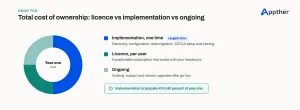
There are two cost layers: the software licence and the implementation project. Treat them separately, because they behave differently.
1. Licence cost
Odoo comes in three editions.
- Community. Free and open source. You self-host and forgo Odoo Studio, the mobile app and official support. Fine for lean teams with in-house technical help.
- Standard (Enterprise). Roughly SAR 90 per user per month, billed yearly. Unlocks all apps on Odoo Online hosting.
- Custom (Enterprise). Roughly SAR 140 per user per month. Adds Odoo Studio, external API access, multi-company and self-hosting options.
These are indicative. Odoo prices by region and runs promotional first-year rates, so confirm the live figure for Saudi Arabia on Odoo’s pricing page before you budget.
2. Implementation cost
This is the bigger and more variable number. Industry benchmarks put implementation services at 40 to 60 percent of your first-year ERP spend. In Saudi Arabia it carries an extra layer, because your partner has to build in Arabic, VAT, Zakat and ZATCA compliance from day one.
| Tier | Best fit | Indicative one-time cost |
|---|---|---|
| Starter | Small business or single branch. Core accounting, sales, inventory. ZATCA e-invoicing and Arabic switched on. Light customisation. | SAR 20,000 to 75,000 |
| Growth SME | Multiple departments. Finance, CRM, inventory, purchase and HR. ZATCA Phase 2 clearance, VAT and Zakat logic, some custom workflows and one or two integrations. | SAR 75,000 to 250,000 |
| Enterprise | Multi-entity or multi-branch. Heavy customisation, manufacturing or field operations, several third-party integrations, data migration from legacy ERP. | SAR 250,000 and up |
Figures are pegged to the SAR-USD rate and rounded for planning. Your real number depends on scope, data quality and how much you customise.
3. The costs teams forget
- Custom modules. A real custom module, not a tweak, runs about SAR 15,000 to 55,000 each to build, plus ongoing upkeep across version upgrades.
- Hosting. Odoo.sh or your own cloud. Scales with workers, storage and staging environments.
- Data migration. Cleaning and moving history from legacy systems is often underestimated.
- Training and support. Budget for user training and an annual support plan so adoption sticks.
| RULE OF THUMB
Every custom module you can avoid is budget you keep. The cleaner your processes map to standard Odoo, the lower your build cost and the smoother your future upgrades. A good partner pushes you toward standard first, and customises only where it earns its keep. |
 |
The Odoo implementation process, step by step
A disciplined rollout is what separates a smooth go-live from a stalled project. Here is the path Appther follows.
- Discovery and scoping. We map your current processes, pain points and compliance obligations. Output: a clear scope and a fixed set of modules.
- Solution design. We design workflows in Odoo, decide what stays standard and what needs customisation, and plan every integration.
- Configuration and localisation. Chart of accounts, VAT and Zakat logic, Arabic and RTL templates, and ZATCA Phase 2 clearance are all set up and tested.
- Data migration. Master data and history are cleaned, mapped and moved. We validate against the source before sign-off.
- Testing and user training. Real users run real scenarios on a staging environment. We fix, refine and train in parallel.
- Go-live and hypercare. We cut over, monitor closely for the first weeks, then move you onto a steady support plan.
For a focused deployment, this runs 6 to 12 weeks. Multi-entity or heavily customised projects take longer, and that is normal. Odoo’s modular design also lets you phase it: go live on finance and compliance first, then add HR or manufacturing later.
The benefits for Saudi businesses
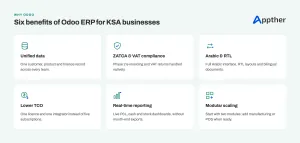
One connected system
Finance, sales, inventory, HR and operations share one database. No more reconciling numbers between disconnected tools. Leadership gets real-time visibility instead of month-old spreadsheets.
Built-in compliance
VAT at 15 percent, Zakat, GOSI, Wage Protection System and ZATCA e-invoicing all live inside the workflow. Compliance stops being a separate, error-prone task and audit-ready records become the default.
Lower total cost
Odoo delivers a functioning ERP for a small share of what legacy suites cost to license and maintain. That gap is why Saudi CFOs keep choosing it.
Scales with Vision 2030 growth
Add modules, users and legal entities as you expand. The platform grows with you rather than forcing a rip-and-replace later.
Which Odoo version should you use in 2026?
For a new implementation this year, go with Odoo 19. It was released in October 2025 and is fully stable. Odoo officially supports the three most recent versions, currently 17, 18 and 19.
Odoo 19 matters for one reason in particular: AI is now built into the platform. AI agents can read an uploaded PDF, create and update records, and draft content on command. For an AI-first partner like Appther, that is a natural fit, and it points toward the more autonomous workflows coming in Odoo 20, expected around October 2026.
Want the detail before you decide? Our Odoo 19 vs Odoo 17 comparison breaks down what changed, feature by feature. And if you already run an older version, the Odoo 17 to Odoo 19 migration guide walks through the upgrade step by step.
Starting on Odoo 19 now means you get the newest features and the longest runway before your next upgrade window.
What to look for in an implementation partner
The software is the same everywhere. The partner is the variable that decides whether your project succeeds. In Saudi Arabia, screen for these.
- Proven ZATCA Phase 2 experience. Ask for specifics on Fatoora clearance, not just a claim of VAT support.
- Real Arabic and RTL delivery. Bilingual invoices, reports and workflows, done properly across every module.
- A standard-first mindset. Partners who customise everything inflate your cost and your upgrade pain.
- Support after go-live. Hypercare and a clear support plan, not a disappearing act once the invoice clears.
Why work with Appther
Appther is an AI-first software company that implements and customises Odoo for businesses across finance, manufacturing, pharma and real estate. We bring functional ERP consulting together with real AI engineering, so your Odoo build is compliant, clean and ready for the automation that Odoo 19 and beyond unlock.
We deliver end-to-end Odoo implementation, customisation and support, across Odoo 17, 18 and 19, in both Community and Enterprise editions.
For Saudi clients that means Arabic-ready, ZATCA-compliant Odoo, delivered on a realistic timeline, by a team that customises only where it adds value.

Keep reading
- Odoo ERP implementation checklist for manufacturers – a practical, phase-by-phase rollout guide.
- Odoo 19 vs Odoo 17: what changed and should you upgrade – full feature-by-feature comparison.
- Explore Appther’s Odoo services – implementation, custom modules, integration and support.
Frequently asked questions
How much does Odoo implementation cost in Saudi Arabia?
Implementation typically ranges from SAR 20,000 for a small starter setup to SAR 250,000 and above for complex enterprise projects, plus per-user licence fees. Scope, customisation and data migration drive the final figure.
Is Odoo ZATCA compliant?
Yes, when it is localised correctly. Odoo can produce ZATCA-format XML invoices with QR codes, digital signatures and UUIDs, and integrate with the Fatoora platform for Phase 2 clearance. The compliance quality depends on your implementation partner.
How long does an Odoo implementation take?
A focused go-live usually takes 6 to 12 weeks. Multi-entity or heavily customised rollouts take longer. Odoo’s modular design lets you phase the project and go live on the most urgent modules first.
Should I choose Odoo Community or Enterprise?
Community is free and self-hosted but lacks Studio, the mobile app and official support. Most Saudi businesses that need ZATCA compliance, Arabic templates and reliable support choose Enterprise, on the Standard or Custom plan.
Which Odoo version is best for a new project in 2026?
Odoo 19. It is the current stable release, supported through future versions, and it brings AI features built into the platform. Starting on 19 gives you the longest runway before your next upgrade.