Saudi Arabia’s logistics sector is growing faster than most operators’ back-office systems can keep up with. Between Vision 2030’s push to turn the Kingdom into a global logistics hub, the expansion of the National Industrial Development and Logistics Program (NIDLP), and rising freight volumes through Jeddah Islamic Port, King Abdulaziz Port in Dammam, and the Riyadh dry port, logistics companies are under pressure to move faster, track more, and prove compliance at every step.
Spreadsheets, disconnected fleet-tracking tools, and manual invoicing can’t keep pace with that. This is exactly where Odoo ERP for logistics companies in Saudi Arabia comes in, a single platform that connects dispatch, warehousing, fleet, procurement, finance, and ZATCA-compliant invoicing into one live system.
In this guide, we’ll break down why Odoo has become the ERP of choice for Saudi logistics and transportation companies, which modules matter most, and how a properly implemented system pays for itself within months.
Why Logistics Companies in Saudi Arabia Are Moving to Odoo ERP

Saudi logistics operators typically run on a patchwork of tools: a fleet tracking app, an Excel-based inventory sheet, a separate accounting package, and WhatsApp for dispatch coordination. Each disconnected tool creates a blind spot, a truck that’s marked “available” but is actually mid-delivery, an invoice raised without matching the delivery note, or stock counts that don’t reconcile with what’s physically in the warehouse.
Odoo solves this by putting every department on one database. A single source of truth means:
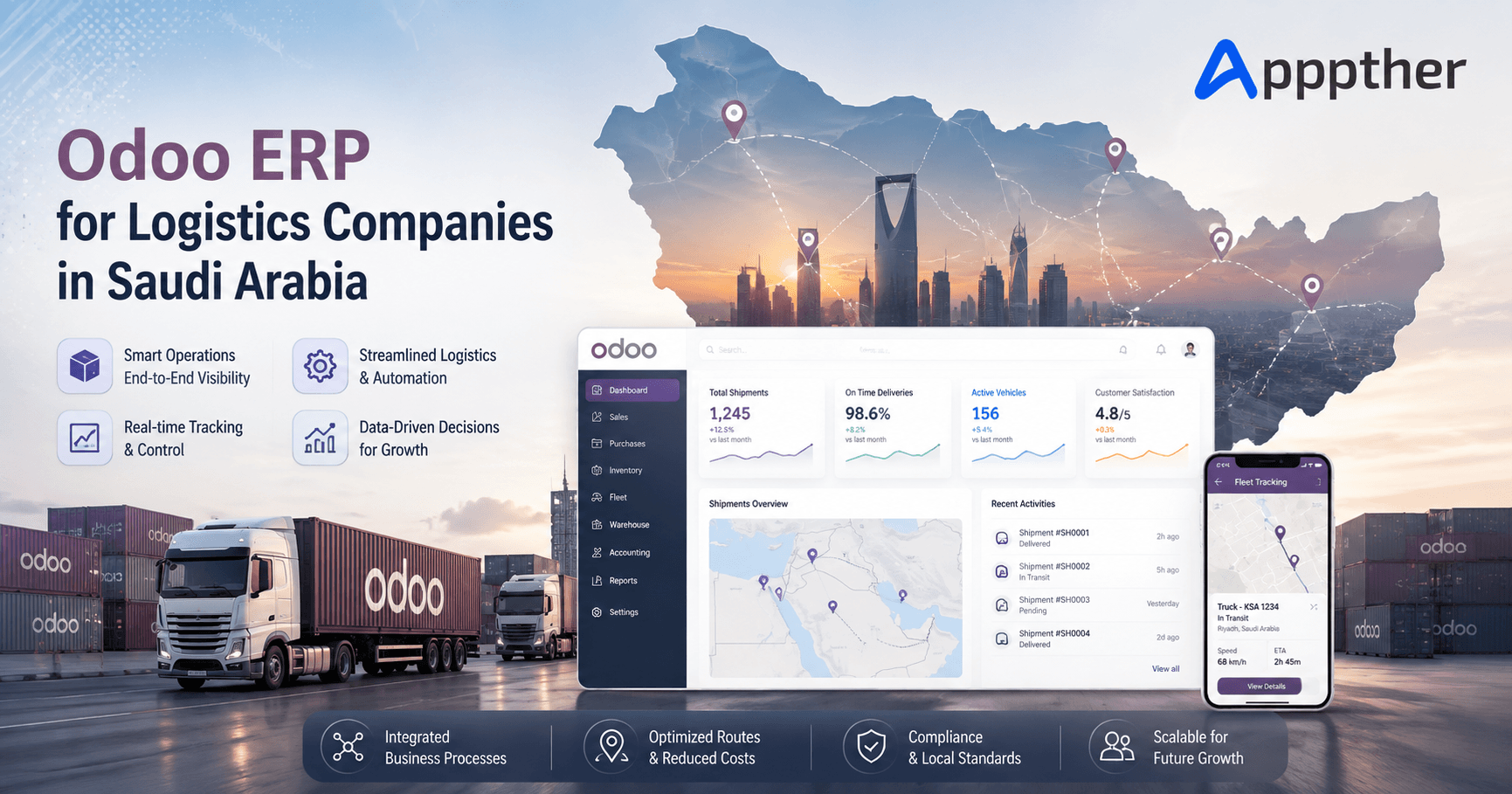
- Dispatch and fleet teams see real-time truck availability, driver assignments, and route status.
- Warehouse teams track inbound and outbound stock against actual delivery orders, not manual counts.
- Finance teams generate ZATCA Phase 2 e-invoices directly from confirmed deliveries, with VAT calculated automatically.
- Management gets live dashboards on fleet utilization, on-time delivery rates, and margin per shipment, without waiting on a monthly report.
This is also why Odoo has become one of the fastest-growing ERP platforms across the GCC: it’s modular, it’s built to comply with Saudi tax regulation out of the box, and it scales from a 10-truck operator to a multi-branch 3PL without a system migration.
Core Odoo Modules for Logistics and Transportation Companies
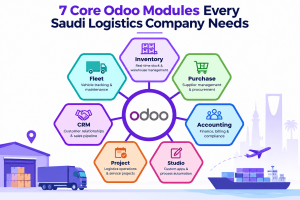
Not every logistics company needs the same setup. But most Saudi freight, 3PL, and fleet operators build their ERP around these core modules:
1. Inventory & Warehouse Management
Tracks stock across multiple warehouses or distribution centers in real time, with barcode scanning, batch/lot tracking, and automated reordering rules. Critical for 3PLs managing client inventory across Jeddah, Dammam, and Riyadh hubs simultaneously.
2. Fleet Management
Logs vehicle assignments, maintenance schedules, fuel costs, and driver documentation in one place, reducing unplanned downtime and giving finance an accurate cost-per-vehicle view.
3. Purchase & Vendor Management
Automates purchase orders for fuel, spare parts, and third-party carrier services, with approval workflows tied directly to budget.
4. Sales & CRM
Manages freight quotes, contracts, and client onboarding, with full visibility into shipment history per customer.
5. Accounting & ZATCA E-Invoicing
Generates VAT-compliant invoices automatically from delivery confirmations, supporting ZATCA’s Fatoora e-invoicing requirements without a separate compliance tool bolted on.
6. Project & Timesheets
Useful for logistics companies that also run installation, last-mile, or field-service teams, tracking labor hours against specific jobs or contracts.
7. Studio (No-Code Customization)
Lets operations teams adjust workflows, like adding a custom dispatch approval step, without waiting on a developer for every small change.
Appther’s team has deep hands-on experience across these exact modules, having built and scaled ERP systems for manufacturing and supply chain operations. Our Odoo services cover implementation, customization, integration, and ongoing support, so logistics companies get a system built around how they actually operate, not a generic template.
Solving Saudi-Specific Logistics Challenges with Odoo
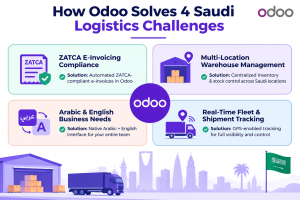
ZATCA Compliance Without the Headache
Saudi Arabia’s Zakat, Tax and Customs Authority (ZATCA) requires phased e-invoicing with strict formatting and integration requirements. A properly configured Odoo instance handles this natively, generating compliant invoices at the point of delivery confirmation rather than as a separate manual step.
Multi-Branch, Multi-Warehouse Visibility
Many Saudi logistics companies operate across Riyadh, Jeddah, Dammam, and increasingly NEOM-adjacent corridors. Odoo’s multi-company and multi-warehouse structure gives head office a consolidated view while letting each branch manage local operations independently.
Arabic and Bilingual Operations
Odoo supports full Arabic-English bilingual interfaces and documents, which matters for driver-facing apps, customer invoices, and government reporting, all without maintaining two separate systems.
Real-Time Fleet and Route Intelligence
Static spreadsheets can’t tell you which truck is closest to a new pickup or which route is burning excess fuel. Appther has built AI-powered route optimization on top of Odoo-connected data for logistics clients, cutting dispatch time and fuel costs. You can see the approach in our AI route optimization case study and read more about our broader work in the logistics and supply chain industry.
Odoo ERP + AI: The Next Step for Saudi Logistics
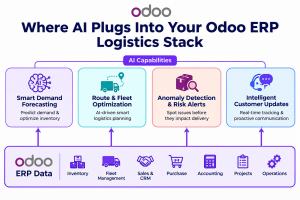
Implementing Odoo is the foundation. The real competitive advantage comes when logistics companies layer AI on top of that clean, centralized data:
- Predictive maintenance that flags a vehicle before it breaks down mid-route
- Demand forecasting for warehouse stocking based on historical shipment patterns
- AI dispatch optimization that assigns the right truck to the right job automatically
- Automated exception handling, flagging delayed shipments before the customer has to ask
Appther specializes in exactly this combination, an Odoo AI integration approach that connects machine learning models directly into your existing Odoo workflows instead of building a separate system your team has to check twice. We’ve applied the same predictive-analytics thinking to manufacturing and sales operations too, as shown in our predictive analytics case study.
What a Real Odoo ERP Implementation Looks Like
We recently implemented a full Odoo ERP system for a manufacturing operation managing production, weighbridge tracking, procurement, and multi-department supply chain, all six departments running off a single live system after go-live. It’s the same underlying logic that applies to a logistics fleet: one database, one source of truth, no more reconciling numbers between five different tools. You can read the full breakdown in our sugar factory ERP implementation case study.
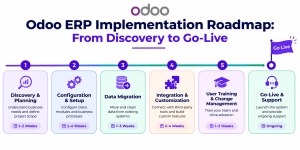
For logistics companies, the implementation path typically looks like:
- Discovery – Mapping current dispatch, warehouse, and finance workflows to identify what’s breaking today.
- Configuration – Setting up warehouses, fleet records, pricing rules, and ZATCA-compliant invoicing.
- Data Migration – Moving existing customer, vendor, and inventory data into Odoo cleanly.
- Integration – Connecting fleet-tracking hardware, driver apps, or existing accounting tools via API.
- Training & Go-Live – Getting dispatch, warehouse, and finance teams comfortable before flipping the switch.
- Ongoing Support – Monitoring, optimization, and feature rollouts as the business grows.
This mirrors Appther’s broader enterprise software development process, and it’s built to be milestone-driven so logistics operators always know what’s shipping next and when.
Choosing the Right Odoo Implementation Partner in Saudi Arabia
Not every Odoo partner understands logistics. Before committing, Saudi logistics companies should look for a partner that can show:
- Prior ERP implementation experience in complex, multi-department operations (not just a basic accounting setup)
- Familiarity with ZATCA e-invoicing requirements
- The ability to build custom modules for fleet, weighbridge, or route-specific workflows Odoo doesn’t cover out of the box
- Experience layering AI and automation on top of ERP data, not just the base implementation
- A support model that continues past go-live, since logistics operations change constantly
Appther brings all of this together: certified Odoo implementation expertise, an in-house AI engineering team, and a track record of building ERP systems for real, complex operations across manufacturing and supply chain. You can browse examples of our delivered work in our portfolio.
Final Thoughts
Saudi Arabia’s logistics sector isn’t slowing down, and the companies that scale successfully will be the ones running on connected, compliant, real-time systems instead of spreadsheets stitched together with WhatsApp messages. Odoo ERP gives logistics companies in Saudi Arabia that foundation: fleet, warehouse, finance, and ZATCA compliance in one place, with room to layer in AI as operations mature.
If you’re evaluating Odoo ERP for your logistics company in Saudi Arabia, Appther can walk you through a discovery session tailored to your fleet size, warehouse footprint, and compliance needs. Get in touch with our team to start the conversation.
Frequently Asked Questions
Is Odoo ERP suitable for small logistics companies in Saudi Arabia, or only large fleets?
Odoo is modular, so a small operator can start with core inventory, fleet, and accounting modules and add sales, project management, or AI features as the business grows.
Does Odoo support ZATCA e-invoicing requirements?
Yes. With the right configuration, Odoo generates ZATCA Phase 2-compliant e-invoices automatically at the point of delivery confirmation.
How long does an Odoo ERP implementation take for a logistics company?
A focused implementation covering core modules typically takes 8 to 14 weeks, depending on fleet size, number of warehouses, and integration complexity.
Can Odoo integrate with existing fleet-tracking or GPS hardware?
Yes, Odoo can integrate with most GPS and telematics providers via API, feeding live location and route data directly into dispatch and reporting dashboards.