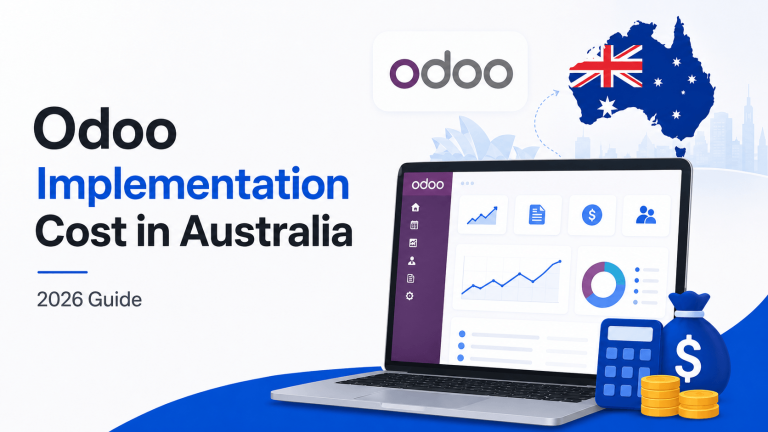
Odoo implementation cost Australia is one of the most important questions for businesses planning to move from spreadsheets, disconnected tools or legacy ERP systems to a modern, integrated business platform.
The cost of Odoo implementation in Australia depends on your business size, number of users, selected modules, data migration needs, custom workflows, integrations, training and support requirements. A small Odoo setup may start from AUD 8,000 to AUD 25,000, while a mid-size implementation may range from AUD 25,000 to AUD 80,000. A complex enterprise Odoo rollout can cost AUD 80,000 to AUD 200,000+.
Odoo is a suite of integrated business apps covering CRM, eCommerce, accounting, inventory, point of sale, project management and more. Odoo’s official pricing page also states that its plans include support, hosting and maintenance, while implementation services are a separate consideration.
This guide explains Odoo ERP implementation cost in Australia, key pricing factors, module-wise cost impact, timelines, hidden costs and how to reduce your overall ERP budget.
Quick answer: how much does Odoo implementation cost in Australia?
Odoo implementation cost in Australia can vary widely depending on project complexity. Here is a practical estimate:
| Business size | Estimated Odoo implementation cost | Typical timeline |
|---|---|---|
| Small business setup | AUD 8,000 to AUD 25,000 | 4 to 8 weeks |
| Mid-size business implementation | AUD 25,000 to AUD 80,000 | 8 to 16 weeks |
| Enterprise Odoo implementation | AUD 80,000 to AUD 200,000+ | 16 to 32+ weeks |
A simple CRM and sales setup costs less than a full ERP rollout with accounting, inventory, manufacturing, HRMS, purchase, warehouse, custom reports and third-party integrations.
However, the software subscription is only one part of the total cost. The bigger cost usually comes from implementation, configuration, data migration, customisation, integration, training and post-launch support.
That is why businesses should not only ask, “How much does Odoo cost?” They should ask, “What is the full Odoo implementation cost for our business process?”
What is included in Odoo implementation?
Odoo implementation means setting up Odoo according to your actual business workflows. It is not just software installation.
A proper Odoo implementation usually includes:
- Business process discovery
- Requirement analysis
- Module selection
- Odoo configuration
- User role setup
- CRM setup
- Sales and quotation setup
- Purchase workflow setup
- Inventory and warehouse configuration
- Accounting setup
- HR and payroll setup if required
- Manufacturing or production workflow if required
- Website or eCommerce setup
- Data migration
- Custom reports and dashboards
- Third-party integrations
- User training
- UAT and testing
- Go-live support
- Post-launch maintenance
For example, a retail business may need CRM, sales, inventory, purchase, accounting and POS. A manufacturing company may need BOM, work orders, inventory, quality, maintenance and production planning. A service business may only need CRM, sales, invoicing, project management and helpdesk.
The more workflows you include, the more time and budget will be required.
Odoo licensing cost vs Odoo implementation cost
Many businesses confuse Odoo licensing with Odoo implementation. These are different costs.
Odoo licensing cost
Odoo licensing is the recurring subscription fee paid for using Odoo Enterprise apps and platform services. Odoo’s Standard and Custom plans include access to apps under a single pricing model, along with hosting, support and maintenance depending on the plan.
Odoo implementation cost
Implementation cost is the professional service cost required to configure, customise, migrate, integrate, test and launch Odoo for your business.
This may include:
- Business analysis
- Functional consulting
- Configuration
- Custom module development
- API integration
- Migration scripts
- Testing
- Training
- Support
Hosting cost
If you use Odoo Online, hosting is included in the plan. If you need Odoo.sh or self-hosting for custom development, hosting and infrastructure planning may be different.
Custom development cost
Custom development is needed when standard Odoo modules cannot fully support your business workflow. This may include custom fields, custom reports, custom approval flows, custom dashboards, mobile apps or external system integration.
Training and support cost
Training is important because ERP success depends on user adoption. Support is also needed after go-live to fix issues, improve workflows and help users work confidently.
Odoo implementation cost by module
Odoo is modular. You can start with a few modules and add more later. This makes it flexible for Australian SMEs and growing businesses.
| Odoo module | Cost impact | Why it affects cost |
|---|---|---|
| CRM | Low to medium | Lead stages, sales pipeline and team workflows need configuration |
| Sales | Low to medium | Quotations, sales orders, pricing and approvals may need setup |
| Purchase | Low to medium | Vendor management, purchase orders and approval rules need configuration |
| Inventory | Medium | Warehouses, stock rules, locations and routes add complexity |
| Accounting | Medium | Chart of accounts, taxes, invoices and reports need careful setup |
| Manufacturing | High | BOM, work orders, routing, production planning and quality checks are complex |
| HRMS | Medium | Employee records, leaves, attendance and payroll rules may vary |
| Website / eCommerce | Medium | Product catalogue, checkout, payments and shipping require setup |
| Helpdesk | Low to medium | Ticket stages, SLAs and support workflows need configuration |
| Custom workflows | High | Custom logic requires development and testing |
| Third-party integrations | Medium to high | Depends on API quality and data flow complexity |
A CRM-only implementation may be completed quickly. A full ERP implementation with sales, purchase, inventory, accounting and manufacturing requires deeper planning.
If you are unsure where to start, Appther can help you define a module roadmap through its Odoo ERP services.
Main factors that affect Odoo implementation cost in Australia
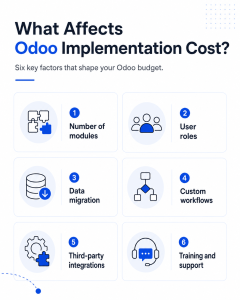
Several factors influence the final Odoo implementation budget.
1. Number of users
The number of users affects licensing, training, access control and support planning. A 5-user setup is much easier than a 100-user rollout across multiple departments.
2. Number of modules
Each module adds configuration, testing and training time. Starting with too many modules at once can increase cost and delay go-live.
3. Business process complexity
If your business has simple workflows, implementation will cost less. If you have multi-level approvals, complex pricing, multi-warehouse operations or industry-specific processes, the cost will increase.
4. Data migration
Data migration can become a major cost factor. You may need to migrate customers, vendors, products, inventory, invoices, purchase orders, employees, accounting records and historical transactions.
Clean data reduces migration cost. Poor data increases it.
5. Customisation requirements
Odoo works well with standard modules, but many businesses need custom workflows. Customisation can include new fields, automated actions, reports, dashboards, approval rules, integrations or custom modules.
Appther’s custom ERP development services are useful when businesses need workflows beyond standard ERP configuration.
6. Third-party integrations
Odoo may need to connect with:
- Payment gateways
- Accounting tools
- eCommerce platforms
- CRM systems
- POS systems
- Shipping providers
- Bank systems
- HR systems
- Marketing automation tools
- Business intelligence tools
Each integration needs API planning, development, testing and error handling.
7. Reporting and dashboards
Standard reports may be enough for some businesses. Others need custom dashboards for sales, inventory, finance, operations, manufacturing or management reporting.
Custom reports increase effort but can create strong business value.
8. User training
Even the best ERP can fail if users do not understand how to use it. Training should be included in the implementation plan.
Training may include admin training, department-level training, process manuals and post-go-live support sessions.
9. Support model
After go-live, users may need help with errors, workflow improvements, reports, access rights and new feature requests. Ongoing support should be planned as part of the total cost.
10. Local vs offshore implementation team
A local Australian implementation team may cost more. A hybrid or offshore team can reduce cost while still maintaining strong communication and delivery quality.
For many Australian SMEs, a hybrid model works well because it provides ERP expertise, structured delivery and cost efficiency.
Odoo implementation timeline in Australia
The implementation timeline depends on business size and complexity.
| Project type | Estimated timeline |
|---|---|
| Basic Odoo setup | 4 to 8 weeks |
| Mid-level Odoo implementation | 8 to 16 weeks |
| Complex enterprise rollout | 16 to 32+ weeks |
Appther’s Odoo services page highlights Odoo 17, 18 and 19 implementation expertise, 8–16 week go-live timelines and support across manufacturing, retail, healthcare and other sectors.
A basic implementation may include CRM, sales and invoicing. A mid-level implementation may include inventory, purchase, accounting and reporting. A complex rollout may include manufacturing, warehouse, HRMS, custom workflows, integrations and migration from legacy ERP.
Sample Odoo implementation budget breakdown
Here is a practical way to understand where the budget usually goes:
| Implementation phase | Budget allocation |
|---|---|
| Discovery and process mapping | 10% to 15% |
| Module configuration | 20% to 30% |
| Data migration | 10% to 20% |
| Customisation | 15% to 30% |
| Integrations | 10% to 25% |
| Testing and UAT | 10% to 15% |
| Training and go-live support | 10% to 15% |
If your project requires heavy customisation and integrations, those two areas may take the largest share of the budget.
Odoo implementation cost examples
Example 1: Small service business
A small Australian service business may need CRM, sales, invoicing and basic project management.
Estimated cost: AUD 8,000 to AUD 25,000
Estimated timeline: 4 to 8 weeks
Typical scope:
- CRM pipeline
- Customer database
- Quotation flow
- Invoice setup
- Basic reports
- User training
Example 2: Retail or distribution business
A retail or distribution company may need sales, purchase, inventory, accounting and warehouse workflows.
Estimated cost: AUD 25,000 to AUD 80,000
Estimated timeline: 8 to 16 weeks
Typical scope:
- Sales workflow
- Purchase workflow
- Product catalogue
- Inventory locations
- Warehouse rules
- Vendor management
- Accounting setup
- Reports and dashboards
Example 3: Manufacturing business
A manufacturing business may need inventory, purchase, manufacturing, BOM, work orders, quality control and production planning.
Estimated cost: AUD 80,000 to AUD 200,000+
Estimated timeline: 16 to 32+ weeks
Typical scope:
- Manufacturing module
- BOM setup
- Work centres
- Production routing
- Inventory integration
- Purchase planning
- Quality checks
- Maintenance workflow
- Custom reports
- Legacy ERP migration
Manufacturing ERP is usually more complex because it involves real-time stock, production stages, quality checks and operational reporting.
Hidden costs in Odoo implementation
Odoo can be cost-effective, but businesses should plan for hidden costs.
Data cleaning
If your old data is duplicate, incomplete or inconsistent, it needs cleaning before migration.
Change requests
New requirements during implementation can increase cost. A clear scope reduces this risk.
Custom reports
Management teams often need custom reports after seeing the first version of the system.
Integration errors
Third-party systems may have limited APIs or poor documentation. This can increase integration time.
User adoption issues
If users are not trained properly, productivity may drop after go-live.
Version upgrades
Odoo releases new versions regularly. Businesses should plan future upgrades and compatibility checks.
Ongoing support
ERP systems need continuous improvement. Support should be part of your ERP budget.
Common Odoo implementation mistakes
Avoiding common mistakes can reduce cost and improve success.
Starting without process mapping
If business processes are unclear, implementation becomes confusing. Always map workflows before configuration.
Installing too many modules at once
Adding too many modules in phase one increases complexity. Start with core modules and expand later.
Over-customising Odoo
Customisation can be useful, but too much customisation can make upgrades harder and increase maintenance cost.
Poor data migration planning
Data migration should not be left until the end. It should be planned early and tested carefully.
No user training
Users need training before go-live. Without training, ERP adoption becomes difficult.
Not testing workflows before launch
Every workflow should be tested with real business scenarios before go-live.
No post-launch support plan
Go-live is not the end. Users will need support, adjustments and improvements after launch.
How to reduce Odoo implementation cost
You can reduce Odoo implementation cost in Australia by making the right decisions early.
Start with core modules
Do not implement every module at once. Start with the modules that solve your most important business problems.
For example, a distribution business may start with sales, purchase and inventory before adding advanced reporting.
Use standard Odoo features first
Before requesting custom development, check whether standard Odoo features can handle the workflow.
Avoid unnecessary customisation
Customisation increases cost and maintenance. Customise only where it creates clear business value.
Clean your data before migration
Clean data reduces migration effort and improves system accuracy.
Use phased rollout
A phased rollout allows your team to adopt Odoo gradually. It also reduces implementation risk.
Train users early
Training should happen before go-live, not after users start facing problems.
Choose the right implementation partner
A good partner can help you avoid over-customisation, reduce rework and design the right implementation roadmap.
Appther supports ERP, CRM, workflow automation and cloud-native enterprise platforms through its enterprise software development services.
Odoo vs custom ERP: which is better?
Odoo is a strong choice for many SMEs because it is modular, flexible and faster to implement than building a full ERP from scratch.
However, custom ERP may be better when your business has very unique workflows, proprietary processes or deep integration needs.
Choose Odoo when:
- You want faster implementation
- You need CRM, sales, inventory, accounting or HR modules
- You prefer a modular ERP system
- You want to start small and scale later
- Your workflows can fit standard Odoo modules with limited customisation
Choose custom ERP when:
- Your workflow is highly unique
- Standard ERP modules do not fit your process
- You need full control over architecture
- You need deep legacy integration
- You want a fully tailored platform
Appther builds both Odoo-based ERP and custom ERP solutions. You can explore Appther’s custom ERP development company page to compare both options.
Can AI improve Odoo implementation?
Yes. AI can make Odoo more powerful when used correctly.
AI can support Odoo workflows such as:
- AI lead scoring in CRM
- Sales follow-up suggestions
- Inventory forecasting
- Smart customer support
- Automated document reading
- Invoice data extraction
- AI-powered reports
- Demand forecasting
- Chatbot connected with Odoo data
- Voice agent connected with CRM or helpdesk
For example, a business can connect an AI chatbot with Odoo CRM to answer customer questions and create leads automatically. A distribution company can use AI to predict stock demand. A service company can use AI to summarise helpdesk tickets.
Appther’s AI development services can help businesses combine Odoo ERP with AI automation, chatbots, LLM applications and intelligent workflows.
Why choose Appther for Odoo implementation in Australia?
Appther helps businesses implement Odoo, customise ERP workflows, integrate third-party systems and build scalable enterprise platforms.
Appther’s Odoo ERP services include implementation, custom modules, third-party integrations and ongoing support. Appther also highlights experience across manufacturing, retail, healthcare and other industries.
For Australian businesses, Appther can support:
- Odoo implementation
- Odoo 17, 18 and 19 setup
- Odoo CRM configuration
- Sales and invoicing workflows
- Inventory and warehouse setup
- Manufacturing workflow setup
- Accounting configuration
- HRMS and payroll workflows
- Custom Odoo module development
- Odoo integrations
- Data migration
- Odoo support and maintenance
- ERP automation
- AI and ERP integration
Appther also works across AI, mobile apps, ERP, CRM, enterprise software, cloud and automation, which makes it suitable for businesses that need more than basic Odoo setup.
If you are planning a full digital transformation, Appther can help you connect ERP with mobile apps, web portals, AI automation and reporting dashboards.
Final thoughts
Odoo implementation cost in Australia depends on your business size, number of modules, users, data migration, customisation, integrations and support needs.
A small Odoo setup may cost AUD 8,000 to AUD 25,000. A mid-size implementation may cost AUD 25,000 to AUD 80,000. A complex enterprise Odoo rollout may cost AUD 80,000 to AUD 200,000+.
The best way to control cost is to start with the right modules, avoid unnecessary customisation, clean your data before migration and use a phased implementation approach.
Odoo can be a powerful ERP platform for Australian SMEs and enterprises when implemented properly. With the right planning and the right implementation partner, it can help your business improve visibility, reduce manual work and streamline operations.
Planning an Odoo implementation in Australia?
Get a clear module plan, realistic budget and implementation roadmap for your business.
Book a free Odoo consultation with Appther today.
FAQs
How much does Odoo implementation cost in Australia?
Odoo implementation cost in Australia usually ranges from AUD 8,000 to AUD 25,000 for a small setup, AUD 25,000 to AUD 80,000 for a mid-size implementation and AUD 80,000 to AUD 200,000+ for complex enterprise rollouts.
Is Odoo cheaper than SAP or NetSuite?
Odoo can be more cost-effective for many SMEs because it is modular and can be implemented in phases. However, the final cost depends on users, modules, customisation, data migration and integrations.
How long does Odoo implementation take?
A basic Odoo setup may take 4 to 8 weeks. A mid-level implementation may take 8 to 16 weeks. A complex ERP rollout can take 16 to 32+ weeks.
Which Odoo modules should I start with?
Most businesses start with CRM, sales, invoicing, purchase, inventory or accounting. The right module plan depends on your business process and pain points.
Can Odoo be customised for Australian businesses?
Yes. Odoo can be customised for Australian businesses with custom workflows, reports, dashboards, approval processes, integrations and industry-specific modules.
Can Appther migrate data from an old ERP to Odoo?
Yes. Appther can help migrate customers, vendors, products, inventory, sales data, invoices, purchase records and other business data from old ERP systems or spreadsheets to Odoo.
Do I need ongoing Odoo support after implementation?
Yes. Ongoing support helps fix issues, train users, improve workflows, add reports, manage upgrades and keep the ERP system aligned with business needs.
Can Odoo integrate with other business systems?
Yes. Odoo can integrate with payment gateways, eCommerce platforms, CRM systems, accounting tools, shipping providers, HR systems, marketing tools and custom APIs.