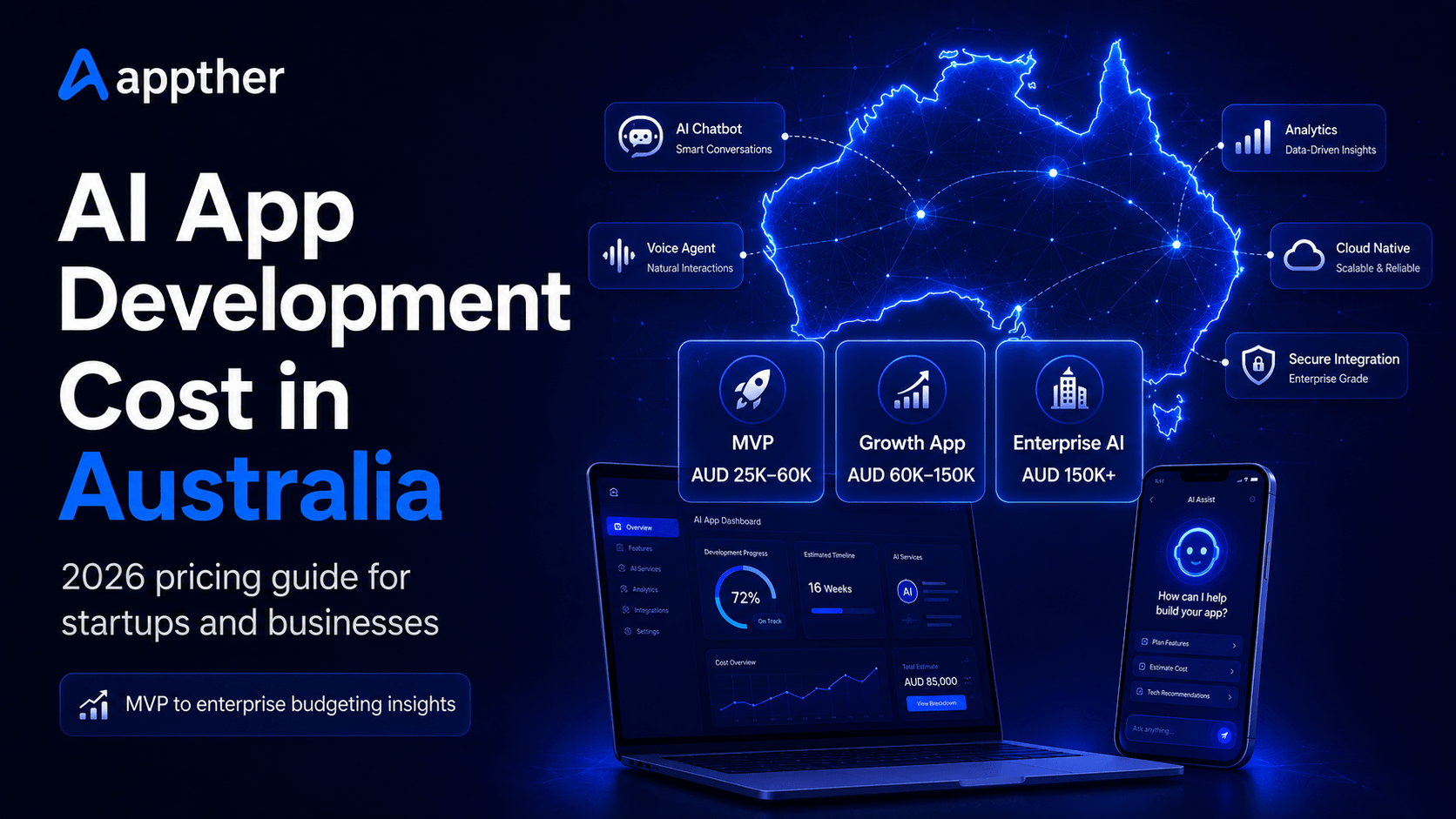
AI app development cost Australia is one of the first questions startups, SMEs and enterprises ask before building an AI-powered mobile app. The answer depends on your app idea, features, AI complexity, integrations, design quality, compliance needs and the team you choose.
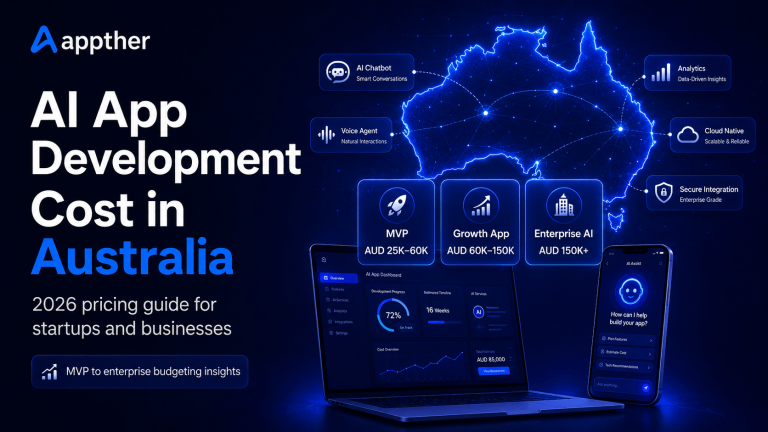
In Australia, a basic AI app MVP can start from AUD 25,000 to AUD 60,000. A mid-level AI app may cost AUD 60,000 to AUD 150,000. An advanced AI platform with custom AI models, complex integrations and enterprise security can go beyond AUD 150,000 to AUD 350,000+.
This guide explains the key cost factors, feature-wise pricing, timelines and practical ways to reduce your AI app development budget without compromising product quality.
Quick answer: how much does AI app development cost in Australia?
The cost to build an AI app in Australia depends on the complexity of the product. Here is a practical estimate:
| AI app type | Estimated cost in Australia | Typical timeline |
|---|---|---|
| Basic AI MVP | AUD 25,000 to AUD 60,000 | 8 to 12 weeks |
| Mid-level AI app | AUD 60,000 to AUD 150,000 | 12 to 20 weeks |
| Advanced AI platform | AUD 150,000 to AUD 350,000+ | 20 to 32+ weeks |
A simple app with an AI chatbot or recommendation engine will cost less than an enterprise AI product with voice agents, custom machine learning models, computer vision, secure admin dashboards and third-party integrations.
However, the lowest cost is not always the best decision. A poorly built AI app can create performance issues, privacy risks, high cloud costs and poor user experience. Therefore, the right approach is to start with a clear MVP and scale features in phases.
What is an AI app?
An AI app is a mobile or web application that uses artificial intelligence to automate tasks, personalise user experience, analyse data or support decision-making.
Common AI app features include:
- AI chatbots
- AI voice agents
- Recommendation engines
- Predictive analytics
- Image recognition
- Document processing
- Natural language search
- AI-powered customer support
- Personalised content
- Smart notifications
- Fraud detection
- Workflow automation
For example, a healthcare app can use AI to collect patient intake details before an appointment. A retail app can recommend products based on user behaviour. A real estate app can qualify leads and match buyers with suitable properties. A logistics app can predict delivery delays and optimise routes.
Why AI apps cost more than normal mobile apps
A normal mobile app usually includes screens, user login, backend APIs, database, payment integration and admin management. An AI app includes all of this plus an intelligence layer.
That intelligence layer can increase cost because it may require:
- AI model selection
- Prompt engineering
- LLM integration
- Data preparation
- AI workflow design
- Model testing
- Human review workflows
- API usage planning
- Security controls
- Cloud infrastructure
- Ongoing monitoring
For example, adding a basic AI chatbot may be simple. But building a secure AI assistant that answers questions from private company documents requires a more advanced architecture. It may need RAG, vector databases, role-based access, document processing, audit logs and fallback handling.
As a result, AI app development cost in Australia depends not only on the number of screens but also on the intelligence and reliability expected from the system.
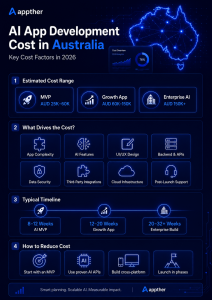
AI app development cost by app complexity
1. Basic AI MVP
A basic AI MVP is ideal for startups or businesses that want to test an idea before investing in a full product.
Typical features may include:
- User registration and login
- Basic profile management
- AI chatbot
- Simple admin panel
- Basic analytics
- Push notifications
- Payment integration if required
- Basic cloud deployment
Estimated cost: AUD 25,000 to AUD 60,000
Estimated timeline: 8 to 12 weeks
Examples of basic AI MVPs:
- AI chatbot app
- AI appointment booking app
- AI content generator
- AI learning assistant
- AI lead qualification app
- AI FAQ assistant for a business website or mobile app
This option is best when you want to validate product-market fit quickly.
2. Mid-level AI app
A mid-level AI app includes more advanced user flows, better design, stronger backend systems and deeper AI functionality.
Typical features may include:
- iOS and Android app
- Advanced UI/UX design
- AI chatbot or AI assistant
- Voice-to-text or text-to-speech
- CRM or ERP integration
- User dashboard
- Admin dashboard
- Payment system
- Notifications and reminders
- Analytics dashboard
- Role-based access
- Security testing
Estimated cost: AUD 60,000 to AUD 150,000
Estimated timeline: 12 to 20 weeks
Examples of mid-level AI apps:
- AI customer support app
- AI healthcare intake app
- AI booking platform
- AI sales assistant
- AI learning management app
- AI-powered real estate lead app
- AI-powered eCommerce recommendation app
This option is suitable for businesses that already understand their use case and want a production-ready application.
3. Advanced AI platform
An advanced AI platform is built for enterprise workflows, high traffic, complex integrations and long-term scalability.
Typical features may include:
- Custom AI model development
- LLM-powered assistant
- RAG-based knowledge base
- Computer vision
- Predictive analytics
- Enterprise admin panel
- Multi-role user access
- API integrations
- Secure data architecture
- Audit logs
- Cloud scaling
- DevOps automation
- Compliance-ready workflows
- Advanced reporting
Estimated cost: AUD 150,000 to AUD 350,000+
Estimated timeline: 20 to 32+ weeks
Examples of advanced AI platforms:
- AI healthcare platform
- AI fintech system
- AI logistics optimisation platform
- AI enterprise copilot
- AI document intelligence platform
- AI marketplace
- AI-powered SaaS product
This option is best for businesses that need strong security, scalability and advanced automation.
Feature-wise AI app development cost
Every AI feature has a different impact on budget. Some features can be built using existing APIs. Others require custom engineering and longer testing.
| Feature | Cost impact | Why it affects cost |
|---|---|---|
| AI chatbot | Medium | Requires prompt design, API integration and response testing |
| AI voice agent | Medium to high | Needs speech-to-text, text-to-speech, call flow and fallback handling |
| Recommendation engine | Medium | Requires user behaviour tracking and personalisation logic |
| Computer vision | High | Requires image processing, model testing and accuracy validation |
| Predictive analytics | Medium to high | Needs data preparation and model validation |
| RAG knowledge base | Medium to high | Requires document processing, vector database and access control |
| Admin dashboard | Medium | Needed to manage users, content, data and reports |
| Payment integration | Low to medium | Depends on payment provider and subscription logic |
| CRM or ERP integration | Medium to high | Depends on API quality and business workflow complexity |
| Security and compliance | Medium to high | Important for healthcare, fintech and enterprise apps |
If you are building your first AI app, it is better to avoid too many AI features in phase one. Start with the feature that creates the highest business value.
Australia-specific cost factors
AI app development cost in Australia can vary based on location, delivery model and compliance requirements.
Local agency cost
Hiring a local team in Sydney, Melbourne or Brisbane may cost more because of higher labour and operational costs. This can be suitable for companies that need in-person workshops or local consulting.
Offshore or hybrid delivery
A hybrid delivery model can reduce cost while keeping quality high. For example, strategy and communication can happen in the Australian time zone, while engineering is handled by an experienced offshore team.
This model works well for startups and SMEs that want a strong product without paying full local agency rates.
Compliance requirements
Apps in healthcare, finance, education and enterprise sectors need more attention to privacy, security and data handling.
In Australia, businesses may need to consider:
- Privacy Act 1988
- Australian Privacy Principles
- Data collection and consent
- Secure storage of personal information
- Access control
- Data breach response planning
- Audit logs
- Vendor data policies
These requirements can increase the development budget, but they also reduce business risk.
Integration complexity
Many Australian businesses need integration with existing systems. These may include:
- CRM
- ERP
- Accounting software
- Payment gateways
- Booking systems
- Marketing automation tools
- Customer support tools
- Internal databases
The more integrations your app needs, the more planning, development and testing will be required.
AI app development cost by industry
Different industries have different cost drivers. Here is a practical view:
| Industry | Common AI app use case | Cost complexity |
|---|---|---|
| Healthcare | Patient intake, appointment booking, AI receptionist | High |
| Retail | Product recommendation, customer support chatbot | Medium |
| Real estate | Lead qualification, property matching, enquiry automation | Medium |
| Logistics | Route optimisation, delivery prediction, fleet analytics | High |
| Education | AI tutor, learning recommendation, student support | Medium |
| Finance | Fraud detection, customer support, financial insights | High |
| Restaurants | AI booking, customer feedback, inventory prediction | Medium |
| Professional services | Document summary, proposal assistant, CRM automation | Medium |
Healthcare and finance apps usually cost more because they need stronger privacy, security and workflow validation.
Technology stack used for AI app development
The technology stack also affects cost and scalability.
A modern AI app may use:
- Flutter or React Native for cross-platform mobile apps
- Swift for native iOS apps
- Kotlin for native Android apps
- Node.js or Python for backend development
- PostgreSQL or MongoDB for database
- AWS, Azure or Google Cloud for hosting
- OpenAI, Gemini, Claude or custom LLMs for AI features
- Vector databases for knowledge search
- TensorFlow or PyTorch for machine learning
- Stripe or local payment gateways for payments
- Twilio or similar platforms for communication
The best technology stack depends on your budget, timeline, feature set and long-term growth plan.
For many startups, Flutter or React Native is a cost-effective choice because one team can build apps for both iOS and Android. For enterprise apps, native development may be better when performance, device-level features or advanced security are critical.
How to reduce AI app development cost in Australia
You can reduce your AI app budget by making the right decisions early.
Start with an MVP
Do not build everything in phase one. Start with the core workflow that solves the main user problem.
For example, if you are building an AI healthcare app, phase one can include patient intake, appointment booking and admin review. Advanced analytics and integrations can come later.
Use existing AI APIs where possible
Custom model training can be expensive. In many cases, existing LLM APIs can handle the first version of your product. You can move to custom models later when you have enough data and clear business need.
Choose cross-platform development
If your app does not require heavy native features, Flutter or React Native can reduce development time and cost.
Finalise user journeys before development
Changing flows during development increases cost. A clear discovery phase helps define screens, features, user roles and business logic before coding starts.
Build in phases
A phased roadmap helps control risk. You can launch faster, collect user feedback and improve the product based on real usage.
Avoid unnecessary AI features
AI should solve a business problem. Do not add AI only because it sounds modern. Every AI feature should have a clear purpose, such as reducing manual work, increasing conversion, improving support or personalising the experience.
Sample AI app development budget breakdown
Here is how the budget is usually distributed:
| Phase | Budget allocation |
|---|---|
| Discovery and planning | 8% to 12% |
| UI/UX design | 10% to 15% |
| Frontend development | 20% to 25% |
| Backend and API development | 20% to 25% |
| AI/ML integration | 15% to 25% |
| QA and security testing | 10% to 15% |
| Deployment and support | 5% to 10% |
AI integration can take a larger share of the budget when the app requires custom models, voice workflows, computer vision or private knowledge base search.
Timeline to build an AI app
The timeline depends on scope and complexity.
| Project type | Estimated timeline |
|---|---|
| AI MVP | 8 to 12 weeks |
| Mid-level AI app | 12 to 20 weeks |
| Enterprise AI platform | 20 to 32+ weeks |
A clear MVP can often be designed, developed and launched faster than a large product with too many features. Therefore, it is better to start with the smallest useful version and improve it after launch.
Common mistakes that increase AI app development cost
Many businesses overspend because they start without a clear plan. Avoid these mistakes:
Building too many features in phase one
A large first release increases cost and delays launch. Start with essential features only.
Choosing custom AI too early
Custom AI models can be powerful, but they are not always required for the first version. Existing AI APIs may be enough to validate your idea.
Ignoring data quality
AI depends on data. Poor data leads to poor output. Before building AI features, check whether your data is clean, structured and usable.
Not planning for AI usage cost
AI APIs, voice processing, image processing and cloud infrastructure may create ongoing monthly costs. These should be estimated before launch.
Ignoring privacy and security
AI apps often handle user data. If privacy and access control are not planned early, fixing them later can be expensive.
Skipping human review
AI output should not always be fully automated. For sensitive workflows, add human review before important actions are taken.
When should you choose custom AI app development?
Custom AI app development is a good choice when your business needs more than a ready-made SaaS tool.
You should consider custom development when:
- Your workflow is unique
- You need ownership of the product
- You want to integrate with internal systems
- You need custom user roles
- You handle sensitive customer data
- You want a long-term scalable platform
- You need AI to work with your business-specific data
- You want to create a product that competitors cannot easily copy
Ready-made tools are useful for simple tasks. However, custom AI development gives you more flexibility, control and scalability.
Why choose Appther for AI app development in Australia?
Appther helps startups, SMEs and enterprises build AI-powered mobile apps, custom software and intelligent automation platforms.
Our team works across:
- AI app development
- Mobile app development
- AI chatbot development
- AI voice agents
- LLM integration
- RAG-based knowledge systems
- Web app development
- CRM and ERP integration
- Cloud and DevOps
- UI/UX design
- Post-launch support
We build intelligent iOS, Android, Flutter and React Native apps powered by AI. Our team can integrate LLMs, voice agents, recommendation engines and computer vision into new or existing products.
For Australian businesses, Appther offers a practical delivery model with clear communication, structured discovery, agile development, full IP ownership and long-term support.
Final thoughts
AI app development cost in Australia depends on your product scope, AI features, design quality, integrations, security and delivery model. A basic AI MVP may cost between AUD 25,000 and AUD 60,000, while a more advanced AI platform can cost AUD 150,000 to AUD 350,000+.
The best way to control cost is to start with a focused MVP, use proven AI technologies, define clear user journeys and build the product in phases.
If you are planning to build an AI app for the Australian market, Appther can help you turn your idea into a clear scope, timeline and development roadmap.
Need an AI app cost estimate?
Share your idea with Appther and get a free project scope, timeline and budget breakdown.
Book a free consultation with Appther today.
FAQs
How much does AI app development cost in Australia?
AI app development in Australia usually costs between AUD 25,000 and AUD 60,000 for a basic MVP, AUD 60,000 to AUD 150,000 for a mid-level app and AUD 150,000 to AUD 350,000+ for an advanced AI platform.
How long does it take to build an AI app?
A basic AI MVP can take 8 to 12 weeks. A mid-level AI app may take 12 to 20 weeks. A complex enterprise AI platform may take 20 to 32+ weeks, depending on features and integrations.
Is AI app development more expensive than normal app development?
Yes, AI app development is usually more expensive because it requires AI model integration, data handling, prompt engineering, testing, security controls and ongoing monitoring.
Can I start with an AI MVP?
Yes. Starting with an AI MVP is the best way to reduce risk and cost. You can launch the core version first, collect user feedback and add advanced AI features later.
What factors affect AI app development cost?
The main cost factors include app complexity, number of platforms, UI/UX design, AI features, backend architecture, third-party integrations, data security, compliance requirements and post-launch support.
Can Appther add AI features to an existing app?
Yes. Appther can add AI chatbots, voice agents, recommendation engines, predictive analytics, computer vision and LLM-based features to existing mobile or web applications.
Which technology is best for AI mobile app development?
Flutter and React Native are good for cost-effective cross-platform apps. Swift and Kotlin are better for high-performance native apps. The right choice depends on your budget, audience, features and long-term product plan.