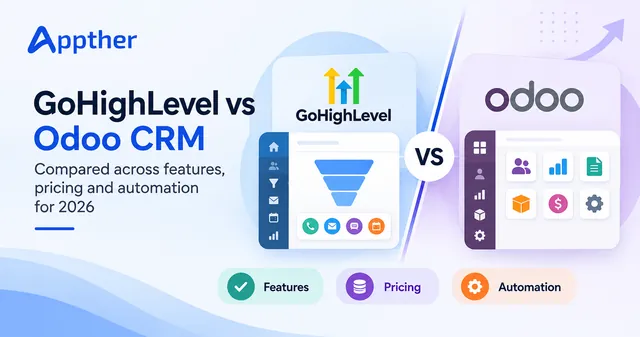
In the GoHighLevel vs Odoo decision, GoHighLevel wins if your priority is generating and converting leads. It bundles funnels, SMS, calls, booking and marketing automation from $97 a month. Odoo CRM wins if your pipeline has to connect to quotes, invoicing, stock and projects. It starts free for one app and runs to $38.90 per user per month.
Both tools get called a CRM. That label hides how differently they think. GoHighLevel was built to capture and chase leads at volume. Odoo was built to run a company, and the CRM is one app sitting next to fifty others.
So the honest question is not which product is better. It is which problem is currently costing you more money: leads going cold, or your operations running on spreadsheets behind the sale. This guide answers that with real 2026 pricing, feature-by-feature detail and a decision table you can act on.
GoHighLevel vs Odoo CRM: Quick comparison
Here is the short version before we go deep.
| Factor | GoHighLevel | Odoo CRM |
|---|---|---|
| Core purpose | Marketing and sales automation built for lead generation | Business operating system with CRM as one app among many |
| Entry price | $97 per month, flat, unlimited users | $0 for CRM alone, or $31.10 per user per month on Standard |
| Pricing model | Per account, not per seat | Per user, across all apps |
| Built-in phone and SMS | Yes, with usage billing | No, needs a third-party gateway |
| Funnels and landing pages | Native, with templates and A/B testing | Website builder, but no funnel logic |
| Quotes and invoicing | Basic invoicing and payment links | Full quotations, invoicing and double-entry accounting |
| Inventory, manufacturing, projects | Not available | Native apps, tightly linked to CRM |
| White label and SaaS resale | Yes, from $497 per month | Not designed for it |
| Hosting options | SaaS only | Odoo Online, Odoo.sh, or your own servers |
| Typical go-live | 1 to 4 weeks | 6 to 16 weeks |
| Best fit | Agencies, local services, coaches, high-volume inbound | Manufacturers, distributors, multi-department teams |
What is GoHighLevel?
GoHighLevel is an all-in-one sales and marketing platform. Agencies adopted it first, then service businesses followed. It replaces the stack most small teams cobble together: a landing page builder, an email tool, an SMS tool, a booking calendar, a review requester and a light CRM.
The pipeline sits at the center, but the platform’s real strength is everything that feeds it. You build a funnel, run ads to it, capture the lead, fire an SMS within seconds, book the call automatically, then chase the no-shows. All of that happens inside one account with no integrations to maintain.
The sub-account structure is what makes it an agency favorite. Each client gets an isolated environment. You clone a proven setup into a new sub-account using a snapshot, and a new client is live the same week. On the Agency Pro plan you can rebill phone, email and AI usage with your own markup, then sell the platform under your own brand.
The trade-off is scope. GoHighLevel stops at the sale. It has no stock ledger, no bill of materials, no purchase orders and no real accounting. Once the deal closes, most GoHighLevel users switch to another system to actually deliver the work.
What is Odoo CRM?
Odoo is a modular business suite. Sales, CRM, invoicing, accounting, inventory, manufacturing, projects, HR, helpdesk and ecommerce all run on the same database. Odoo CRM is the lead and opportunity app inside that suite.
On its own, Odoo CRM is a clean, fast pipeline tool. Kanban stages, activity scheduling, email integration, lead assignment rules and a good mobile app. Nothing exotic. What makes it different is what happens when an opportunity is marked won.
The opportunity becomes a quotation. The quotation becomes a sales order. The sales order reserves stock, triggers a manufacturing order if needed, creates a delivery, raises the invoice and posts to the general ledger. No exports, no middleware, no reconciliation. Your sales rep and your accountant look at the same record.
Odoo is also open source at its core, so you can read the code, extend the models and host it wherever you want. That matters for regulated industries and for anyone who does not want their operational data locked inside a SaaS vendor.
That breadth is the reason Odoo turns up in places a marketing CRM never could. Our sugar factory ERP implementation case study runs 12 modules on one database, from farmer slips and weighbridge readings through to cane payments and finance.
CRM and sales pipeline features
Both platforms handle the basics well. Contacts, pipelines, drag-and-drop stages, task reminders, notes and email logging are table stakes in 2026 and neither tool embarrasses itself.
The differences show up at the edges.
Where GoHighLevel is stronger
- Speed to first contact. Trigger links, missed-call text-back and instant SMS replies are native, not bolted on.
- Appointment booking. Round-robin calendars, buffers, reminders and no-show sequences all live in the same place as the pipeline.
- Conversation history. Every SMS, call recording, email, Instagram DM and WhatsApp message sits in one unified inbox against the contact.
- Reputation. Review requests fire automatically after a job is marked complete.
Where Odoo CRM is stronger
- Quote-to-cash. Build a multi-line quote with real products, discounts, taxes and margins, then convert it without rekeying anything.
- Data model depth. Custom fields, computed fields and relational links to any other app, without leaving the interface.
- Team structure. Sales teams, targets, commission plans and multi-company setups are handled natively.
- Forecasting against reality. Expected revenue is calculated from real product pricing, not a number a rep typed in.
If your sales process ends with “book the call,” GoHighLevel is the better pipeline. If it ends with “send a priced proposal and deliver it,” Odoo is. If neither models your process cleanly, custom CRM development is the third option worth pricing.
Marketing automation and lead nurturing
This is the widest gap between the two platforms, and it is the main reason people search for a comparison in the first place.
GoHighLevel’s workflow builder is genuinely strong. You get triggers on almost any event, branching conditions, wait steps, split tests, internal notifications, webhook calls and multi-channel actions in the same flow. A single workflow can send an SMS, wait an hour, check whether the lead replied, place an AI voice call if not, then move the opportunity stage and notify the rep on Slack. Building that takes an afternoon.
Odoo has a Marketing Automation app and an Email Marketing app, and they work. Campaigns are built as activity chains against a target model, with conditions on any field in the database. That last part is powerful. You can nurture a segment defined by invoice history, product purchased or support ticket volume, which GoHighLevel simply cannot see.
But Odoo’s automation is email-first. SMS needs Odoo’s own credit-based service or a third-party gateway. There is no funnel builder, no call tracking and no unified messaging inbox. For pure top-of-funnel marketing, GoHighLevel is several years ahead.
Our guide on how CRM automation improves customer engagement covers the sequencing principles that apply to either platform.
Pricing and total implementation cost
Both vendors publish list prices. Neither price is the number you will actually pay.
GoHighLevel pricing in 2026
| Plan | Monthly | Annual | What you get |
|---|---|---|---|
| Starter | $97 | $970 | 3 sub-accounts, unlimited contacts, unlimited users, all core features |
| Unlimited | $297 | $2,970 | Unlimited sub-accounts, rebill phone and email at cost, basic API access |
| Agency Pro | $497 | $4,970 | SaaS mode, automated sub-account creation, rebilling with markup, advanced API |
| Enterprise | Custom | Custom | Dedicated success manager, white label mobile app, HIPAA compliance, higher API limits |
The plan fee is only part of the bill. Add-ons and usage charges stack on top:
- AI Employee: $50 per month per sub-account for the Growth tier (1,000 conversation responses and 100 voice minutes), or $97 per month per sub-account for unlimited use.
- HIPAA compliance: $297 per month.
- White label mobile app: $497 per month.
- Dedicated email IP: $59 per month per IP. WhatsApp: $10 per month per sub-account.
- SMS, phone minutes, email sends and premium AI are all billed on consumption.
A single business running one sub-account with moderate SMS volume and the AI add-on typically lands between $150 and $400 a month once usage settles.
Odoo pricing in 2026
| Plan | List price | First 12 months | What you get |
|---|---|---|---|
| One App Free | $0 | $0 | One app only, unlimited users, Odoo Online hosting |
| Standard | $38.90 / user / mo | $31.10 / user / mo | All apps on Odoo Online |
| Custom | $76.20 / user / mo | $61.00 / user / mo | All apps, Odoo Studio, multi-company, external API, Odoo.sh or on-premise |
Three things about that table matter more than the headline numbers.
- The discount expires. Odoo’s promotional rate is a 20 percent reduction valid for 12 months, on the initial block of users only. Users you add mid-term, and every user at renewal, pay list price. Budget off the renewal year.
- One App Free is a real option. If you only need CRM, you get it free for unlimited users on Odoo Online. That is the cheapest credible CRM on this page. The catch is that adding a second app moves you to a paid plan for every user.
- Prices vary by country. Odoo runs regional pricelists, and the India and Southeast Asia lists are far cheaper than the US one. Check odoo.com/pricing from the country you will be billed in.
Odoo also puts external API access and on-premise hosting on the Custom plan only. If you plan to integrate anything, price Custom, not Standard.
What implementation actually costs
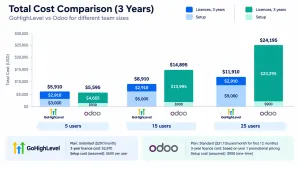
Licence fees are the easy part. Setup is where the budgets diverge.
| Scope | Typical setup cost | Typical timeline |
|---|---|---|
| GoHighLevel: snapshot, funnels, workflows, numbers, migration | $1,500 to $8,000 | 1 to 4 weeks |
| Odoo CRM only: pipeline, email, imports, training | $6,000 to $20,000 | 4 to 8 weeks |
| Odoo CRM plus sales, invoicing and inventory | $20,000 to $75,000 | 10 to 20 weeks |
Setup ranges are indicative bands from Appther project experience and vary with data quality, integrations and the number of departments involved.
We break the Odoo side down line by line in our Odoo CRM implementation cost guide, including where the hours actually go.
Put the two together and the picture inverts. GoHighLevel costs more per month and far less to set up. Odoo costs less per month for a small team and far more to implement properly. Over three years, a 25-person Odoo rollout usually costs more than GoHighLevel and does about ten times as much.
Customization and integrations
GoHighLevel gives you configuration. Odoo gives you code.
Inside GoHighLevel you can build custom fields, custom objects, custom values, workflows and snapshots without a developer. The API v2 supports OAuth and covers contacts, opportunities, conversations, calendars, payments and workflows, and webhooks fire on most events. That is enough to connect it to almost anything through n8n, Make or Zapier. What you cannot do is change how the platform works. If GoHighLevel does not model your process, you adapt your process.
Odoo goes the other way. Odoo Studio lets business users add fields, views, automated actions and reports by clicking. Below that, the source is open. A developer can inherit any model, override any method and ship a custom module that behaves as if Odoo shipped it. The Odoo Apps Store carries tens of thousands of modules, including several GoHighLevel connectors built for Odoo 18 and 19.
The cost of that freedom is discipline. Heavy customization makes upgrades harder and slower. We cover that trade-off in our Odoo migration guide and in the Odoo 19 vs Odoo 17 upgrade comparison.
Reporting and AI capabilities
Both platforms shipped serious AI in the last two release cycles, and they aimed at different problems.
GoHighLevel AI
- Voice AI answers inbound calls, makes outbound calls, qualifies leads and books appointments, then hands off to a human.
- Conversation AI replies across SMS, Facebook, Instagram, WhatsApp and live chat.
- Workflow AI Builder generates an automation from a plain-English description, which you then review and edit.
- Reviews AI, Content AI and Funnel AI handle review responses, copy and page structure.
The pattern is clear. GoHighLevel’s AI does the talking, so a two-person business can respond like a ten-person one.
Odoo 19 AI
- Predictive lead scoring assigns each lead a closing probability from your own historical win data, with the contributing factors shown.
- Sentiment analysis reads emails and live chat to flag conversations that need attention.
- Generative summaries condense long Chatter threads and attachments, and draft replies.
- Pipeline forecasting combines opportunity value with probability to project expected revenue.
- An AI lead-generation agent can sit on Odoo Live Chat and create opportunities directly.
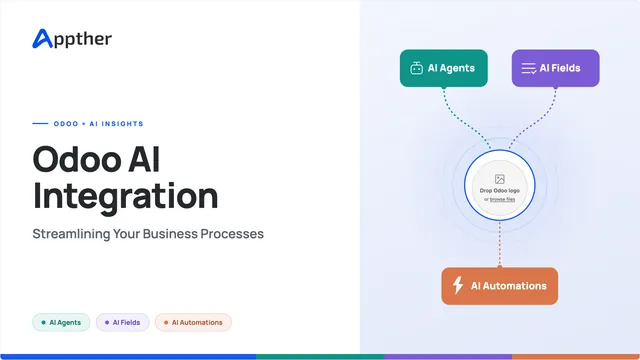
Odoo’s AI does the thinking. It scores, forecasts and summarizes against operational data the marketing platform never sees. Our Odoo AI integration guide covers how to extend that with your own models, and how generative AI is changing CRM automation sets the wider context.
On reporting, Odoo is the stronger tool by a wide margin. Any model can be pivoted, graphed, grouped and filtered, and because sales, stock and accounting share a database you can report on gross margin by lead source in a few clicks. GoHighLevel’s dashboards are good at attribution, funnel conversion, call outcomes and appointment rates, and stop there.
GoHighLevel vs Odoo for small businesses
For a small business with under ten people, start by asking where the bottleneck is.
If leads arrive and go cold because nobody follows up fast enough, buy GoHighLevel. The flat $97 covers your whole team, you will be live in two weeks, and speed-to-lead alone usually pays for it.
If leads are fine but quoting, invoicing and stock are a mess of spreadsheets, buy Odoo. Start on One App Free with CRM, prove the pipeline, then add Sales and Invoicing when you are ready to pay per user.
If both hurt equally, fix the revenue side first. Cash flow buys you the time to fix operations properly.
If you are still shortlisting, our roundup of the best CRM software for small businesses puts both of these against the other main contenders.
Which is better for marketing agencies?
GoHighLevel, without much debate.
Nothing in the Odoo ecosystem matches the sub-account model. An agency can onboard a client into an isolated environment in an afternoon, deploy a proven snapshot, and hand over a branded login. On Agency Pro you resell the platform at your own price, and the rebilling markup on SMS and AI becomes a recurring margin line instead of a cost.
The one place agencies outgrow it is their own back office. Once you are running twenty clients, retainers, project delivery, timesheets and contractor payments, GoHighLevel cannot help you. That is where agencies add Odoo behind the scenes for projects, timesheets and invoicing while keeping GoHighLevel client-facing. Our article on how GoHighLevel uses automation and AI to drive growth covers the front-end side in more depth.
Which is better for operationally complex businesses?
Odoo, and it is not close.
If you manufacture, hold inventory, run field service, deliver billable projects or manage multiple legal entities, your CRM has to talk to the rest of the business. A won deal has to reserve stock, schedule production, allocate an engineer and raise a compliant invoice. GoHighLevel has no way to represent any of that.
You can bolt an ERP onto GoHighLevel with integrations, and plenty of businesses do. But you then maintain a sync layer forever, and every field you add has to be added twice. Odoo removes the sync layer by removing the second system. For the wider platform choice, see our Odoo vs SAP vs NetSuite comparison.
Should you integrate GoHighLevel with Odoo?
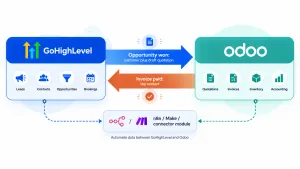
For a meaningful number of businesses, this is the right answer. Not a replacement, a division of labor.
The pattern that works looks like this:
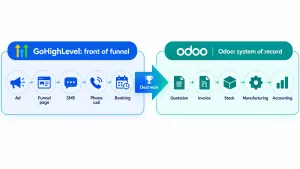
- GoHighLevel owns the front of funnel. Ads, funnels, forms, SMS, calls, booking, nurture and reactivation campaigns.
- Odoo owns the record. Customers, quotes, orders, stock, invoices, projects, support and the ledger.
- The handover happens once, at won. A won opportunity in GoHighLevel creates or updates the customer in Odoo and drops a draft quotation.
- A small amount flows back. Invoice paid, order shipped or project completed writes a tag or custom field into GoHighLevel so onboarding, upsell and review sequences can fire.
You have three ways to build it. A connector module from the Odoo Apps Store is the fastest start. A middleware flow in n8n or Make gives you the most control for the least code, and our n8n workflows guide for sales, marketing and support walks through that style of build. A custom module using GoHighLevel’s API v2 and Odoo’s external API is the right call once the logic gets specific.
Four things break these integrations, so design for them on day one:
- Identity. Decide whether email or phone is the matching key, and enforce it in both systems. Duplicates are the number one failure.
- Ownership. One system owns each field. Pick which one and never write to it from the other.
- Direction. Keep the sync one-way wherever you can. Two-way sync on the same field creates loops.
- Consent. Marketing consent flags must travel with the contact, or you will send campaigns to people who opted out.
Final decision table
| If this describes you | Choose |
|---|---|
| You sell services and live on inbound leads, calls and bookings | GoHighLevel Starter or Unlimited |
| You run a marketing agency and want to resell a platform | GoHighLevel Agency Pro |
| You need CRM plus quoting, invoicing and accounting in one system | Odoo Standard |
| You carry stock, manufacture, or run projects against the pipeline | Odoo Standard or Custom |
| You have 1 to 5 users and want zero licence cost on CRM alone | Odoo One App Free |
| You need HIPAA-covered messaging out of the box | GoHighLevel Enterprise with the HIPAA add-on |
| You need data on your own servers or a custom-built process | Odoo Custom |
| You already run both and rekey the same data every day | Integrate the two |
How Appther can help
Appther builds on both sides of this decision. We implement Odoo across CRM, sales, inventory, manufacturing and accounting, and we build the automation layers that connect marketing platforms like GoHighLevel to the systems that fulfil the work.
If you are choosing between the two, a short scoping session usually settles it. We map your lead flow and your delivery process, then tell you plainly whether you need a marketing platform, an operational system, or both wired together.
- Odoo implementation services if the answer is Odoo, from CRM through to full ERP.
- Custom CRM development if neither platform fits your process off the shelf.
- Sugar factory ERP case study for an example of what a full Odoo rollout looks like in practice.
Talk to our team about your CRM and ERP requirements, and we will come back with a scoped recommendation, not a pitch.
Frequently asked questions
Is Odoo CRM free?
Yes, in a real sense. Odoo’s One App Free plan gives you the CRM app with unlimited users at no licence cost on Odoo Online. The limit is that it is one app only. The moment you add Sales, Invoicing or anything else, you move to a paid plan priced per user across the whole team.
Is GoHighLevel a CRM or a marketing platform?
Both, but the marketing half is the stronger half. GoHighLevel includes a working pipeline CRM, and most users adopt it for the funnels, SMS, calls, booking and automation wrapped around that pipeline. If you evaluate it purely as a CRM you will undervalue it.
Which is cheaper, GoHighLevel or Odoo?
It depends on team size and scope. For a team of five needing CRM only, Odoo is cheaper and can be free. For a team of five needing funnels, SMS, calls and booking, GoHighLevel is cheaper than assembling equivalents around Odoo. Once you add implementation, GoHighLevel is cheaper to start and Odoo is cheaper to run at scale.
Can GoHighLevel replace an ERP?
No. GoHighLevel has no inventory, manufacturing, purchasing, warehouse or accounting functionality. It handles basic invoicing and payment collection, and that is the extent of its back-office reach.
Can you integrate GoHighLevel with Odoo?
Yes. GoHighLevel exposes an OAuth-based API v2 plus webhooks, and Odoo exposes an external API on the Custom plan. You can connect them with a connector module from the Odoo Apps Store, with middleware such as n8n or Make, or with a purpose-built module. The most common design sends won opportunities from GoHighLevel into Odoo as customers and draft quotations.
Does Odoo have marketing automation like GoHighLevel?
Odoo has Marketing Automation and Email Marketing apps that build multi-step campaigns against any data in the database, which is a genuine advantage for behavior-based nurture. It does not have funnels, call tracking, a unified messaging inbox or native SMS at GoHighLevel’s level.
Which is better for a small business in 2026?
Choose by bottleneck. Slow lead follow-up points to GoHighLevel. Messy quoting, invoicing and stock point to Odoo. Small businesses that need both usually start with the one that unblocks revenue first, then add the second within a year.