Short answer: for most Australian small businesses in 2026, HubSpot (free core CRM) and Zoho CRM (from about AUD $20 per user per month) are the best starting points. Pipedrive suits simple sales pipelines, Salesforce suits fast-growing teams with complex sales, and Freshsales suits SMEs wanting AI-assisted selling. Expect AUD $0 to $25 per user per month at entry level and $25 to $80 for mid-tier plans. A custom CRM makes sense when per-user fees or rigid workflows start costing more than they save.
Customer relationships are the foundation of every successful small business. In Australia’s competitive, service-driven market, managing leads, tracking customer interactions and keeping follow-ups consistent gets overwhelming fast without the right system. That is exactly where the best CRM software for small business earns its keep.
A well-chosen CRM helps Australian small businesses streamline sales, sharpen the customer experience and drive predictable growth. In this 2026 guide we compare the best CRM software for small business in Australia, the features that matter, realistic pricing, and how to pick the right platform for the long term.
What is a CRM and why Australian small businesses need it
A CRM, or Customer Relationship Management platform, is a central place to store customer data, track communication, manage sales pipelines and automate follow-ups. Instead of juggling spreadsheets, inboxes and scattered notes, you get a single source of truth for every customer interaction.
For Australian SMEs, CRM adoption keeps rising for a few clear reasons:
- Customers now expect fast, personalised service.
- Local competition is strong across almost every industry.
- Digital marketing and online lead generation keep growing.
- Data security and privacy obligations under the Privacy Act 1988 matter more each year.
With the right CRM, a small business can close more deals, cut manual work and improve customer retention. That is the difference between chasing leads and managing them.
Key features to look for in a CRM in 2026
Modern CRM platforms do far more than store contacts. When you compare the best CRM software for small business, focus on these capabilities:
- Contact and lead management to organise prospects and customers in one place.
- Sales pipeline tracking for clear visibility into deals and revenue.
- Marketing automation, including email campaigns and nurturing workflows.
- Multi-channel communication across email, SMS and messaging apps.
- AI-powered insights and forecasting to support better decisions.
- Mobile access for teams working remotely or in the field.
- Reporting and dashboards for performance monitoring.
- Data security and compliance readiness aligned with Australian standards.
- Integration with accounting tools like Xero and MYOB.
A CRM with these features stays useful as your business grows, rather than becoming something you outgrow in a year.
Quick comparison: best CRM software for small business in Australia
Here is a fast side-by-side view before we go deeper on each option.
| CRM | Starting price (AUD/user/month) | Free plan | Best for |
|---|---|---|---|
| HubSpot CRM | From $0 | Yes | Inbound marketing and lead nurturing |
| Zoho CRM | From $20 | Yes | Budget-conscious, feature-rich needs |
| Salesforce | From $35 | No | Fast growth and complex sales |
| Pipedrive | From $25 | No | Simple, sales-focused pipelines |
| Freshsales | From $20 | Yes | AI-assisted sales for SMEs |
| Custom CRM | Project-based | N/A | Unique workflows and full ownership |
Prices are indicative and change often, so confirm current plans before you commit.
Best CRM software for small business in Australia (2026)
1. HubSpot CRM
HubSpot is still one of the most popular platforms for startups and growing teams. It stands out for a genuinely useful free core CRM, strong marketing automation and email tools, and an interface non-technical teams pick up quickly. It suits Australian startups and service businesses focused on inbound marketing and lead nurturing. The free plan lets you start with no upfront cost, then upgrade as your pipeline grows.
2. Zoho CRM
Zoho packs powerful automation into affordable pricing, which makes it a favourite for budget-conscious SMEs. You get competitive pricing tiers, solid workflow automation and analytics, and a wide ecosystem of connected business apps. It is a strong pick for small businesses that want a feature-rich CRM without high monthly costs, and it scales as your team expands.
3. Salesforce
Salesforce is globally recognised and highly scalable, though more complex to set up than lighter tools. It offers enterprise-level customisation, an enormous app marketplace, and strong reporting and forecasting. It fits Australian businesses planning rapid growth or running complex sales operations. If you expect to scale hard, the depth is there when you need it.
4. Pipedrive
Pipedrive is built for sales teams that want simplicity and clarity. Its visual pipeline management, quick setup and sales automation make deal tracking straightforward. It is ideal for small, sales-focused teams that want to see every deal at a glance without a heavy learning curve.
5. Freshsales (Freshworks)
Freshsales blends CRM basics with AI-driven insights. You get built-in communication tools, AI lead scoring and forecasting, and competitive pricing for SMEs. It suits businesses that want AI-assisted sales management without enterprise complexity or cost.
6. Custom CRM development
SaaS CRMs work well for many companies, but some Australian businesses outgrow standard tools. A custom CRM makes sense when you need unique workflows or approval processes, deep integration with internal systems, industry-specific compliance or reporting, or long-term cost control without per-user fees. Over time, a custom build often delivers higher ROI for scaling organisations, because you own the system instead of renting it. This is where Appther’s CRM development team helps.
CRM pricing in Australia: what to expect in 2026
CRM costs depend on features, user numbers and how much you customise.
Typical SaaS pricing looks like this:
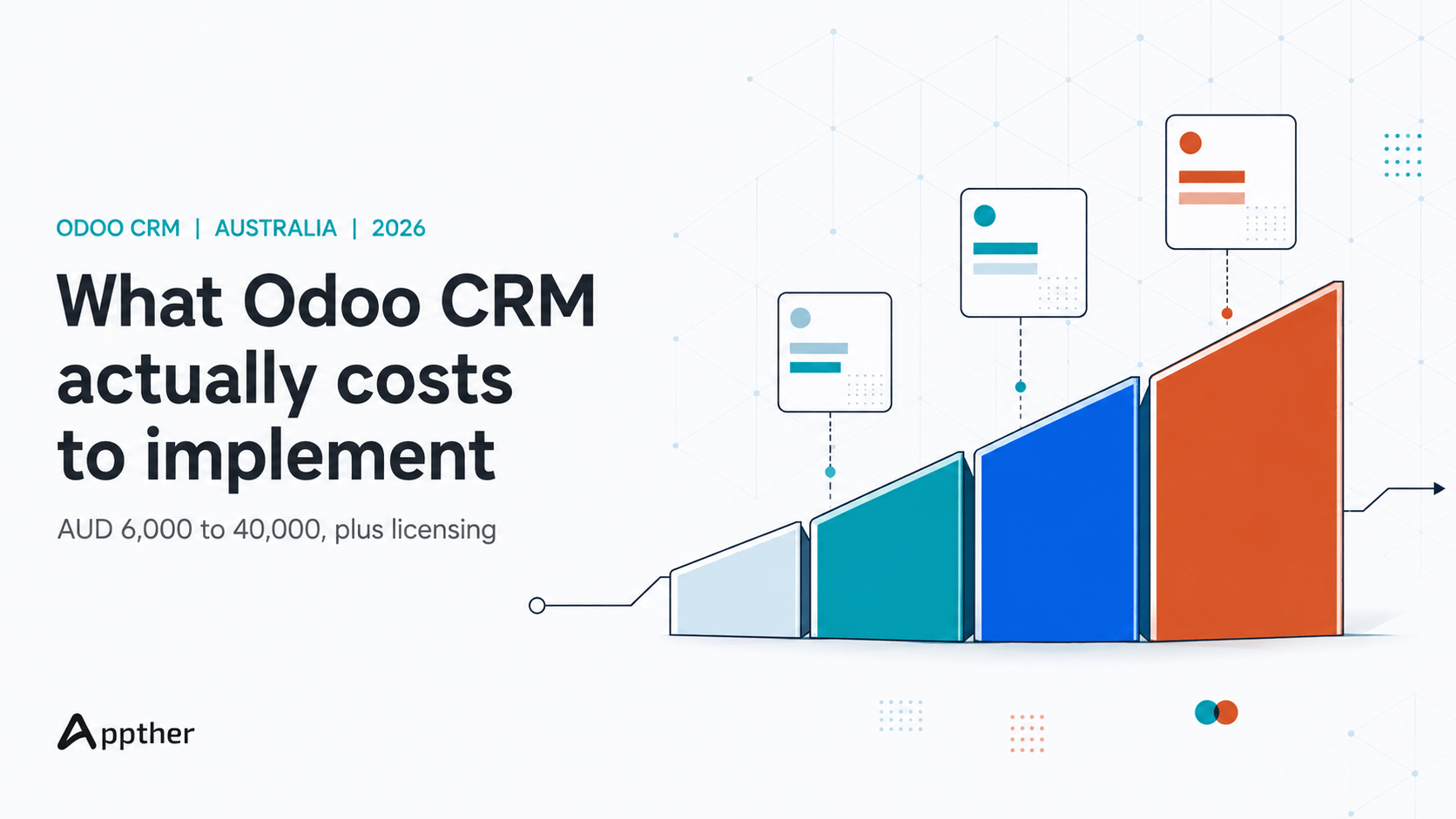
- Entry-level: AUD $0 to $25 per user per month.
- Mid-tier: AUD $25 to $80 per user per month.
- Advanced: AUD $80 and up per user per month.
Then there are costs beyond the licence to plan for:
- Setup and onboarding.
- Custom integrations.
- Data migration from your old system.
- Ongoing support and training.
Custom CRM development carries a higher upfront investment, but it removes recurring per-user fees and gives you full ownership. For a growing team, that trade can pay off within a couple of years.
How to choose the right CRM for your business
Picking the best CRM software for small business takes more than comparing feature lists. Work through this practical sequence:
- Define your sales and customer-management goals.
- Set a realistic budget for software and implementation.
- Identify the integrations you need, such as accounting, marketing and support tools.
- Confirm the CRM can scale as the business grows.
- Check onboarding, training and local support availability.
- Trial your shortlist with real data before you commit.
A structured evaluation now prevents a costly migration later.
Industry-specific CRM recommendations in Australia
Different sectors have different CRM needs. A quick guide:
- Real estate: lead tracking, property matching and automated follow-ups. See real estate software.
- NDIS and healthcare: compliance, appointment management and secure records. See healthcare software.
- Education and training: student lifecycle tracking and communication.
- Trades and field services: mobile access, job scheduling and invoicing.
- eCommerce: customer segmentation and marketing automation.
Choosing an industry-aligned CRM lifts efficiency almost immediately.
Benefits of a custom CRM for Australian small businesses
Custom CRM solutions are gaining ground across Australia because they deliver:
- Tailored workflows that match your real processes.
- Compliance-ready data handling and reporting.
- Advanced automation beyond SaaS limits.
- Freedom from rising subscription costs.
- Strong competitive differentiation.
For many growing SMEs, a custom CRM becomes a strategic investment rather than just another software expense.
Why choose Appther for CRM development in Australia
Appther helps Australian businesses design and build scalable, secure and fully customised CRM solutions. What sets the team apart:
- Proven experience in CRM and business automation.
- Expertise in AI-powered workflows and integrations.
- A cost-effective, timezone-aligned delivery model.
- Agile delivery with transparent communication.
- Long-term support and system optimisation.
The result is a CRM that evolves alongside your business rather than holding it back. See recent work on the portfolio page, or start a conversation through the contact page.
Frequently asked questions
What is the best CRM software for small business in Australia? It depends on your goals. HubSpot suits inbound marketing, Zoho suits budget-conscious teams, Pipedrive suits simple sales pipelines, and a custom CRM suits businesses with unique workflows. Start by matching the tool to your process, not the other way around.
What is the best free CRM in Australia? HubSpot CRM is widely used for its generous free plan and ease of use. Zoho and Freshsales also offer capable free or low-cost tiers for small teams.
How much does CRM software cost in Australia? Most small businesses spend between AUD $25 and $80 per user per month, depending on features. Entry-level plans can start free, while advanced tiers run higher.
Is a custom CRM worth it for a small business? Often yes, especially when your workflows, integrations or long-term per-user costs make SaaS limiting. A custom build gives you ownership and removes recurring licence fees.
How long does CRM implementation take? A SaaS CRM can be set up in days or weeks. A custom CRM build usually takes six to sixteen weeks, depending on complexity and integrations.
Can a CRM integrate with Xero or MYOB? Yes. Most modern CRMs support Australian accounting integrations directly or through APIs, which keeps your sales and finance data in sync.
Final thoughts
Choosing the right CRM is a critical decision for any Australian small business that wants to grow sustainably through 2026 and beyond. Whether you pick a ready-made SaaS platform or invest in a fully customised build, the goal is the same: align the technology with your real business processes.
A well-implemented CRM does more than manage contacts. It drives revenue, improves the customer experience and builds long-term competitive advantage. Match the platform to your goals, trial your shortlist, and start with a clear plan.