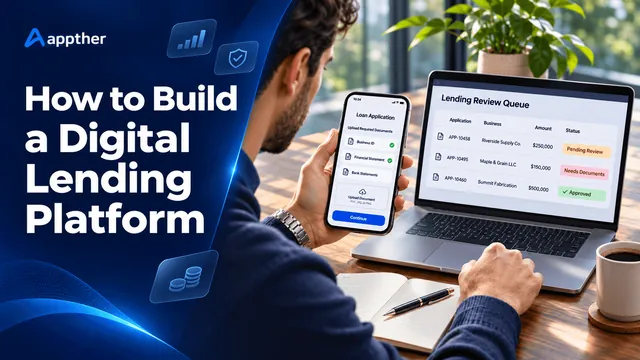
You’ve designed a loan application that borrowers can complete on their phones. Then, in testing, the payment provider times out after you send a payout. The borrower may already have received the money. Your operations team needs to confirm what happened, your finance team needs a record it can reconcile, and the borrower needs an accurate status.
That one scenario shows how much sits behind a digital loan application. To build a digital lending platform, start with one loan product and map the entire lifecycle, from the first application to the final repayment. Decide who makes credit decisions, who moves the money, and which system owns each record. Those answers tell you what to build and what to integrate.
This guide walks through the process for banks, lenders, and fintech teams. It covers architecture, underwriting, loan servicing, development cost drivers, and the checks to complete before launching.
What Is a Digital Lending Platform?
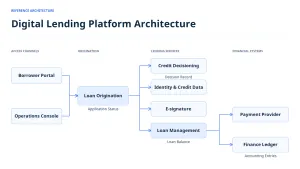
A digital lending platform connects the borrower experience with the systems a lender uses to assess applications, issue loans, disburse funds, and manage repayments. The borrower may see one app or website. Behind it, several systems manage different stages of the loan.
| Component | What it handles |
|---|---|
| Borrower portal or mobile app | Applications, document uploads, offer acceptance, signing, loan status, and payment visibility |
| Loan origination system (LOS) | Application records, verification, underwriting, offers, approvals, and handoff for funding |
| Credit decision engine | Lender-approved policy rules, decision outcomes, and recorded reasons |
| Loan management system (LMS) | Funded loan accounts, repayment schedules, balances, adjustments, and closure |
| Operations and finance console | Manual reviews, payment exceptions, reconciliation, and reporting |
If your core banking system already books loans and maintains balances, you can build the application and origination experience around it. Teams evaluating how those pieces fit together can explore Appther’s banking software development capabilities.
How to Build a Digital Lending Platform Step by Step
Step 1. Define Your Lending Model and First Loan Product
Start by identifying the lender of record. A bank or licensed lender may fund and originate loans directly. A fintech may run the borrower experience while a lending partner owns the loan and sets the credit policy. A marketplace may display offers from several lenders. The model determines who approves loans, what data each party needs, and who handles servicing and complaints.
For the first release, document these decisions:
- Borrowers and market. Which borrower segment and jurisdiction will you serve?
- Loan terms. What amounts, terms, rates, permitted fees, and repayment schedules will you support?
- Credit policy. What evidence is required, and who can approve exceptions?
- Money movement. Who disburses funds, receives repayments, and reconciles transactions?
- Servicing. Who handles failed payments, early payoff, hardship requests, and complaints?
Capture the answers in a product brief and assign an owner to each workflow. Include who takes over when a provider or lender integration becomes unavailable.
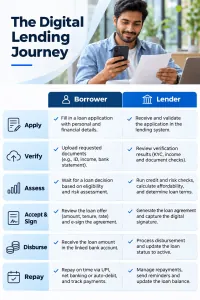
Step 2. Map the Borrower Journey and the Operations Workflow
Map what the borrower does at each stage alongside what your operations team and systems do. A borrower-facing status such as Documents requested or Disbursement pending should correspond to a documented event and a clear next action.
Suppose a small-business applicant uploads an unreadable bank statement. The borrower should see which document needs replacing and be able to upload it without restarting the application. Operations should see the same exception in its queue, and the application should resume from the correct stage once the document arrives.
Use the same approach for interrupted applications, duplicate submissions, delayed verification, and offers that expire before signing. If mobile is your first channel, test document capture, upload retries, and application recovery on a poor connection. See Appther’s mobile app development services.
Step 3. Turn Compliance Requirements Into Product Controls
Work with the lender’s compliance team to establish what applies to the loan product and launch market. For each requirement, specify what the software does, who owns the control, and what evidence staff can retrieve later.
| Control area | What the platform should support |
|---|---|
| Identity and business verification | Run applicable checks, route inconclusive results to reviewers, and retain the necessary evidence. |
| Disclosures and consent | Present required information at the appropriate stage and record relevant versions, timestamps, and acknowledgements. |
| Credit decisions | Record policy versions and decision reasons, generate required notices, and track delivery. |
| Sensitive data access | Limit access by role, log privileged actions, and apply retention rules. |
| Complaints and servicing | Assign cases and preserve the correspondence and transaction records needed for resolution. |
For example, India’s RBI Digital Lending Directions address disclosures, data practices, and disbursement and repayment for covered arrangements. In the United States, Regulation B sets notification requirements. When specific reasons for adverse action are provided, they must identify the principal reasons. Confirm the workflow with the lender’s compliance team for the applicable product and jurisdiction. RBI Digital Lending Directions · U.S. Regulation B, § 1002.9
Step 4. Decide What to Build, Buy, or Integrate
Start the architecture with a record-ownership map. The LOS might own application status, the LMS might own the contractual loan balance, and the finance ledger might own accounting entries. A payment provider confirms transfer events, while your systems determine how those events affect the loan balance and books.
| Capability | Practical first-release choice |
|---|---|
| Borrower experience and operations workflows | Build around your product, credit policy, and service model. |
| Identity checks, credit data, and e-signature | Integrate approved providers and retain the evidence the lender needs. |
| Underwriting | Configure versioned rules or integrate the lender’s existing decision engine. |
| Servicing | Reuse the existing LMS or core if it supports the product’s schedules, payment events, and adjustments. |
| Payments and accounting | Integrate approved payment rails and define posting and reconciliation rules with finance. |
A focused first release can use one backend with clearly separated modules, a relational database, secure document storage, and background processing for provider calls. Choose boundaries your team can operate and recover when an integration fails. For lender-specific workflows and systems integration, explore Appther’s custom software development services.
Step 5. Build Traceable Credit Decisioning and Manual Review
Convert approved credit policy into rules you can test. A decision may depend on product limits, verification results, credit data, affordability inputs, and other lender-approved criteria. Store the outcome, supporting inputs or references, the policy version, and the reasons used to reach the decision.
Support separate outcomes for approve, decline, refer for review, and request more information. Give technical exceptions their own path. If a credit bureau is unavailable, for example, keep the case pending and route it to retry or manual review. If staff can override a decision, capture who did it, why, and which approval they obtained.
AI can help with tasks such as extracting fields from uploaded documents. Start by measuring accuracy and sending uncertain values to a reviewer. If a model influences credit decisions, include validation, monitoring, applicable fair-lending review, and a reliable way to produce specific decision reasons.
Step 6. Build Disbursement, Repayment, and Reconciliation Together
Give each payout instruction a unique reference. If a provider times out, confirm the status of the original instruction before sending another. Repeated provider notifications should leave the loan and accounting records in the same state as one successful notification.
For repayments, test how the platform handles partial payments, failed debits, reversals, early payoff, and payments received outside the normal schedule. Confirm the allocation rules with the lender and finance team.
Finance should be able to follow a repayment from the provider’s transaction reference to the borrower’s loan account and then to the accounting entry. If those records differ, the platform should show which item is outstanding, who is investigating it, and how it was resolved.
Step 7. Scope and Estimate Your Digital Lending MVP
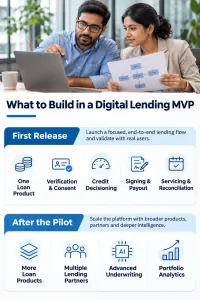
A digital lending MVP should support one complete loan lifecycle for one borrower segment and one product. Existing systems and manual review can keep the first release manageable while you validate how the lending operation works.
| Build for the pilot | Consider after the pilot |
|---|---|
| One borrower channel, loan product, and market | Additional products, markets, and borrower channels |
| Verification, document capture, and applicable consent | More data sources and specialized fraud tools |
| Policy-based decisions and manual review | More automated underwriting and portfolio analytics |
| Offer, signing, disbursement, and status tracking | Multiple lending partners or embedded lending APIs |
| Repayment visibility, servicing, and reconciliation | More payment options and servicing automation |
Estimate origination, integrations, and servicing separately. Adding a new borrower portal to an existing LOS and LMS is a different project from replacing both systems. Include initial engineering, provider fees, migration, monitoring, and post-launch support. Put provider onboarding, sandbox access, and lender approvals on the delivery schedule so their lead times are visible.
Step 8. Test the Full Loan Lifecycle and Run a Controlled Pilot
Take a test loan from application through final repayment, reconciliation, and closure. Test declined, incomplete, and withdrawn applications too. Simulate delayed provider responses, failed payouts, duplicate notifications, and payment reversals. Confirm that the borrower sees an accurate status and that operations and finance can resolve each exception.
For the pilot, define a borrower cohort and funding limits. Assign clear owners for credit, servicing, finance, and technical incidents. Review application completion, time to decision, manual review volume, disbursement failures, and unresolved reconciliation exceptions. As loans mature, review early delinquency alongside approval speed.
Common Digital Lending Platform Development Mistakes
Building the Application Screen Before Agreeing on Credit Policy
Changing the eligibility criteria late can affect the data you collect, the disclosures you show, the rules you test, and the decisions your team can explain. Agree on the first product’s policy and evidence requirements before finalizing the application.
Leaving Failed Payments and Exceptions Until After Launch
A demo can show a successful payout. The pilot needs to show what happens when a payout is delayed, reversed, or reported twice. Define how staff investigate and resolve each case before borrower funds are involved.
Letting Multiple Systems Maintain the Same Loan Balance
If two applications both calculate or update the outstanding balance independently, finance may have to resolve inconsistencies by hand. Name the authoritative system for the loan balance and define how other systems receive updates.
Trying to Launch Multiple Loan Products at Once
Each product can bring different rules, documents, schedules, and servicing needs. A single product makes it easier to trace problems during the pilot and decide what to improve before expanding.
How Appther Helps With Digital Lending Platform Development
Appther works with fintech teams and financial institutions to design borrower journeys, build lender operations workflows, and connect origination and servicing systems. If you already use a loan management system or core banking platform, we can help map where it fits and scope the capabilities you need to add.
Bring your first loan product, target market, and existing systems to the discovery discussion. Those details help identify which integrations the pilot needs and which workflows can be configured or built.
Explore Appther’s FinTech app development services.
Final Thoughts
The first release should prove that your team can originate, fund, service, and close one loan product. Before expanding, run realistic cases through that journey, including the ones that need manual review, delayed payments, or finance intervention. The results give you a concrete basis for choosing the next product, integration, or process to automate.
Frequently Asked Questions
What Is the Difference Between a Loan Origination System and a Loan Management System?
A loan origination system handles application intake, verification, underwriting, and offers through handoff for funding. A loan management system manages the booked loan, including balances, repayment schedules, adjustments, and closure. Some core banking platforms cover both.
How Much Does It Cost to Build a Digital Lending Platform?
The cost depends on the systems you can reuse, the number and complexity of integrations, and whether the project includes servicing, accounting, or migration. Request separate estimates for the initial build, provider fees, and ongoing operations so you can compare implementation options.
How Long Does It Take to Build a Digital Lending Platform?
The timeline depends on scope and provider readiness. A borrower portal connected to an existing LOS and LMS can go live sooner than a platform that also needs underwriting, servicing, and accounting. Allow time for lender sign-off, end-to-end testing, and a controlled pilot.
Can a Digital Lending Platform Work With an Existing Core Banking System?
Yes. A new platform can handle borrower onboarding and origination while the core books loans and maintains balances. Define how the two systems exchange application status, booking results, repayment events, and exceptions.
Do You Need AI to Launch a Digital Lending Platform?
A versioned rules engine and a manual review queue can support a first release. AI can be added where it measurably improves a task, such as extracting information from documents with a human review path for uncertain results.
What Should a Digital Lending MVP Include?
A digital lending MVP should cover application intake, applicable verification and consent, decisioning, signing, funding, and repayment servicing for one loan product. It should also give operations and finance a way to resolve exceptions and reconcile transactions.