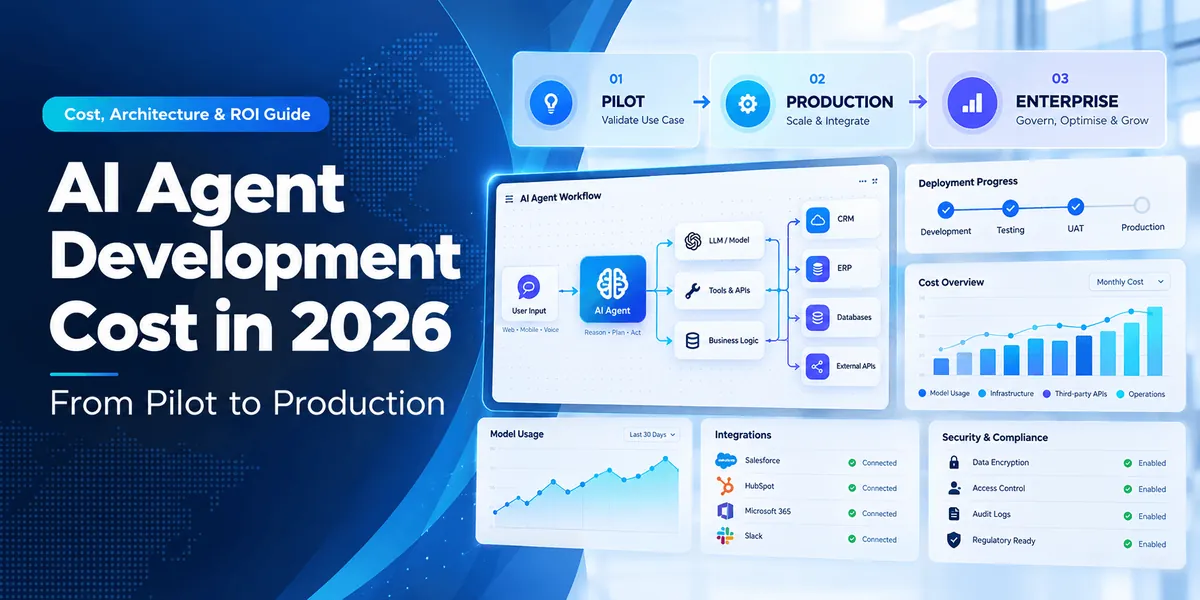
How much does it cost to build an AI agent in 2026? A narrowly scoped pilot can be considerably less expensive than a production system connected to multiple business applications. The difference comes down to what the agent must do, which systems it can access, how its decisions are controlled, and how reliably it must operate.
For businesses considering AI automation, the challenge is not simply finding the lowest development quote. It is understanding what the quoted price includes.
A demonstration that retrieves information and drafts responses is one thing. An AI agent that checks inventory, updates customer records, processes requests, and handles exceptions is a different engineering project.
The distinction matters because businesses increasingly want AI agents to complete work rather than simply answer questions.
This guide explains AI agent development costs in 2026, including pilot budgets, production deployments, enterprise platforms, monthly operating expenses, and common hidden costs. It also provides a practical framework for evaluating proposals from an AI development company.
How Much Does AI Agent Development Cost in 2026?
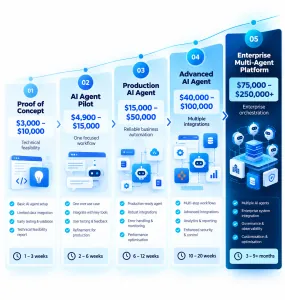
AI agent development can range from a focused pilot costing a few thousand dollars to a complex enterprise platform requiring a six-figure investment.
The following figures are illustrative budgeting scenarios for custom development, not independently surveyed market averages or fixed vendor quotations.
| AI agent project | Illustrative development budget (USD) | Indicative timeline |
|---|---|---|
| Feasibility proof of concept | $3,000–$10,000 | 1–3 weeks |
| Single-workflow AI agent pilot | $4,900–$15,000 | 2–6 weeks |
| Production AI agent | $15,000–$50,000 | 6–12 weeks |
| Advanced agent with multiple integrations | $40,000–$100,000 | 10–20 weeks |
| Enterprise multi-agent platform | $75,000–$250,000+ | 3–9+ months |
These ranges assume different scopes and should not be interpreted as guaranteed prices or delivery commitments.
For example, a $4,900 pilot might validate one business workflow with limited integrations and a small group of users. It would not normally include all the infrastructure, security reviews, integrations, operational controls, and support expected from a large enterprise deployment.
The practical starting point: Define one measurable business outcome and determine the minimum agent capability needed to test it.
What Is an AI Agent?
An AI agent is a software system that uses artificial intelligence to interpret information, make limited decisions, and perform tasks through connected tools or applications.
Unlike a conventional chatbot that primarily responds to messages, an AI agent may execute a sequence of actions.
Consider a customer support workflow.
A chatbot might explain how customers can track an order. An AI agent could retrieve the order using an authorized API, check its current status, create a support ticket when needed, and prepare a response.
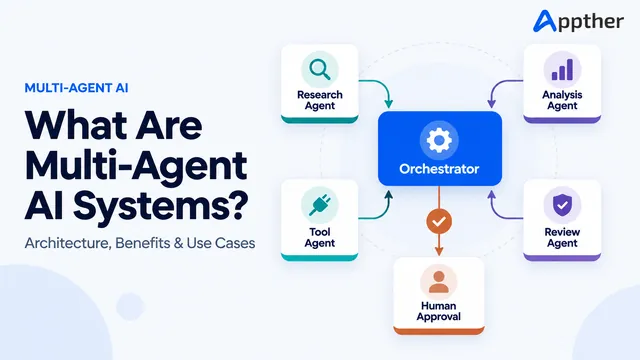
More complex systems may coordinate several specialized agents.
However, autonomy should not be confused with unrestricted access. Production AI agents need clearly defined permissions, validation rules, and human approval for sensitive actions.
AI agent vs. chatbot: What changes the cost?
| Capability | Basic chatbot | AI agent |
|---|---|---|
| Answers customer questions | Yes | Yes |
| Retrieves knowledge-base information | Often | Often |
| Calls external APIs | Sometimes | Commonly |
| Executes multi-step workflows | Limited | Core capability |
| Updates business systems | Depends on integration | Common use case |
| Uses tool permissions and approval rules | Sometimes | Important for production |
| Requires workflow-level evaluation | Limited for simple bots | Essential |
| Handles action failures and recovery | Limited | Essential for reliable deployment |
A sophisticated chatbot may already have agent-like capabilities, so the categories overlap.
The cost difference depends on the required behavior rather than the product label.
For businesses focused primarily on conversational interfaces, Appther’s AI chatbot development services may be a more suitable starting point.
AI Agent Development Cost by Project Stage
One of the most useful ways to estimate AI agent pricing is to separate the project into four stages.
Stage 1: Proof of Concept, Validate Technical Feasibility
Illustrative budget: $3,000–$10,000
A proof of concept (PoC) determines whether an AI agent can perform a narrowly defined task with acceptable results.
For example, a logistics business might want to test whether an agent can retrieve shipment details and summarize delivery exceptions.
The PoC could use a controlled dataset, limited integrations, and a simple interface.
Typical deliverables include:
- Defined use case and success criteria
- Basic agent workflow
- Initial model and tool integration
- Sample test scenarios
- Technical feasibility findings
- Recommendations for the next stage
A PoC is not necessarily ready for external users.
It may lack production monitoring, comprehensive security controls, disaster recovery, and operational support.
Best suited for: Businesses that need evidence of feasibility before committing to a larger project.
Stage 2: AI Agent Pilot, Validate Business Value
Illustrative budget: $4,900–$15,000
A pilot takes the idea beyond a technical demonstration.
The objective is to test the agent in a realistic but controlled business environment.
For example, a sales operations team might pilot an agent that reads incoming inquiries, identifies relevant information, and drafts CRM updates for employee approval.
A typical pilot may include:
- One clearly defined workflow
- A limited number of authorized tools
- Basic API integrations
- User access controls
- Human approval for consequential actions
- Logging and error tracking
- Evaluation against agreed scenarios
- Limited-user testing
A pilot should produce evidence about operational value.
Useful measurements include task completion rate, average handling time, escalation frequency, correction rate, and cost per completed task.
What does a $4,900 AI agent pilot include?
That depends entirely on the signed scope. At this budget, a sensible starting point is one bounded workflow, limited integrations, and defined testing, not an unrestricted enterprise agent.
Appther can assess whether a proposed use case is suitable for a focused pilot through its AI development services.
Stage 3: Production AI Agent, Deploy Reliable Automation
Illustrative budget: $15,000–$50,000
Moving from a successful pilot to production is often the most underestimated part of AI agent development.
A pilot may perform well during supervised testing but encounter unexpected inputs, unavailable APIs, changing business data, and user behavior once deployed.
A production-ready agent therefore requires additional engineering.
Typical requirements include:
- Reliable API authentication and authorization
- Role-based access control
- Secure credential management
- Input and output validation
- Error handling and retries
- Human escalation workflows
- Operational monitoring
- Usage and cost tracking
- Regression testing
- Deployment and rollback procedures
- Documentation and support processes
For example, an appointment-booking agent must do more than recognize a requested time.
It needs to check actual availability, prevent duplicate bookings, handle cancellations, and recover when the scheduling system is unavailable.
Best suited for: Businesses ready to make an AI agent part of a recurring operational workflow.
Stage 4: Enterprise Multi-Agent Platform, Scale Across Teams
Illustrative budget: $75,000–$250,000+
An enterprise platform may involve several agents working across departments or business applications.
Consider an organization that wants separate agents for customer service, sales operations, procurement, and reporting.
These agents may need to share approved context, access different systems, and operate under centralized governance.
Enterprise requirements can include:
- Multi-agent orchestration
- Centralized access management
- Single sign-on
- Detailed audit trails
- Workflow versioning
- Evaluation and monitoring dashboards
- Private networking or dedicated infrastructure
- Data residency controls
- High-availability architecture
- Enterprise security reviews
- Disaster recovery
- Support and service-level agreements
The architecture should also account for cases where an agent cannot complete a task safely.
In many situations, a single well-designed agent with deterministic workflow components is more economical and reliable than an elaborate multi-agent system.
Best suited for: Organizations automating several related workflows with substantial security, governance, and integration requirements.
What Determines the Cost of Building an AI Agent?
Two businesses may request an “AI customer service agent” and receive very different development estimates.
The reason is that AI agent pricing depends on the work required around the model.
1. Workflow complexity
A straightforward agent that retrieves information and creates a draft is less complex than one that coordinates several systems.
Complexity increases when the agent must manage exceptions, maintain state, obtain approvals, or execute long-running processes.
2. Number of integrations
Integrations are a major cost driver.
An agent connected to one documented API is different from one that must interact with a legacy ERP, CRM, accounting platform, and custom database.
Integration work may include authentication, field mapping, rate-limit handling, retries, and reconciliation.
For businesses planning extensive integrations, enterprise software development expertise is as important as model selection.
3. AI model and architecture
Some tasks can be completed using a relatively inexpensive model.
Others require stronger reasoning capabilities, larger context windows, specialized models, or multiple model calls.
A good development partner should compare alternatives rather than automatically choosing the most expensive model.
4. Business data and RAG
Agents that rely on internal documents may need retrieval-augmented generation.
The project may involve document extraction, chunking, indexing, retrieval, access permissions, and ongoing updates.
Poorly organized data can increase implementation and maintenance costs.
5. Security and approval requirements
An agent that reads public product information has a different risk profile from one that changes customer records or initiates financial transactions.
Higher-risk workflows may require stronger authentication, human approval, audit logs, and security testing.
6. Testing and evaluation
AI systems need more than conventional software testing.
Teams must assess whether the agent chooses appropriate tools, produces valid outputs, respects permissions, and handles unexpected conditions.
The evaluation effort grows with workflow complexity.
7. Infrastructure and scale
Operating costs depend on model usage, hosting, storage, observability, and workload volume.
A pilot used by five employees may have very different infrastructure requirements from an agent serving thousands of customers.
AI Agent Development Cost Breakdown
A project budget should show where the money is being spent.
The following example illustrates a hypothetical $30,000 production AI agent project.
| Development component | Example allocation |
|---|---|
| Discovery and workflow design | $3,000 |
| Architecture and agent development | $7,500 |
| API and business system integrations | $6,000 |
| Security and access controls | $3,000 |
| Testing and AI evaluation | $4,500 |
| Deployment and monitoring setup | $3,000 |
| Documentation and handover | $3,000 |
| Total | $30,000 |
This is an example allocation, not an Appther quotation.
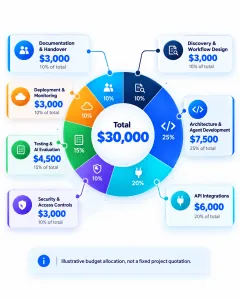
Actual projects may require more investment in integrations, security, or data preparation.
For example, an agent using existing APIs and structured data may be relatively straightforward to implement. A project involving undocumented legacy systems could require substantial integration engineering before agent development begins.
How Much Does It Cost to Run an AI Agent Every Month?
Development cost and operating cost are separate.
An AI agent may be inexpensive to demonstrate but costly to operate at scale if it performs numerous model calls, processes large documents, or repeatedly invokes external services.
Typical recurring expenses include:
- LLM API usage
- Cloud hosting
- Database and vector storage
- Logging and monitoring
- External software APIs
- Human review
- Maintenance and improvements
- Security and compliance operations
Example monthly AI agent operating budget
Consider a production agent processing approximately 10,000 business tasks per month.
The following is a hypothetical planning scenario.
| Monthly expense | Example budget |
|---|---|
| LLM and embedding usage | $300 |
| Application hosting | $150 |
| Database and storage | $100 |
| Monitoring and logging | $100 |
| Third-party API services | $150 |
| Maintenance and technical support | $800 |
| Estimated monthly total | $1,600 |
This example excludes substantial human-review costs, unusual usage spikes, and enterprise-specific security requirements.
It should not be treated as a benchmark for every 10,000-task workload.
Calculate cost per completed task
One of the most useful metrics is:
Cost per completed task = Total monthly operating cost ÷ Successfully completed tasks
If the system costs $1,600 per month and successfully completes 8,000 tasks:
$1,600 ÷ 8,000 = $0.20 per completed task
This is more informative than looking only at the price of an individual model call.
A cheap model that repeatedly fails or requires human correction may produce a higher effective cost than a more capable model.
AI Agent Development Cost in the USA vs. UK
US and UK businesses often compare local development teams with international engineering providers.
The important question is not simply which country has the lowest hourly rate.
The comparison should account for project management, communication, architecture, security, testing, maintenance, and delivery accountability.
What affects regional pricing?
US-based development teams may be attractive when domestic contracting, time-zone alignment, or specific procurement requirements are important.
UK-based development teams may offer similar advantages for organizations requiring local collaboration and familiarity with UK business and regulatory expectations.
International development teams can offer alternative commercial models, but buyers should verify communication arrangements, data handling, technical oversight, and support coverage.
A lower hourly rate does not necessarily produce a lower total project cost.
Poor requirements, repeated rework, incomplete testing, and unstable integrations can outweigh the initial savings.
Should UK businesses budget in GBP?
Yes. UK buyers should request proposals in GBP when practical.
However, model APIs and cloud services may still be billed in USD or another currency.
Contracts should specify how exchange-rate changes and third-party usage charges are handled.
Rather than converting a generic US price table into GBP using an arbitrary exchange rate, request a dated, project-specific quotation.
Hidden Costs of AI Agent Development
Several expenses are frequently overlooked during initial budgeting.
Data preparation
Business documents, customer records, and operational data may need cleaning or restructuring before the agent can use them reliably.
Third-party subscriptions
The solution may depend on paid CRM APIs, automation platforms, communication services, databases, or document-processing tools.
Human oversight
Sensitive workflows may require employees to review actions before execution.
That review time should be included in the operating model.
Evaluation and regression testing
Changes to prompts, tools, data sources, or models can alter agent behavior.
Testing should continue after the initial launch.
Security reviews
External penetration testing, legal review, and compliance assessments may be separate from development.
Vendor and model changes
Model availability, pricing, capabilities, and API behavior can change.
An adaptable architecture may reduce the cost of switching providers.
Ongoing improvements
A production agent will need updates as business rules, software integrations, and user expectations evolve.
Before signing a contract, request a 12-month total cost of ownership estimate.
Single-Agent vs. Multi-Agent Development: Which Costs More?
Multi-agent systems generally introduce additional design and operational complexity.
They may involve coordination between specialized agents, shared state, task routing, communication protocols, and more extensive evaluation.
| Factor | Single AI agent | Multi-agent system |
|---|---|---|
| Architecture | Usually simpler | More coordination required |
| Tool integration | One primary agent | Tools distributed across agents |
| Monitoring | One main execution path | Multiple execution paths |
| Testing | Focused workflows | Interaction and coordination testing |
| Operational cost | Often lower | Can increase with extra model calls |
| Governance | Centralized around one agent | May require agent-specific permissions |
| Best fit | Bounded business workflows | Distinct specialized tasks requiring coordination |
A multi-agent architecture is not automatically better.
For example, a customer support workflow may be easier to maintain with one agent and several conventional API functions.
Multi-agent orchestration becomes more useful when distinct responsibilities genuinely benefit from separation.
The architecture should follow the business requirement, not a technology trend.
How to Estimate AI Agent ROI
AI agent ROI should be based on measurable business outcomes.
Common benefits include reduced manual processing time, faster response times, fewer repetitive tasks, and improved service availability.
However, not every minute saved translates into direct financial savings.
A realistic calculation should distinguish between labor capacity released and actual cash savings.
Example: Customer operations automation
Assume a business handles 10,000 eligible requests per month.
Before automation:
- Average manual handling time: 6 minutes
- Fully loaded labor cost: $25 per hour
The current labor cost associated with those requests is:
10,000 × 6 ÷ 60 × $25 = $25,000 per month
Now assume an AI agent successfully handles 60% of those requests without human intervention.
Potential gross labor capacity value:
$25,000 × 60% = $15,000 per month
Assume:
- Monthly AI operating and support cost: $2,000
- Additional human review and exception cost: $3,000
The illustrative monthly net capacity value is:
$15,000 − $2,000 − $3,000 = $10,000
If the initial implementation costs $30,000, the simple payback period would be:
$30,000 ÷ $10,000 = 3 months
This is an illustrative model, not a guaranteed outcome.
The calculation assumes the remaining workload does not generate additional costs beyond those stated. Actual cash savings depend on staffing decisions, workload growth, and whether the released capacity can be redeployed productively.
Measure outcomes before expanding
A useful pilot should track:
- Task completion rate
- Average processing time
- Human escalation rate
- Error and correction rate
- Cost per successful task
- Customer or employee experience
- Financial value of the improvement
These measurements help determine whether to improve the pilot, deploy it more broadly, or reconsider the use case.
How Long Does It Take to Build an AI Agent?
Development timelines depend on the scope and readiness of the underlying business systems.
A narrow proof of concept may take only a few weeks.
A production agent integrated with several applications requires more time for security, testing, and operational preparation.
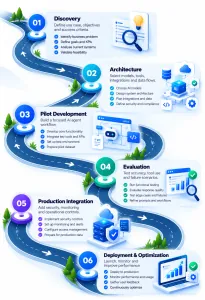
Typical development phases
Phase 1: Discovery
Define the business process, users, permissions, expected outcomes, and success criteria.
Phase 2: Architecture
Select the model strategy, tools, integration approach, and data-handling requirements.
Phase 3: Pilot development
Implement a controlled workflow and test it against representative scenarios.
Phase 4: Evaluation
Measure performance, identify failure cases, and improve the design.
Phase 5: Production integration
Add operational controls, monitoring, security, deployment procedures, and support processes.
Phase 6: Rollout and optimization
Introduce the agent to users gradually, monitor outcomes, and expand its responsibilities only when justified.
How to Reduce AI Agent Development Costs Without Sacrificing Reliability
Start with one workflow
Avoid attempting to automate an entire department in the first release.
Choose a task with clear inputs, outputs, and measurable results.
Reuse existing software
Before building a new platform, assess whether the agent can work within the CRM, ERP, or application your team already uses.
Use deterministic logic where appropriate
Not every step needs an LLM.
Business rules, validation, calculations, and certain API operations may be more reliable when implemented with conventional code.
Limit unnecessary model calls
Use appropriate models, concise context, caching where safe, and efficient tool execution.
Build evaluation into the project
Detecting failures early is usually less expensive than correcting them after widespread deployment.
Separate pilot scope from production scope
A pilot should validate the most important assumptions.
Production requirements should be budgeted explicitly rather than assumed to be included in the pilot price.
Plan maintenance from the beginning
A system that cannot be monitored or updated economically may become expensive despite a low initial development cost.
Build vs. Buy: Should You Develop a Custom AI Agent?
Not every business needs a custom-built AI agent.
Existing SaaS products and automation platforms may already cover common use cases.
Choose an existing platform when:
- The workflow is relatively standard.
- Required integrations are already supported.
- Custom business logic is limited.
- The platform meets security and data requirements.
- Subscription costs are acceptable.
Consider custom development when:
- The workflow is specific to your organization.
- Multiple internal systems must be coordinated.
- The agent requires custom permissions and approval rules.
- Data must remain within controlled infrastructure.
- You need ownership of custom application code.
- Existing platforms cannot support the required process reliably.
A hybrid approach is also possible.
For example, a business may use a hosted language model while developing its own application, workflow logic, integrations, and monitoring.
How Appther Approaches AI Agent Development
AI agent development involves more than selecting a language model and writing prompts.
A successful implementation must combine business requirements, software architecture, reliable integrations, security controls, and measurable outcomes.
Appther Technologies provides custom AI development services for organizations planning AI-powered applications and business automation.
Its published capabilities include AI agents, RAG, conversational AI, enterprise integrations, and production monitoring.
1. Use-case discovery
Identify workflows where an AI agent can deliver measurable operational value.
2. Architecture and model selection
Evaluate the required models, orchestration approach, data sources, and application components.
3. Custom agent development
Develop the workflow logic, tool connections, permissions, and application interfaces.
4. CRM and ERP integration
Connect the agent to authorized business systems through secure APIs and integration services.
5. Testing and evaluation
Test expected behavior, incorrect inputs, unavailable tools, and approval boundaries.
6. Production deployment
Implement monitoring, logging, operational controls, and deployment processes appropriate to the project.
7. Ongoing optimization
Improve task performance, reliability, and operating costs based on actual usage.
For voice-based workflows, businesses can also explore Appther’s AI voice agent development services.
What Should an AI Agent Development Proposal Include?
Before comparing vendor quotes, request a clear statement of work.
The proposal should identify:
- Business objectives and use cases
- Agent responsibilities and prohibited actions
- Number of integrations
- Data sources and access permissions
- User interface requirements
- Model and infrastructure assumptions
- Evaluation criteria
- Security responsibilities
- Development milestones
- Acceptance criteria
- Deployment environment
- Third-party usage costs
- Maintenance and support arrangements
- Source-code and intellectual property ownership
- Change request process
A proposal that simply promises an “AI agent” without defining these details is difficult to evaluate.
Frequently Asked Questions About AI Agent Development Cost
1. How much does it cost to build an AI agent in 2026?
A focused AI agent pilot may cost approximately $4,900–$15,000 in an illustrative custom-development scenario. Production systems can cost $15,000–$50,000 or more, while complex enterprise platforms may require six-figure budgets. Actual pricing depends on scope, integrations, security, and deployment requirements.
2. What is included in an AI agent pilot?
A typical pilot includes one defined workflow, limited integrations, basic safeguards, and evaluation against agreed test cases. Production-scale infrastructure and enterprise governance are usually scoped separately.
3. How much does an AI agent cost per month?
Monthly costs depend on model usage, infrastructure, integrations, monitoring, and support. Businesses should calculate the cost per successfully completed task rather than relying only on token prices.
4. Is an AI agent more expensive than a chatbot?
Not necessarily. A simple agent may cost less than a sophisticated enterprise chatbot. However, agents that execute actions across multiple systems generally require additional integration, security, and testing work.
5. How long does AI agent development take?
A narrow proof of concept may take one to three weeks. A pilot may take several weeks, while a production deployment can require two to three months or longer. Complex enterprise programs may take substantially more time.
6. What is the biggest cost driver in AI agent development?
Workflow complexity and integration requirements are often major cost drivers. Data preparation, security, evaluation, and production reliability can also contribute significantly.
7. Can an AI agent integrate with Salesforce, Odoo, or other CRM systems?
Yes, provided suitable APIs, permissions, and integration capabilities are available. The exact scope depends on the connected system and the actions the agent must perform.
8. Do AI agents require ongoing maintenance?
Yes. Business rules, APIs, models, and data sources change. Production agents need monitoring, testing, security updates, and periodic improvements.
9. Is it cheaper to build one AI agent or several specialized agents?
A single agent is often less expensive to build and operate for a bounded workflow. Multiple agents can be useful for distinct responsibilities, but they introduce coordination and monitoring complexity.
10. How do I calculate the ROI of an AI agent?
Compare the measurable value of completed tasks, time savings, and operational improvements against implementation costs and ongoing expenses. Include human review, maintenance, and exception handling.
11. Can UK businesses hire an international AI agent development company?
Yes. UK businesses can work with international providers, subject to their procurement, contractual, data protection, and operational requirements. They should confirm support arrangements and any applicable UK GDPR obligations.
12. What should I ask before hiring an AI agent development company?
Ask about comparable projects, technical architecture, integration experience, security controls, evaluation methods, recurring costs, source-code ownership, and post-launch support.
Final Thoughts: Start with a Pilot, but Budget for Production
The cost of developing an AI agent is determined by the responsibilities the system must perform and the reliability required to perform them.
A focused pilot can help validate the concept and establish measurable success criteria.
Production deployment requires additional investment in integrations, permissions, monitoring, evaluation, and ongoing operations.
For businesses in the USA and UK, the most useful approach is to define one valuable workflow, assess its technical feasibility, and compare development proposals against a consistent scope.
The goal should not be to build the most autonomous agent possible.
It should be to develop an AI system that completes useful work reliably, operates within clear boundaries, and produces measurable business value.
Ready to Estimate Your AI Agent Development Cost?
Appther Technologies helps businesses plan and develop custom AI agents, intelligent applications, and enterprise automation workflows.
Whether you are evaluating a pilot or preparing for production deployment, the first step is understanding your use case, integrations, security requirements, and expected operating volume.
Discuss Your AI Agent Development Project with Appther
Share your requirements to explore an appropriate development approach, project scope, and cost estimate.