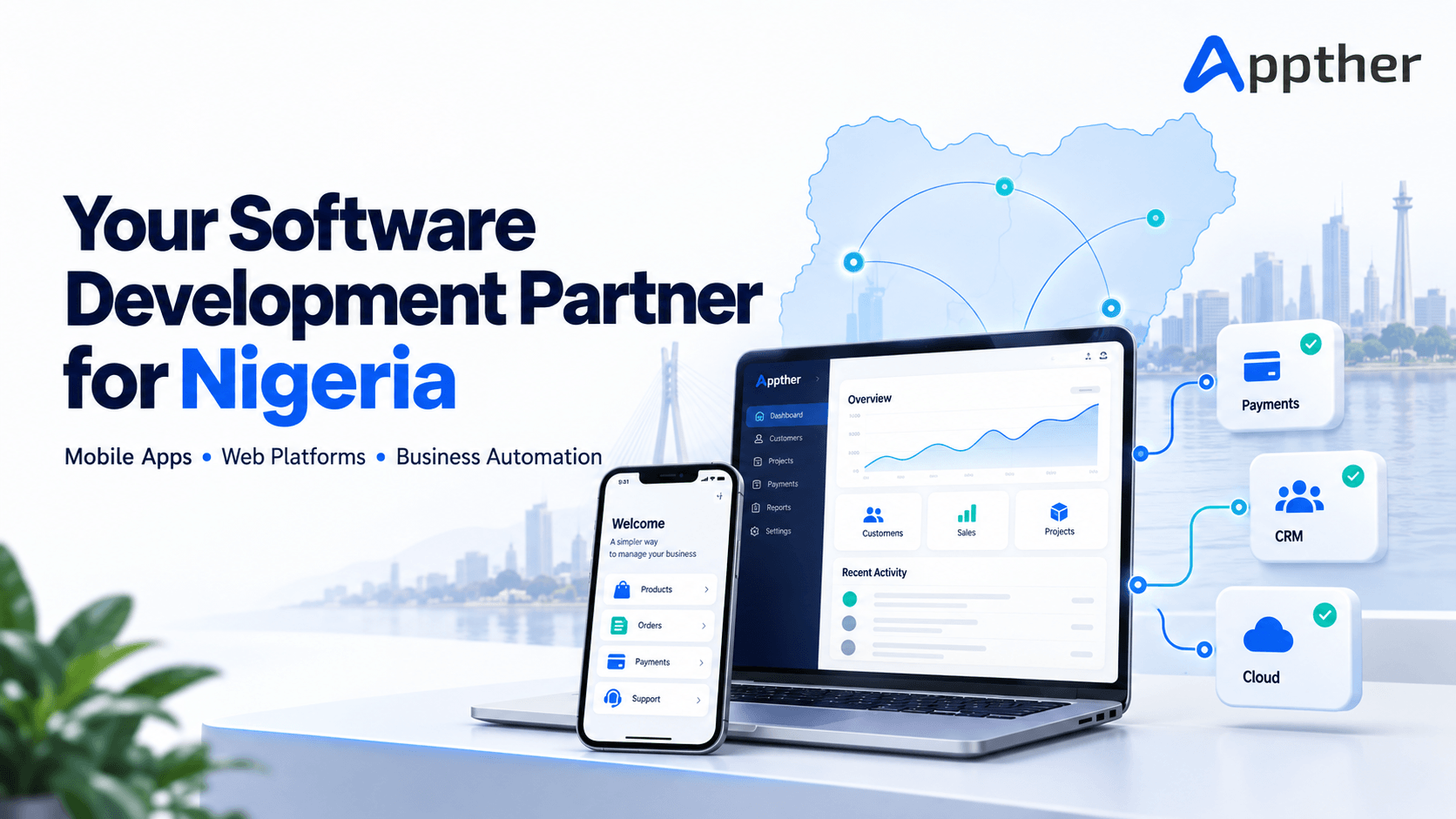
Building software for your business starts with understanding what needs to work better. Customers may need an easier way to place orders. Your sales team may struggle to track enquiries. Staff may spend hours moving information between spreadsheets, payment records and internal systems.
For Nigerian businesses, choosing a software development partner means finding a team that understands these workflows and can translate them into a reliable product.
The right partner should help you define requirements, evaluate technology options, manage integrations and support the system after launch.
At Appther, we help businesses develop mobile applications, web platforms, enterprise software and AI solutions. This guide explains what to consider when selecting a development partner for your business in Nigeria.
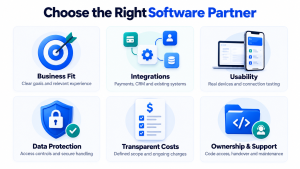
1. Start With Your Business Goals
Before asking for a development quote, define the problem you want to solve.
“We need an app” is a starting point. A clearer requirement would be: “We need customers to place orders, receive payment confirmation and track fulfilment without calling our staff.”
That description helps identify the customer journey, backend requirements and operational responsibilities.
Consider these questions:
- Who will use the software?
- Which tasks are currently slow or difficult?
- What information must move between departments?
- Which existing systems must remain connected?
- How will you measure success?
For a distributor, success might mean faster order processing. For a service business, it might mean more enquiries followed up on time.
Appther’s enterprise software development services support custom ERP, CRM and workflow applications for businesses looking to connect these processes.
2. Evaluate Payment Integration Beyond Checkout
If your application accepts payments, your development partner should explain the complete transaction lifecycle.
A payment button is only one part of the system. Your business also needs to know whether a transaction succeeded, which order it belongs to and what happens when confirmation is delayed.
For example, Paystack supports payment options for Nigerian businesses, including cards and Pay with Transfer. Your team should confirm which channels fit your account and business requirements using the provider’s current payment channel documentation.
Ask your development partner:
- How will the backend verify successful payments?
- What happens when a payment remains pending?
- How are duplicate notifications handled?
- How will finance reconcile payments with orders?
- What is the process for refunds and failed transactions?
These details affect customer confidence and the amount of manual work your finance team inherits.
3. Build for Your Customers’ Devices and Connections
Your application should be tested in conditions that reflect how customers will actually use it.
Identify the devices, screen sizes and connection conditions relevant to your audience. Test interrupted sessions, slow uploads and recovery after a connection drops.
For example, a field representative recording a customer visit may need to save information temporarily and synchronise it later. A customer completing a long application form should not lose every entry because the connection briefly fails.
Useful requirements may include:
- Lightweight screens and optimised images.
- Saved form progress.
- Clear payment and submission statuses.
- Recoverable uploads.
- Offline access for selected tasks.
- Simple navigation and readable interfaces.
Our mobile app development services cover iOS, Android and cross-platform applications, alongside backend integrations and maintenance.
The platform choice should follow your audience and requirements.
4. Decide Whether to Build Custom Software or Configure an Existing Platform
Not every business process needs a completely custom application.
An existing CRM or ERP platform may already support your sales pipeline, inventory, purchasing and customer service requirements. Custom development may be more appropriate when your workflow or customer experience needs capabilities that standard products cannot provide effectively.
| Approach | When to consider it |
|---|---|
| Existing software | Your requirements closely match standard features |
| Configured ERP or CRM | You need connected business functions with some customisation |
| Custom application | Your workflows or customer experience require distinctive functionality |
| Combined approach | You need a custom app connected to an existing business platform |
For example, a company could use Odoo to manage internal operations while offering customers a separate ordering application.
Appther’s Odoo development and implementation services provide an option for businesses evaluating configuration, customisation and integration.
Ask your partner to explain the initial cost, ongoing maintenance and limitations of each approach.
5. Include Data Protection in Project Planning
Applications often process customer details, employee information, payment references and uploaded documents.
Nigeria’s data protection framework includes the Nigeria Data Protection Act 2023 and the NDPC’s General Application and Implementation Directive 2025. The obligations relevant to your project should be identified during discovery. See the Nigeria Data Protection Act and NDPC implementation directive.
Discuss what information the application needs, where it will be stored, who can access it and how long it should be retained.
The development scope should reflect those decisions through appropriate access controls, secure data handling, audit records and retention settings.
If an overseas development team will access personal data, include that arrangement in the privacy and contractual review. Sector-specific requirements should be assessed with the relevant qualified advisers.
6. Compare Development Proposals Using the Same Scope
A lower quotation may cover fewer features, less testing or a different level of support.
To compare proposals meaningfully, ask each vendor to use the same requirements and explain its assumptions.
| Cost area | What to clarify |
|---|---|
| Discovery and design | Requirements, wireframes and approved designs |
| Development | Platforms, user roles, workflows and integrations |
| Testing and launch | Device testing, acceptance testing and deployment |
| Third-party services | Hosting, messaging and usage-based charges |
| Support | Maintenance coverage, response targets and enhancements |
For international engagements, agree on billing currency, payment milestones, exchange-rate treatment and applicable taxes.
Also ask what could change the estimate. Data migration, undocumented APIs and additional approval workflows can materially affect delivery effort.
A useful proposal makes these dependencies visible.
7. Look for Regular Demonstrations and Clear Accountability
You should be able to see the product developing throughout the engagement.
Ask for an agreed backlog, regular demonstrations and access to a testing environment. Each milestone should explain what users can do and how your team will assess completion.
For remote collaboration, establish:
- Meeting overlap in West Africa Time.
- A named project contact.
- A shared process for tracking questions and decisions.
- Responsibilities for providing content and integration access.
- A change-request process covering cost and timing.
Before selecting a team, review relevant project examples. Appther’s app and AI development case studies provide a starting point for discussing comparable work and delivery requirements.
8. Confirm Ownership and Post-Launch Support
Clarify ownership before development begins.
Your agreement should explain rights to custom code, designs, documentation and business data, together with any third-party licence restrictions.
Confirm access to source repositories, hosting accounts, domains and app-store accounts. Include handover documentation and a process for transferring responsibility if the engagement ends.
Support also needs a clear definition.
Ask what qualifies as a warranty defect, which maintenance activities are included and how urgent incidents are handled. New features, infrastructure upgrades and changes to external APIs may require separate arrangements.
Clear responsibilities make the system easier to operate after launch.
Practical Software Opportunities for Nigerian Businesses
The right first release should address a specific operational need.
A distributor in Lagos, for example, could start with an ordering portal that allows customers to request products, staff to confirm availability and finance to verify payment. Later releases could introduce delivery tracking once the core process works reliably.
A service business could begin with enquiry capture, lead assignment and follow-up reminders. A field operation could prioritise an agent application that reduces repeated paperwork.
Appther’s web application development services can support customer portals, dashboards and operational platforms.
AI can also support a defined workflow. An order-status assistant, for example, needs access to verified records, appropriate permissions and a route to a human when it cannot resolve a request.
Our AI agent development services focus on connecting AI capabilities with business systems and workflows.
How Appther Can Support Your Software Project
Appther brings mobile, web, enterprise software and AI development capabilities into the same project conversation.
For a Nigerian business, the starting point is understanding the users, operational process and integration requirements. The project can then be shaped into a focused first release with clear responsibilities and measurable outcomes.
A practical engagement should establish:
- Discovery: Business goals, users, constraints and priorities.
- Design: Agreed workflows and a prototype for feedback.
- Development: Prioritised milestones and regular demonstrations.
- Validation: Functional testing, integration checks and user acceptance.
- Launch and support: Deployment responsibilities, monitoring and support coverage.
Whether you are planning a customer application, an operations platform or an Odoo integration, we can help you define what the software needs to achieve.
Looking for a software development partner for your business in Nigeria?
Share your idea, existing workflow and key challenges with Appther to discuss your requirements and next steps.

Frequently Asked Questions
Can Nigerian businesses work with an overseas software development partner?
Yes. Evaluate relevant experience, communication, contractual terms and support coverage. Agree responsibilities for ownership, hosting, data access and applicable cross-border requirements before starting.
How much does custom software development cost in Nigeria?
A meaningful estimate requires a defined scope. Request a breakdown covering discovery, design, development, integrations, testing and ongoing operations, with the currency and assumptions clearly stated.
What should an MVP include?
An MVP should contain the smallest complete workflow that delivers value and helps you evaluate demand or operational improvement. Include essential security, payment verification and support capabilities wherever the workflow requires them.
Can Appther improve an existing application?
Appther offers application modernisation and development services. The first step is reviewing the existing product, codebase, integrations and business requirements to determine what can be retained and what needs improvement.