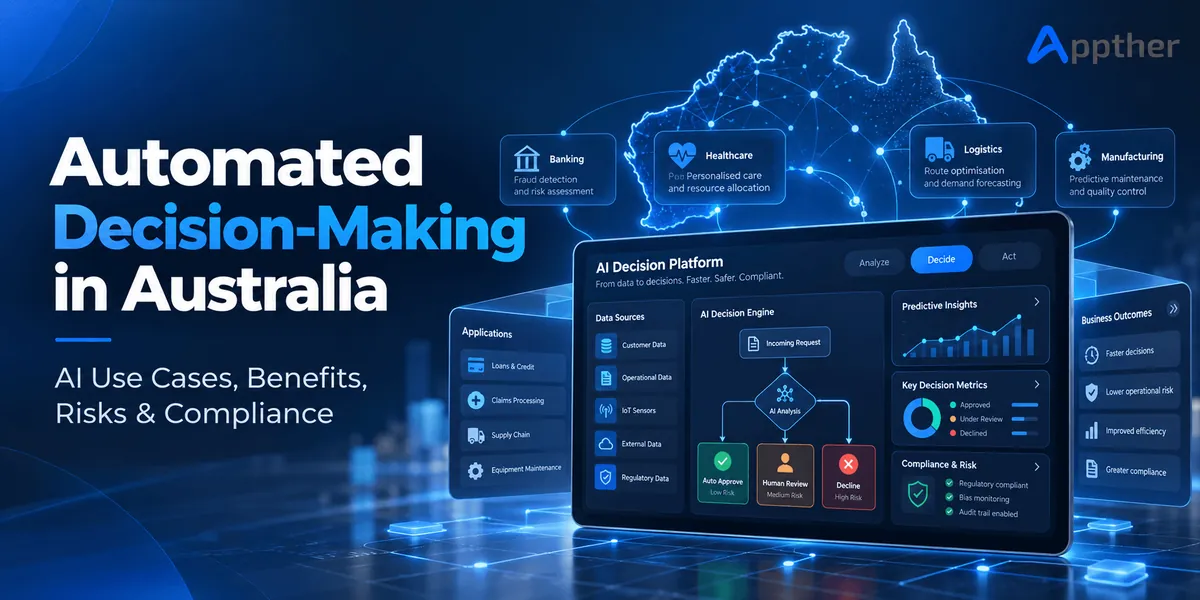
Australian businesses have spent years digitising their operations. Customer records have moved into CRMs, financial transactions are processed through cloud platforms, and operational teams increasingly rely on real-time dashboards.
Yet an important part of many business processes remains manual: deciding what happens next.
A loan application needs assessment. A supplier invoice requires verification. A logistics company must decide which driver should handle an urgent delivery. A customer service team needs to determine whether an issue can be resolved automatically or requires human intervention.
These decisions may take seconds individually, but across thousands of transactions, they can consume considerable time and resources.
Automated decision-making (ADM) offers a different approach. By combining business rules, data analytics, machine learning and, where appropriate, artificial intelligence, organisations can automate some decisions while maintaining appropriate controls over the outcomes.
For Australian businesses, however, implementing ADM involves more than selecting an AI model. Privacy obligations, transparency, data quality, fairness and human oversight all influence how these systems should be designed.
This guide explains how automated decision-making works, where Australian businesses can use it, the benefits and risks involved, and how to implement it responsibly in 2026.
What Is Automated Decision-Making?
Automated decision-making is the use of technology to make or substantially contribute to decisions based on predefined rules, data analysis or computational models, with varying levels of human involvement.
For example, an insurance company may use an automated system to assess whether a submitted claim meets specific policy conditions. A retail business might automatically approve a refund when an order satisfies predefined eligibility requirements.
Not every automated decision requires artificial intelligence.
A simple system might use a rule such as:
If an invoice matches an approved purchase order and the goods receipt, route it for payment processing.
A more sophisticated system might use machine learning to identify unusual invoice patterns and recommend further investigation.
The distinction matters because different technologies introduce different levels of complexity, uncertainty and risk.
How Is Automated Decision-Making Different From AI?
Automated decision-making describes a business process or outcome. Artificial intelligence is one of the technologies that may support that process.
| Technology | How it works | Example |
|---|---|---|
| Rules-based automation | Applies predefined conditions | Automatically approving eligible refunds |
| Machine learning | Identifies patterns and predicts outcomes | Predicting customer churn |
| AI-assisted decision-making | Recommends an outcome for human review | Flagging potentially fraudulent transactions |
| AI-powered automated decision-making | Uses AI outputs within an automated decision process | Routing eligible applications for approval |
| Agentic AI | Plans and executes actions through connected tools | Investigating an exception and preparing a case for approval |
A business can implement automated decision-making without generative AI or large language models.
In many situations, a well-designed rules engine is more predictable, less expensive and easier to audit than an unnecessarily complex AI system.
How Does Automated Decision-Making Work?
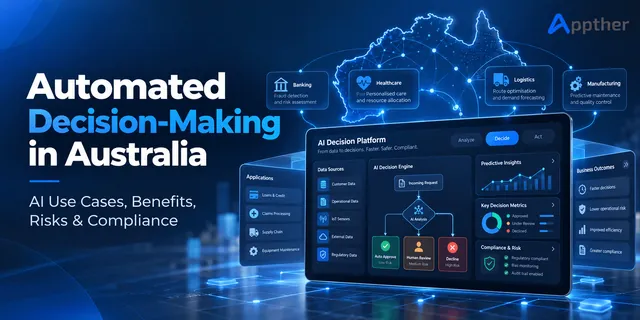
Most enterprise automated decision-making systems follow a structured process that connects operational data to decision logic and business actions.
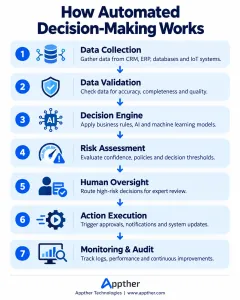
Step 1: Collect relevant data
The system receives information from sources such as:
- Customer relationship management platforms
- Enterprise resource planning systems
- Financial applications
- Online forms
- Transaction databases
- IoT devices
- Business intelligence platforms
For example, a logistics company might collect delivery locations, vehicle availability, traffic conditions and service-level requirements.
Step 2: Validate and prepare the data
Before a decision is made, the system checks whether the available information is complete, accurate and suitable for the intended purpose.
This stage may include duplicate detection, missing-value handling, document validation and data normalisation.
Poor-quality data can produce unreliable decisions, even when the underlying AI model performs well.
Step 3: Apply decision logic
The system evaluates the information using one or more methods:
Business rules: Explicit conditions defined by the organisation.
Predictive models: Statistical or machine-learning models that estimate outcomes.
Optimisation algorithms: Methods that identify a suitable option under specified constraints.
AI reasoning components: Models that interpret unstructured information or support more complex workflows.
The appropriate technology depends on the decision being made.
Step 4: Evaluate confidence and risk
Not every result should trigger an automatic action.
A responsible ADM system can assess whether a decision falls within an approved confidence range, meets policy requirements and carries an acceptable level of risk.
For example:
- Low-risk, clearly eligible transactions may be processed automatically.
- Uncertain cases may be referred to a reviewer.
- High-impact decisions may require explicit human approval.
Step 5: Execute or recommend an action
Once the relevant conditions are satisfied, the system may update a CRM record, assign a service request, generate a notification or initiate another permitted workflow.
For higher-risk decisions, it may instead present a recommendation and supporting evidence to an authorised employee.
Step 6: Record, monitor and review
An enterprise-grade ADM system should retain appropriate decision records, including the relevant inputs, rules or model versions, decision outcome and any human intervention.
These records support troubleshooting, governance, accountability and ongoing performance improvement.
Suggested infographic placement: Insert an original diagram here showing:
Data Sources → Validation → Rules/AI Engine → Risk Assessment → Human Approval (where required) → Business Action → Audit & Monitoring.
Businesses planning to integrate these capabilities into existing systems can explore Appther’s AI Development Services, which cover predictive models, AI agents, enterprise integrations and responsible AI governance.
Why Automated Decision-Making Matters for Australian Businesses
Australian organisations operate across industries with very different operational requirements.
A bank processing financial applications, a healthcare provider managing patient administration and a mining company coordinating remote equipment maintenance may all benefit from faster decisions. However, the acceptable level of automation will differ substantially.
Several factors make ADM relevant to Australian businesses.
Increasing operational complexity
As businesses expand, they often accumulate multiple applications, departments and approval processes.
Employees may need to retrieve information from several systems before completing a routine task.
ADM can help standardise suitable decisions and reduce repetitive administrative work.
Demand for faster customer experiences
Customers increasingly expect timely responses to service requests, applications and transactions.
Automated eligibility checks, routing and prioritisation can reduce delays when implemented with appropriate safeguards.
Better use of business data
Many organisations collect substantial amounts of operational data but use only a portion of it to guide decisions.
Decision automation can turn this information into practical workflows, rather than leaving it confined to dashboards and reports.
Pressure to improve efficiency
Manual decision processes may create bottlenecks, particularly when organisations handle high transaction volumes.
Automation can help employees focus on exceptions, complex cases and decisions requiring professional judgement.
Growing governance expectations
Automated systems must also be accountable.
Australian privacy requirements and the increasing scrutiny of AI-related risks mean organisations need to understand what their systems decide, which information they use and how those decisions can be reviewed.
10 Automated Decision-Making Use Cases in Australia
Automated decision-making can support a wide range of industries, but the most effective applications usually begin with a clearly defined operational problem.
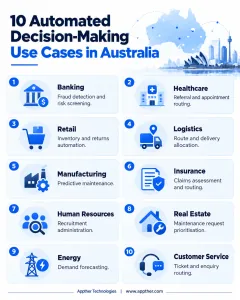
1. Banking and financial services
Financial institutions can use automated systems to support transaction monitoring, fraud detection, customer segmentation and application assessment.
Example workflow:
A transaction enters the banking platform. A fraud detection model assesses relevant risk signals. Low-risk transactions proceed, while suspicious activity is flagged for investigation or handled according to established controls.
Potential benefits include faster transaction screening and more consistent risk prioritisation.
However, decisions affecting access to financial services require particular attention to fairness, explainability, privacy and applicable financial regulations.
2. Healthcare administration
Healthcare organisations can use decision automation to improve appointment management, referral routing, administrative prioritisation and resource allocation.
For example, an automated workflow might identify missing information in a referral and request completion before administrative processing continues.
Clinical diagnosis, treatment and patient triage introduce substantially greater risks and require appropriate clinical validation, professional oversight and consideration of medical-device regulation where applicable.
ADM should support qualified healthcare professionals rather than replace their judgement in high-impact clinical decisions.
3. Retail and eCommerce
Retailers can automate decisions involving inventory replenishment, order routing, returns eligibility and promotional workflows.
An online store might use inventory levels, supplier lead times and historical sales patterns to recommend replenishment quantities.
A separate rules engine could automatically create purchase requests when approved thresholds are reached.
4. Logistics and transportation
Logistics businesses regularly make decisions about delivery allocation, route planning, vehicle availability and shipment prioritisation.
An automated system can evaluate operational constraints and recommend efficient assignments.
For example, a delivery platform might select an available driver based on distance, vehicle capacity, service area and delivery urgency.
Dynamic route optimisation can then adjust recommendations when operational conditions change.
5. Manufacturing and industrial operations
Manufacturers can combine machine sensor data, inspection results and maintenance records to support operational decisions.
A predictive maintenance system may identify equipment with an elevated probability of failure and recommend an inspection.
The organisation can then determine whether to create a maintenance task automatically or require supervisor approval.
For safety-critical operations, automation should follow established engineering and workplace safety controls.
6. Insurance claims processing
Insurance companies can use ADM for document completeness checks, policy eligibility verification, duplicate detection and claim routing.
Straightforward administrative cases may move through predefined workflows, while ambiguous or disputed claims are escalated.
Claims decisions should remain subject to appropriate review, complaint-handling and applicable regulatory requirements.
7. Human resources and recruitment
Recruitment teams can automate interview scheduling, document verification and administrative screening.
AI may also assist with matching applicants to role requirements, but automated ranking and rejection systems can introduce discrimination and fairness risks.
Organisations should evaluate whether selection criteria are job-relevant, whether protected attributes or proxies influence outcomes, and whether meaningful human review is available.
8. Real estate and property management
Property businesses can automate maintenance request routing, inspection scheduling, document checks and administrative follow-ups.
For example, a property management platform might classify a maintenance request and assign it to the appropriate service provider based on urgency and availability.
Decisions affecting tenancy eligibility or access to housing warrant stronger safeguards.
9. Energy and utilities
Energy providers can use predictive models to support demand forecasting, asset monitoring and maintenance prioritisation.
A system might analyse historical demand, weather information and equipment performance to recommend operational adjustments.
Decisions affecting critical infrastructure require rigorous validation, security and human oversight.
10. Customer service and CRM operations
Customer service teams can automate enquiry classification, ticket routing, lead prioritisation and follow-up scheduling.
For example, an AI-assisted CRM workflow may analyse an incoming enquiry, identify its subject, create a support ticket and assign it to the appropriate team.
Appther’s Enterprise Software Development Services include CRM, ERP and workflow automation capabilities that can support these types of integrated processes.
Key Benefits of Automated Decision-Making
The business value of ADM depends on the process being automated, the quality of the underlying data and the safeguards used.
Faster processing
Automated systems can evaluate routine conditions without waiting for manual review at every stage.
This is particularly useful in high-volume administrative processes.
Greater consistency
Clearly defined decision rules help reduce variation in how similar cases are handled.
However, consistency does not automatically mean fairness. A flawed rule can produce consistently poor outcomes.
Reduced administrative workload
Employees can spend less time on repetitive verification and routing tasks, allowing more attention to be directed toward exceptions and customer-facing activities.
Improved operational visibility
When decisions are recorded systematically, managers can analyse processing times, exceptions, outcomes and bottlenecks.
Scalable operations
Well-designed systems can handle increasing transaction volumes without requiring a proportional increase in manual processing capacity.
Better decision support
Predictive analytics can help organisations identify patterns that may not be obvious through manual analysis.
The value comes from using these insights appropriately, not simply generating more predictions.
Automated Decision-Making Architecture: What Does an Enterprise System Need?
A production-ready ADM solution generally requires more than a standalone AI model.
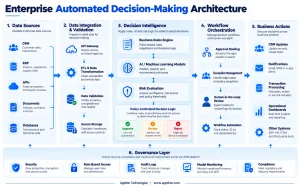
A practical architecture may include the following layers.
| Architecture layer | Purpose | Example technologies |
|---|---|---|
| Data integration | Connect operational systems | REST APIs, webhooks, ETL pipelines |
| Data storage | Store authorised operational information | PostgreSQL, managed cloud databases |
| Rules engine | Evaluate explicit business conditions | Custom rules services, workflow engines |
| AI/ML layer | Generate predictions or classifications | Python, scikit-learn, PyTorch |
| Workflow orchestration | Coordinate actions and approvals | Event queues, orchestration services |
| Human review | Handle exceptions and high-risk decisions | Review dashboards, approval queues |
| Security | Control access and protect information | RBAC, encryption, identity management |
| Monitoring | Track performance and decision outcomes | Logging, model monitoring, audit dashboards |
A key design principle is to keep decision authority separate from model output.
For example, a machine-learning model might produce a fraud-risk score. A policy-controlled decision engine should determine what action is permitted based on that score, other evidence and applicable rules.
This separation makes it easier to change models without unintentionally changing the organisation’s decision policies.
Should businesses use generative AI for automated decisions?
Not always.
Large language models can be useful for interpreting emails, extracting information from documents and preparing decision summaries.
However, their outputs may vary, and they can produce incorrect information.
For deterministic decisions, traditional business rules are often preferable. For predictions, specialised machine-learning models may be more suitable.
Generative AI is most valuable when the process involves unstructured information or complex interaction, and when its outputs are independently validated before consequential actions.
Automated Decision-Making Regulations in Australia
Regulatory compliance is one of the most important considerations for Australian businesses implementing ADM.
The applicable requirements depend on the organisation, the personal information involved, the nature of the decision and the industry in which the system operates.
Privacy Act 1988 and Australian Privacy Principles
The Privacy Act 1988 and Australian Privacy Principles (APPs) establish important obligations for covered organisations handling personal information.
Depending on the circumstances, these obligations may affect:
- Collection and use of personal information
- Privacy notices and transparency
- Data quality
- Information security
- Disclosure to third parties
- Access to and correction of personal information
Businesses should assess these requirements before deploying automated systems that process customer, employee or other personal information.
New automated decision-making transparency obligations
Australia’s Privacy and Other Legislation Amendment Act 2024 introduced new transparency requirements concerning certain automated decisions.
From 10 December 2026, covered APP entities will be required to include information in their privacy policies about certain uses of automated decision-making involving personal information where decisions could reasonably be expected to significantly affect individuals’ rights or interests.
The requirements concern the kinds of personal information used and the kinds of decisions made through relevant automated processes.
The Office of the Australian Information Commissioner (OAIC) is developing guidance to support implementation.
Organisations should not assume that every automated workflow falls within these provisions. Applicability depends on the statutory criteria and the circumstances of the decision.
Official reference: OAIC, Guidance Consultation on Transparency in Automated Decision-Making.
Other legal and regulatory considerations
Depending on the application, organisations may also need to consider:
Anti-discrimination law: Automated outcomes should be assessed for potentially unlawful discriminatory effects.
Consumer protection: Businesses should avoid misleading claims about how automated systems work or what they can reliably achieve.
Financial services obligations: Financial institutions may face additional requirements relating to governance, customer outcomes and decision processes.
Healthcare regulation: Clinical AI applications may require consideration of professional standards, health privacy obligations and medical-device regulation.
Cybersecurity: Automated decision systems should be protected against unauthorised access, manipulation and data leakage.
Because these requirements vary by sector and use case, legal and compliance review should be part of implementation planning.
Risks and Challenges of Automated Decision-Making
Automating a decision can make a process faster, but it can also increase the speed and scale at which mistakes occur.
Data bias and unfair outcomes
Models trained on historical information may reproduce patterns of unequal treatment.
Even when protected attributes are excluded, other variables may act as indirect proxies.
Organisations should evaluate outcomes across relevant groups and investigate unexplained disparities.
Incorrect or incomplete data
An otherwise accurate model may produce a poor result when it receives outdated, incomplete or incorrect information.
Data validation and correction processes are therefore essential.
Limited explainability
Some models are difficult to interpret.
Where decisions significantly affect individuals, organisations should consider whether the system can provide understandable reasons and supporting evidence.
Excessive automation
Not every process should be fully automated.
Decisions involving health, employment, financial hardship or other significant consequences may require meaningful human judgement.
Privacy and cybersecurity risks
ADM platforms often connect multiple systems and process sensitive operational information.
This creates risks involving unauthorised access, insecure integrations, inappropriate data retention and exposure through third-party AI services.
Model drift
A model that performs well during testing may become less reliable as business conditions or data patterns change.
Ongoing monitoring and periodic evaluation are essential.
Accountability gaps
Organisations should clearly establish who owns the decision policy, who approves model changes and who handles disputes or exceptions.
Technology should not obscure responsibility for business outcomes.
Human-in-the-Loop: When Should People Review AI Decisions?
Human-in-the-loop design means that an authorised person participates in reviewing, approving or overriding selected automated outputs.
A practical ADM framework can divide decisions into three categories.
| Decision category | Example | Recommended control |
|---|---|---|
| Low risk | Routing a general support enquiry | Automated processing with monitoring |
| Medium risk | Flagging an invoice discrepancy | Human review of exceptions |
| High risk | Recommending rejection of a significant financial application | Meaningful human review and documented justification |
The categories should be determined through a documented risk assessment rather than assigned solely by technology type.
Human review must also be meaningful.
A reviewer who simply approves every recommendation without sufficient information, authority or time provides limited protection against automated errors.
An effective review process should give employees access to relevant evidence, an understandable explanation and the ability to change the outcome.
How Much Does Automated Decision-Making Cost in Australia?
There is no universal development price for ADM systems.
Costs depend on the number of decision workflows, data sources, integration complexity, AI requirements, transaction volume and governance obligations.
The following are illustrative planning ranges, not independently verified Australian market averages or fixed Appther quotations.
| Solution type | Indicative development budget (AUD) |
|---|---|
| Simple rules-based decision workflow | $5,000–$15,000 |
| AI-assisted decision support prototype | $12,000–$30,000 |
| Integrated departmental ADM solution | $30,000–$80,000 |
| Enterprise-grade ADM platform | $80,000–$200,000+ |
Actual costs may fall outside these ranges.
What influences implementation cost?
Data readiness: Poorly structured information requires additional preparation.
Integration requirements: Connecting multiple legacy systems increases engineering effort.
AI complexity: Custom predictive models generally require more testing and evaluation than straightforward business rules.
Security requirements: Sensitive information may require stronger controls, private infrastructure or additional assurance.
Decision criticality: High-impact workflows require more extensive validation, governance and review processes.
Ongoing operations: Hosting, monitoring, model maintenance, security updates and periodic audits create recurring costs.
Businesses should evaluate total ownership cost rather than comparing development quotations alone.
How to Calculate the ROI of Automated Decision-Making
Return on investment should be calculated against a measurable baseline.
A basic formula is:
ROI (%) = [(Total Financial Benefits − Total Costs) ÷ Total Costs] × 100
Consider a hypothetical Australian organisation processing 4,000 routine cases each month.
Assume:
- Current handling time: 8 minutes per case
- Handling time after automation: 3 minutes per case
- Monthly time saved: approximately 333 hours
- Fully loaded labour cost: AUD $45 per hour
The estimated gross labour-capacity value would be approximately AUD $15,000 per month, or AUD $180,000 annually.
These figures are illustrative, not measured project results.
Crucially, time saved is not automatically cash saved. The financial benefit depends on whether the organisation reduces overtime, avoids additional hiring, increases throughput or reallocates capacity to valuable work.
A realistic ROI assessment should also deduct implementation, software, infrastructure, maintenance, governance and review costs.
Other relevant metrics include error rates, processing time, customer satisfaction and the proportion of cases requiring human intervention.
How to Implement Automated Decision-Making in Your Business
A successful ADM initiative should begin with the business decision, not the AI technology.
Step 1: Identify a suitable use case
Start with a process that is repetitive, measurable and governed by understandable decision criteria.
Avoid choosing a high-impact decision as the first pilot simply because it appears commercially attractive.
Step 2: Map the current workflow
Document where information enters the process, who makes decisions, what rules they apply and how exceptions are handled.
Identify unnecessary approvals and inconsistent practices before automating them.
Step 3: Assess data readiness
Review data availability, completeness, accuracy, access permissions and retention requirements.
Determine whether the organisation has sufficient reliable information to support the proposed decision logic.
Step 4: Select the right technology
Choose among rules-based automation, predictive analytics, optimisation, AI-assisted workflows or a combination.
Use the simplest technology that reliably satisfies the business requirements.
Step 5: Define decision boundaries
Specify which outcomes the system can execute automatically and which require human approval.
Establish escalation triggers, exception handling and override permissions.
Step 6: Build a controlled pilot
Implement the solution for a limited workflow or user group.
Where appropriate, run the automated system in parallel with the existing manual process to compare outcomes before enabling live actions.
Step 7: Test accuracy, fairness and resilience
Evaluate performance using representative cases, including unusual inputs, missing information and edge conditions.
Test system outages, integration failures, security controls and inappropriate outputs.
Step 8: Deploy with monitoring
Introduce the solution gradually and monitor decision quality, exception rates, operational performance and user feedback.
Ensure that changes to decision rules and models are documented and approved.
Step 9: Review and improve
Reassess the system when regulations, business policies, customer needs or data patterns change.
Decision automation is an ongoing operational capability, not a one-time software installation.
Australian organisations planning these projects can explore Appther’s AI and Software Development Services in Australia for information about its AI, machine learning, automation and enterprise engineering capabilities.
Automated Decision-Making vs Agentic AI: What’s the Difference?
Automated decision-making and agentic AI are related, but they are not interchangeable.
ADM focuses on how a decision is reached or executed.
Agentic AI focuses on software systems that can pursue defined goals, coordinate multiple steps and interact with external tools.
For example, a conventional ADM workflow might automatically approve a purchase request that satisfies predefined conditions.
An agentic system might examine a purchase request, retrieve supplier information, compare quotations, identify missing documents and prepare a recommendation.
The final purchasing decision could still be governed by explicit business rules and human approval.
| Feature | Traditional ADM | Agentic AI |
|---|---|---|
| Primary purpose | Automate defined decisions | Coordinate goal-oriented tasks |
| Workflow structure | Generally predefined | May adapt within permitted boundaries |
| Typical technologies | Rules engines, ML, optimisation | LLMs, tools, orchestration, memory |
| Business-system integration | Common | Common |
| Human oversight | Risk-dependent | Risk-dependent |
| Key challenge | Decision accuracy and fairness | Reliability, tool permissions and action control |
For organisations considering more autonomous workflows, Appther’s article on Agentic AI in Australia provides additional context on how AI agents can interact with enterprise processes.
The important principle is that greater autonomy should be accompanied by appropriate permissions, monitoring and governance.
What Does the Future of Automated Decision-Making Look Like in Australia?
Over the next several years, the most valuable developments in ADM are likely to come from better integration between decision systems and everyday business applications.
Several areas deserve attention.
More explainable decision systems
Organisations will increasingly need to understand why automated systems recommend or produce particular outcomes.
Explainability tools, documented decision policies and clearer audit records will become important parts of system design.
Hybrid AI and rules-based architectures
Rather than allowing AI models to control every step, businesses can combine predictive intelligence with explicit policies and approval controls.
This approach can provide flexibility while preserving operational boundaries.
Closer integration with ERP and CRM platforms
Decision automation will increasingly operate within the applications employees already use, rather than requiring separate dashboards for every workflow.
Continuous evaluation
Organisations will need to monitor model performance and decision outcomes after deployment, not just during initial testing.
Stronger governance practices
Privacy, accountability, fairness and security will remain central considerations as automation becomes more deeply embedded in business operations.
The organisations that benefit most will be those that treat ADM as a governed business capability rather than a shortcut for eliminating human involvement.
How Appther Helps Australian Businesses Build Automated Decision-Making Systems
Implementing ADM requires a combination of business process analysis, data engineering, software development, AI expertise and integration capabilities.
Appther helps organisations design and build software solutions that connect intelligent decision-making capabilities with operational systems.
Its relevant capabilities include:
AI and machine learning development: Building predictive models, classification systems and intelligent applications for defined business use cases.
Enterprise software integration: Connecting decision workflows with CRMs, ERPs, databases and existing business applications.
Intelligent workflow automation: Developing rule-driven and AI-assisted processes with exception handling and approval mechanisms.
Custom application development: Creating dashboards, review interfaces and operational applications that support automated workflows.
Security and governance: Designing access controls, monitoring, auditability and human oversight into the solution architecture.
The objective should not be to automate every decision. It should be to identify where technology can improve consistency, efficiency and decision quality without creating unacceptable risk.
Explore Appther’s AI Development Services or Enterprise Software Development Services to learn more.
Frequently Asked Questions About Automated Decision-Making in Australia
1. What is automated decision-making in Australia?
Automated decision-making refers to using software, rules, algorithms or AI to make or substantially contribute to decisions. Australian businesses may use it for administrative approvals, transaction monitoring, customer service routing, forecasting and other operational processes.
2. Is automated decision-making legal in Australia?
Automated decision-making is not generally prohibited in Australia. However, particular uses may be subject to privacy, anti-discrimination, consumer protection and sector-specific requirements. Businesses should assess the legal obligations relevant to their systems and decisions.
3. What are examples of automated decision-making?
Examples include rules-based refund approvals, fraud-risk screening, insurance claim routing, inventory replenishment, delivery allocation and automated eligibility checks.
4. Does automated decision-making always involve artificial intelligence?
No. Automated decision-making can operate entirely through predefined business rules. AI and machine learning are optional technologies that may support more complex classification, prediction or information-processing tasks.
5. What is the difference between automated and AI-assisted decision-making?
In fully automated decision-making, a system can produce or execute an outcome without individual human approval. In AI-assisted decision-making, the system provides information or recommendations while a human retains responsibility for making the final decision.
6. What are the main risks of automated decision-making?
Major risks include inaccurate data, discriminatory outcomes, privacy violations, limited explainability, security weaknesses, model drift and insufficient human oversight.
7. How much does an ADM system cost in Australia?
Costs vary significantly. A straightforward rules-based workflow may require a relatively modest investment, while a complex enterprise platform involving AI, multiple integrations and extensive governance can cost substantially more. A detailed estimate requires assessment of the actual business requirements.
8. Can automated decisions be reviewed by humans?
Yes. Systems can be designed with approval queues, escalation rules, audit logs and override capabilities. The appropriate level of human involvement should depend on the significance and risk of the decision.
9. Which industries benefit most from automated decision-making?
Banking, insurance, logistics, manufacturing, retail, healthcare administration and enterprise customer service are among the industries with practical opportunities for decision automation.
10. How should an Australian business get started with ADM?
Start by identifying a repetitive, measurable decision process. Review its data, business rules and risks, then test a controlled pilot before expanding automation to more complex workflows.
Final Thoughts
Automated decision-making is changing how organisations turn information into action.
For Australian businesses, the opportunity extends beyond processing tasks faster. Well-designed ADM systems can improve operational consistency, make better use of existing data and help employees concentrate on decisions that genuinely require human expertise.
But automation is only valuable when the decisions remain reliable, understandable and appropriately governed.
The strongest implementations combine suitable technology with clear business policies, dependable data, security controls and meaningful human oversight.
As Australia’s regulatory expectations evolve, organisations that build transparency and accountability into their systems from the beginning will be better positioned to scale automation responsibly.
Ready to Explore Automated Decision-Making for Your Business?
Whether you’re considering an AI-powered approval workflow, predictive decision engine or enterprise automation platform, Appther can help you evaluate the technical requirements and design a practical implementation approach.
Discuss Your AI Automation Project With Appther
Disclaimer: Regulatory information is provided for general educational purposes and reflects the position described as of October 2026. It is not legal advice. Organisations should consult appropriate legal and compliance professionals about their specific obligations.