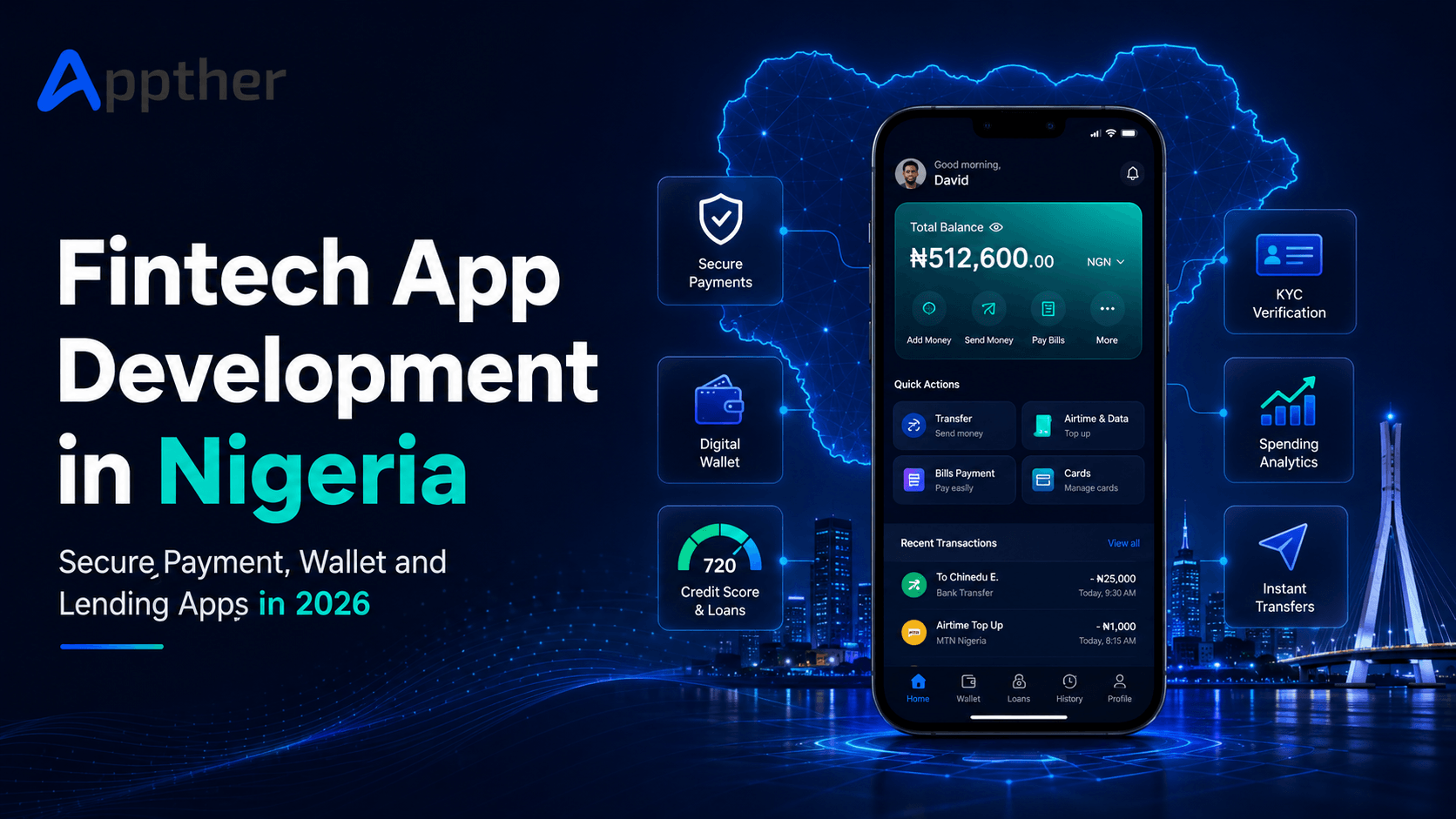
Fintech app development in Nigeria is becoming one of the most promising digital opportunities for banks, startups, payment companies, lenders, cooperatives, real estate platforms and enterprises. Nigeria has a fast-growing digital payment ecosystem, strong mobile-first adoption and rising demand for secure financial products that can serve both banked and underbanked users.
From mobile wallets and digital banking apps to loan platforms, merchant payment apps, savings apps and agent banking solutions, Nigeria is moving toward a more digital financial future. For founders and financial institutions, this creates a clear opportunity: build fintech products that are fast, secure, compliant and designed for real transaction volume.
At Appther, we help startups and enterprises build scalable fintech apps, mobile wallets, lending platforms, payment systems and AI-powered financial software. Our fintech app development services are designed around security, compliance, customer experience and long-term scalability.
Why Nigeria is a strong market for fintech app development
Nigeria has one of Africa’s most active financial technology ecosystems. The country’s payment infrastructure has grown quickly, especially through instant payment systems, digital wallets, agency banking, mobile banking and merchant payment solutions.
According to NIBSS, nearly 11 billion transactions were processed through the NIBSS Instant Payments platform in 2024, up from 5 billion in 2022. This places Nigeria among Africa’s leading real-time payment markets.
The Central Bank of Nigeria’s Payments System Vision 2025 also focuses on electronic payment adoption, payment safety, reliability, resilience, financial inclusion, open banking, agent banking, QR payments, contactless payments, BVN-based fraud control and interoperability.
This means fintech app development in Nigeria is no longer limited to simple payment apps. Businesses now need full financial ecosystems that can support onboarding, KYC, wallet management, payments, lending, collections, reconciliation, fraud detection and analytics.
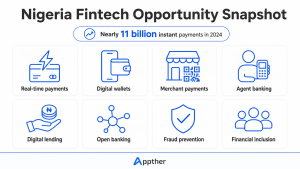
What types of fintech apps can be built in Nigeria?
Fintech products in Nigeria can serve consumers, merchants, SMEs, banks, cooperatives, real estate businesses, logistics companies and government-linked payment workflows. The right product depends on your business model, licensing path and target users.
1. Digital wallet apps
A digital wallet app allows users to store value, transfer money, pay bills, buy airtime, make merchant payments and manage transaction history. Wallet apps are useful for consumer fintech startups, cooperatives, retail networks, transport companies, marketplaces and agent-led financial services.
A strong wallet app should include:
- User registration and KYC
- Wallet balance
- Add money and withdraw money
- P2P transfers
- Bank transfer integration
- Airtime and bill payment
- Merchant QR payment
- Transaction PIN and biometrics
- Push notifications
- Reversal and dispute flow
- Admin dashboard
- Audit logs and reporting
For wallet products, Appther’s mobile app development team can build secure Android, iOS, Flutter and React Native apps with scalable backend APIs.
2. Payment apps
Payment apps help consumers and merchants collect, send and reconcile payments. These apps can support bank transfers, cards, QR codes, USSD flows, invoices, payment links and merchant dashboards.
A payment app in Nigeria should be designed for speed, uptime and reconciliation. Payment failure handling is especially important because users expect clear transaction status, instant notification and easy dispute resolution.
3. Loan and digital lending apps
Digital lending is another high-demand fintech category in Nigeria. Loan apps can support personal loans, salary advances, SME loans, cooperative loans, asset financing and merchant credit.
However, lending apps must be handled carefully because they involve credit risk, consumer protection, data privacy and repayment management. Nigeria’s FCCPC has introduced digital lending regulations and registration guidance for digital, electronic, online and non-traditional consumer lending services.
A loan app should include:
- Borrower onboarding
- KYC and document verification
- Credit scoring
- Loan eligibility rules
- Offer generation
- Repayment schedule
- Auto reminders
- Penalty and interest calculation
- Collection dashboard
- Complaint management
- Compliance reporting
Appther also builds AI development solutions such as fraud scoring, credit-risk models, KYC OCR and anomaly detection for fintech products.
4. Neobank and digital banking apps
A neobank or digital banking app gives users access to account management, transfers, savings, virtual cards, statements, budgeting tools and customer support without visiting a branch.
For banks and financial institutions, digital banking apps must integrate with core banking systems, payment rails, KYC providers, CRM systems and notification engines. Appther’s enterprise software development services can support these integrations through secure APIs, middleware and workflow automation.
5. Merchant payment and POS apps
Nigeria has strong demand for merchant payment products because businesses need faster settlement, better reconciliation and lower dependency on manual cash handling.
Merchant apps can include:
- QR payment acceptance
- Payment links
- POS transaction history
- Settlement reports
- Staff accounts
- Store-level dashboards
- Refund management
- Customer receipts
- Commission reports
- Tax-ready exports
6. Real estate escrow and transaction apps
Nigeria’s real estate sector has a trust gap. Buyers, sellers, brokers and property companies need stronger verification, payment protection and transparent transaction tracking.
A proptech fintech app can combine:
- Property verification
- Buyer and seller KYC
- Escrow wallet
- Milestone-based release
- Document upload
- Agent verification
- Payment tracking
- Legal review workflow
- Dispute management
This is a strong opportunity for fintech startups that want to combine financial trust with property transactions.
Must-have features for fintech app development in Nigeria
A fintech app cannot be treated like a normal mobile app. It must be secure, traceable, scalable and easy to use. Below are the most important features to include.
User onboarding and KYC
The onboarding journey should be short, clear and secure. Users should be able to register with phone number, email, password, OTP, PIN and biometric login.
For regulated fintech products, onboarding may also include BVN or NIN verification, ID document upload, face verification, address information, business registration documents, a risk profile and consent capture.
Wallet and account management
Wallet and account management is the core of most fintech platforms. Users should be able to see balances, add money, withdraw funds, view statements and track every transaction.
Behind the scenes, the wallet system should run on ledger-based accounting with transaction references, clear pending, successful and failed statuses, reversal handling, settlement tracking, wallet limits, user-level restrictions and real-time notifications.
Payments and transfers
Payment flows should be simple for users but robust behind the scenes. The app should manage payment initiation, processing, confirmation, status update and failure handling.
Important payment features include:
- Bank transfers
- Wallet-to-wallet transfers
- Payment links
- QR payments
- Merchant payments
- Bill payments
- Airtime and data recharge
- Bulk payments
- Recurring payments
- Transaction receipt generation
Admin dashboard
Every fintech app needs a strong admin dashboard. This is where the operations team manages users, wallets, transactions, disputes, KYC reviews, failed payments, reports and risk alerts.
For better scalability, Appther can build admin dashboards as secure web platforms using its web app development services.
Fraud detection and risk monitoring
Fraud prevention should be part of the architecture from day one. A fintech app should detect suspicious patterns before they become financial losses.
Useful fraud controls include device fingerprinting, login risk scoring, velocity checks, transaction limit rules, location-based alerts, unusual transfer detection, blacklist and watchlist management, manual review queues and admin alerts.
Appther’s AI development services can help fintech businesses add ML-based fraud detection, KYC automation and transaction anomaly detection.
Customer support and dispute management
Users need help when a transaction fails, a transfer is delayed or a repayment does not reflect. Therefore, customer support should be built inside the app: in-app ticket creation, a transaction dispute flow, chat support, a help centre, complaint category selection, SLA tracking, a refund request flow and an admin response panel.
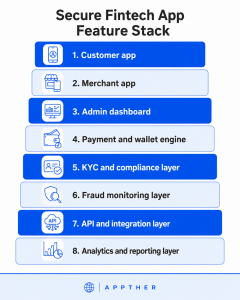
Compliance and security for fintech apps in Nigeria
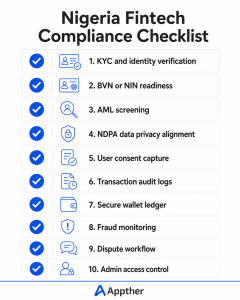
Compliance is one of the most important parts of fintech app development in Nigeria. Before building, you should understand your business model, licensing needs, data protection requirements and payment flow.
The CBN payments system supervision page lists several payment-related frameworks and guidelines, including mobile money services, agent banking, QR code payments, open banking, contactless payments, payment service providers and information security management frameworks.
Nigeria also has a dedicated Nigeria Data Protection Commission, established under the Nigeria Data Protection Act 2023, which focuses on data privacy, enforcement and responsible data handling.
A fintech app should include security controls such as:
- Data encryption
- Secure APIs
- Role-based access control
- Transaction PIN
- Biometric authentication
- Audit logs
- Secure session handling
- Server-side validation
- Rate limiting
- Webhook verification
- PCI-DSS aligned payment handling
- KYC and AML workflows
- Penetration testing before launch
A common mistake is to build the app first and think about compliance later. This increases cost and delays launch. At Appther, we recommend compliance mapping before UI/UX and backend architecture begin.
Recommended tech stack for fintech app development in Nigeria
The right tech stack depends on whether you are building an MVP, a full-scale wallet, a lending platform or an enterprise banking system.
Mobile app
Recommended options: Flutter, React Native, native Android with Kotlin, and native iOS with Swift.
Flutter and React Native are usually strong choices for fintech MVPs because they allow faster cross-platform development. Native development is useful when the product needs deeper platform-level performance or security features.
Backend
Recommended options: Node.js, Python, Java Spring Boot.NET, PostgreSQL, Redis, and Kafka or RabbitMQ for event processing.
For wallet and payment systems, backend architecture should be modular. Payment, wallet, KYC, notification, settlement and reporting modules should be separated to reduce risk and improve maintainability.
Cloud and DevOps
Recommended options: AWS, Azure or Google Cloud, with Docker, Kubernetes, CI/CD pipelines, CloudWatch or similar monitoring, and WAF and DDoS protection.
For fintech apps, monitoring is not optional. You need logs, alerts, uptime checks, transaction monitoring and error tracking.
AI and analytics
AI can be useful for fraud detection, credit scoring, KYC document reading, customer support chatbots, transaction pattern analysis, risk alerts and loan default prediction.
However, AI should not be added just for marketing. It should solve a clear operational or risk problem.
How much does fintech app development cost in Nigeria?
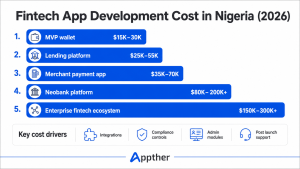
The cost of fintech app development in Nigeria depends on app type, features, integrations, compliance requirements, team size and launch timeline.
Below is a practical estimate. Figures are in US dollars, which is how most Nigerian fintech development projects are quoted; naira equivalents shift with the exchange rate, so agree the billing currency with your development partner early.
| App type | Estimated cost range | Typical timeline |
|---|---|---|
| Basic fintech MVP | $15,000 – $30,000 | 8-12 weeks |
| Digital wallet app | $30,000 – $60,000 | 12-18 weeks |
| Loan app MVP | $25,000 – $55,000 | 10-16 weeks |
| Merchant payment app | $35,000 – $70,000 | 14-20 weeks |
| Neobank or digital banking platform | $80,000 – $200,000+ | 20-32+ weeks |
| Enterprise fintech ecosystem | $150,000 – $300,000+ | 28-40+ weeks |
These are general planning ranges. The final cost depends on the number of integrations, admin modules, payment flows, compliance controls and post-launch support needs.
For example, a simple wallet MVP with user onboarding, wallet balance, P2P transfer, admin panel and notifications will cost much less than a full lending platform with credit scoring, repayment automation, KYC verification, collection dashboard and regulatory reports.
Fintech app development timeline
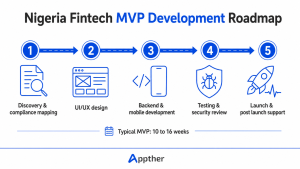
A secure fintech app should not be rushed without proper planning. A realistic MVP timeline is usually 10 to 16 weeks, while larger platforms may take 5 to 8 months.
Phase 1: Discovery and compliance mapping
This stage defines the business model, user roles, payment flows, risk points, licensing assumptions, KYC requirements and integration needs. Deliverables: product scope, feature list, user roles, compliance checklist, technical architecture and an MVP roadmap.
Phase 2: UI/UX design
The design phase converts the product idea into wireframes and clickable prototypes. Deliverables: user journey map, mobile app screens, admin dashboard screens, wallet flow, payment flow, loan application flow and a design system.
Phase 3: Backend and mobile development
This is where the app, APIs, database, wallet logic, admin panel and integrations are built. Deliverables: mobile app, backend APIs, admin dashboard, wallet ledger, payment integration, notification engine and KYC workflow.
Phase 4: Testing and security review
Testing is critical for fintech products. The team should test functionality, performance, transaction status, failed payment handling, edge cases and security. Deliverables: QA report, security test report, UAT build, bug fixes, performance optimisation and app store readiness.
Phase 5: Launch and post-launch support
After launch, the product should be monitored closely for transaction failures, user drop-offs, server issues and support tickets. Deliverables: production deployment, app store launch, monitoring setup, analytics dashboard, support process and a feature roadmap.
Common mistakes to avoid
Building without compliance planning
Fintech apps involve money movement, user data and risk. If compliance is not considered early, the product may require major rework before launch.
Weak wallet ledger design
A wallet system must maintain accurate records. Every credit, debit, reversal, fee and settlement should be traceable.
Poor failed transaction handling
Users lose trust quickly when money leaves their account but the app does not show a clear status. Every payment flow should include pending, success, failed, reversed and disputed states.
No fraud monitoring
Fraud detection should not be added after launch. Even an MVP should include basic fraud rules and admin alerts.
Overloading the MVP
A fintech MVP should solve one strong use case first. For example, start with wallet transfers, merchant payments or loan origination. Add advanced features after market validation.
Why choose Appther for fintech app development in Nigeria?
Appther builds secure financial software, including digital banking platforms, payment and wallet systems, lending platforms, KYC workflows and fraud detection solutions. Our fintech development approach focuses on compliance-conscious architecture, secure APIs, scalable backend systems and simple user experience.
Our fintech app development services cover:
- Digital wallet app development
- Payment app development
- Loan app development
- Neobank platform development
- Merchant payment app development
- KYC and AML workflow development
- Core banking and payment API integration
- Fraud detection and AI risk scoring
- Admin dashboard and reporting system
- Post-launch support and scaling
Appther also provides mobile app development, AI development, web app development and enterprise software development services for fintech businesses that need a complete product team.
We have also written about fintech growth in Ethiopia. You can read our related blog on fintech app development in Ethiopia, Telebirr and CBE Birr to compare East and West African fintech opportunities.
Build your fintech app with Appther
Nigeria’s fintech market is moving fast. Users want payment products that are simple, secure and reliable. Businesses want better collections, wallet systems, lending workflows and merchant payment tools. Regulators want stronger compliance, consumer protection and data privacy.
The opportunity is clear, but success depends on execution.
If you are planning to build a wallet app, payment app, lending platform, neobank, merchant payment solution or fintech MVP in Nigeria, Appther can help you plan, design, build and launch it with the right architecture from day one.

Frequently asked questions
What is fintech app development in Nigeria?
Fintech app development in Nigeria is the process of building digital financial products such as wallet apps, payment apps, lending platforms, neobank apps, merchant payment apps, savings apps and financial management platforms for Nigerian users and businesses.
How much does it cost to build a fintech app in Nigeria?
A basic fintech MVP may cost around $15,000 to $30,000. A digital wallet or lending platform may cost $30,000 to $70,000. A full neobank or enterprise fintech platform can cost $80,000 to $200,000 or more depending on features, integrations and compliance requirements.
How long does it take to build a fintech app?
A focused fintech MVP usually takes 10 to 16 weeks. A full digital wallet, lending platform or merchant payment system can take 4 to 6 months. A large-scale digital banking platform can take 6 to 9 months or more.
What are the most important features of a fintech app?
The most important features include user onboarding, KYC, wallet management, payments, transaction history, notifications, admin dashboard, fraud monitoring, dispute management, reports, audit logs and secure authentication.
Do fintech apps need compliance planning?
Yes. Compliance planning is essential for fintech apps because they handle personal data, payments, financial records and user funds. Compliance should be considered before development starts, including KYC, AML and Nigeria Data Protection Act alignment.
What technology is best for fintech app development?
Flutter, React Native, Kotlin and Swift are strong options for mobile apps. Node.js, Python, Java Spring Boot, PostgreSQL, Redis and AWS are commonly used for backend and cloud infrastructure. The final stack depends on product complexity and scaling needs.