AI agents are becoming an important part of business automation. They can answer customer questions, analyse documents, update CRM records and assist with complex workflows.
However, one AI agent cannot always complete an entire business process.
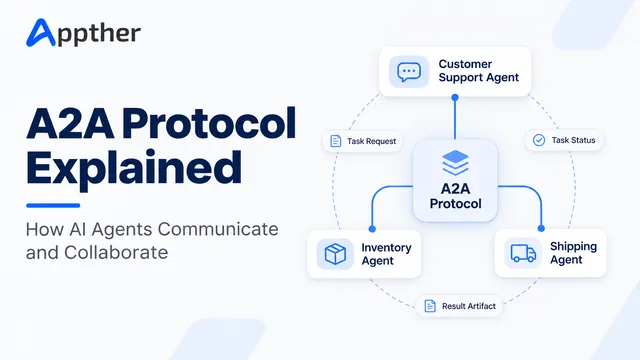
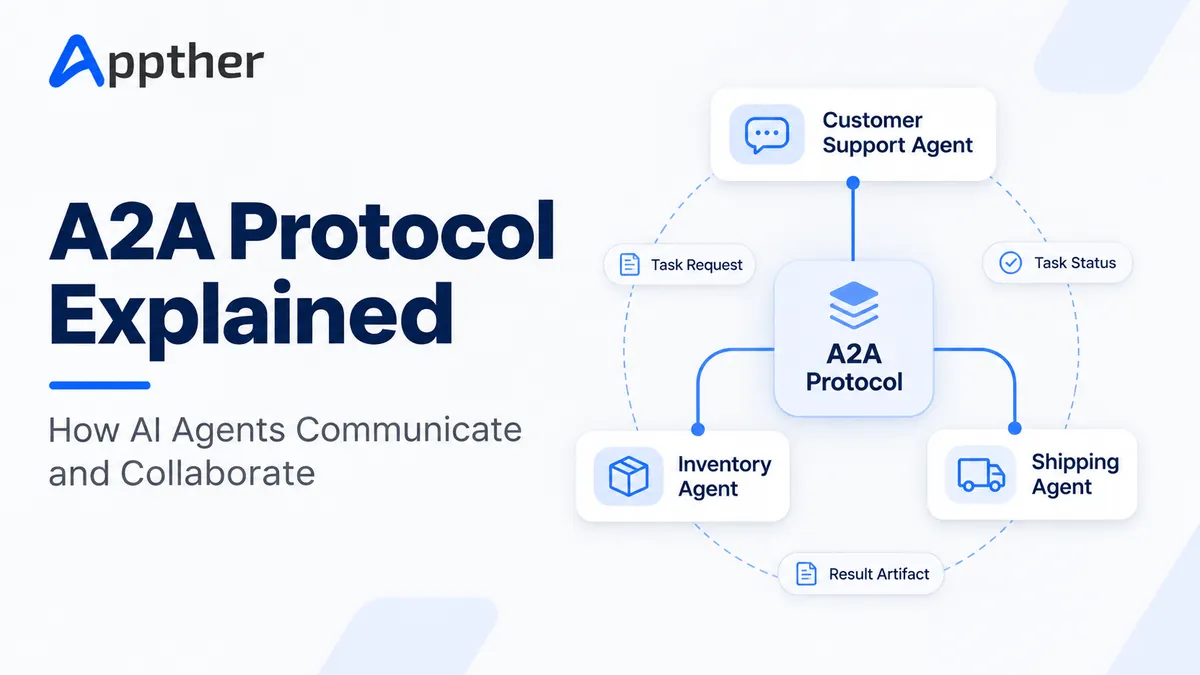
Imagine an online store using three AI agents. One manages customer enquiries, another checks inventory, and a third coordinates shipping.
What happens when a customer asks when their order will arrive?
The customer support agent needs information from the other two agents. It must exchange requests, receive results and present an accurate answer.
This is where the Agent2Agent (A2A) protocol becomes useful.
A2A provides a standard way for independent AI agents to discover capabilities, exchange messages, delegate tasks and share results.
It allows agents built using different technologies to collaborate without requiring them to expose their internal logic.
In this guide, we’ll explain what the A2A protocol is, how it works, how it differs from MCP and where businesses can use it for enterprise automation.
What Is the A2A Protocol?
The Agent2Agent (A2A) protocol is an open communication standard that allows independent AI agents to discover one another, exchange messages, delegate tasks and collaborate across different systems.
Originally introduced by Google in April 2025, A2A was subsequently contributed to the Linux Foundation.
The protocol reached its first stable v1.0 release in March 2026. In August 2026, it joined the Agentic AI Foundation as a Growth Stage project.
Its goal is straightforward: help AI agents work together, even when they use different frameworks, programming languages or technology providers.
For example, a company might have:
- A customer service agent built using Python
- A sales agent connected to Salesforce
- An inventory agent integrated with Odoo
- A service management agent connected to ServiceNow
These agents may use different AI models and internal tools.
With compatible A2A implementations, they can exchange requests and results through a common protocol.
A2A standardises communication between agents. It does not automatically provide the business logic, permissions or security rules needed to complete a workflow.
Those parts must still be designed and implemented.
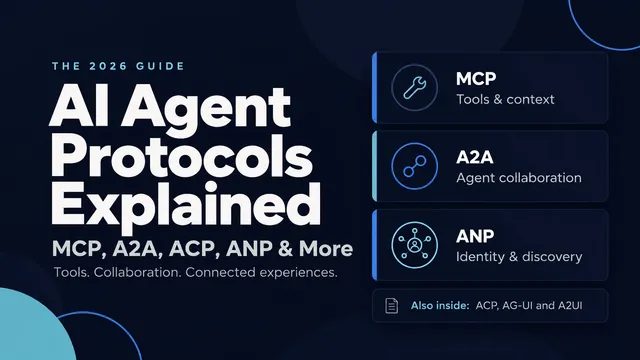
For more background on related standards, read Appther’s AI Agent Protocols: MCP, A2A, ACP and ANP Explained.
Why Do AI Agents Need a Communication Protocol?
Most businesses use several applications to manage their operations.
A sales team may work in a CRM. Finance uses an accounting platform. Warehouse employees use an inventory system. IT teams manage requests in ServiceNow.
Now, imagine introducing AI agents into each department.
Without a common communication method, developers may need to build custom connections between every pair of agents.
This creates several problems.
1. Different agents use different technologies
One agent might use LangGraph, while another uses a different framework.
Each may have its own request formats and communication methods.
2. Agents need to delegate work
A customer service agent may understand the customer’s question but lack access to warehouse information.
It needs a reliable way to ask a specialised inventory agent for help.
3. Long-running tasks need progress tracking
Some tasks take more than a few seconds.
An agent processing a complex document or checking several systems may need to provide progress updates while work continues.
4. Businesses need better interoperability
Companies frequently use software from multiple vendors.
A standard communication approach can reduce the need for custom integration logic between compatible agents.
5. Security responsibilities must remain clear
An agent should only receive the information and permissions required for its task.
A2A provides mechanisms for describing authentication requirements, while applications must enforce actual access controls.
These challenges explain why agent interoperability matters as enterprise AI systems become more complex.
How Does the A2A Protocol Work?
A2A allows one agent to communicate with another through a structured request-and-response process.
The main concepts are:
Client Agent: The agent that initiates a request.
Remote Agent: The agent that receives the request and performs the work.
Agent Card: A structured description of an agent’s capabilities, supported interfaces and authentication requirements.
Message: Information exchanged between agents.
Task: A unit of work that an agent can track through different states.
Artifact: An output produced during a task, such as a report, document or structured dataset.
Let’s look at a practical example.
A customer asks an AI assistant:
“Can you check whether my order is ready to ship?”
The customer service agent needs information from an inventory agent.
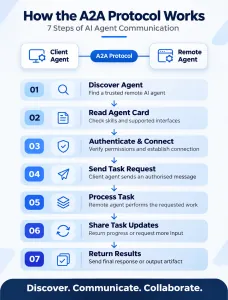
Here’s how the interaction can work.
Step 1: Discover the right agent
The customer service agent identifies a trusted inventory agent that can check stock and order availability.
It may retrieve the inventory agent’s Agent Card or use an approved internal agent registry.
The Agent Card describes what the inventory agent can do and how other agents can communicate with it.
Step 2: Check the agent’s capabilities
Before sending a request, the client agent checks whether the remote agent supports the required operation.
It also reviews the available protocol interface and authentication requirements.
Step 3: Authenticate and send a message
The customer service agent sends an authorised request.
For example:
“Check the availability of products for order #12345.”
The request includes the relevant task information.
The application must also enforce permissions and limit access to authorised order data.
Step 4: The remote agent processes the request
The inventory agent receives the message.
It uses its own internal logic and approved tools to check the order.
The remote agent does not need to reveal its private prompts, internal architecture or complete implementation.
Step 5: Exchange updates if needed
If the task takes longer, the inventory agent may provide progress updates.
A2A supports mechanisms such as task polling, streaming and push notifications, depending on the agent’s advertised capabilities.
Step 6: Return the result
The inventory agent returns the relevant information.
For example:
“All items are available. The order is ready for fulfilment.”
The result may arrive as a direct message or as part of a completed task.
Step 7: Continue the business workflow
The customer service agent can use the result to answer the customer.
If necessary, it may also ask a shipping agent to check collection or delivery details.
This creates a connected workflow involving several specialised agents.
The key benefit is that each agent can focus on its own responsibility while communicating through a standard interface.
What Is an Agent Card in A2A?
An Agent Card is one of the most important parts of the A2A protocol.
Think of it as a digital business card for an AI agent.
It helps another agent understand what services are available and how to request them.
An Agent Card can describe:
- Agent name and description
- Available skills
- Supported communication interfaces
- Service endpoint information
- Supported input and output formats
- Authentication requirements
- Optional capabilities, such as streaming
For example, an inventory agent might advertise skills for checking stock availability and retrieving inventory information.
A client agent can use this information to decide whether the inventory agent is suitable for a particular request.
A2A defines a standard discovery location:
/.well-known/agent-card.json
However, organisations can also use approved registries or configured discovery mechanisms.
Important: Discovering an Agent Card does not mean the remote agent should automatically be trusted.
Businesses should verify agent identity, apply appropriate access policies and use secure communication.
Understanding A2A Messages, Tasks and Artifacts
Three concepts are especially useful when designing multi-agent workflows.
Messages: Exchange information
Messages let agents communicate.
A message can contain a request, a response or additional context.
For example, a customer support agent might ask:
“Which invoices for this customer remain unpaid?”
A finance agent can then respond with relevant information, provided the request is authorised.
Tasks: Track work over time
Some requests require several steps.
For example, preparing a supplier risk assessment may involve collecting documents, checking records and generating a report.
A2A provides a task model for tracking this work.
Tasks can move through states such as submitted, working, completed, failed, cancelled or waiting for additional input or authorisation.
These states help the requesting agent understand what is happening.
Artifacts: Return useful outputs
An artifact is an output generated during a task.
Examples include:
- A PDF report
- A structured JSON response
- A generated document
- A summary of analysed records
- A completed assessment
Separating tasks from their outputs makes complex agent collaboration easier to manage.
For example, a reporting agent can return a completed analysis as an artifact while the original requesting agent handles user communication.
A2A Protocol vs MCP: What’s the Difference?
A2A and MCP are often discussed together.
However, they solve different communication problems.
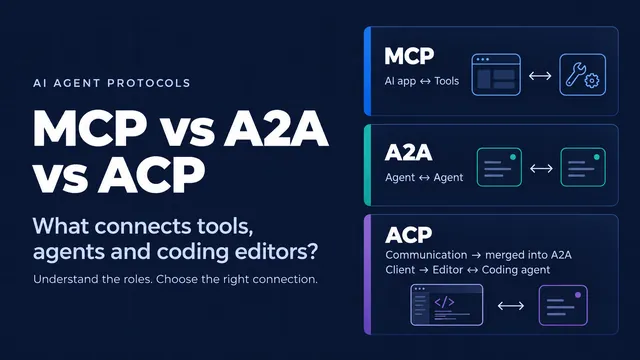
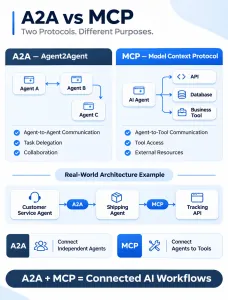
A2A focuses on communication and collaboration between independent AI agents. MCP focuses on how AI applications access tools and external resources.
| Comparison | A2A Protocol | MCP |
|---|---|---|
| Full name | Agent2Agent Protocol | Model Context Protocol |
| Main purpose | Agent-to-agent collaboration | Agent-to-tool and resource access |
| Common interaction | Delegate work to another agent | Request a tool operation |
| Capability discovery | Agent Cards | Tool and resource discovery |
| Task coordination | Explicit task lifecycle | Typically handled by the application |
| Typical example | Sales agent asks inventory agent for availability | Inventory agent queries a database |
| Best use | Multi-agent collaboration | Tool and data integration |
A simple example
Suppose a customer service agent needs the delivery status of an order.
It first communicates with a shipping agent through A2A.
The shipping agent then uses its own tools to retrieve tracking information.
Those tools could be exposed through MCP.
The shipping agent returns the result to the customer service agent through A2A.
In this architecture:
- A2A connects the agents.
- MCP can connect an agent to its tools.
- Business rules control what each agent is allowed to do.
A2A and MCP are complementary rather than competing technologies.
For a more detailed explanation of tool connectivity, read Appther’s What Is MCP? Model Context Protocol for AI Agents.
A2A vs APIs vs Multi-Agent Frameworks
A2A does not replace every existing integration method.
Businesses should understand when it adds value.
Traditional APIs
APIs allow applications to exchange data and trigger defined operations.
For example, a CRM can call an inventory API to retrieve stock availability.
This is often the simplest option for a predictable task.
Multi-agent frameworks
Frameworks help developers build and coordinate agents.
Some provide tools for reasoning, state management, orchestration and handoffs.
They can be effective when all agents operate within a shared application or framework.
A2A protocol
A2A becomes useful when independent agents need a standard way to communicate.
These agents may belong to different departments, applications or organisations.
They may also use different frameworks.
A2A provides the communication model, while the application architecture still determines how work is assigned and governed.
Do not introduce A2A simply because a workflow contains more than one AI step.
If a direct API integration or a standard workflow engine solves the problem, that may be the simpler and more maintainable choice.
Real-World A2A Protocol Use Cases for Businesses
The commercial value of A2A becomes clearer when we look at enterprise workflows.
1. Customer support and order fulfilment
A customer asks:
“Where is my order, and can I change the delivery address?”
A customer service agent may delegate work to an order agent and a shipping agent.
The order agent verifies the current order status.
The shipping agent checks whether the delivery address can still be changed.
The customer service agent combines the results.
If the change requires approval, the workflow sends the request to an authorised person.
This approach can help businesses connect customer conversations with existing order and fulfilment systems.
2. ServiceNow and IT service automation
A company receives an IT service request through ServiceNow.
A service management agent classifies the request and identifies the required action.
It may then communicate with a separate specialist agent that handles application access or device provisioning.
The remote agent returns the result or requests additional authorisation.
Finally, the ServiceNow workflow updates the ticket.
This is an example of how A2A could support cross-platform service automation when compatible agent interfaces are implemented.
Appther’s ServiceNow AI Agent Development services cover related enterprise workflow and integration requirements.
3. CRM and sales automation
A sales agent receives a customer enquiry.
It may ask a product agent to confirm availability and a pricing agent to prepare a quote.
The sales agent then creates a draft response for review.
Each agent remains responsible for its own function.
However, quote approvals and pricing rules should remain under business control.
4. Finance and invoice processing
A finance agent receives a supplier invoice.
It may ask a document-processing agent to extract invoice details.
Next, a procurement agent checks whether the purchase order matches.
The finance agent prepares the payment request or flags a discrepancy.
Payment authorisation remains with the appropriate human or controlled approval system.
5. Enterprise reporting
A reporting agent may need data from finance, sales and operations.
Rather than having unrestricted access to every system, it could request approved summaries from specialised agents.
The reporting agent combines the responses into a management report.
These are illustrative architectures, not claims that every listed enterprise product exposes an A2A interface by default.
Benefits of A2A for Enterprise AI Automation
A2A offers several potential advantages when businesses need agents to collaborate across system boundaries.
Better interoperability
Compatible agents can communicate through a standard protocol even when they use different technology stacks.
Reusable agent capabilities
A specialised agent can support several authorised business workflows rather than being built separately for every application.
Clearer task tracking
A2A provides a consistent model for exchanging task states and results.
This is useful for workflows that take time or require additional information.
Easier integration across teams
Organisations can connect independently developed agents without forcing them to share the same internal architecture.
More flexible system design
Teams may be able to replace or upgrade an agent without redesigning every connected workflow.
However, these benefits depend on compatible implementations, stable interfaces and well-managed dependencies.
A2A itself does not guarantee faster processing, lower costs or better decisions.
Those outcomes must be measured in the actual system.
What Are the Security Risks of A2A Communication?
AI agents often process business data and trigger operational actions.
Connecting them introduces new security responsibilities.
Agent identity and trust
A client must confirm that it is communicating with the intended agent.
An unfamiliar Agent Card should not automatically become a trusted service.
Authentication and authorisation
An agent should only access the information needed for its assigned task.
For example, a reporting agent should not gain permission to approve financial payments simply because it can communicate with a finance agent.
Sensitive data exposure
Agents should exchange only the necessary information.
Personal data, confidential business records and credentials should not be shared unnecessarily.
Prompt injection and untrusted content
A malicious document or message could contain instructions designed to manipulate an agent.
Applications should treat external content as untrusted data and enforce permissions outside the AI model.
Workflow failures
Agents may become unavailable or return incomplete results.
Production systems need timeouts, retries, error handling and recovery procedures.
Retries must also be designed carefully to prevent duplicate business actions.
Monitoring and auditability
Organisations should be able to identify which agent requested a task, what was authorised, what happened and which result was returned.
The A2A specification supports authentication-related metadata and secure communication patterns. However, the business remains responsible for implementing and operating effective controls.
How to Implement the A2A Protocol: A Practical Roadmap
Businesses should begin with one clearly defined process.
A small, testable implementation is usually more valuable than building a complex agent network without a specific business goal.
Step 1: Choose a multi-agent use case
Identify a workflow where independent agents genuinely need to collaborate.
For example, connect a customer support agent with an inventory agent.
Step 2: Define each agent’s responsibility
Document what every agent can do.
Specify the information it can access, the tasks it can accept and the actions it cannot perform.
Step 3: Design agent discovery
Define how agents will discover one another.
Use Agent Cards, trusted registries or approved configurations.
Avoid exposing sensitive internal details through publicly accessible metadata.
Step 4: Select the communication interface
A2A v1.0 supports standard protocol bindings including JSON-RPC, gRPC and HTTP+JSON/REST.
Choose the appropriate interface based on the available SDKs and the systems being connected.
Step 5: Implement secure task exchange
Add authentication, authorisation, message validation and appropriate data protection.
Define what happens when an agent requests more information or cannot complete a task.
Step 6: Add monitoring and human approvals
Track requests, task states, failures and outputs.
Require appropriate human approval for sensitive actions such as payments, account changes and external commitments.
Step 7: Test and expand
Test successful requests, incomplete responses, authentication failures, interrupted tasks and retries.
Confirm compatibility between the protocol versions and bindings used by the connected agents.
Only then should the organisation expand to additional agents and business processes.
For businesses building connected AI systems, Appther’s AI integration services can help assess existing APIs, agent interfaces and enterprise integration requirements.
How Much Does an A2A Multi-Agent System Cost?
A2A is an open standard. Businesses do not pay a protocol licence fee simply to use the specification.
However, implementing a production multi-agent system still involves development and operational costs.
The main cost factors include:
- Number of agents and supported capabilities
- Existing system APIs and integration complexity
- Authentication and access-control requirements
- Agent discovery and orchestration design
- AI model usage and hosting
- Monitoring, logging and task storage
- Testing and ongoing maintenance
- Human approval and compliance requirements
A small proof of concept connecting two existing agents may need relatively limited development.
A multi-department platform with sensitive data, multiple vendors and complex approvals will require more engineering.
The best approach is to define a narrow use case, establish its technical dependencies and estimate costs from that scope.
How to Measure A2A Implementation Success
An A2A implementation should be evaluated using business and technical measures.
| Metric | Why it matters |
|---|---|
| Task completion rate | Measures whether delegated work finishes successfully |
| Task latency | Shows how long agent collaboration takes |
| Handoff success rate | Identifies failures between agents |
| Recovery rate | Measures how often interrupted tasks recover correctly |
| Manual intervention | Tracks how often staff must correct or complete work |
| Cost per completed task | Helps evaluate infrastructure and AI expenses |
| Security incidents | Identifies inappropriate access or unsafe actions |
| Business outcomes | Measures the actual value delivered by the workflow |
Success should not be judged only by the number of connected agents.
A two-agent system that completes a useful task reliably may provide more value than a complex network that frequently fails.
How Appther Helps Businesses Build A2A-Powered AI Solutions
Building a reliable multi-agent system requires more than giving several AI models access to the same conversation.
The solution needs clear responsibilities, trusted communication, secure integrations, task management and operational monitoring.
At Appther Technologies, our Custom AI Agent Development Services focus on building agents around real business processes.
For organisations evaluating A2A, a technical implementation can include:
- Multi-agent solution architecture
- Agent capability and task design
- A2A compatibility assessment
- Agent Card and discovery configuration
- CRM, ERP and ServiceNow integrations
- MCP tool connectivity where appropriate
- Authentication and permission controls
- Human approval workflows
- Task monitoring and error recovery
- Testing and deployment support
Our AI automation services also address workflows that combine AI analysis with reliable rules, APIs and approval steps.
The objective is to connect the right systems without adding unnecessary complexity.
Planning a Multi-Agent AI System?
If your business uses different AI agents or wants to connect agents across enterprise applications, a technical feasibility assessment is a practical starting point.
Appther can help evaluate the required agent interfaces, data flows, permissions, integrations and implementation approach.
Contact Appther Technologies to discuss an A2A Multi-Agent Integration Feasibility Assessment.

Conclusion
The A2A protocol addresses an important challenge in enterprise AI: helping independent agents communicate and collaborate.
Instead of requiring every agent to use the same technology, A2A defines common mechanisms for discovery, messaging, task management and exchanging results.
This makes it a useful option for businesses building connected multi-agent systems.
However, A2A is a communication standard, not a complete automation solution.
Businesses still need secure integrations, clear responsibilities, monitoring, error handling and human oversight.
The best starting point is a business workflow where agent collaboration provides a measurable benefit.
Frequently Asked Questions
What does A2A stand for in AI?
A2A stands for Agent2Agent, also called Agent-to-Agent. It is an open protocol that helps independent AI agents discover capabilities, exchange messages and coordinate tasks.
Who developed the A2A protocol?
Google introduced the Agent2Agent protocol in April 2025. It was later contributed to the Linux Foundation and became part of the Agentic AI Foundation ecosystem.
Is the A2A protocol open source?
Yes. A2A is an open standard with publicly available specifications and open-source SDKs. Businesses can implement compatible agent systems without paying a licence fee for the protocol itself.
What is the difference between A2A and MCP?
A2A supports communication between independent agents. MCP provides a standard way for AI applications to access tools and resources. Both can be used in the same system.
Does A2A replace REST APIs?
No. A2A defines a standard agent communication model that can use HTTP-based interfaces. Traditional APIs remain useful for direct application and data integrations.
Can A2A agents use different AI models?
Yes. A2A is designed to support independent agents built with different frameworks, languages or underlying AI models, provided their implementations use compatible protocol interfaces.
What is an Agent Card?
An Agent Card is a structured description of an agent’s identity, skills, supported communication interfaces and authentication requirements. Other agents can use it to understand how to interact with that agent.
Does A2A support long-running tasks?
Yes. A2A provides a task model and supports polling, streaming and push notifications where the remote agent advertises the required capabilities.
Is A2A secure by default?
No communication protocol alone guarantees security. Production A2A systems must enforce trusted discovery, authentication, authorisation, data protection, monitoring and safe handling of external inputs.
Can A2A connect agents across ServiceNow, Salesforce and Odoo?
Potentially, yes. Agents operating around these platforms can communicate through A2A if compatible interfaces are available or developed. The underlying system APIs, permissions and business rules must also support the required tasks.
When should a business use A2A?
A2A is worth considering when independently developed agents need to collaborate across frameworks, applications or organisational boundaries. For a simple, fixed workflow, direct APIs or traditional automation may be easier.
How can a business get started with A2A?
Choose a small use case, define agent responsibilities, select compatible SDKs, implement secure discovery and task exchange, and test the workflow before expanding it.