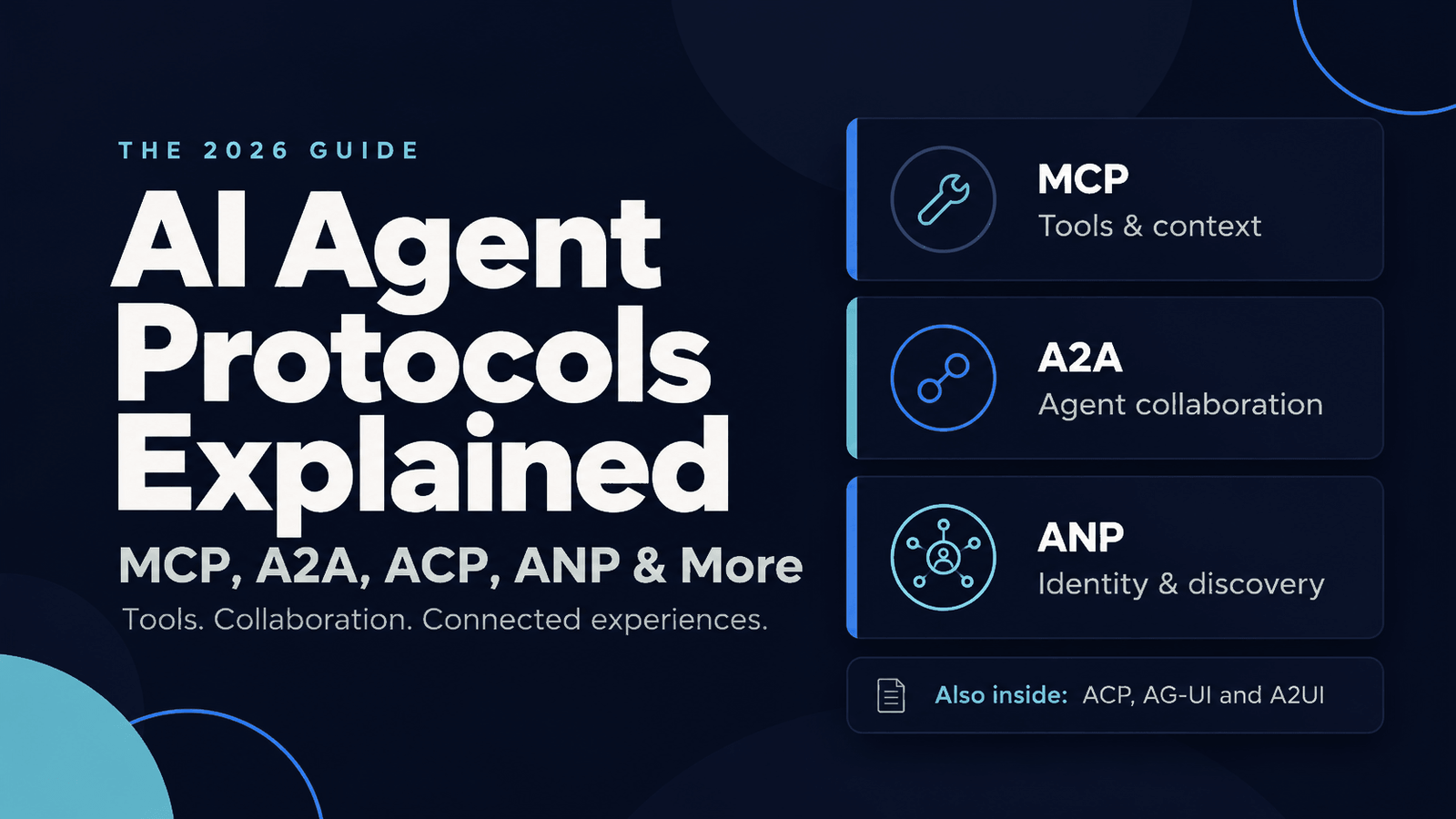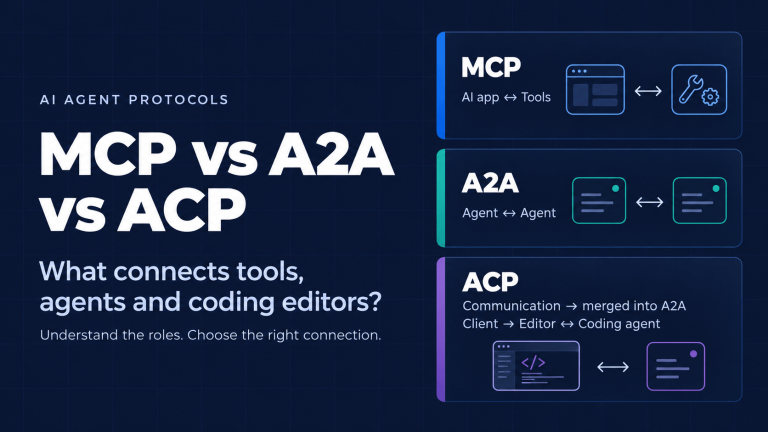
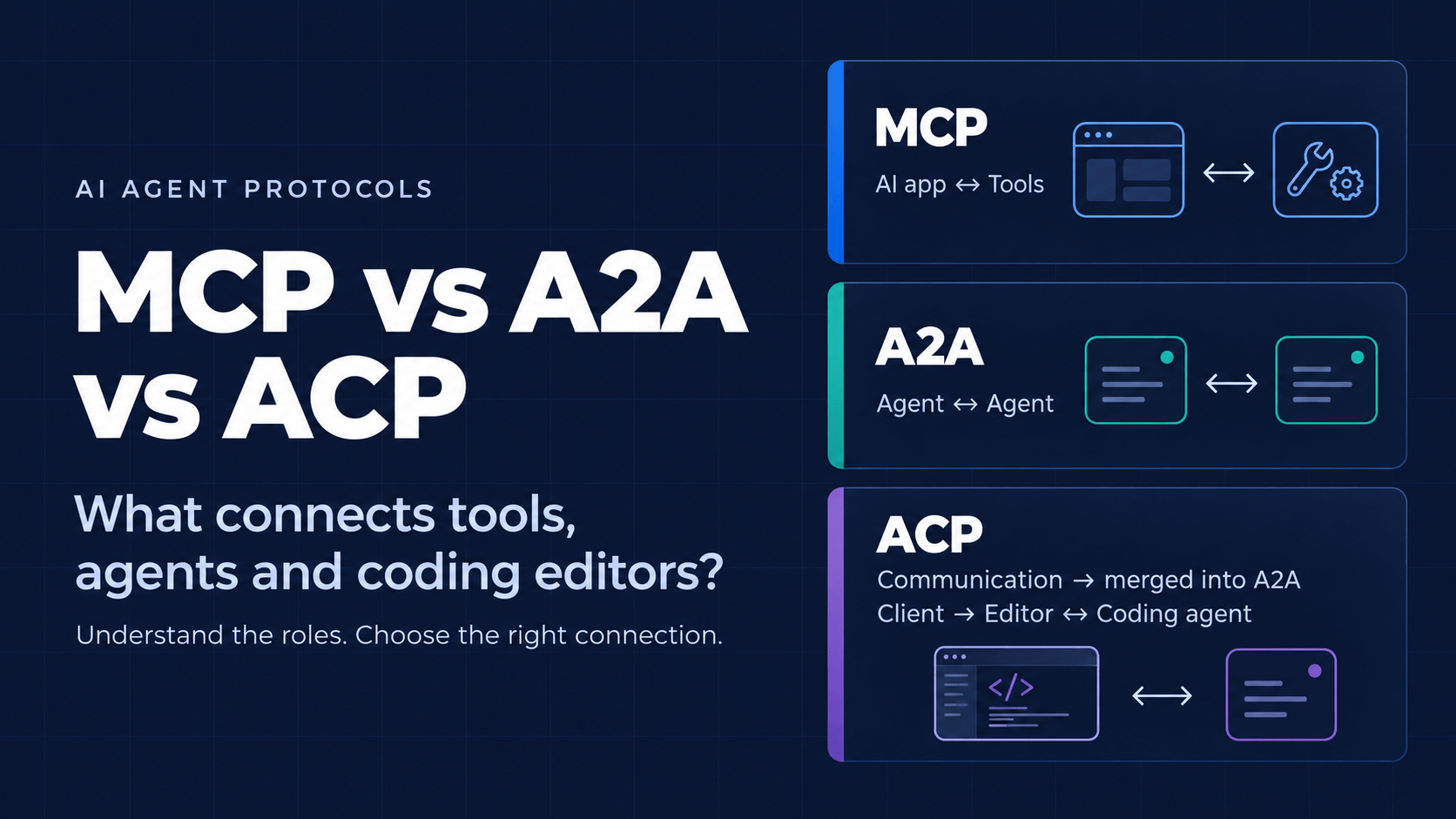
MCP connects AI applications to tools and context. A2A connects independent agents so they can exchange work. ACP needs a qualifier: IBM’s Agent Communication Protocol merged into A2A in 2025, while Agent Client Protocol connects coding agents to editors. Your choice depends on the connection your product needs.
A customer asks why an order arrived late and whether they qualify for a refund. One assistant might retrieve the order, check the delivery record and prepare a response. Another system might hand the investigation to a logistics agent and the refund assessment to a billing agent.
Those designs can produce a similar customer experience, but they have different integration requirements. Reading an order is a tool operation. Delegating an investigation gives another system responsibility for a piece of work.
That distinction is where an MCP vs A2A vs ACP comparison becomes useful. This guide explains the protocols, the two meanings of ACP, and the architecture decisions that matter when building an agent-based product.
Technical references checked on 13 October 2026. Protocol capabilities vary by version and implementation.
MCP vs A2A vs ACP: comparison at a glance
| Comparison | MCP | A2A | ACP: Agent Communication Protocol | ACP: Agent Client Protocol |
|---|---|---|---|---|
| Full name | Model Context Protocol | Agent2Agent Protocol | Agent Communication Protocol | Agent Client Protocol |
| Main relationship | AI application to tools and context | Client application or agent to an independent agent | Applications and agents exchanging messages and runs | Code editor or IDE to a coding agent |
| Main purpose | Discover and access external capabilities | Delegate and track work across agent boundaries | Standardize agent communication through a RESTful interface | Standardize the coding-agent experience across editors |
| Key concepts | Hosts, clients, servers, tools, resources, prompts | Agent Cards, messages, tasks, artifacts | Agent manifests, messages, runs, sessions | Clients, agents, coding sessions and interaction updates |
| Typical example | Retrieve an order through an approved tool | Ask a logistics agent to investigate a delayed order | Maintain an existing BeeAI-era ACP integration | Connect an editor to a compatible coding assistant |
| Direction for a new project | Evaluate for reusable tool integration | Evaluate for independent agent collaboration | Assess migration to A2A | Evaluate for editor and coding-agent interoperability |
The comparison follows the official MCP architecture, A2A core concepts, Agent Communication Protocol documentation and Agent Client Protocol introduction.
For the wider ecosystem, including ANP, see Appther’s guide to AI agent protocols.
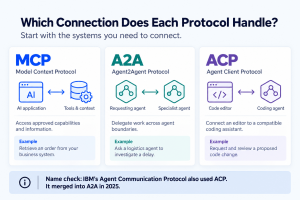
What is MCP, and how does it work?
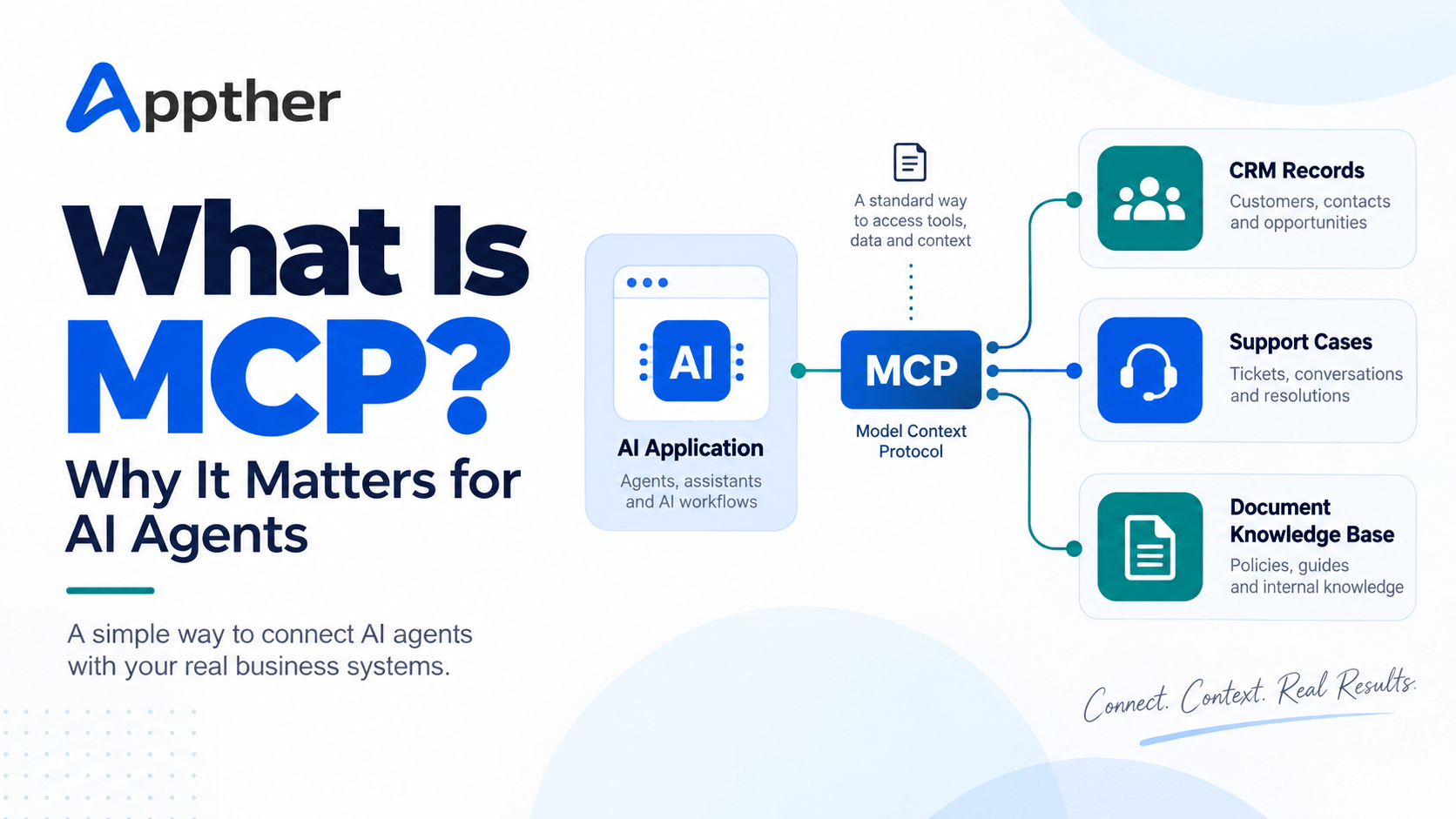
Model Context Protocol is a standard interface through which an AI application discovers and uses capabilities exposed by external servers. These capabilities include tools, contextual resources and reusable prompts.
An MCP implementation has three main participants. The host is the AI application. An MCP client operates within that application and communicates with a server. The MCP server exposes the capabilities that the application can access. Servers may run locally or remotely.
The official architecture documentation describes this separation. It lets an application consume a server’s interface without needing to reproduce its integration logic internally.
Tools: actions the application can request
An MCP tool exposes an operation with a defined input schema. An order-management integration might offer get_order_status, check_return_eligibility and create_return_request.
The first operation reads information. The third changes business records. Both can use MCP, but they should have different permissions and approval requirements.
The server still needs to validate inputs and enforce business rules. A tool description helps the application understand an operation; it does not make the operation safe by itself. See the MCP tools specification.
Resources: information that provides context
Resources expose contextual information identified by URIs. Examples include a product catalogue, a policy document or a database schema.
A returns policy might be available as a resource, while submitting a return is a tool operation. Separating these concerns can make permissions easier to reason about. See the MCP resources specification.
Prompts: reusable interaction templates
Prompts provide reusable message templates that clients can discover and retrieve. A support application could offer a template for preparing a case summary from supplied evidence.
A prompt is neither an authorization rule nor a complete workflow engine. The application remains responsible for how it uses that template. See the MCP prompts specification.
When MCP is a good fit
Consider MCP when several compatible AI applications need access to the same business capabilities, or when your product needs a consistent way to discover and invoke integrations.
For example, a sales assistant could read customer records and prepare follow-up tasks through narrowly scoped tools. The relevant design questions are which records it may access, which changes it may make, and how the system verifies the result.
What is A2A, and how does it work?
Agent2Agent Protocol provides a common interface for communicating with independent agents, discovering their capabilities and exchanging work. The remote agent can retain control over its internal implementation.
Consider an operations assistant asking a supplier’s agent to investigate a shipment. The supplier may use different models, tools and infrastructure. The requesting assistant needs a dependable way to describe the request, receive updates and obtain a result.
The A2A core concepts distinguish the main objects involved:
| Object | Purpose | Illustrative example |
|---|---|---|
| Agent Card | Describes an agent’s advertised capabilities and connection details | A supplier agent offers shipment investigation |
| Message | Carries an interaction between participants | A request containing an order reference |
| Task | Tracks a unit of work | An investigation waiting for carrier information |
| Artifact | Represents an output produced by the work | A structured delivery investigation report |
Agent discovery does not establish trust
An Agent Card helps a client assess whether a remote agent offers the required capability. Cards can be found through a well-known endpoint, a curated catalogue or private configuration. A2A does not prescribe one universal registry API.
An advertised capability is still a claim. Before sending sensitive data, your application needs a policy for which providers it trusts and which credentials it will use. The A2A discovery guide explains the available discovery approaches.
A2A supports both immediate replies and tracked work
Not every A2A interaction needs a long-running task. A remote agent can return a self-contained message or create a task with a lifecycle.
Tasks can report progress, request input and reach a terminal outcome. Context identifiers group related interactions; task identifiers identify individual units of work. A completed task is not simply reopened for every follow-up request. These distinctions matter when designing retries and follow-up conversations. See the life of an A2A task.
Where supported, streaming provides live updates and push notifications support clients that cannot keep a connection open. Your client should check advertised capabilities rather than assume every endpoint supports both. See A2A streaming and asynchronous operations.
What does ACP mean in AI agent development?
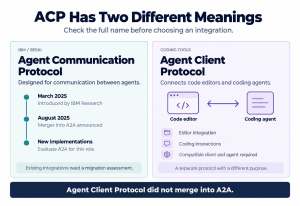
ACP is an ambiguous acronym. Agent Communication Protocol and Agent Client Protocol address different integration problems, and their project histories must be kept separate.
Agent Communication Protocol: the IBM and BeeAI project
IBM Research introduced Agent Communication Protocol in March 2025. Its REST-oriented design supported communication between agents across frameworks, including synchronous responses, asynchronous work and streaming.
Its run lifecycle also supported pausing execution to collect additional input. That history matters when maintaining applications built against the original interfaces. The ACP run lifecycle documentation describes those execution patterns.
On 25 August 2025, the project announced that ACP was merging into A2A under the Linux Foundation. The announcement stated that active ACP development would wind down and the team would contribute to A2A. It also said the BeeAI platform had moved to A2A. See the official merger announcement.
For a new implementation, our recommendation is to evaluate A2A for this role. Existing ACP systems need a compatibility and migration assessment; the merger does not automatically convert their interfaces.
Agent Client Protocol: the editor integration standard
Agent Client Protocol standardizes communication between coding agents and code editors or IDEs. It addresses the problem of every editor needing a separate integration for each coding agent.
The official introduction describes local agents using JSON-RPC over standard input/output. It also discusses remote scenarios, while noting that full remote-agent support remains a work in progress. Check the specific client and agent before promising deployment compatibility.
Agent Client Protocol is separate from the IBM protocol that merged into A2A. Its role is the interaction between a developer’s editor and a coding agent. See the Agent Client Protocol introduction.
MCP vs A2A: where is the real boundary?
Choose by responsibility: MCP usually exposes a capability that the calling application uses; A2A exposes an agent that can take responsibility for a delegated request.
The official A2A and MCP comparison presents the protocols as complementary.
Suppose a product needs to assess a late delivery:
| Design decision | Tool-oriented approach | Agent-oriented approach |
|---|---|---|
| Request | Retrieve tracking events for an order | Investigate why an order missed its delivery window |
| Planning responsibility | The calling application decides the next steps | The remote agent decides how to investigate |
| Internal access | The caller uses explicitly exposed operations | The caller need not access the remote agent’s internal tools |
| Useful interface | MCP tool integration | A2A task exchange |
The presence of an LLM behind an endpoint does not settle the choice. An agent can be wrapped as a tool, and a tool can run a complex process. Decide what contract callers need, how much responsibility crosses the boundary, and whether they need ongoing dialogue with the remote system.
Does MCP support long-running tasks?
Yes, through supported task capabilities. It is inaccurate to claim that MCP is limited to immediate responses while A2A alone handles asynchronous work.
In the MCP specification published on 28 July 2026, tasks moved into the io.modelcontextprotocol/tasks extension. The same release removed protocol-level sessions in favour of stateless requests; applications can still maintain their own state using explicit handles.
Older MCP tutorials can therefore describe different lifecycle behaviour. Confirm the supported protocol version and extensions on both sides. See the MCP July 2026 release notes.
Is A2A restricted to JSON-RPC?
No. The A2A specification lists JSON-RPC, gRPC and HTTP+JSON/REST bindings. At the time of this review, its latest released specification is 1.0.0.
A protocol binding is the way its operations are represented over a particular communication mechanism. Two implementations still need a compatible binding and version. See the A2A specification.
Can MCP, A2A and Agent Client Protocol work together?
Yes. They can serve different connections within the same product ecosystem. A coding editor could communicate with a coding agent through Agent Client Protocol; that agent could access approved tools through MCP and collaborate with an independently hosted agent through A2A.
For an enterprise application, a more common starting point is MCP plus A2A. The following is an illustrative design, not a claim about an existing Appther deployment.
Example: investigate a refund request
A retailer receives a request for a refund after a missed delivery deadline.
- Retrieve the facts. A support assistant uses an MCP tool to obtain the customer’s order and delivery reference.
- Delegate the investigation. It asks a logistics agent through A2A to establish what happened.
- Collect supporting evidence. The logistics agent uses its own approved integrations to inspect carrier events.
- Return a bounded result. The logistics agent supplies findings, evidence references and any unresolved questions.
- Apply the retailer’s policy. The support application checks the refund conditions and calculates the proposed action.
- Obtain approval where required. A supervisor reviews exceptions or refunds above the configured limit.
- Execute and verify. An authorized operation creates the refund, and the application checks the resulting transaction record.
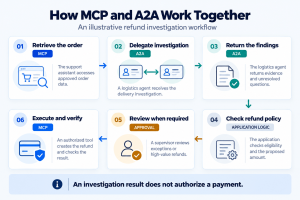
The design keeps investigation separate from payment authority. A logistics agent’s recommendation should not, by itself, authorize a refund.
It also creates a clear failure path. If carrier evidence is unavailable, the system can escalate the case rather than invent a delivery explanation. If the payment request times out, it should check whether the refund exists before submitting another one.
Which AI agent protocol should your business choose?
Use the table below as an architecture starting point. These are implementation recommendations based on the boundaries described above.
| Your requirement | Starting point | What to confirm |
|---|---|---|
| Give an assistant access to CRM, ERP or support operations | MCP | Available tools, permissions and client compatibility |
| Delegate work to an independently operated specialist agent | A2A | Task semantics, supported binding and provider trust |
| Support interchangeable coding agents inside an editor | Agent Client Protocol | Client support, coding interaction features and deployment mode |
| Maintain an existing IBM ACP integration | Migration assessment toward A2A | Existing clients, run states and message formats |
| Perform one fixed backend operation | A direct API may be sufficient | Whether a protocol layer creates measurable integration value |
| Run several agents inside one application | Start with the application’s orchestration needs | Whether an external interoperability boundary actually exists |
An AI protocol should solve an integration problem you can name. If a single application calls one stable service, an additional adapter may add maintenance without creating useful reuse.
For teams comparing implementation partners, Appther’s AI agent development services provide a starting point for discussing workflows, integrations and approval requirements.
What security controls do MCP and A2A still need?
Protocol compatibility does not establish permission to access data or execute a business action. Authentication, authorization and operational controls must be implemented across the workflow.
MCP’s security guidance addresses risks including token passthrough, unsafe URL handling, malicious local servers and server-side request forgery. A2A’s enterprise guidance places authorization decisions with the receiving service.
In a practical implementation, review these controls:
- Narrow permissions: Separate reading a record from changing it, and restrict operations to the required tenant and account.
- Identity at each boundary: Verify the caller and the destination. Do not assume an upstream login authorizes every downstream service.
- Approval at execution: Check approval immediately before consequential actions, including payments and external communications.
- Untrusted content handling: Treat retrieved documents and remote agent messages as input. They should not override application policy.
- Safe retries: Use business transaction references and duplicate detection so a network failure does not create a second payment or order.
- Traceable outcomes: Record the request, relevant evidence, approval and resulting business transaction, with appropriate redaction.
These controls belong in enforceable application and service logic. A sentence in a prompt is not a reliable substitute for an authorization check.
How should you migrate an existing ACP integration to A2A?
Treat migration as a contract change. The official merger announcement establishes the direction; the following checklist is a recommended engineering process.
- Inventory current usage. List consuming applications, endpoints, message formats, sessions and run behaviours.
- Choose a supported target. Agree on the A2A version, SDK and binding that clients and servers will use.
- Map advertised capabilities. Define Agent Cards that accurately describe the skills and interaction modes you support.
- Map execution semantics. Decide how existing runs, intermediate updates, interruptions and final outputs map to tasks, messages and artifacts.
- Recheck access controls. Validate tenant isolation, credential handling, output access and notification destinations.
- Test difficult cases. Include cancellation, timeouts, missing input, repeated requests and interrupted connections.
- Migrate gradually. Where necessary, provide an adapter during a documented transition period and track remaining legacy consumers.
An adapter may preserve an old interface temporarily. It should not hide a semantic mismatch, such as treating an accepted request as completed work.
What should you test before production?
A successful demonstration proves that one request worked. A useful acceptance test asks whether the system behaves correctly when the request cannot be completed.
| Test scenario | Expected behaviour |
|---|---|
| A required capability is unavailable | Report the limitation and choose an approved fallback |
| A remote agent returns an unsupported format | Reject or safely handle the response without fabricating a result |
| A task requires more information | Ask for the missing detail and preserve the relevant work context |
| A caller requests another tenant’s record | Deny access at the receiving service |
| A network timeout follows a write request | Reconcile the transaction before retrying |
| A user rejects a proposed action | Prevent execution and record the decision |
| A protocol or SDK version changes | Detect incompatibility before releasing the integration |
Measure business outcomes alongside technical health. Useful measures include verified task completion, incorrect-action rate, escalation rate, response time and cost per completed workflow. A high tool-call success rate is insufficient if the final customer outcome is wrong.
Frequently asked questions
What is the difference between MCP and A2A?
MCP focuses on access to tools and context. A2A focuses on interaction with independent agents, including delegated work and returned outputs. A system can use both when agents need their own tools as well as collaboration across service boundaries.
Did ACP merge with A2A?
IBM’s Agent Communication Protocol announced its merger into A2A on 25 August 2025. This does not apply to the separate Agent Client Protocol used for coding-agent and editor integration.
Does A2A replace MCP?
No. They address different integration relationships. A remote agent reached through A2A can use MCP internally to access approved business capabilities.
Can MCP replace REST APIs?
MCP can provide a standardized AI-facing interface over capabilities implemented through REST APIs or other services. It does not remove the need for the underlying business logic, data access rules or service operations.
Is MCP only for chatbots?
No. Its interfaces can be used by different AI applications, including assistants and developer tools. The relevant requirement is compatible client and server support.
Do all multi-agent systems need A2A?
No. Agents within one application can communicate through its existing orchestration mechanisms. Evaluate A2A when independently implemented or operated agents need a shared external interface.
Which protocol is best for enterprise AI agents?
There is no universal winner. Evaluate MCP for tool access, A2A for independent agent collaboration, and Agent Client Protocol for coding interfaces. Then assess permissions, compatibility and operational support for the actual workflow.
Plan your agent integrations with Appther
Start with one workflow and define what a successful, authorized outcome looks like. Identify the systems involved, the actions that need approval and the situations that should go to a person. Those decisions make protocol selection much clearer.
Appther’s AI development services cover applications and integrations that can support this work. For a focused conversation about tool access, agent handoffs and implementation scope, explore our AI agent development services.