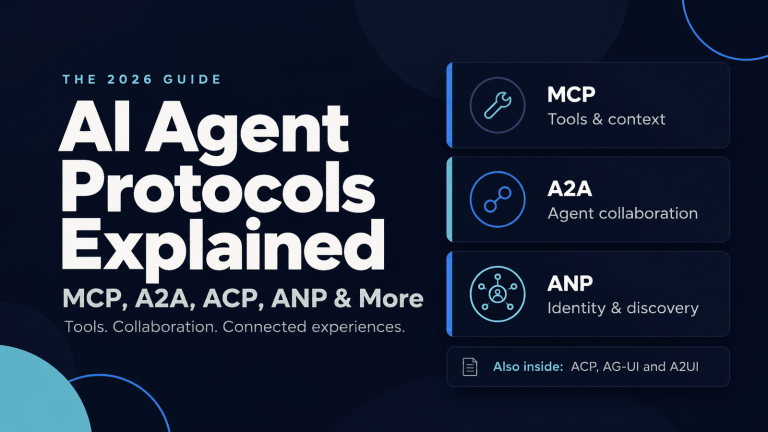
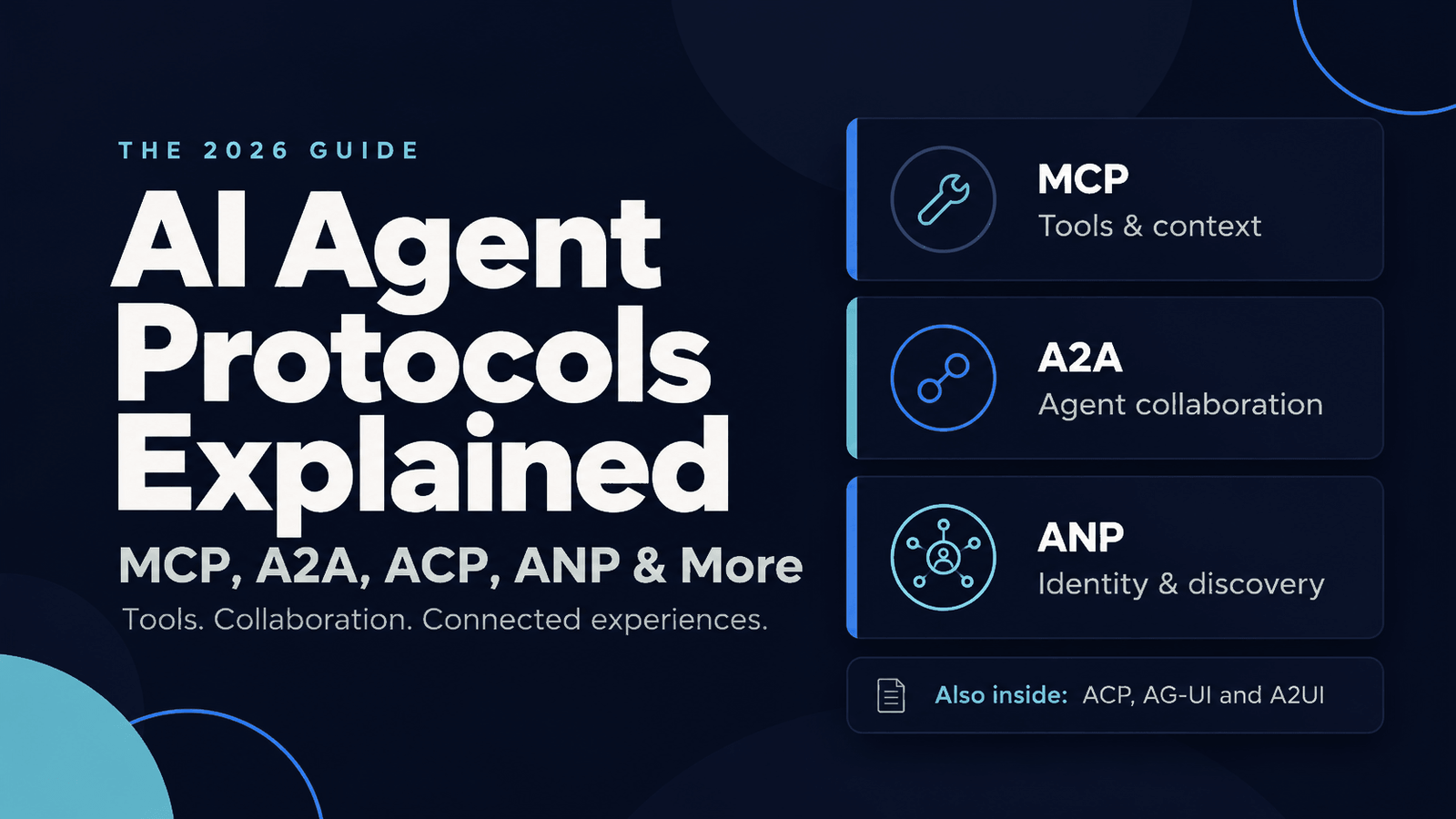
AI agent protocols define how AI applications connect to tools, exchange work with other agents, and interact with users. MCP focuses on tools and context; A2A supports collaboration between independent agents; ANP addresses agent networking and decentralized identity. ACP needs clarification: IBM’s Agent Communication Protocol merged into A2A, while Agent Client Protocol is a separate standard for connecting coding agents to editors.
For businesses building AI assistants, these distinctions matter. Connecting an agent to a CRM is a different engineering problem from asking a supplier’s agent to complete a task.
This guide explains the major AI agent communication protocols, where they fit, and how to choose a practical architecture for enterprise AI automation.
What are AI agent protocols?
An AI agent protocol is an agreed set of rules for communication between an agent application and another system. Depending on its scope, it can define capability discovery, message formats, task updates, tool access, or user interaction.
Consider an assistant that handles a customer’s order query. It may need to retrieve order data, ask a logistics agent for an updated delivery estimate, and show the customer its progress. Those connections can require different interfaces.
A protocol standardizes communication. Your application still needs business logic, permissions, monitoring, and reliable integrations.
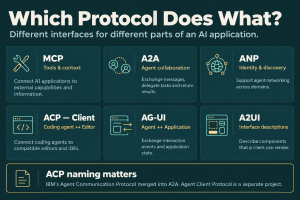
MCP vs A2A vs ACP vs ANP: a quick comparison
| Protocol | Full name | Main purpose | Example use |
|---|---|---|---|
| MCP | Model Context Protocol | Connect AI applications to tools, resources, and prompts | Read CRM records through an authorized tool |
| A2A | Agent2Agent | Exchange tasks and results between independent agents | Delegate delivery planning to a logistics agent |
| ACP, communication | Agent Communication Protocol | Earlier agent communication initiative, now merged into A2A | Evaluate migration of an existing ACP integration |
| ACP, client | Agent Client Protocol | Connect coding agents to compatible editors and IDEs | Use a coding agent from an editor |
| ANP | Agent Network Protocol | Support agent identity, discovery, and communication across a network | Explore cross-domain agent discovery |
| AG-UI | Agent–User Interaction Protocol | Exchange events between an agent backend and a user-facing application | Stream progress and synchronize interface state |
| A2UI | Agent-to-UI | Describe interfaces that a client renders with supported components | Present an agent-generated form or selection card |
These are different architectural responsibilities. They are not seven interchangeable options for the same problem.
Sources: MCP, A2A, ACP merger, Agent Client Protocol, ANP, AG-UI, A2UI.
What is MCP, and how does it work?
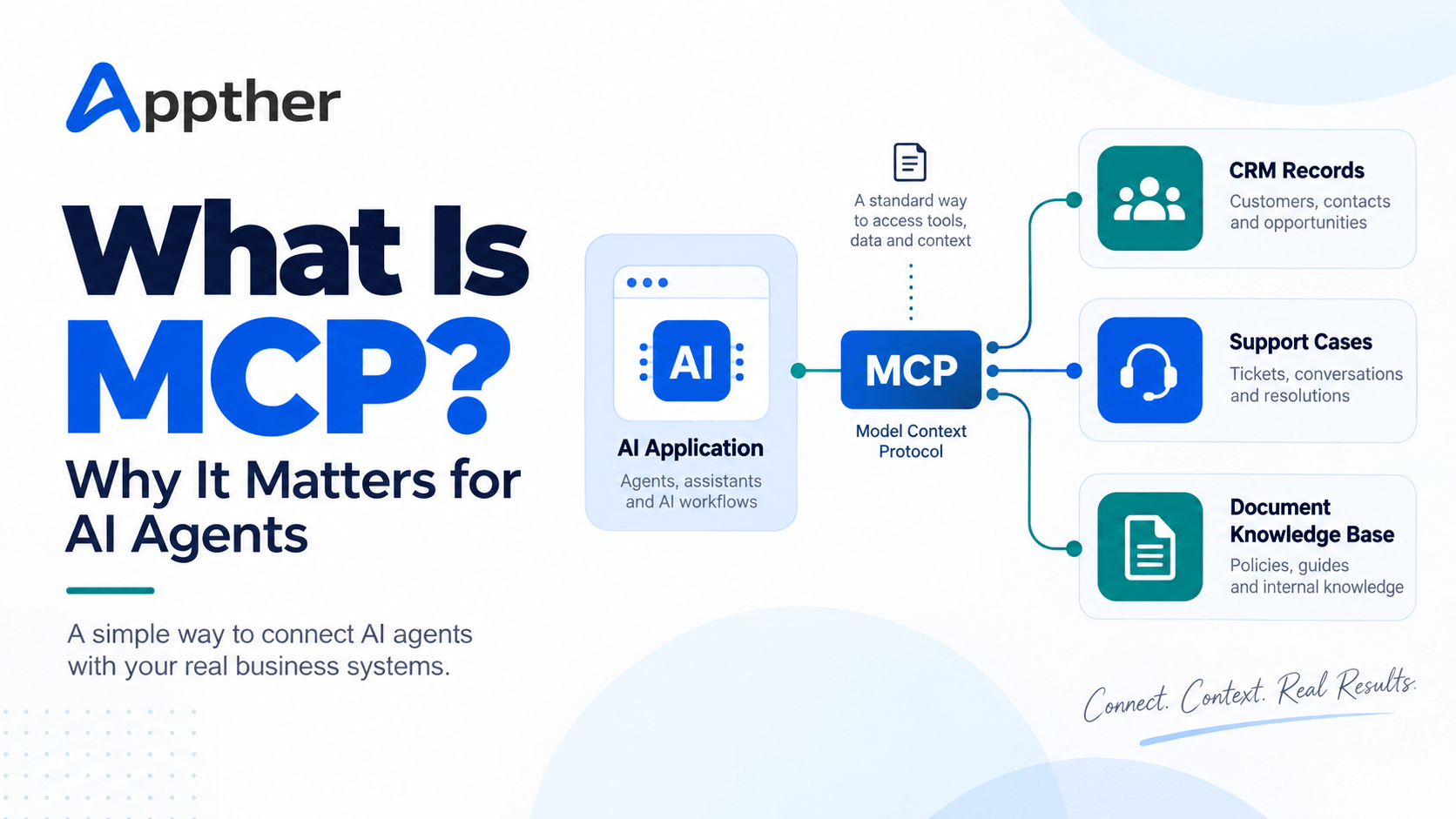
Model Context Protocol (MCP) standardizes how AI applications access external capabilities and context. An MCP server can expose tools, resources, and reusable prompts.
An MCP integration typically involves three participants:
- Host: The AI application coordinating the interaction.
- Client: The component within that application communicating with a server.
- Server: The component exposing selected data or functions.
For example, an enterprise assistant could use an MCP tool to look up an order. The server would validate the request, access the underlying business system, and return a result.
MCP servers can expose:
| Capability | What it provides | Illustrative example |
|---|---|---|
| Tools | Callable functions | Find an order or create a draft CRM lead |
| Resources | Contextual information | A document or database schema |
| Prompts | Reusable interaction templates | A structured customer-support workflow |
MCP uses JSON-RPC messages and supports local stdio and remote Streamable HTTP connections. Implementation details depend on the supported protocol version.
Sources: MCP architecture, MCP specification.
When should a business use MCP?
Consider MCP when several compatible AI applications need consistent access to business capabilities. Examples include knowledge retrieval, CRM lookups, inventory queries, and support tools.
For an Odoo AI integration, a deliberately scoped MCP server could expose approved operations such as checking stock or preparing a quotation.
That is an architectural option, not a claim that every Odoo installation includes a native MCP server. The connector, permissions, and underlying API access still need implementation.
What is A2A, and how is it different from MCP?
Agent2Agent (A2A) supports communication and collaboration between independent agents. It provides concepts for describing capabilities, exchanging messages, tracking work, and returning outputs.
Its main building blocks include:
- Agent Cards: Describe an agent’s capabilities and connection requirements.
- Messages: Carry instructions, questions, and responses.
- Tasks: Represent work that may take time or require further interaction.
- Artifacts: Hold outputs such as documents or structured results.
A2A supports interaction patterns including polling, streaming, and push notifications where implemented.
For example, a customer-service agent could delegate a delivery investigation to a logistics agent and receive updates before the final answer.
Source: A2A core concepts.
MCP vs A2A: which should you choose?
Use MCP when the central requirement is access to a capability exposed as a tool or resource. Consider A2A when the central requirement is handing work to an independently operating agent.
A useful design question is: “Am I calling a defined function, or delegating an outcome?”
This is a practical distinction, not a hard technical limit. An agent can sit behind an MCP tool, and agent workflows can overlap. Choose based on the contract and lifecycle your integration needs.
A system can use both: A2A for collaboration between services and MCP within each service for authorized tool access.
What happened to ACP?
IBM’s Agent Communication Protocol is now part of A2A. The Linux Foundation’s LF AI & Data announced the merger in August 2025, and IBM’s project documentation directs readers toward A2A and migration guidance.
Earlier ACP work focused on a lightweight, HTTP-native interface for communication between agents across frameworks and runtimes.
For a new project, evaluate A2A rather than treating the former ACP initiative as an equally active standalone alternative. For an existing ACP deployment, review its SDK dependencies, task behavior, and migration path before changing production integrations.
Sources: LF AI & Data merger announcement, IBM Research.
Is Agent Client Protocol the same ACP?
No. Agent Client Protocol is a separate project that connects coding agents to editors and IDEs.
It addresses the integration work required when each editor and coding agent uses a different interface. Compatible implementations can support a more interchangeable development environment.
Its documentation describes local agents communicating through JSON-RPC over stdio. Remote scenarios are also in scope, although full remote support is described as work in progress.
Always expand “ACP” when writing a technical specification or comparing products.
Source: Agent Client Protocol introduction.
What is ANP?
Agent Network Protocol (ANP) is an open protocol initiative for agent networking, with an emphasis on decentralized identity, discovery, and communication.
The project describes an Agentic Web in which agents can identify and discover each other across organizational boundaries. Its specifications include agent descriptions and discovery, alongside identity mechanisms such as did:wba.
An illustrative use case is a purchasing assistant discovering supplier agents and exchanging structured requests with them.
ANP vs A2A: what is the difference?
A2A centers on interoperable agent collaboration and task exchange. ANP emphasizes a broader networking approach involving identity, discovery, and communication across domains.
Their goals overlap. Avoid reducing the comparison to “A2A is private and ANP is public,” because deployment choices are more flexible than that.
Evaluate ANP when its identity and discovery approach solves a specific requirement. Check the actual counterparties, libraries, and deployment support available for your use case.
Decentralized identity also does not prove that an agent’s commercial claims or returned information are trustworthy.
Sources: ANP project, ANP white paper.
Other agent protocols to understand: AG-UI and A2UI
AG-UI: connecting the agent to the application
AG-UI defines an event-based connection between an agent backend and a user-facing application. It covers the flow of agent state, user interactions, and interface-related events.
It can be useful when a product needs to show progress, receive user input during a workflow, and keep the interface synchronized with ongoing work.
For example, a service dashboard might display that an agent is checking records, waiting for confirmation, or returning a result.
Source: AG-UI overview.
A2UI: describing an interface the client can render
A2UI lets an agent describe an interface using structured component data. The client renders those descriptions with supported components.
For example, a booking assistant could return a date selector and appointment cards instead of expressing every choice as plain text.
AG-UI handles interaction and event flow; A2UI describes interface content. They can be used together. Neither is a substitute for authorization or server-side validation.
Source: A2UI documentation.
How can these protocols work together?
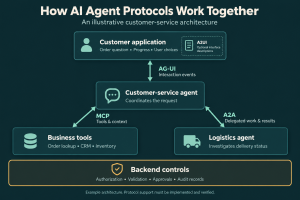
Consider this illustrative customer-service workflow:
- A customer asks about an order. The application passes the request to its agent backend.
- The agent retrieves the order. An MCP connection exposes an authorized order-lookup tool.
- The agent requests specialist help. If an independently operated logistics agent exists, A2A can carry the delegated delivery investigation.
- The application shows progress. AG-UI can carry updates between the backend and frontend.
- The customer chooses an action. A2UI could describe supported options, such as selecting a revised delivery window.
- The backend validates the change. Business rules and permissions determine whether it can proceed.
ANP could be evaluated if discovering external agents and verifying their network identities is part of the requirement. It is not necessary just because the workflow contains several agents.
This is a proposed architecture, not evidence that any particular CRM, carrier, or booking platform supports every protocol.
How to choose the right AI agent protocol
Start with the integration boundary and business outcome.
| Requirement | Practical starting point |
|---|---|
| Give an assistant controlled access to internal tools | Evaluate MCP |
| Delegate work across independent agent services | Evaluate A2A |
| Maintain an existing IBM ACP deployment | Review the A2A migration guidance |
| Connect a coding agent to an editor | Evaluate Agent Client Protocol |
| Explore decentralized agent identity and discovery | Evaluate ANP |
| Build interactive agent experiences | Evaluate AG-UI |
| Let agents describe supported interface components | Evaluate A2UI |
| Automate one predictable operation in one application | First assess a direct API integration |
These are architecture recommendations based on the protocols’ documented scopes.
Before selecting a protocol, check what both sides actually support: versions, optional capabilities, authentication, task handling, supported data formats, and deployment constraints. A shared acronym does not guarantee compatibility.
Security and reliability for enterprise AI agents
A standard communication format does not make an integration safe by itself. MCP’s security guidance, for example, covers risks around authorization, token handling, and server-side request forgery.
Source: MCP security best practices.
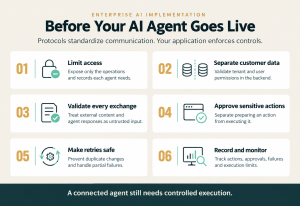
For a production implementation, apply these engineering controls:
- Limit access: Give each user and agent only the operations and records needed.
- Enforce tenant boundaries: Validate access in the backend, independently of prompts.
- Validate inputs and outputs: Treat retrieved documents and agent responses as untrusted input.
- Require approval where appropriate: Separate drafting a refund or purchase from executing it.
- Handle retries safely: Prevent duplicate writes and record what completed before a failure.
- Keep audit records: Track delegation, tool calls, approvals, and resulting changes.
- Set execution limits: Control timeouts, cost, repeated delegation, and failure escalation.
Measure successful business outcomes as well as response speed. A fast answer that updates the wrong record is still a failed workflow.
Frequently asked questions
What is the difference between MCP and A2A?
MCP focuses on exposing tools and context to AI applications. A2A focuses on communication and delegated work between independent agents. A system can use both.
Has ACP been replaced by A2A?
IBM’s Agent Communication Protocol merged into A2A. This does not refer to Agent Client Protocol, which is a separate editor-to-coding-agent standard.
What is ANP used for?
ANP addresses agent networking, including decentralized identity, discovery, and communication. Its suitability depends on the ecosystem and counterparties an application needs to connect.
Do AI agents need every protocol?
No. Choose the interfaces required by the workflow. A single assistant accessing a few business systems may need only direct API integrations or MCP.
Does MCP replace APIs?
No. An MCP server can use existing APIs to provide tools to an AI application. API credentials, business rules, rate limits, and access permissions still apply.
Is an agent framework the same as an agent protocol?
No. A framework helps developers build and execute agent logic. A protocol defines how systems communicate. A framework may implement one or more protocols.
Which protocol is best for enterprise AI automation?
There is no universal best choice. Evaluate MCP for tool access, A2A for independent agent collaboration, and UI protocols when the product needs interactive agent experiences.
Build AI agents around your business workflow
Protocol selection should follow a clear definition of the work: which systems the agent can access, which decisions it can make, where it needs approval, and how failures reach a person.
Appther builds AI agents, custom applications, and CRM and Odoo workflows around business processes. Explore Appther’s AI and software development capabilities or discuss the integrations your product needs.