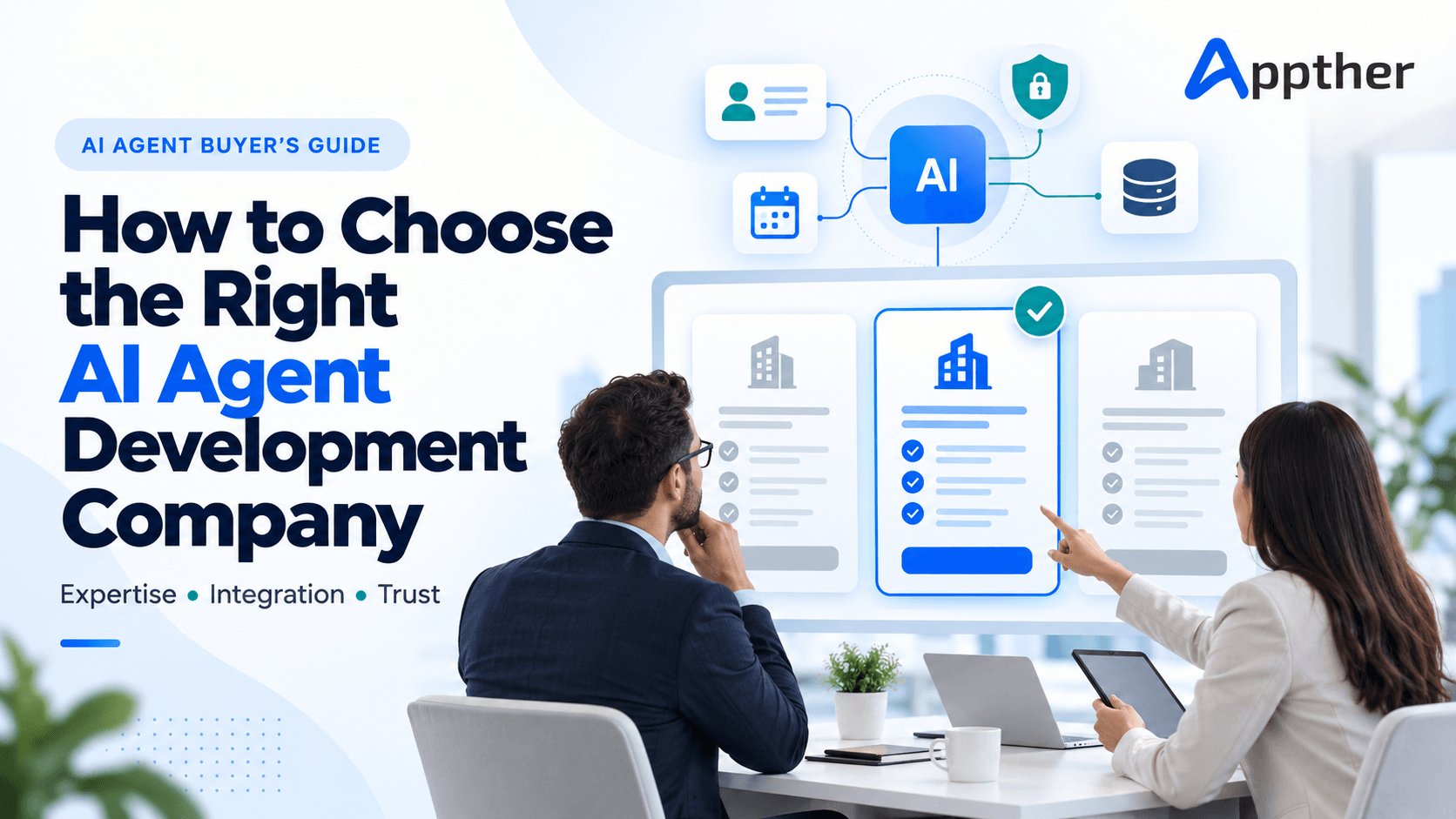
Choosing an AI agent development company means choosing who will connect AI to your customers, business data and everyday operations. A polished demonstration is useful, but your decision should depend on how the system performs when information is incomplete, an integration fails or a request needs human approval.
To choose the right AI agent development company, evaluate its understanding of your workflow, relevant delivery experience, integration capability, security controls, testing approach, total costs and ongoing support. Ask shortlisted providers to prove one clearly defined business outcome through a measurable pilot before expanding the project.
Whether you want to qualify leads, answer customer calls, support employees or automate CRM updates, this guide explains what to assess, what evidence to request and which warning signs deserve attention.
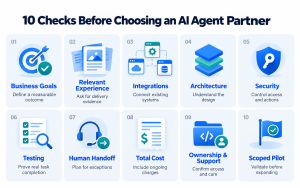
What does an AI agent development company do?
An AI agent development company designs software that uses AI models, business information and connected tools to complete tasks within defined permissions.
For example, a customer service agent might identify a request, retrieve an order, check its delivery status and create a support ticket when it cannot resolve the issue. The development work includes the conversation, the system connections, the rules governing actions and the operational controls around them.
A complete engagement may cover workflow discovery, data preparation, integration, agent development, evaluation, deployment and maintenance. Appther’s AI agent development services cover business workflows, tool integration and the controls needed to manage agent actions.
Before comparing providers, clarify the level of automation you need. A knowledge assistant, a voice receptionist and an agent that updates enterprise records require different designs and acceptance criteria.
1. Start with one business problem and a measurable outcome
A useful brief explains the work you want to improve. “We need an AI agent” leaves too much open to interpretation.
A clearer requirement would be:
We want an agent to handle appointment enquiries, check availability, create confirmed bookings and pass exceptions to our team with the conversation history attached.
Document the current process, who uses it, the systems involved, typical request volume and the actions that require approval. Record a baseline so you can judge whether the new system improves the workflow.
| Business goal | Example measure |
|---|---|
| Reduce repetitive support work | Eligible requests resolved correctly without staff rework |
| Improve sales follow-up | Qualified enquiries recorded and assigned in the CRM |
| Simplify scheduling | Confirmed bookings with correct customer and calendar details |
| Speed up internal operations | End-to-end processing time and exception rate |
| Improve service availability | Requests successfully handled outside staffed hours |
Agree on both the desired outcome and unacceptable errors. Faster processing has limited value if staff must repair the records afterwards.
2. Look for relevant evidence of delivery
Ask providers to walk through a project with similar operational demands. The closest match may share your integration complexity, user behaviour or approval requirements even if it belongs to another industry.
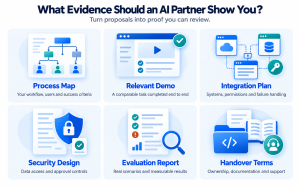
Useful evidence includes a working demonstration, an architecture overview, a sample evaluation report and a clear explanation of the team’s contribution. Where clients permit it, references can help you understand communication, delivery quality and support after launch.
Ask: What did the agent actually do? Which systems did it access? What happened when it failed? How was success measured?
For a voice project, look beyond natural speech. Appther’s healthcare AI voice agent case study describes scheduling connections, human handoff and an operations dashboard. Those are useful areas to examine when assessing a receptionist or customer service solution.
Treat percentages in any case study as a starting point for questions. Request the baseline, measurement period and scope before using those results to forecast your own return.
3. Evaluate CRM, ERP and API integration capability
An agent often creates value by completing work inside an existing system. Ask the company to explain how it will read information, validate requests and confirm that each authorised action succeeded.
Consider a sales assistant creating a CRM lead. It must map the right fields, check for an existing record, assign ownership and handle an unavailable API. If a request is retried, it should avoid creating duplicate leads.
For your project, request answers to these questions:
- Which systems and API operations are included in scope?
- How will user permissions restrict the records and actions available?
- What happens when a system times out or rejects an update?
- How will the agent confirm a successful write before telling the user it is complete?
- Who maintains the integration when the connected system changes?
If Odoo supports your operations, review the relevant modules and workflows as part of discovery. Appther’s Odoo AI integration services provide a related starting point for businesses planning ERP-connected agents.
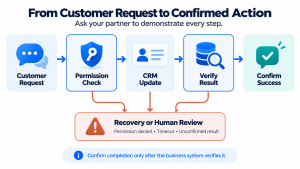
4. Ask for a clear explanation of the architecture
You should be able to understand the proposed design without being an AI engineer. Ask the provider to show where requests enter, how information is retrieved, which tools the agent can use and where business rules are enforced.
The proposal should explain why each major component is needed, including the model, knowledge retrieval, application backend and monitoring. Ask which parts can be replaced later and what switching would involve.
For voice applications, the design must also account for audio streaming, speech recognition, interruptions and response playback. Appther’s guide to AI voice agent architecture explains these layers in more detail.
Be cautious if a provider recommends a complex multi-agent system before understanding the task. Ask what the additional agents improve and how their coordination will be tested. The architecture should be proportionate to the workflow.
5. Check data access, security and approval controls
Security discussions should lead to specific design decisions. Ask the provider to document what information enters the system, where it is processed, who can access it and how long it remains in conversations, logs and backups.
The review should cover:
- Identity verification and permissions for each user role.
- Restricted access to approved tools and business records.
- Secure handling of credentials and sensitive information.
- Approval requirements for consequential actions.
- Audit records showing the request, action and result.
- Retention, deletion and incident-handling responsibilities.
Request a demonstration of a forbidden action. For example, can a user persuade the agent to reveal another customer’s record or bypass an approval step? The expected result should be defined and tested.
If a provider mentions certifications or regulatory readiness, ask what the claim covers and what evidence supports it. Record any project-specific requirements and responsibilities in the agreement.
6. Review the evaluation plan before development begins
Define acceptance criteria while scoping the project. Testing should establish whether the agent completes the intended task correctly, within the agreed permissions and operating limits.
Give shortlisted companies a representative set of scenarios. Include common requests, incomplete information, conflicting records and failures in connected systems. For voice agents, include interruptions, relevant accents, background noise and corrections midway through a conversation.
Useful measures include successful task completion, incorrect actions, appropriate escalation, response time, operating cost and staff rework. Ask how results will be segmented by task type so a strong overall average does not hide a weak critical workflow.
Appther’s article on why AI voice agents fail discusses production issues such as conversation handling, system synchronisation and escalation. Use those categories to make vendor demonstrations more demanding.
Also ask what happens after a model, prompt or integration changes. The company should explain which checks must pass before an update reaches users.
7. Make human handoff part of the scope
Define when an agent should stop, ask for clarification or transfer the request. These are product decisions that affect customer experience and staff workload.
A useful handoff includes the user’s request, verified details, actions attempted and unresolved issue. Confirm where it goes: a live support queue, a CRM task, a helpdesk ticket or a callback list.
Ask what happens outside business hours or when nobody is available. A handoff plan is incomplete until it defines the fallback and tells the customer what to expect.
For a pilot, agree on which tasks the agent may complete independently and which need review. Expand its permissions only when the evidence supports that change.
8. Compare the total cost of ownership
Request proposals against the same scope and usage assumptions. A low development quote may exclude integrations, testing, monitoring or the administration tools your team needs.
| Cost area | What to clarify |
|---|---|
| Discovery and design | Workflow mapping, data review and acceptance criteria |
| Development | Agent logic, backend, interfaces and admin tools |
| Integrations | Included systems, operations and custom connectors |
| AI and channel usage | Model calls, voice processing, telephony or messaging charges |
| Infrastructure | Hosting, storage, logs and monitoring |
| Validation and launch | Evaluation, security review, deployment and training |
| Ongoing operation | Support, knowledge updates, maintenance and regression checks |
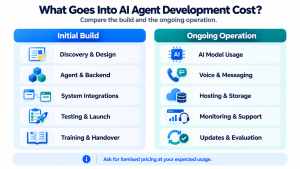
Ask for expected monthly costs at your initial volume and at a higher-volume scenario. Clarify assumptions about conversation length, model calls, retries and human review.
For a defined reporting period, one useful calculation is:
Operating cost per successfully completed task = total agent operating cost ÷ correctly completed tasks.
Define the numerator consistently, including relevant review and support costs. Assess the initial build investment separately, or amortise it explicitly when calculating a fully loaded cost. This makes comparisons more meaningful than a price per message alone.
9. Confirm ownership, access and ongoing support
Before signing, document ownership and access arrangements for custom code, prompts, configurations, evaluation datasets, documentation and deployment accounts. Separate custom deliverables from third-party components and their licence terms.
Ask whether another engineering team could maintain the system using the handover materials. Clarify how you would export business data, change providers or move infrastructure.
Support should also be specific. Record who responds to incidents, how issues are prioritised, what monitoring is included and which changes require a separate estimate. Distinguish defect fixes from new features and define any warranty or maintenance terms in writing.
The operating relationship matters because your workflows, knowledge sources and connected applications will continue to change.
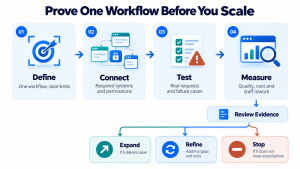
10. Use a scoped pilot to make the final decision
A pilot gives both teams evidence before a wider commitment. Choose one valuable workflow, a limited set of integrations and a clearly defined user group.
Set the scope, budget, acceptance measures, review period and stop conditions before work begins. Require a demonstration using representative data and inspect the resulting business records, not only the conversation transcript.
For example, a booking pilot should show a correct appointment in the scheduling system, an accurate confirmation and a usable escalation when no suitable slot exists.
At the review, decide whether to expand, refine or stop. A useful pilot identifies both what works and what still needs attention.
AI agent development company comparison scorecard
Use the same questions and evidence requirements for every shortlisted provider. This suggested scorecard can help structure the discussion; adjust the weights to your business priorities.
| Evaluation area | Suggested weight | Evidence to request |
|---|---|---|
| Workflow understanding and relevant experience | 20% | Process map and comparable delivery example |
| Integration capability | 20% | API plan and failure-handling demonstration |
| Security and access controls | 15% | Data flow, permissions and approval design |
| Evaluation and reliability | 15% | Test scenarios, metrics and acceptance plan |
| Architecture and maintainability | 10% | Design rationale and documented dependencies |
| Cost transparency | 10% | Itemised quote and usage-based operating estimate |
| Ownership and support | 10% | Handover terms and support responsibilities |
Score each area from 1 to 5, then calculate the weighted total. Treat missing evidence as an unresolved issue. A mandatory security, ownership or integration requirement should remain a pass/fail condition regardless of the overall score.
Warning signs to address before hiring
Pause the selection process if a provider guarantees perfect accuracy, cannot explain a failed action, offers only a scripted demonstration or avoids documenting ongoing charges.
Other concerns include broad access to business systems without a clear reason, undefined ownership and a rollout proposal with no acceptance criteria. Ask for written clarification and a practical demonstration before proceeding.
A capable partner should be comfortable explaining limitations, dependencies and the circumstances in which human review remains necessary.
How Appther approaches AI agent development
At Appther, we begin with the business task, the systems it touches and the outcome that makes the project worthwhile. That creates a foundation for selecting the architecture, defining permissions and agreeing on how success will be evaluated.
Our approach brings together workflow discovery, business-case development, integration and controls around agent actions. We scope the work around your operating environment so the proposal can address delivery, ownership and ongoing operation together.
If you are evaluating a project, bring one priority workflow, the systems involved and a few examples of real requests. These details make the first discussion more useful and help identify a practical starting point.
Ready to choose an AI agent development partner?
Talk to Appther about your workflow, integration needs and success criteria. We can help you define the scope and next steps for a focused AI agent project.
Frequently asked questions
How do I choose an AI agent development company?
Start with a defined business workflow and compare providers on relevant experience, integration capability, security, testing, cost transparency and support. Request evidence for each area and use a scoped pilot to validate the most important assumptions.
What questions should I ask an AI agent development partner?
Ask what the agent can do, which systems it will access, how permissions are enforced, how failures are handled and how success is measured. Also clarify ownership, recurring costs, human escalation and maintenance responsibilities.
How much does custom AI agent development cost?
The scope determines the cost. Integration complexity, data readiness, channels, evaluation requirements and administration tools all influence the build effort. Request an itemised proposal and separate estimates for development, ongoing usage and support.
Should I use an existing AI platform or build a custom agent?
Evaluate existing platforms when their workflows, integrations and controls fit your requirements. Consider custom development when your processes need specialised connections, interfaces or operational controls. Ask providers to compare the options against the same requirements and long-term costs.
Can an AI agent work with my existing CRM or ERP?
Assess the system’s supported interfaces, permissions, data structure and vendor restrictions first. Ask the development company to confirm the specific operations it can implement and maintain. A generic claim that a platform is supported does not establish that your workflow is covered.
What should happen after an AI agent launches?
The operating plan should include monitoring, incident handling, knowledge updates and checks before changes are released. Review task outcomes, errors, escalation and cost regularly, then use those findings to decide where the agent can improve or expand.