| Quick answer: What is AI voice agent architecture?
AI voice agent architecture is the technical framework that lets an AI receive a voice call, understand speech, work out intent, access enterprise data, run business workflows, and speak a verified answer back to the caller. A basic system only answers questions. An enterprise system takes action, because it adds orchestration, agent tools, CRM and ERP integration, a knowledge base, security, analytics, and human escalation around the core speech and LLM layers. |
AI voice agents can sound simple from the outside. A caller speaks. The AI understands. The AI responds.
An enterprise Voice AI system is doing far more behind the scenes. A production-grade agent may be handling several things at once:
Real-time audio → speech recognition → LLM reasoning → business rules → CRM/ERP APIs → knowledge retrieval → text-to-speech → analytics → human escalation
All of this has to happen fast enough to feel like a natural conversation. That is what makes AI voice agent architecture so important.
This guide explains how enterprise Voice AI actually works, from the basic call flow to production architectures that connect with CRM, ERP, calendars, payment systems, knowledge bases, analytics, and human agents.
AI Voice Agent Architecture at a Glance
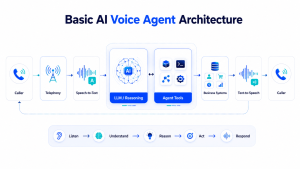
The simplest architecture looks like this:
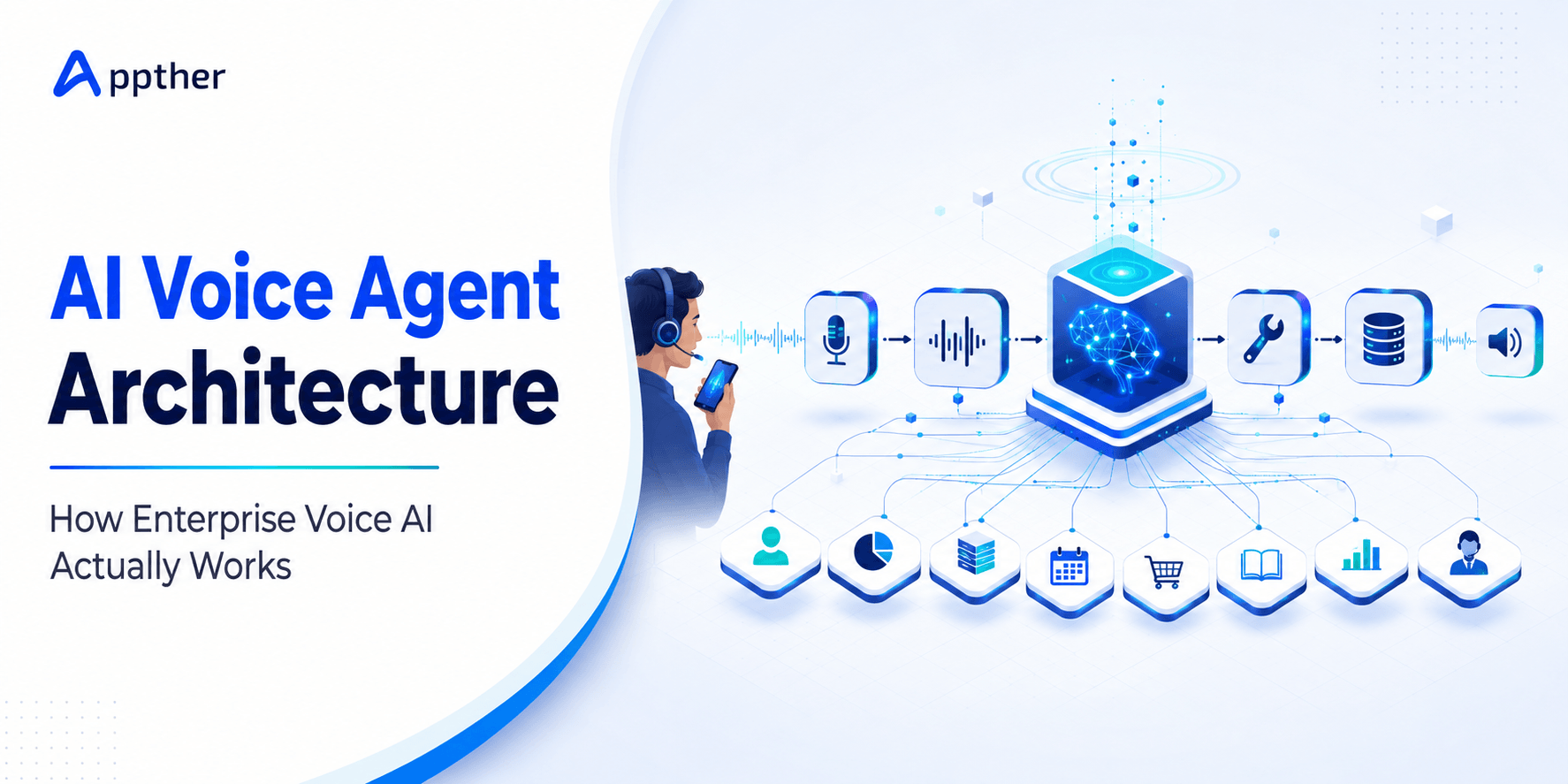
Caller → Telephony → Speech-to-Text → LLM / Reasoning → Agent Tools → Business Systems → Text-to-Speech → Caller
For an enterprise deployment, the real architecture is closer to this:
Caller → Telephony / SIP / WebRTC → Real-Time Audio Streaming → Speech-to-Text → Conversation Orchestrator → LLM + Guardrails + Business Rules → Knowledge + Tools + APIs → CRM / ERP / Calendar / Payments / Databases → Response Generation → Text-to-Speech → Streaming Audio → Caller
Across the entire system:
Security • Monitoring • Call Recording • Transcripts • Analytics • Human Escalation
What Is an AI Voice Agent Architecture?
An AI voice agent architecture is the technical framework that enables an AI system to receive a voice call, understand spoken language, identify user intent, decide what action is required, access enterprise data, execute business workflows, generate a response, and speak naturally back to the caller.
A basic system may only answer questions. An enterprise system can take action.
For example, a caller may say:
“Can you move my appointment to Friday afternoon?”
A production AI voice agent may need to understand the request, identify the caller, retrieve the current appointment, check calendar availability, offer new time slots, confirm the selected slot, update the scheduling system, update the CRM or EHR, send a confirmation, and speak the result back.
The conversation is only the interface. The architecture behind it performs the actual business work.
The 7 Core Layers of AI Voice Agent Architecture
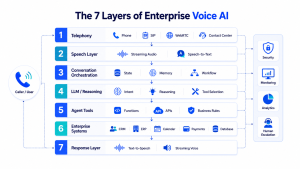
A strong Voice AI system can be understood as seven connected layers.
Layer 1: Telephony
The telephony layer connects the caller to the AI system. It may support PSTN calls, SIP, VoIP, WebRTC, browser calling, mobile applications, and contact-center platforms.
Common capabilities include inbound calls, outbound calls, audio streaming, call routing, DTMF, recording, call transfer, and conference or human handoff. For real-time Voice AI, the most important capability is usually media streaming. Instead of waiting for the caller to finish an entire recording, the audio streams continuously into the AI pipeline.
Layer 2: Real-Time Speech-to-Text
Speech-to-Text converts the caller’s voice into machine-readable text. The quality of this layer directly affects everything that follows.
Enterprise STT should be evaluated on transcription accuracy, latency, streaming support, accent handling, background noise, telephone-quality audio, multilingual support, and how well it handles names, numbers, industry terminology, and custom vocabulary.
This matters most in specific industries:
- Healthcare: doctor names, medications, specialties.
- ERP: invoice numbers, SKUs, order references.
- Finance: account identifiers, transaction amounts.
- Logistics: tracking numbers, locations.
A small transcription mistake can trigger the wrong business workflow.
Layer 3: Conversation Orchestrator
This is the layer that coordinates the entire conversation. The orchestrator knows what the caller has already said, what information is still missing, which tools are available, which business rules apply, whether the caller is authenticated, what actions have already run, and when escalation is required.
For example, the agent offers three slots and the caller says “take the second one.” The phrase “second one” only makes sense if the system remembers the earlier turn. The orchestrator manages conversation state, session memory, workflow state, authentication state, available tools, policy rules, and escalation conditions. This is why enterprise Voice AI needs more than a prompt and an LLM.
Layer 4: LLM and Reasoning
The LLM interprets what the caller means and determines what should happen next. It helps with intent understanding, entity extraction, reasoning, tool selection, response generation, summarization, and context interpretation.
Take the request “I need to reschedule my dermatologist appointment to Monday afternoon.” The AI may identify the intent as reschedule appointment, the specialty as dermatology, the date as Monday, and the time as afternoon. It can then decide that a scheduling tool needs to run.
The LLM should not directly control enterprise systems. A better architecture is:
LLM → Tool Request → Permission Check → Business Rules → API Execution
Layer 5: Agent Tools
Tools turn the AI from a conversational assistant into a business agent. Example tools might include:
find_customer() check_invoice() get_order_status()
find_available_slots() create_appointment() create_crm_lead()
update_opportunity() create_support_ticket() generate_payment_link()
transfer_to_human()
Instead of giving the LLM unrestricted system access, the application exposes only approved actions. That is one of the most important enterprise architecture principles.
Avoid: LLM to direct ERP database access.
Prefer: LLM to controlled tool, to validation, to API, to ERP.
This provides better security, auditability, reliability, permission control, and error handling.
Layer 6: Enterprise Business Systems
This is where the AI becomes useful to the business. Typical integrations include CRM (Salesforce, HubSpot, Zoho, Odoo CRM, Microsoft Dynamics), ERP (Odoo, SAP, Dynamics, custom platforms), scheduling (Google Calendar, Microsoft 365, healthcare and custom booking systems), healthcare records (EHR and EMR), payments (gateways, billing, invoicing), and other systems such as databases, helpdesk, inventory, and logistics.
The business system should remain the source of truth. The AI retrieves information from it. It does not invent information.
Layer 7: Text-to-Speech
After the AI determines the correct response, the system converts text back into audio and streams it to the caller. Enterprise TTS selection should consider first-audio latency, naturalness, pronunciation, streaming, languages, consistency, telephone audio quality, and cost.
A voice that sounds impressive but responds slowly can still create a poor experience. In enterprise Voice AI, speed, clarity, and reliability matter more than theatrical realism.
How a Real Enterprise Voice AI Call Works
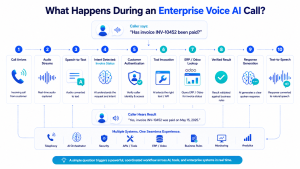
Consider a customer calling about an invoice.
- Call arrives. The caller reaches the company’s AI-enabled number.
- Audio streams. The telephony system sends live audio to the AI platform.
- STT transcribes: “Has invoice INV-10452 been paid?”
- The LLM understands the intent: invoice status.
- Authentication. The system verifies the caller if required.
- Tool invocation. The AI calls check_invoice(“INV-10452”).
- ERP lookup. The ERP returns status: paid.
- Response generation. The AI creates a concise response.
- Text-to-speech. The response becomes streaming voice.
- The caller hears the result: “Yes. Invoice INV-10452 has already been paid.”
One apparently simple sentence therefore involves telephony, STT, the LLM, authentication, a tool gateway, the ERP, and TTS working together.
Enterprise Voice AI Architecture
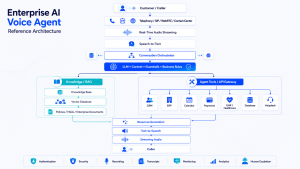
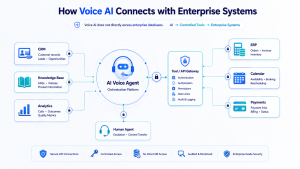
A mature enterprise deployment adds several capabilities around the basic pipeline. They fall into four groups.
Core intelligence: conversation orchestration, LLM reasoning, memory, and business rules.
Knowledge: a knowledge base, RAG, a vector database, and enterprise documents.
Business actions: CRM, ERP, calendar, payments, EHR, and databases.
Operations: call recording, transcripts, analytics, monitoring, security, and human escalation.
These layers are what separate a prototype from a production-ready system.
CRM Integration Architecture
CRM integration gives the voice agent business context. The AI may access the caller profile, previous interactions, opportunities, tickets, sales activities, lead status, assigned representative, and customer history. We go deeper on this pattern in our guide to AI voice agents with CRM integration.
A typical inbound sales flow:
Incoming Sales Call → Identify Caller → Search CRM → Understand Requirement → Qualify Lead → Update Opportunity → Book Meeting → Assign Salesperson
This turns Voice AI into part of the revenue workflow.
ERP Integration Architecture
ERP integration enables operational automation. The voice agent may support invoice inquiries, quotation status, order status, stock availability, customer information, support tickets, and purchase information. For a question like “Has my order shipped?” the flow could be:
Voice Request → AI Agent → Tool Gateway → ERP API → Order Information → AI Response → Caller
For platforms such as Odoo, this architecture can connect Voice AI with CRM, Sales, Invoicing, Helpdesk, Appointments, Contacts, and Inventory. Our Odoo AI integration guide covers how to wire these modules up safely.
Calendar Integration
Scheduling is one of the most natural Voice AI use cases. For a request like “I want an appointment next Tuesday after 2 PM,” the architecture can execute:
Intent Detection → Calendar API → Retrieve Available Slots → Present Options → Caller Selection → Create Appointment → CRM / EHR Update → Confirmation
This can automate appointments across healthcare, sales, real estate, professional services, and customer support. For the healthcare pattern specifically, see our post on AI voice agents for clinics.
Payment Architecture
Payment-related workflows require stronger controls. Use cases include checking an outstanding balance, generating a payment link, invoice payment, subscription renewal, and collections. A secure architecture should look like this:
Caller → AI Voice Agent → Payment Intent → Authentication → Secure Payment Tool → Payment Provider → Transaction Result → Voice Confirmation
Sensitive payment credentials should not be unnecessarily exposed to the LLM.
Knowledge Base and RAG
Not every conversation requires an API call. Many questions require trusted business knowledge, such as “What is your return policy?” The architecture can use:
Caller Question → Query Understanding → RAG Retrieval → Knowledge Base → Approved Information → LLM → Voice Response
Knowledge sources may include FAQs, SOPs, product manuals, policies, websites, healthcare documentation, internal knowledge, and support documentation. This lets the AI answer from company-approved sources rather than relying on general model knowledge.
Human Escalation Architecture
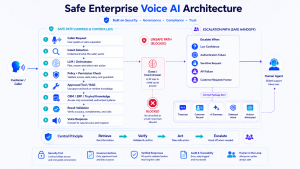
Human escalation should be designed from the beginning. The AI may escalate when confidence is low, the caller repeatedly corrects it, the caller asks for a human, authentication fails, an API fails, a request is sensitive, a complaint needs human judgment, or a high-value lead requires a salesperson.
A good handoff passes more than the call. It can pass the caller identity, the CRM record, the transcript, an AI summary, the detected intent, the actions already taken, and the reason for escalation. The flow is:
AI Agent → Escalation Trigger → Context Package → Human Agent → Conversation Continues
The caller does not need to start again.
Analytics and Observability
Voice AI should be measurable. A production platform should monitor both technical and business outcomes.
Technical metrics: response latency, STT accuracy, API success rate, tool execution errors, call drop rate, and interruption recovery.
Business metrics: task completion, containment rate, booking rate, lead conversion, average handling time, human escalation rate, cost per resolved call, and customer satisfaction.
The goal is not simply “did the AI answer?” The better question is “did the AI successfully complete the customer’s task?”
Real-Time Streaming Architecture
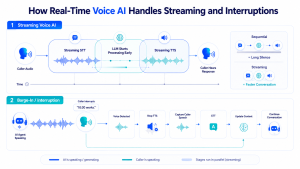
Voice AI is highly sensitive to latency. The caller experiences it across endpoint detection, STT, the LLM, API execution, and TTS. If every layer runs sequentially, the caller hears long pauses.
Sequential: listen completely, transcribe completely, generate the response, generate the audio, then play. This is slow.
Streaming: live audio feeds streaming STT, the LLM begins early, streaming TTS starts speaking before the full sentence is ready, and the caller hears the response sooner.
The streaming architecture feels significantly more natural.
Barge-In: When the Caller Interrupts
People rarely wait politely for every sentence to finish. Suppose the AI says “Available appointments are 10:30 AM, 1 PM, and…” and the caller cuts in with “10:30 is fine.” The AI must immediately detect the voice, stop TTS, capture the speech, transcribe it, update the context, and continue the conversation.
This behavior is known as barge-in. Without it, even sophisticated AI can feel like a traditional IVR.
Guardrails and Hallucination Prevention
Enterprise Voice AI should never depend on the LLM guessing business-critical information. For a question like “Has my payment arrived?” the wrong architecture is caller to LLM to answer. The safer architecture is:
Caller → Intent → Authorized Tool → Payment / ERP System → Verified Result → LLM Response → Caller
The principle is simple: retrieve, verify, then respond. Guardrails can include system policies, RAG, tool permissions, structured outputs, business rules, authorization, output validation, and human escalation.
Security and Access Control
Enterprise Voice AI can access sensitive business information. The architecture should include authentication, authorization, API security, encryption, audit logs, secret management, data retention policies, and PII controls.
For example, “What time does your office close?” may require no identity verification. But “What is my outstanding invoice balance?” may require authentication. The LLM should never decide access rights by itself.
Call Recording and Transcription
Calls may also flow into a post-call intelligence pipeline:
Call → Recording → Transcript → PII Redaction → Summary → Intent Classification → Quality Evaluation → CRM / Analytics
This supports QA, compliance, sales coaching, customer-service analysis, dispute investigation, and AI improvement. Recording and retention must follow applicable consent and regulatory requirements.
Basic vs Enterprise Voice AI Architecture
| Basic Architecture | Enterprise Architecture |
|---|---|
| Telephony | Telephony + contact center |
| STT | Streaming STT |
| LLM | LLM + orchestration |
| Prompt | Guardrails + policies |
| Basic response | Agent tools |
| Limited integration | CRM + ERP + APIs |
| TTS | Streaming TTS |
| Minimal memory | Session + workflow state |
| No formal auth | Authentication + authorization |
| Basic logging | Full observability |
| Call transfer | Context-aware human escalation |
| Demo focused | Production focused |
The difference is not simply more technology. It is the shift from a conversation demo to a business system.
What a Production-Ready Architecture Should Achieve
A good architecture should answer these questions:
- Can the caller interrupt naturally? If not, the experience will feel robotic.
- Can the AI access real business information? If not, it is mostly a conversational FAQ system.
- Can it safely execute actions? If not, it cannot automate workflows.
- Does it know when to escalate? If not, difficult calls will fail badly.
- Can the system recover from API or STT failures? If not, production reliability will suffer.
- Can you measure successful outcomes? If not, optimization becomes guesswork.
The Real Role of the LLM
One of the biggest misconceptions about Voice AI is that the LLM is the entire system. It is not. The LLM provides intelligence. The surrounding architecture provides the voice, context, knowledge, data, permissions, actions, security, reliability, and measurement.
The strongest Voice AI systems do not ask “how powerful is our LLM?” They ask “how reliably can our entire system complete a customer workflow?”
Bringing It Together
The full enterprise architecture chains telephony, real-time streaming, STT, the orchestrator, the LLM with guardrails, knowledge and tools, the CRM, ERP, calendar, payment and database systems, response generation, and TTS, all supported by authentication, security, monitoring, analytics, recording, transcripts, and human escalation. If you are planning the build itself, our companion guide walks the process step by step: how to build an AI voice agent in 2026.
Conclusion
AI voice agent architecture is not simply STT to LLM to TTS. That is only the conversational core. Enterprise Voice AI adds orchestration, tools, business rules, knowledge, CRM, ERP, calendar, payments, security, analytics, and human escalation. The LLM understands the conversation. The enterprise architecture turns that understanding into action.
At Appther, we design and develop enterprise AI voice agents that connect real-time conversations with CRM, ERP systems such as Odoo, healthcare platforms, scheduling systems, payment workflows, databases, and custom enterprise APIs. The goal is not merely to create an AI that can talk. It is to build a voice system that can understand, reason, act, verify, escalate, and complete real business workflows reliably.
Ready to Build Your Enterprise Voice AI Architecture?
From architecture and proof of concept to CRM and ERP integration, real-time streaming, enterprise APIs, testing, and deployment, Appther can help build production-ready Voice AI systems.
Discuss Your Voice AI Project →
Frequently Asked Questions
What is AI voice agent architecture?
AI voice agent architecture is the combination of telephony, real-time audio, speech recognition, LLM reasoning, orchestration, tools, business systems, text-to-speech, security, analytics, and human escalation that enables automated voice conversations.
What are the main layers of an AI voice agent?
The main layers are telephony, audio streaming, Speech-to-Text, orchestration, LLM reasoning, agent tools, enterprise integrations, and Text-to-Speech.
Why does an AI voice agent need agent tools?
Tools let the AI execute real actions such as checking orders, creating appointments, updating CRM records, retrieving invoices, creating support tickets, or transferring calls.
How does Voice AI integrate with CRM and ERP systems?
The AI calls controlled APIs or tools that communicate with CRM and ERP applications. The LLM identifies the required action, while application logic handles authorization, validation, and execution.
What is the role of RAG in Voice AI?
RAG lets the system retrieve approved business information from knowledge bases, documents, policies, FAQs, and manuals before generating a response.
Why is human escalation important?
Not every interaction should be automated. Human escalation provides a safe path for low-confidence, sensitive, complex, or unsupported requests while preserving conversation context.
What makes enterprise Voice AI different from a voice bot?
Enterprise Voice AI integrates with business systems, maintains workflow state, executes tools, applies security and business rules, provides analytics, and supports structured human escalation.
Is the LLM the most important part of Voice AI architecture?
The LLM is important, but it is only one component. Reliable enterprise Voice AI depends equally on telephony, streaming, integrations, business logic, security, orchestration, and observability.