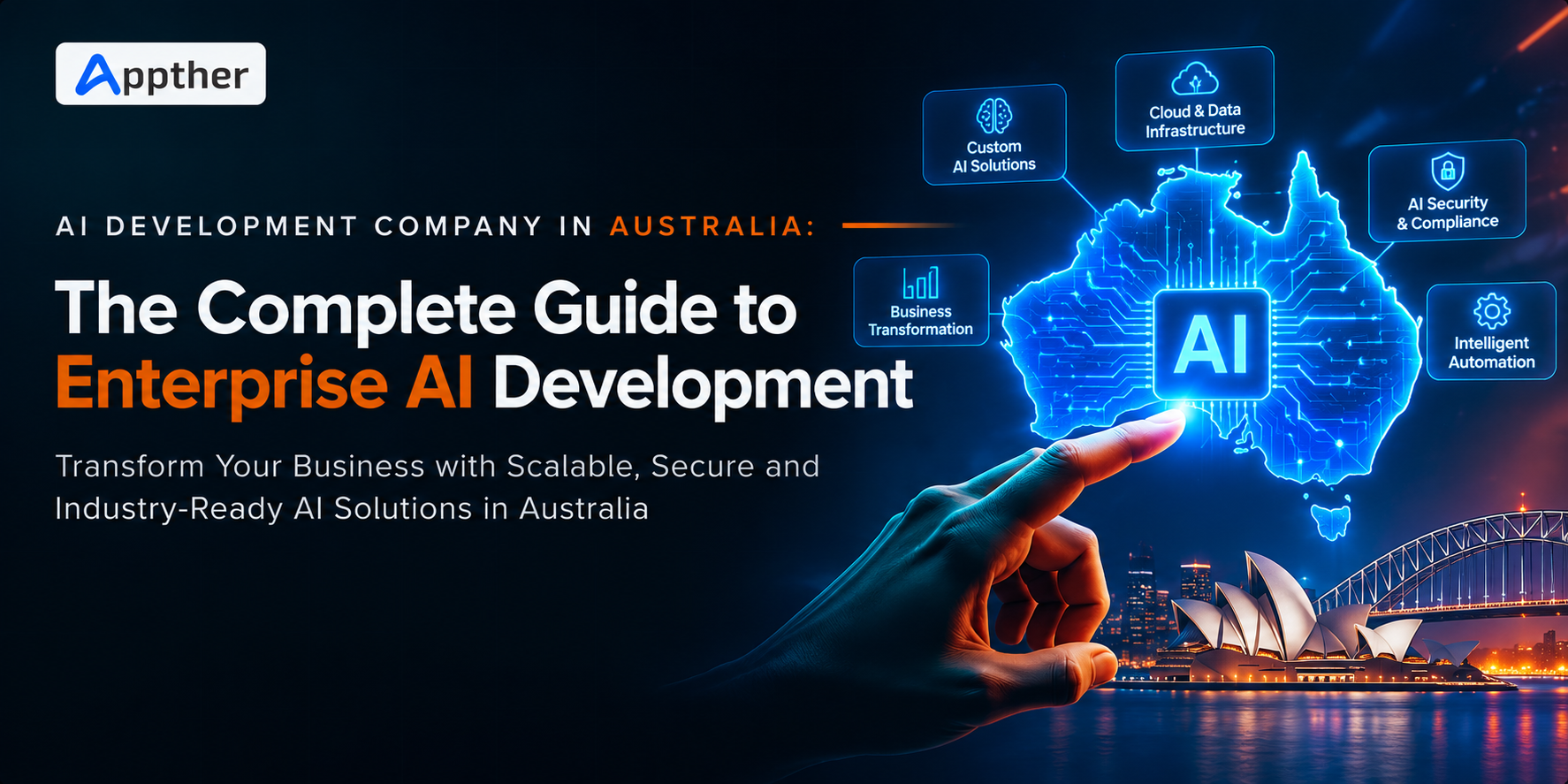
| To choose the right AI development company in Australia, look past app builders and strategy-only consultants. You want a partner that ships production AI systems: machine learning, RAG, AI agents and computer vision built into your ERP, CRM and daily operations. Judge candidates on live systems running today, engineering and integration depth, Privacy Act 1988 compliance with onshore data, genuine AEST overlap, transparent AUD pricing with full IP ownership, and MLOps support after launch. A focused pilot commonly starts around AUD 20,000 to 50,000. |
Australia’s AI shift is real and fast. Businesses are moving AI out of slide decks and into the systems that run their operations: ERP, CRM, supply chain, finance, and field services.
That shift created a labelling problem. Almost every software firm now calls itself an AI company. Some engineer machine learning into production systems. Some wrap a chatbot around an API and change their homepage. From the outside, the two look the same.
This guide helps you tell them apart, and it focuses on one job: building AI into the business systems you already run. If you are building a brand new AI-powered app instead, start with our guide to choosing an AI app development agency in Australia. If you only need strategy and governance advice, our guide to choosing an AI consultant in Australia is the better fit.
Here we cover what a real AI development company does, what it costs in AUD, the questions that expose weak candidates, and the red flags worth walking away from.
What an AI Development Company Actually Builds
Three roles get blurred together, so it helps to be precise.
A strategy consultant advises on use cases, roadmaps and governance, then hands over. An app agency builds new mobile or web products with AI features inside them. An AI development company engineers intelligence into your existing operations. It connects models to your ERP and CRM, automates document-heavy workflows, adds forecasting and anomaly detection to your data, and puts computer vision on your production line or site.
The work is integration-first. The value shows up inside the systems your team already uses every day, not in a standalone app. That takes a different skill set: data engineering, retrieval pipelines, model operations, and the discipline to keep AI accurate and safe once it touches live business data.
Why the Choice Carries More Risk with AI
Choosing badly always costs money. AI raises the stakes in three ways.
Demos deceive. A slick prototype is easy to build now and hard to run in production. The gap between the two is where AI projects fail, and you cannot see it in a sales meeting.
Integration is unforgiving. Bolting AI onto a live ERP or CRM touches real data, real permissions and real workflows. Weak engineering here breaks things people depend on.
The compliance surface is larger. An AI system reads more data, makes more decisions, and carries more privacy duties than a standard build. In Australia, that obligation lands on you, the business, not only the vendor.
Six Criteria That Separate Real AI Companies from Rebranded Ones
1. Production AI systems, not case-study slides
Ask to see an AI system real users depend on today. Then dig in. Which model runs it? How is accuracy monitored? What happened when it failed? Specifics and war stories signal real experience. Slideware signals a rebrand.
2. Engineering and integration depth
You need the model and the plumbing. Look for real work with LLMs, RAG pipelines, and frameworks like TensorFlow and PyTorch, plus the data engineering and cloud skills to connect them to your ERP, CRM and databases. A company that outsources half of this adds cost, delay and finger-pointing.
3. Privacy Act 1988 compliance and onshore data
AI systems run on your data, so privacy is architecture, not paperwork. Your partner should design around the Privacy Act 1988 and the Australian Privacy Principles from day one, offer onshore hosting in Australian regions such as AWS Sydney where your sector needs it, and guarantee your private data never trains public models. For health, finance and government workloads, treat this as non-negotiable.
4. Genuine AEST overlap
AI work is a stream of decisions: model trade-offs, data questions, behaviour reviews. Those cannot wait a full day. Look for a team that genuinely overlaps Australian business hours, through local presence or a delivery centre in a nearby time zone.
5. Transparent AUD pricing and full IP ownership
Know what you pay for, and own what you paid for: the code, the fine-tuned models, the prompts and the data pipelines. Insist on clear work-for-hire terms and signed NDAs. A partner that keeps your models is building leverage, not software.
6. MLOps and post-launch support
AI is not fire-and-forget. Models drift, costs need tuning, behaviour needs watching. A serious partner offers ongoing MLOps: accuracy tracking, retraining, model and prompt updates, and cost control. If support is an afterthought in the proposal, they have not run production AI for long.
Industry Experience That Shortens Delivery
Every sector carries its own rules, data and workflows. A strong AI development company already understands yours.
- Healthcare: clinical document processing, patient flow, and My Health Records and Privacy Act alignment.
- Financial services: fraud detection, KYC automation and secure workflows, with APRA CPS 234 in mind.
- Construction: safety document automation, risk analysis, and site inspection with computer vision.
- Mining: equipment monitoring, predictive maintenance, and worker safety analytics.
- Retail and eCommerce: demand forecasting, recommendations, and customer service automation.
- Manufacturing: predictive maintenance, inventory optimisation, and quality inspection.
Domain knowledge shortens delivery and lowers risk, because the partner already understands your data and your rules.
What Enterprise AI Development Costs in Australia
Prices vary with scope, but the market has settled into recognisable AUD bands. Use the table below as a planning guide, then get a fixed quote against your actual brief.
| Engagement | What it covers | Typical cost | Timeline | Run cost / mo |
|---|---|---|---|---|
| Pilot / PoC | One automated workflow or a document assistant | 20,000 to 50,000 | 8 to 12 weeks | 500+ |
| Production integration | Custom models and a data pipeline inside your ERP or CRM | 60,000 to 150,000 | 3 to 5 months | 2,000+ |
| Enterprise programme | Deep ML, computer vision or heavy-compliance systems | 150,000+ | 4 to 6 months+ | 5,000+ |
All figures are indicative and in AUD. Running costs vary with usage, model choice and data volume.
Not sure which tier fits? Most first AI builds in Australia start as a pilot, then grow into a production integration once the value is proven.
What drives the price up or down
Two projects with the same goal can differ in cost by a wide margin. Five factors explain most of the gap.
| Cost driver | Keeps cost lower | Pushes cost higher |
|---|---|---|
| Data readiness | Clean, structured, documented data | Messy, siloed or missing data |
| Integration scope | One system with a clear API | Several legacy systems and custom connectors |
| Model approach | An existing model called via API | Fine-tuning or a custom-built model |
| Compliance load | Standard business data | Health, finance or government data |
| Usage volume | Low, predictable traffic | High volume, real-time and always-on |
Ask each candidate which side of these five factors your project sits on. Their answer explains the quote.
Two notes on the numbers. AI systems carry ongoing model and infrastructure costs that a normal build does not, so ask for the monthly running cost, not just the build price. And a hybrid partner, with Australian-hours leadership and a global engineering centre, often delivers the same senior quality at a lower rate than a fully local team. Judge the proof and the process, not the postcode. For app-specific budgets, see our AI app development cost guide for Australia.
Questions to Ask Before You Sign
Take these into your first meetings. Strong partners welcome them. Weak ones deflect.
- Which AI systems have you put into production, and can I speak to that client?
- How will you integrate with our existing ERP, CRM and data, without breaking what works?
- How do you keep our data compliant with the Privacy Act, and can it stay onshore?
- Who owns the code, prompts, models and pipelines when we part ways?
- How do you test AI behaviour, not just software function?
- What will this cost to run each month, and how do you monitor accuracy and drift?
Red Flags That Should End the Conversation
- Every answer is a demo, and no production system is ever named.
- AI is offered as the fix before anyone asks about your data or systems.
- Vague answers on privacy, data location or model training.
- No mention of integration testing, model monitoring or running costs.
- The partner keeps ownership of your models, prompts or data.
- Pressure to commit to a big build with no discovery phase or pilot.
One more, easy to miss: a partner that agrees to everything. Real AI engineers push back, because some problems do not need AI and some data cannot support the goal. Honest friction early is a feature, not a flaw.
Company, Consultant, or In-House
An AI development company is not the only path, so be honest about the alternatives.
In-house gives you the most control, but senior AI engineers are among the scarcest and most expensive hires in Australia, and one hire cannot cover data engineering, machine learning, integration and MLOps at once.
A consultant is right when you only need strategy and governance. See our guide to choosing an AI consultant in Australia.
An AI development company gives you the full team, the delivery process and the accountability in one contract. For most Australian businesses embedding AI into live operations, it is the fastest route to production.
A Simple Process for Choosing
Pull it together into a sequence that works.
Write a one-page brief: the problem, the systems involved, the data you hold, and what success looks like in numbers.
Shortlist three to five companies, filtered for shipped AI work and Australian-market experience. Our list of the top AI development companies in Australia is a useful starting point.
Put each through the six questions above, and vet the actual engineering team, not the salesperson.
Compare on proof, integration approach and running costs, not the headline rate.
Then start the winner on a discovery phase or a small paid pilot before the full build. Two to four weeks of discovery removes the most expensive risk of all, which is building the wrong thing with confidence.
Where Appther Fits
| Appther is an AI-first software development company, founded in 2018, that builds production AI into business systems: machine learning, RAG, AI agents and computer vision inside ERP, CRM and operational platforms. Our team has delivered more than 200 projects across healthcare, manufacturing, mining, real estate and logistics, in over a dozen countries including Australia.
The delivery model suits Australian buyers. Leadership overlaps AEST hours, engineering runs through a dedicated centre that keeps costs sensible, and every engagement includes full IP ownership, signed NDAs and Privacy Act aware architecture. See our AI development services and our Australian AI and software development page, or book a free consultation. |

Frequently Asked Questions
How much does an AI development company cost in Australia?
A focused pilot commonly starts around AUD 20,000 to 50,000. A production integration into your ERP or CRM runs into six figures. Enterprise programmes can exceed AUD 150,000. Always ask for the monthly running cost as well.
What is the difference between an AI development company and an AI app agency?
An app agency builds a new product with AI inside it. An AI development company builds AI into the systems you already run, such as your ERP, CRM and data. Many businesses use one or the other, and some use both.
Does the company need to be based in Australia?
No, but it needs to work like it is. Genuine AEST overlap, Privacy Act compliance and onshore data options matter more than the office address.
How do you keep AI projects compliant with Australian privacy law?
A good partner designs around the Privacy Act 1988 and the Australian Privacy Principles, offers onshore hosting where your sector needs it, and never trains public models on your private data.
How long does an enterprise AI project take?
A focused pilot can ship in 8 to 12 weeks. A full integration with custom models and compliance takes four to six months or more.