Quick answer
| In short
AI voice agents usually pass the demo and fail on production calls. The failures come from the engineering around the model, not the model itself. Latency, hallucination, interruptions, accents and code-switching, background noise, intent routing, escalation, CRM writes, authentication, prompt drift and cost all break under real conditions. Below are the 11 failure points we hit most often, what we assumed each time, and exactly what we changed after listening back to calls that went wrong. |
Voice agents pass demos. Production calls are different.
Real callers speak over the agent. They change their request halfway through a sentence. They use regional accents, give incomplete information, and call from noisy places. They also expect the agent to remember what they said two turns ago.
At the same time the agent may need to authenticate the caller, retrieve live information, update a CRM, invoke business APIs and escalate the conversation safely. That is a lot of machinery for something the demo made look like a chat window with a microphone.
The market is not waiting. Gartner forecasts that conversational AI will cut global contact centre labour costs by around USD 80 billion, the voice AI agents market is projected to reach USD 47.5 billion by 2034 at roughly 34.8 percent CAGR, and about 80 percent of businesses now plan to bring AI voice into customer service. Production deployments grew sharply year on year, and so did the failure rate.
Gartner also attributes 57 percent of failed AI initiatives to unrealistic expectations and 38 percent to poor data quality. That matches what we see. Through our work on voice and conversational AI systems, production quality turned out to depend far less on building an impressive demo and far more on engineering for uncertainty. A mediocre model wrapped in good AI voice agent architecture beats a state-of-the-art model wrapped in poor architecture, every time.
Below are the 11 failure points that cost us the most, what we assumed in each case, and exactly what we changed after listening back to the calls that broke.
The 11 failure points at a glance
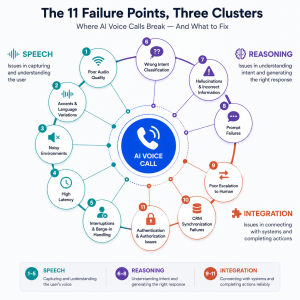
| # | Failure point | What actually fixes it |
|---|---|---|
| 1 | High response latency | Streaming STT and TTS, partial transcripts, per-stage latency budgets |
| 2 | Hallucinated answers | RAG grounding plus a verified tool result before any transactional claim |
| 3 | Poor interruption handling | Interruption classification with conversation state preserved |
| 4 | Accents, dialects, code-switching | Region-matched ASR, custom lexicons, utterance-level language detection |
| 5 | Background noise | Noise suppression plus confidence-based clarification and keypad fallback |
| 6 | Wrong intent routing | Multi-intent support and an explicit unknown-intent route |
| 7 | Broken escalation | Trigger rules, queue routing, warm transfer with full context |
| 8 | CRM and backend sync failures | Idempotency keys, confirmed writes, queued retries |
| 9 | Weak or excessive authentication | Progressive verification matched to the risk of the action |
| 10 | Prompt drift | Split prompts, deterministic workflow controls, versioning and regression suites |
| 11 | Cost and ROI overruns | Cost per resolved call, model tiering, phased rollout with real KPIs |
The 11 reasons AI voice agents fail, and what we changed
1. Latency is a conversation-design problem, not just an infrastructure problem
Our first instinct was to reduce model inference time. That helped, but it did not solve the whole problem.
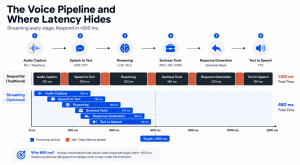
A voice response passes through several stages: audio capture, then speech to text, then intent and reasoning, then business tools, then response generation, then text to speech. A small delay at every stage adds up to several seconds of silence. Peer-reviewed work published through the ACM found statistically significant degradation in user engagement, impression and willingness to re-engage at a four-second response delay. In production, callers expect sub-second responses; anything past about 1.5 seconds already reads as robotic. Roughly 600 milliseconds end to end is the benchmark worth architecting for.
What we changed
- Started processing partial transcripts before the caller finished speaking.
- Streamed generated sentences into the text-to-speech engine instead of waiting for the full response.
- Cached common responses and frequently accessed business data.
- Removed unnecessary prompts, tools and model calls from the hot path.
- Added short acknowledgement phrases when a backend operation needed more time.
- Measured latency at each pipeline stage, not just total call latency.
| Appther field note
A technically accurate answer delivered too slowly still feels like a failed answer. Callers read unexplained silence as a dropped call or a broken system. |
We set out the full pipeline, stage by stage, in our guide to AI voice agent architecture.
2. Hallucination controls must live outside the prompt
A prompt telling the model to only provide accurate information is not a reliable safety mechanism.
Voice hallucinations are especially damaging because callers act immediately on what they hear about pricing, appointments, payments, eligibility or account status, and they cannot scan back up the page to check it the way they can with text.
What we changed
- Restricted sensitive answers to approved knowledge and live system data.
- Required a confirmed tool result before communicating any transactional outcome.
- Separated generated conversation from authoritative business facts.
- Introduced explicit “information unavailable” and escalation paths.
- Prevented the model from inventing missing API values.
- Logged the source used for every important response.
| Appther field note
If the CRM does not return an appointment confirmation, the agent must not say the appointment was booked, even when the conversation model believes that is the most helpful thing to say. |
The grounding layer is a retrieval problem before it is a prompting problem; we break the pattern down in how to implement RAG in your AI system, and the same pipelines sit behind our AI chatbot development services.
3. Interruption handling is a dialogue-state problem, not a stop-speaking feature
Adding voice activity detection makes interruption possible. It does not automatically make interruption natural.
We saw agents stop speaking at exactly the right moment, then lose the caller’s original objective, repeat an earlier response, or restart the dialogue from the top. Humans interrupt constantly, to correct themselves, add context, or cut off an answer they did not need, and an agent that resets on every barge-in pushes callers straight to “operator”.
What we changed
- Distinguished genuine interruptions from background speech and short acknowledgements.
- Stopped audio playback without deleting the conversation state.
- Preserved unfinished tasks and already-collected information.
- Classified whether the interruption corrected, replaced or supplemented the previous request.
- Tested rapid back-and-forth exchanges, not only clean turn-by-turn conversations.
| Appther field note
Barge-in is not a stop-speaking feature. Losing context on interruption is an architecture flaw, not a limitation of the language model. |
4. Accent, dialect and code-switching testing must use your actual customer population
An agent can hit strong transcription accuracy on a generic test set and still misunderstand real customers. Regional pronunciation, non-native English, local names, addresses, product terms and code-switching all affect recognition, and standard ASR models are typically trained on clean, accent-neutral audio.
Code-switching is the harder half. A caller in Addis Ababa may move between Amharic and English inside one sentence; a caller in Mumbai may blend Hindi and English. Agents trained on single-language datasets fail hard in those conversations, and translating one English dialogue flow into another language is not the same as localising it.
What we changed
- Tested with speakers representing the target regions rather than a generic benchmark set.
- Created custom dictionaries for names, locations and industry terminology.
- Used contextual hints where the speech provider supports them.
- Deployed multilingual NLU with language detection and switching at the utterance level.
- Built language-specific dialogue flows instead of translating a single English flow.
- Confirmed critical values such as names, dates, amounts and account numbers.
- Routed low-confidence transcripts into clarification flows.
| Appther field note
Overall accuracy hides serious problems. A system can understand most of a sentence while repeatedly mishearing the one account number or suburb name it needed to finish the task. |
We cover the language architecture in more depth in our multilingual chatbot development guide, and Appther’s AI development services include NLP models trained for accent diversity and multilingual customer bases.
5. Noisy calls need confidence-based recovery, not just noise suppression
Callers do not phone from quiet rooms. They are driving, travelling, working in a branch, standing near machinery or calling from a crowded space. An Interspeech study found overlapping speech at moderate noise levels pushed transcription error rates to 74.6 percent against 16.8 percent on clean audio, roughly a 4.4x degradation, with background noise alone doubling the error rate.
Noise suppression narrowed the gap for us. It did not close it. What changed the outcome was what the agent did when it was unsure.
What we changed
- Combined noise reduction and echo cancellation with transcript-confidence thresholds.
- Asked callers to repeat only the uncertain part, not the whole request.
- Used digit-by-digit confirmation for sensitive numeric input.
- Stopped treating uncertain transcripts as confirmed intent.
- Offered keypad entry or a human when voice capture stayed unreliable.
| Appther field note
The goal is not to understand every noisy utterance. It is to recover safely when the system is unsure. |
6. Intent classification should not force every call into a label
Rigid intent taxonomies make an agent look confident while sending the caller down the wrong workflow.
Real requests often carry more than one intent, “move tomorrow’s appointment, and also check whether my payment went through” is one utterance and two jobs. A single-label classifier answers half of it and drops the rest.
What we changed
- Supported multiple intents within the same utterance.
- Preserved unresolved tasks in the conversation state.
- Added an unknown-intent route instead of forcing the nearest classification.
- Asked a clarifying question when two workflows were equally likely.
- Reviewed misclassified production calls weekly and updated the taxonomy continuously.
| Appther field note
An unknown classification is usually safer and more useful than a confidently incorrect one. |
This is one of the practical differences between a scripted bot and a genuine conversational system, which we unpack in chatbots vs conversational AI.
7. Human escalation must be designed as a complete workflow
Transferring the call is not enough on its own. A poor escalation sends callers to the wrong queue, loses their context, or makes them repeat everything to the human agent.
The most damaging pattern is not an agent that cannot answer a question. It is an agent that keeps trying when it should have transferred the call three exchanges earlier. By the time that caller reaches a person, they have already formed a view about how much the business values their time.
What we changed
- Added escalation triggers for repeated failures, explicit requests and negative sentiment.
- Detected loops where the agent asked the same question again and again.
- Routed calls by intent, geography, language and operating hours.
- Passed the transcript, a summary and all collected details to the human agent.
- Defined an alternative path for when no human agent was available.
| Appther field note
Containment rate should not be maximised at the expense of customer experience. A timely escalation is a successful outcome, not a failed one. |
8. CRM and backend synchronisation need transaction-level controls
A voice agent that can talk but cannot act is a novelty. The value sits in the writes: creating leads, updating customer records, booking activities and logging outcomes across CRM, ERP, payment, scheduling and ticketing systems.
Those writes fail even when the conversation sounds perfect, API timeouts, auth failures, format mismatches, rate limits. Worse, naive retries create duplicate leads, duplicate tickets and duplicate appointments.
What we changed
- Used unique transaction identifiers for every write operation.
- Made CRM actions idempotent wherever the API allowed it.
- Confirmed successful writes before telling the caller anything had happened.
- Queued recoverable updates when the CRM was temporarily unavailable.
- Added retry with exponential backoff, circuit breakers and graceful degradation so the conversation never went silent.
- Logged failed synchronisation attempts for daily operational review.
- Separated the call transcript from structured CRM fields.
| Appther field note
A successful conversation with an unsuccessful CRM update is still a failed business transaction. |
The write path is worth designing before the dialogue: see our step-by-step guide to AI voice assistant CRM integration. Appther builds these middleware layers as part of our API development and integration services, connecting voice AI to Salesforce, SAP, Oracle, Odoo and custom platforms.
9. Authentication must match the risk of the requested action
Recognising a returning phone number is convenient. It is not enough for sensitive operations, and the threat model in 2026 is not theoretical: voice cloning can impersonate a customer or an executive, and inaudible command injection can manipulate an agent without the caller noticing.
The other half of the problem is regulatory. Voice systems capture names, account numbers, payment details and medical information, and unintended recording or storage creates real liability under GDPR, HIPAA, CCPA and Australia’s Privacy Act reforms.
What we changed
- Allowed low-risk general enquiries through without unnecessary verification.
- Added OTP or approved identity checks before exposing account information.
- Re-authenticated before payments or high-risk account changes.
- Used voiceprint verification in place of knowledge-based questions where the risk justified it.
- Kept sensitive data from being spoken aloud unnecessarily.
- Encrypted voice data in transit and at rest, and redacted PII from transcripts and logs.
- Escalated to a human when identity verification repeatedly failed.
| Appther field note
Authentication should be progressive. Verifying every caller heavily creates friction; verifying sensitive actions weakly creates risk. |
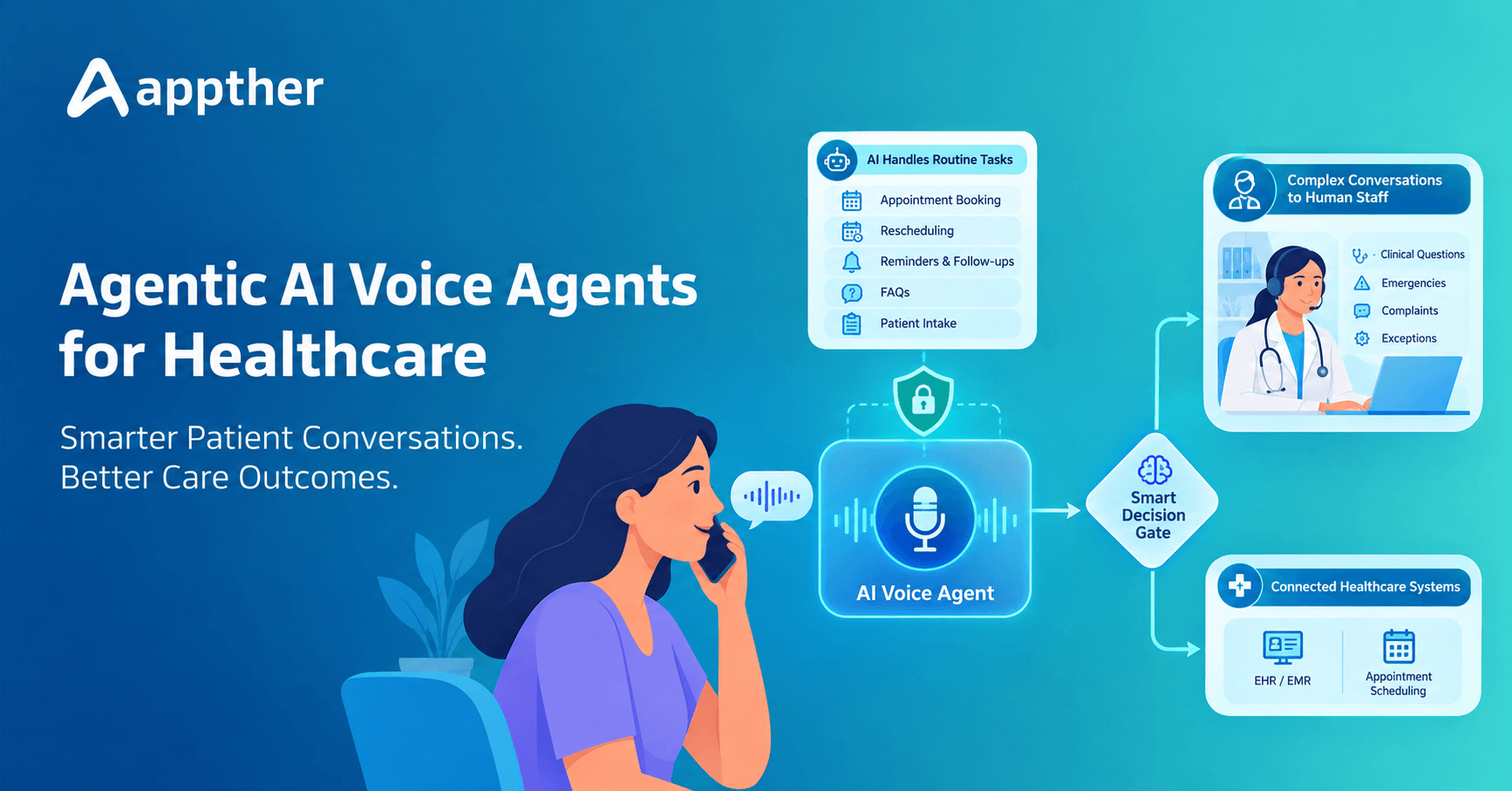
For regulated deployments, the compliance architecture comes first, we set out what that looks like in HIPAA-compliant agentic voice agents for healthcare.
10. Prompt failures usually reveal missing system controls
A large master prompt looks efficient early on. Over time it becomes hard to test and starts to hold instructions that quietly contradict each other.
Prompts also get weakened in production by unexpected caller language, long conversations and retrieved content that pulls the model off script.
What we changed
- Separated policy, persona, task and tool instructions into distinct blocks.
- Used deterministic workflow controls for critical operations instead of trusting instructions.
- Validated tool parameters before execution.
- Limited retrieved content to relevant and trusted sources.
- Versioned prompts and tested every change against recorded call scenarios.
- Wrote explicit rules for uncertainty, prohibited actions and escalation.
| Appther field note
Prompts guide behaviour. They should never be the only control protecting a business transaction. |
11. Cost and ROI break on architecture and expectations, not on per-minute pricing
Per-minute estimates mislead once calls carry long silences, repeated model requests, unnecessary retrieval or oversized prompts. Real operating cost includes telephony, transcription, synthesis, model usage, monitoring, storage and third-party APIs.
The non-technical half of this is the more common project killer. Leadership teams expect 90 percent automation in month one, or assume the agent will replace the human team outright. When early numbers fall short of a benchmark that was never realistic, budget gets pulled, often just before the system would have reached production maturity.
What we changed
- Tracked the cost of each call by pipeline component.
- Used smaller models for classification and routine dialogue steps.
- Reserved more capable models for genuinely complex reasoning.
- Cached repeatable information and trimmed prompt and conversation-history size.
- Added safeguards against loops and excessively long calls.
- Measured cost per successful outcome, not cost per minute.
- Phased the rollout: highest-volume, lowest-complexity use cases first, then expanded scope against real KPIs, containment rate, handling time, CSAT, cost per interaction and escalation rate.
| Appther field note
The cheapest call is not the most efficient call. A slightly more expensive interaction that completes the request beats a cheaper one that creates a support ticket and human rework. |
We break the numbers down by deployment size in AI voice agent development cost: MVP vs enterprise.
Appther field notes: what we changed after testing real calls
The biggest improvements did not come from switching to a newer language model. They came from listening to failed calls and finding exactly where the experience broke.
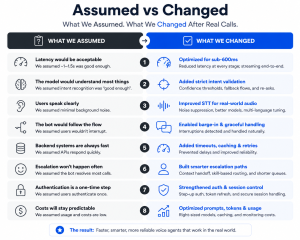
| What happened during testing | What we initially assumed | What we changed |
|---|---|---|
| Callers spoke while the agent was responding | Basic voice activity detection would handle interruptions | Added interruption classification and conversation-state preservation |
| The agent gave a success message after an API timeout | The model would infer that the operation had failed | Required verified tool results before any transactional confirmation |
| Names and account references were mistranscribed | General speech accuracy was enough | Added contextual vocabulary and confirmation for critical values |
| CRM retries created duplicate records | Retrying an unsuccessful request was safe | Added idempotency keys and duplicate controls |
| Frustrated callers stayed trapped in the automated flow | Sentiment detection alone would trigger escalation | Combined sentiment, repeat count, confidence and explicit escalation rules |
| Response times rose during complex requests | A faster model would solve latency | Profiled STT, tools, model and TTS separately and streamed the pipeline |
| Call costs exceeded early estimates | Per-minute provider pricing represented total cost | Measured full cost per successfully resolved call |
| Prompt updates fixed one scenario but broke another | Prompt changes were isolated | Introduced prompt versioning and regression call suites |
Why this section is hard to copy
A competitor can restate 11 problems in an afternoon. So can an AI-generated page. What neither can copy is the specific assumption you got wrong and the specific change you made after a real call broke. This table is the credibility of the article, as live call data accumulates, real figures will sharpen it further.
The deeper pattern: these are architecture problems, not AI problems
If there is one takeaway across all 11 lessons, it is that voice AI failures are almost never caused by the language model. They are caused by what sits around it, pipeline design, the integration layer, data quality, conversation design and deployment strategy.
Production voice AI should be treated as an operational system, not a chatbot connected to a phone number. Reliable deployments need measurable latency budgets, confidence-aware recovery, grounded responses, controlled tool execution, resilient business-system integration, secure authentication, complete human handoff, call-level observability and continuous testing under real conditions.
If you are earlier in the journey, our walkthrough of how to build an AI voice agent covers the build sequence, and AI voice agents for clinic automation shows what the same engineering looks like in one high-volume booking workflow. Our healthcare voice agent case study covers a deployment where most of these controls were load-bearing.
The language model matters. The engineering around it decides whether callers trust the agent.
Frequently asked questions
Why do AI voice agents fail in production but work in demos?
Demos use clean audio and cooperative testers. Production calls bring accents, background noise, interruptions, incomplete information, live system writes and authentication. Most failures sit in the engineering around the model, not in the model itself.
How do you reduce AI voice agent latency?
Treat it as a conversation-design problem. Process partial transcripts, stream text to speech, cache common data, trim prompts and tool calls, and add a short acknowledgement while backend work runs. Measure latency at each pipeline stage rather than end to end only. About 600 milliseconds end to end is a realistic production target.
How do you stop a voice agent from hallucinating?
Keep the controls outside the prompt. Ground answers in live system data through a retrieval layer, require a confirmed tool result before stating any transactional outcome, and give the agent an explicit “information unavailable” path instead of letting it invent values.
When should a voice agent escalate to a human?
On clear triggers: repeated failure on the same step, an explicit request for a person, or negative sentiment. Make it a warm handoff that passes the transcript, a summary and the details already collected, so the caller never repeats themselves.
How much does it cost to build an AI voice agent?
It depends on scope. A focused FAQ agent typically starts around USD 15,000–25,000, while a transactional agent with CRM integration, multilingual support and compliance controls runs closer to USD 40,000–80,000. Production run costs land near USD 0.07–0.15 per minute against USD 2.50–4.00 per minute for a human agent.
What is a good containment rate for a voice agent?
Well-built agents commonly reach 60–80 percent containment on tier-one enquiries, and 85–90 percent on tightly structured use cases such as appointment scheduling, balance enquiries and order status. Start with a focused scope and expand from there.
How long does it take to deploy a production voice agent?
A focused MVP covering the top 20–30 use cases usually takes 8–12 weeks from discovery to launch. Enterprise deployments with complex integrations, multilingual support and compliance requirements run 14–20 weeks, with improvement continuing after go-live.
How do you control AI voice agent costs?
Measure cost per successful outcome rather than cost per minute. Use smaller models for routine steps, reserve capable models for complex reasoning, cache repeatable data, trim context, and guard against loops and overlong calls.
Building a voice agent that has to work on real calls?
Appther builds AI voice agent development for booking, support and reminders, with grounded responses, progressive authentication, clean CRM and calendar sync, and safe human handoff.
Tell us the workflow and we will map the failure points before they reach your callers, talk to our team.