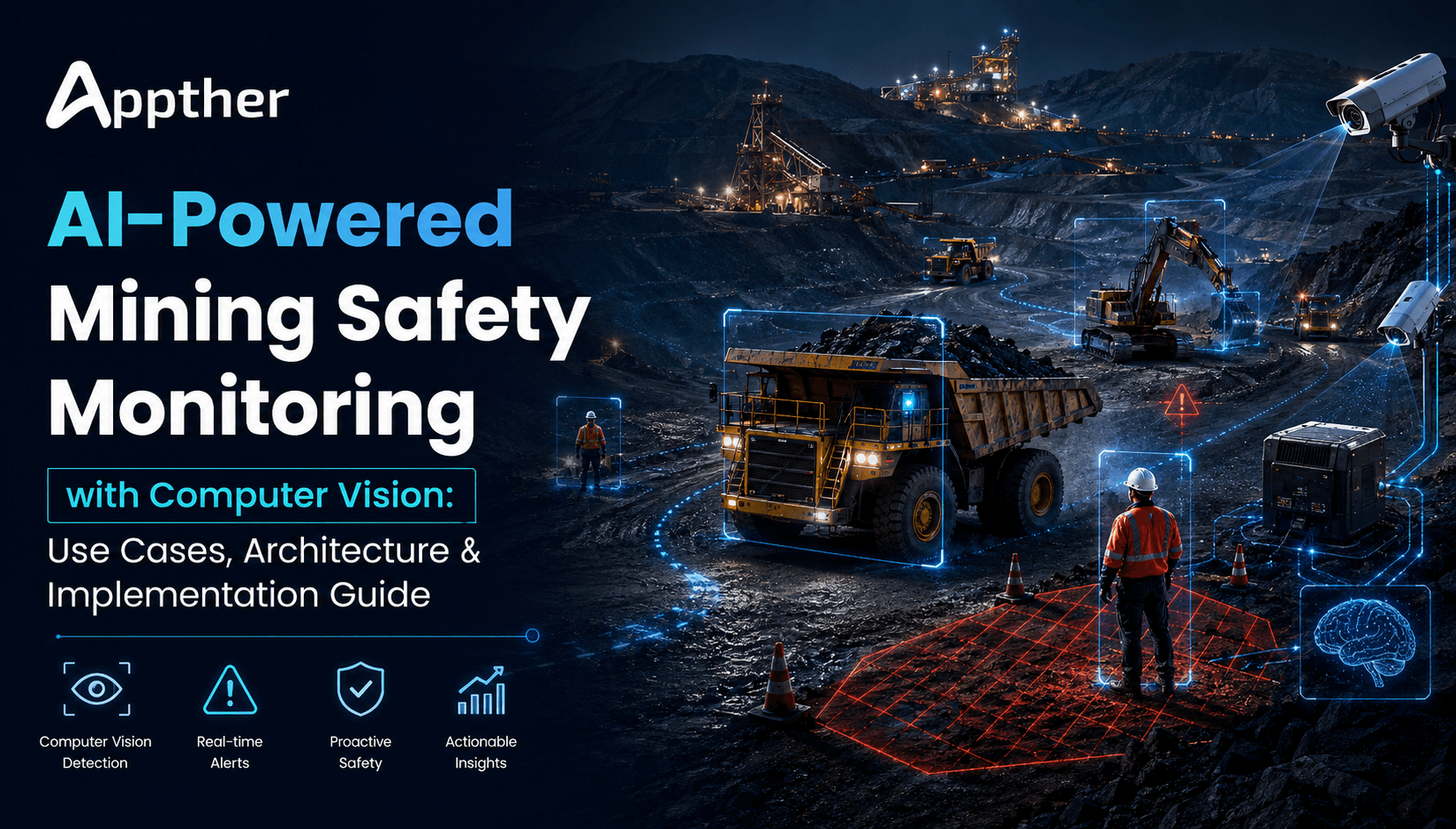
Mining remains one of the world’s most safety-critical industries, where a single lapse in awareness can have severe consequences. In 2025, the U.S. Mine Safety and Health Administration (MSHA) recorded 33 mining fatalities, compared with 28 in 2024. Globally, member companies of the International Council on Mining and Metals (ICMM) reported 39 fatalities in 2025.
At the same time, ICMM members reported 6,183 total recordable injuries in 2025 the lowest number since ICMM began collecting member safety-performance data in 2012.
The divergence highlights an important challenge. Traditional controls such as procedures, training, PPE, critical-control management and worker supervision remain essential, but they cannot provide continuous situational awareness across every high-risk environment.
That is where AI-powered computer vision can add another layer of protection.
By combining cameras, edge AI, sensors and operational data, mining companies can continuously identify hazardous situations such as missing PPE, pedestrian–vehicle interactions, restricted-zone entry, operator fatigue, smoke, equipment overheating and other emerging risks.
At Appther, we build AI and connected-device systems that transform camera and sensor infrastructure into intelligent monitoring platforms capable of detecting, contextualising and escalating safety events in near real time.
This guide explains how computer vision works in mining environments, the highest-value use cases, the technology architecture behind these systems, implementation challenges, regulatory considerations and how mining operators can move from a focused proof of concept to production deployment.
Key Takeaways
- Computer vision can transform CCTV and specialised cameras from passive recording systems into active safety sensors.
- Edge AI is particularly important for latency-sensitive applications such as vehicle interaction and restricted-zone monitoring.
- High-value applications include PPE compliance, pedestrian–vehicle interaction, hazard-zone detection, fatigue monitoring, fire and smoke detection, and equipment tracking.
- Computer vision is often most effective when combined with radar, LiDAR, proximity detection, telemetry and other sensors.
- Operational metrics such as false alarms per shift, missed critical events and detection latency matter more than laboratory accuracy alone.
- Worker privacy, acceptance and clear governance should be treated as system-design requirements.
- Modern vision-language and multimodal AI can make safety footage searchable and easier for safety teams to investigate.
- Successful deployment depends as much on integration, hardware, workflows and MLOps as it does on the AI model.
Why Mine Sites Need Better Safety Monitoring
Environments That Challenge Conventional Camera Systems
Mine sites are among the most demanding environments for computer vision and sensing.
Airborne dust can scatter light and obscure objects. Underground operations may have extremely limited illumination. Equipment vibration can affect camera alignment. Temperature variations, moisture, water ingress and blasting shock can damage hardware designed for conventional indoor environments.
A monitoring system designed around clean, well-lit and stable video feeds may perform poorly when deployed directly into mining operations.
Successful mining computer vision therefore starts with the environment rather than the AI model.
Camera placement, illumination, enclosure design, lens maintenance, thermal management, vibration tolerance and sensor selection can be just as important as model architecture.
The Limits of Continuous Human Monitoring
Large mine sites may already operate hundreds of CCTV feeds.
The challenge is not necessarily capturing video. It is continuously identifying the few seconds of footage that require immediate attention.
Human-factors research has documented a vigilance decrement during prolonged monitoring, particularly in repetitive tasks requiring sustained attention. CCTV control-room guidance commonly recommends task rotation and breaks because maintaining consistent attention across many simultaneous feeds is difficult.
As a result, conventional CCTV is often most useful after an event has occurred.
AI-assisted video analytics changes the role of CCTV from purely forensic monitoring toward proactive event detection, automatically bringing potentially important situations to the attention of operators and safety teams.
Increasing Regulatory and Critical-Control Expectations
Mining safety regulation is increasingly focused not only on whether a safety policy exists, but also on whether critical controls are implemented, functioning and auditable.
Vehicle interaction is a particularly important example.
The EMESRT Vehicle Interaction 9-Layers of Defence model describes progressively stronger controls for managing interactions between vehicles, equipment and people.
At Layer 9, Machine Intervention, a system can automatically influence machine behaviour, such as slowing or stopping equipment when an imminent interaction risk is identified.
South African requirements relating to trackless mobile machinery have also increased the focus on collision prevention technologies capable of warning operators and, under specified circumstances, intervening automatically.
Computer vision can contribute to these systems by providing contextual information about what is near a machine, where it is moving and whether the interaction represents a genuine hazard.
How Computer Vision Works in Mining Safety
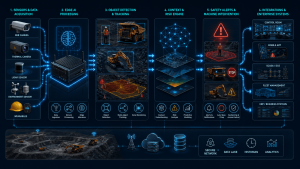
The underlying pipeline is conceptually straightforward, although deploying it reliably in a mine environment requires careful engineering.
1. Capture
Video and sensor data can come from:
- Fixed CCTV cameras
- Vehicle-mounted cameras
- 360-degree camera systems
- Thermal cameras
- Near-infrared cameras
- Drone or pole-mounted cameras
- Radar
- LiDAR
- UWB/RFID or proximity-detection systems
- GNSS
- Machine telemetry
Conventional RGB cameras may be sufficient for well-lit portals, workshops and processing areas.
Thermal or near-infrared sensors can provide additional information in certain low-light, thermal or visibility-constrained environments.
2. Edge AI Processing
For latency-sensitive safety applications, inference is generally best performed at or near the edge.
A collision or proximity warning should not depend on video travelling to a distant cloud region before a decision can be made.
Edge processing also reduces bandwidth requirements because hundreds of video streams do not need to be continuously transmitted to the cloud.
Instead, the edge system can process video locally and transmit:
- Detected events
- Metadata
- Alert information
- Short video clips
- Health/status information
Less time-critical applications such as historical analytics, reporting, model management and cross-site analysis can operate through a hybrid edge-cloud architecture.
3. Detection, Tracking and Scene Understanding
Computer vision models identify relevant objects and behaviour within each video stream.
Typical capabilities include:
Object detection, identifying workers, vehicles, equipment, PPE and other objects.
Multi-object tracking, maintaining identities across frames to understand direction, trajectory, dwell time and movement.
Pose estimation, analysing body or head position for fatigue, posture or behaviour-related applications.
Segmentation, identifying precise regions such as roads, berms, material surfaces or restricted areas.
Vision-language models (VLMs), providing higher-level contextual understanding of scenes and supporting natural-language video search and incident summarisation.
Site-specific validation, and often domain-specific fine-tuning, is critical because models trained primarily on urban, warehouse or construction imagery may not perform reliably under mine-specific conditions.
4. Context and Risk Reasoning
Raw object detections alone do not constitute a safety system.
A person standing inside a predefined area may be completely normal during maintenance but represent a critical event when equipment is energised.
The contextual layer can combine computer vision with:
- Shift rosters
- Worker authorisation
- Permit-to-work information
- Machine operating status
- Vehicle telemetry
- Geofencing
- Proximity information
- Time-of-day rules
- Maintenance status
A useful architecture therefore looks more like:
Vision → Tracking → Context Engine → Risk Scoring → Workflow / Intervention
rather than simply:
Camera → Object Detection → Alarm
This contextual layer is often what separates a useful operational system from an alarm generator.
5. Alerting and Integration
Depending on severity, an event can be routed to:
- In-cab displays
- Audible warnings
- Control-room dashboards
- Supervisor mobile applications
- Safety management systems
- Fleet-management platforms
- SCADA systems
- Incident-management platforms
- Maintenance systems
- ERP workflows
At higher levels of vehicle-interaction control, validated events can also contribute to machine slow-down or stopping functions where the overall safety architecture and equipment certification support intervention.
Our IoT and connected-device engineering work typically operates at this junction between sensors, AI models, operational equipment and enterprise systems.
Key Computer Vision Use Cases in Mining
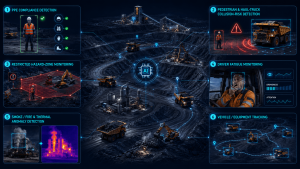
PPE Compliance Detection
PPE detection is often a practical starting point because the use case is relatively easy to define and measure.
Cameras positioned at portals, workshops, change houses and controlled work areas can identify requirements such as:
- Hard hats
- High-visibility clothing
- Respirators
- Gloves
- Eye protection
- Self-rescuers
Performance depends heavily on camera position, distance, lighting, occlusion and the physical size of the PPE item.
For this reason, acceptance criteria should be established using actual mine-site footage rather than generic benchmark results.
A practical deployment approach is to initially use PPE analytics for coaching and aggregate compliance reporting before considering individual enforcement workflows.
Pedestrian–Vehicle Interaction and Collision Risk
Vehicle interaction represents one of the most important opportunities for AI-assisted mining safety.
Computer vision can distinguish between:
- People
- Heavy mining equipment
- Light vehicles
- Road infrastructure
- Berms
- Signs
- Other obstacles
Tracking models can then estimate movement direction and interaction patterns.
However, vision should not automatically be treated as a replacement for existing proximity technologies.
For high-risk environments, sensor fusion can provide a stronger architecture.
Example Sensor-Fusion Architecture
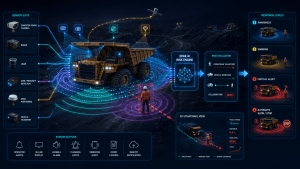
Computer Vision + Radar/LiDAR + UWB/PDS + GNSS + Vehicle Telemetry
Each technology contributes different information.
Computer vision provides classification and visual context.
Radar can provide robust ranging under certain environmental conditions.
LiDAR provides spatial information.
UWB or proximity-detection systems can identify tagged personnel or equipment.
GNSS provides positioning in suitable surface environments.
Vehicle telemetry provides speed, gear, steering and machine-state information.
Combining these signals can reduce uncertainty and improve the confidence of safety decisions.
A well-designed system may escalate progressively:
Awareness → Advisory Warning → Audible Alert → Critical Warning → Machine Intervention
depending on risk level and the site’s safety architecture.
Restricted and Hazard-Zone Monitoring
Computer vision can create software-defined boundaries around areas such as:
- Energised equipment
- Conveyor pinch points
- Tailings edges
- Blast exclusion areas
- Suspended loads
- Confined-space entries
- Workshop danger zones
The system can detect entry into the zone and combine that information with authorisation and machine-state data.
Unlike physical barriers, software-defined zones can also change according to operational requirements.
Fatigue and Distraction Monitoring
In-cab camera systems can analyse signals such as:
- Eye closure
- Blink behaviour
- Head pose
- Gaze direction
- Prolonged downward head position
- These signals can contribute to the detection of possible fatigue, microsleep or distraction events.
Worker governance is particularly important for this use case.
A well-designed system should focus on preventing safety incidents and improving fatigue management rather than automatically treating fatigue signals as employee-performance data.
Slope, Rockfall and Structural Monitoring
Computer vision can complement established geotechnical monitoring technologies by detecting visible changes and rockfall activity across areas such as:
- Highwalls
- Pit walls
- Portal areas
- Rock faces
For safety-critical slope monitoring, computer vision should generally be treated as an additional sensing layer rather than a replacement for technologies such as:
- Slope stability radar
- Prism monitoring
- LiDAR
- GNSS
- Extensometers
- Other geotechnical instrumentation
Combining multiple sources can provide a more complete view of changing site conditions.
Fire, Smoke and Thermal Anomaly Detection
Potential applications include:
- Conveyor systems
- Fuel bays
- Workshops
- Electrical rooms
- Battery-charging stations
- Processing facilities
Video analytics can identify visible smoke or flame patterns, while thermal imaging can detect abnormal heating in equipment such as bearings, rollers or electrical components.
These technologies should complement, rather than replace, certified fire and gas detection systems.
Combining vision with temperature, gas or other sensor readings can also increase event confidence.
Vehicle and Equipment Tracking
Automatic number plate recognition, vehicle detection and equipment recognition can help operators understand:
- What equipment is on site
- Where vehicles are moving
- How long equipment remains in particular areas
- Traffic flows
- Speed compliance
- Equipment utilisation
The same underlying data can therefore support both safety and operational optimisation.
The logistics optimisation patterns used in our AI and ML logistics optimisation work can also be applied to complex mine-site traffic and asset-movement environments.
Technology Stack for Mining Computer Vision
AI Models
Real-time object detection frequently uses efficient detection architectures such as the YOLO family, while transformer-based vision models may be used where different accuracy, context or computational trade-offs are required.
Common components include:
- Object detection
- ByteTrack or similar multi-object tracking
- StrongSORT-style tracking
- Pose estimation
- Semantic/instance segmentation
- Vision-language models
- Anomaly detection
The appropriate architecture should be selected according to the safety requirement rather than model popularity.
Edge Hardware
Depending on the workload, edge processing may use NVIDIA Jetson-class modules or equivalent industrial accelerators.
Deployment hardware may require:
- IP66/IP67 protection
- Vibration-resistant mounting
- Thermal management
- Industrial power conditioning
- Dust protection
- Local storage
- Redundant connectivity
- Underground and hazardous environments may introduce additional intrinsic-safety, explosion-protection and certification requirements.
Models can be quantised and optimised for the selected runtime to balance latency, accuracy, thermal load and power consumption.
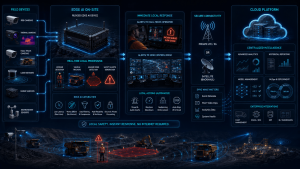
Data and MLOps
A production system requires more than a trained model.
A mature MLOps pipeline should support:
- Collection of difficult or misclassified events
- Data labelling
- Versioned datasets
- Model versioning
- Validation
- Drift monitoring
- Threshold optimisation
- Hard-negative mining
- Retraining when required
- Rollback
- Auditability
Model performance can change as equipment, lighting, layouts, seasons and operating conditions evolve.
Continuous monitoring and periodic revalidation are therefore essential.
Our AI development and MLOps services treat this lifecycle as part of the production system rather than an afterthought.
Enterprise and Industrial Integration
Typical integration technologies can include:
- OPC UA
- Modbus
- MQTT
- REST APIs
- Fleet-management APIs
- SCADA interfaces
- Safety and incident-management platforms
- ERP systems
Safety events may also need to trigger maintenance, compliance or operational workflows.
This is similar to the integration discipline we apply through our enterprise software and Odoo AI integration services.
Benefits of AI-Powered Mining Safety Monitoring
Faster Hazard Detection and Response
Early value often appears in leading safety indicators such as:
- Hazard-zone incursions
- PPE compliance
- Near-miss events
- Alert acknowledgement time
- Interaction frequency
- Critical-event response time
These indicators can help safety teams identify emerging patterns before they result in serious incidents.
Auditable Safety Data
Each event can be associated with:
- Timestamp
- Location
- Camera
- Detection type
- Video evidence
- Risk level
- Alert
- Acknowledgement
- Response
This provides a structured evidence trail for internal investigations, audits and critical-control verification.
Operational Intelligence
The same infrastructure can also generate information about:
- Vehicle movement
- Congestion
- Equipment utilisation
- Dwell time
- Traffic bottlenecks
- Repeated near-miss locations
Safety investment can therefore generate additional operational value.
Data-Driven Safety Management
Over time, aggregated data can identify patterns such as:
- High-risk intersections
- Repeated zone incursions
- Shift-specific patterns
- Congestion hotspots
- Recurring fatigue indicators
This allows organisations to move from isolated incident investigation toward more proactive and predictive analytics.
Operational Accuracy Matters More Than Benchmark Accuracy
One of the most important lessons in production computer vision is that a laboratory accuracy number does not tell the whole story.
A safety system should be evaluated using operational metrics such as:
- Precision
- Recall
- False alarms per camera/hour
- False alarms per operator/shift
- Missed critical events
- Detection latency
- Alert acknowledgement rate
- Percentage of actionable alerts
- System availability
A technically accurate model can still fail operationally if it generates excessive nuisance alerts.
Useful techniques include:
- Multi-frame confirmation
- Context-aware rules
- Confidence thresholds
- Severity tiers
- Temporal filtering
- Sensor fusion
- Site-specific calibration
The objective is not simply to maximise a benchmark score.
The objective is to create alerts that operators trust and act upon.
Worker Privacy and Responsible AI
Worker acceptance can determine whether a mining AI deployment succeeds.
Systems perceived purely as employee surveillance may face resistance or misuse.
Practical measures can include:
- Face blurring where identity is unnecessary
- Role-based access
- Defined retention periods
- Clear documentation of what is recorded
- Clear limitations on how information can be used
- Worker consultation during system design
- Separation of safety analytics from employee-performance monitoring where appropriate
Depending on the jurisdiction and how individuals are identified or profiled, requirements may arise under GDPR, biometric-privacy laws, employment regulations, collective agreements and local data-protection frameworks.
Privacy and governance should therefore be designed into the architecture rather than addressed only after deployment.
Implementation Challenges
Environmental Conditions
Plan for:
- Lens contamination
- Dust
- Moisture
- Vibration
- Temperature
- Camera movement
- Variable lighting
- Equipment changes
Hardware and maintenance design are part of the AI system.
Connectivity
Remote and underground sites may depend on:
- Private LTE/5G
- Leaky feeder systems
- Industrial Wi-Fi
- Microwave links
- Satellite connectivity
For safety-critical applications, systems should continue operating locally when upstream connectivity is unavailable.
Events can be buffered locally and synchronised once connectivity returns.
Alert Fatigue
Excessive alerts can destroy confidence in a safety system.
Alert volume should therefore be treated as a core performance metric from the beginning.
Scaling Too Quickly
A practical approach is to start with:
1 Site → 1–2 Use Cases → 2–5 Cameras → Validation → Controlled Expansion
Scaling an unvalidated configuration across hundreds of cameras simply multiplies the original problem.
From Proof of Concept to Production
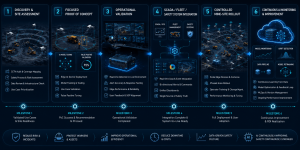
A phased deployment reduces both technical and commercial risk.
Phase 1, Discovery
Review:
- Incident history
- Existing CCTV
- Site conditions
- Connectivity
- Safety systems
- Fleet systems
- Existing sensors
- Regulatory requirements
Then prioritise use cases according to safety impact and implementation complexity.
Phase 2, Proof of Concept
A typical focused Appther POC may take approximately 6–10 weeks, depending on hardware, data availability and integration requirements.
The pilot should use:
- Real site footage
- Real environmental conditions
- Defined acceptance criteria
- Known historical events where available
Phase 3, Operational Validation
Measure:
- Detection performance
- Missed events
- False alarms
- Alert volume
- Latency
- Worker feedback
- Control-room usability
Phase 4, Integration
Connect validated events to existing operational systems.
Phase 5, Controlled Rollout
Expand by area or use case rather than deploying every camera simultaneously.
Phase 6, Continuous Improvement
Monitor drift, collect hard cases, revalidate models and retrain where necessary.
Where Mining Safety AI Is Heading
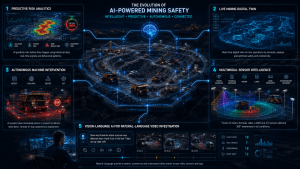
From Detection to Prediction
Today’s systems primarily detect hazardous states.
Future systems will increasingly estimate risk before an interaction occurs.
For example, historical traffic and near-miss data could identify that a particular intersection becomes higher risk during a specific shift-change period.
Operators could then adjust routing or controls proactively.
Digital Twins
Computer vision and telemetry can feed spatial digital twins of mining operations.
This can support:
- Scenario modelling
- Traffic analysis
- Layout validation
- Critical-control testing
- Virtual commissioning
Greater Machine Intervention
Machine intervention is likely to become increasingly important for high-risk vehicle interactions.
This will also increase the importance of functional safety, validation, human-machine handover, operator trust and liability management.
Multimodal Safety Intelligence
Future systems will increasingly combine:
Vision + Audio + Vibration + Gas + Temperature + Vehicle Telemetry
instead of analysing each source independently.
Vision-Language Models and Natural-Language Video Search
Vision-language models can provide a new interface to mine-site video.
Instead of manually reviewing hours of footage, a safety manager could ask:
“Show me pedestrian and haul-truck near misses at the crusher area during night shifts over the last 30 days.”
The system could retrieve relevant events, summarise patterns and generate an investigation report.
This capability is closely related to the AI agent architectures we build for operational applications.
How Appther Can Help
A successful mining computer-vision deployment involves much more than training an object-detection model.
It requires cameras and sensors that work in the operating environment, reliable edge processing, carefully tuned alerts, usable interfaces, enterprise integration and an ongoing model-management strategy.
Appther provides end-to-end AI product engineering across these layers.
Where We Start
Discovery and Use-Case Scoping
We assess:
- Incident history
- Existing cameras
- Network topology
- Available sensors
- Fleet and safety systems
- Candidate AI use cases
The result is a prioritised roadmap with measurable pilot objectives.
Proof of Concept
A focused POC can validate one or two high-value use cases under real operating conditions before a larger investment is made.
Rather than relying only on generic AI benchmarks, we establish measurable acceptance criteria using the site’s own footage and operating environment.
What We Build
| Layer | What We Deliver |
|---|---|
| Vision Models | Detection, tracking, pose estimation, segmentation and contextual AI models validated against site imagery through our AI and ML development services. |
| Edge Deployment | Optimised models running on industrial edge hardware with local inference, buffering and store-and-forward synchronisation through our IoT and connected-device engineering. |
| Alerting & Workflow | Severity-based escalation, acknowledgement workflows and shift-aware routing, including AI agents for event triage and summarisation. |
| Dashboards & Apps | Control-room dashboards, supervisor mobile applications and field interfaces designed by our UI/UX team. |
| Integration | Connections to SCADA, fleet management, safety systems and ERP platforms through our enterprise software and Odoo AI integration capabilities. |
| MLOps | Dataset management, model versioning, drift monitoring, revalidation and retraining pipelines to maintain performance as operating conditions change. |
Why Work With Appther
Appther brings 8+ years of product engineering experience, 200+ delivered projects across 12+ countries, and a 4.9★ Clutch rating.
Our experience in predictive ML for manufacturing and AI/ML logistics optimisation addresses many of the same engineering challenges found in mining environments:
- Heavy assets
- Real-time telemetry
- Operational reliability
- Edge and IoT integration
- Complex workflows
- Predictive analytics
- Enterprise integration
Our manufacturing and industrial practice, portfolio and technology stack provide further examples of our engineering capabilities.
Engagement Models
- Fixed-scope pilot: Defined use cases, timeline and measurable acceptance criteria.
- End-to-end build and run: Discovery, development, deployment, integration and ongoing model maintenance.
- Team extension: Hire AI and ML engineers to work alongside your existing engineering or innovation team.
Frequently Asked Questions
How accurate is computer vision for detecting PPE in mining environments?
Accuracy varies significantly according to lighting, dust, camera position, distance, PPE size, occlusion and site conditions.
Rather than relying on generic laboratory accuracy figures, we recommend establishing acceptance criteria using the mine site’s own footage.
Operational measures such as missed critical events and false alarms per shift are often more useful than a single headline accuracy percentage.
Can we use our existing CCTV cameras?
Often, yes.
Existing fixed cameras may be suitable for applications such as PPE compliance and restricted-zone monitoring if resolution, positioning, frame rate and lighting are sufficient.
More demanding applications may require additional edge computing or specialised cameras such as thermal, NIR or vehicle-mounted systems.
An initial camera and infrastructure audit can determine what can be reused.
Does mining safety AI work without reliable internet connectivity?
Yes.
For safety-critical applications, we design inference to run locally at the edge so detection and alerting can continue even when upstream connectivity is interrupted.
Events, metadata and video clips can be buffered locally and synchronised when connectivity returns.
Cloud-dependent architectures should be evaluated carefully where connectivity is intermittent or response time is safety-critical.
How long does deployment take?
For a typical Appther engagement, a focused proof of concept may take approximately 6–10 weeks, depending on hardware availability, data quality, site access and integration requirements.
A broader rollout can take several months depending on camera count, hardware certification, network infrastructure, safety-system integration and site acceptance requirements.
We recommend validating a small number of cameras and use cases before scaling.
How do you manage worker privacy?
Privacy should be designed into the system.
Measures can include face blurring where identification is unnecessary, access controls, retention policies, transparent documentation and restrictions on individual performance tracking.
Worker representatives should also be involved early where appropriate.
What is EMESRT Layer 9?
The EMESRT Vehicle Interaction framework describes nine layers of defence for managing vehicle interactions.
Layer 9, Machine Intervention involves a system automatically influencing machine behaviour, such as slowing or stopping equipment, when the overall safety system determines intervention is required.
Whether a mine requires Layer 9 depends on its risk profile, equipment, regulatory environment and critical-control strategy.
Will AI replace mine safety officers?
No.
AI is best used to support safety professionals by continuously monitoring large volumes of camera and sensor data and bringing potentially important events to their attention.
Safety professionals remain essential for risk assessment, investigation, operational decision-making and critical-control management.
Can computer vision work underground in dust and low light?
Yes, but performance depends heavily on sensor selection and deployment design.
Solutions may combine RGB, NIR or thermal cameras with appropriate lighting and environmental protection.
The correct approach should be validated using footage captured under the site’s actual operating conditions.
Can computer vision integrate with existing proximity-detection systems?
Yes.
Computer vision can complement technologies such as radar, LiDAR, UWB, RFID-based proximity detection and vehicle telemetry.
Sensor fusion can provide more contextual information than any individual sensing technology alone.
How do you prevent alert fatigue?
We use techniques such as:
- Severity tiering
- Multi-frame confirmation
- Context-aware rules
- Confidence thresholds
- Temporal filtering
- Sensor fusion
- Site-specific calibration
- Alert volume per operator per shift should be treated as an important operational KPI.
Can the platform integrate with SCADA and fleet-management systems?
Yes.
Integration can use technologies such as OPC UA and Modbus for industrial systems, MQTT for event messaging and REST APIs for fleet, safety, maintenance and enterprise platforms.
The objective is to place AI-generated events inside the systems teams already use rather than creating another isolated monitoring screen.
What does an AI mining safety system cost?
Costs depend on:
- Number of cameras
- Number and complexity of use cases
- Existing camera infrastructure
- Edge hardware
- Specialised sensors
- Connectivity
- Integration requirements
- Certification requirements
- Ongoing MLOps and support
For this reason, a reliable estimate should begin with a scoped site assessment and a focused proof of concept rather than a generic per-camera price.
Conclusion
Mining operations have made significant progress in reducing injuries, yet serious and fatal incidents remain a critical challenge.
Computer vision does not replace established mining safety controls.
Instead, it can provide an additional layer of continuous situational awareness, helping safety teams identify hazardous conditions during the short window in which intervention may still be possible.
The technology alone, however, does not determine success.
Successful mining AI depends on choosing the right sensors, designing reliable edge infrastructure, integrating multiple data sources, controlling false alarms, protecting worker privacy, connecting alerts to existing operational systems and continuously validating model performance.
The strongest approach is therefore not to begin with hundreds of cameras.
It is to begin with a clearly defined safety problem, deploy a focused pilot under real site conditions, establish measurable acceptance criteria and scale only after the system has demonstrated operational value.
Considering an AI-powered mining safety monitoring pilot?
Talk to the Appther team about a focused proof of concept using your existing cameras, operational environment and safety requirements.
If you already have an internal engineering team and need additional AI expertise, you can also hire AI and ML engineersfrom Appther.