Construction projects move quickly. Work conditions change, subcontractors come and go, and safety managers must keep documentation aligned with the activities taking place on site.
For Australian construction businesses, managing Safe Work Method Statements (SWMS) is a critical part of planning and monitoring high-risk construction work.
However, reviewing safety documents manually can be demanding, especially when multiple contractors submit different formats, important details are missing, or site conditions change after the original documents have been prepared.
This is where artificial intelligence is creating new opportunities.
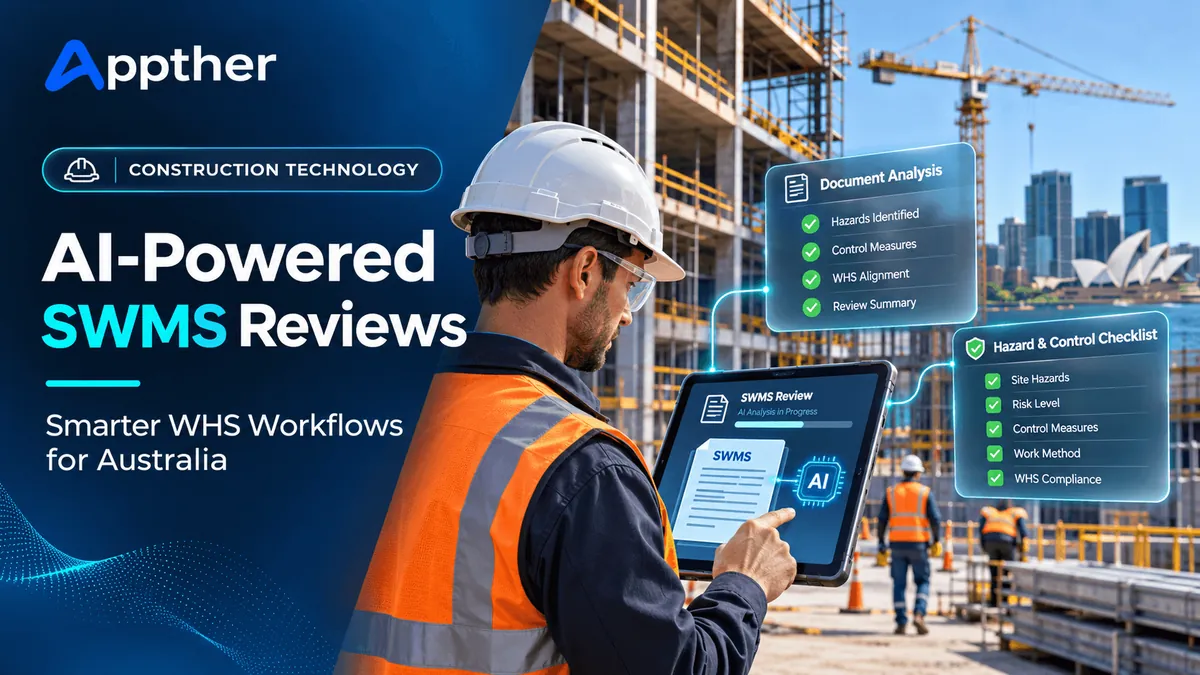
AI-powered SWMS review software can help construction teams analyse safety documents, identify missing information, highlight inconsistent risk controls, and organise findings for human review.
It does not replace experienced safety professionals, worker consultation, site inspections or legal WHS obligations. Instead, it can help those responsible for safety spend less time on repetitive document checks and more time evaluating actual risks.
In this guide, we explore how AI-assisted SWMS reviews work, where they can provide value, what Australian businesses must consider before adoption, and how to implement them responsibly.
What Is a Safe Work Method Statement (SWMS) in Australia?
A Safe Work Method Statement is a document used for high-risk construction work. It identifies the relevant work activities, the hazards and risks arising from those activities, and the control measures that will be implemented.
Under the model WHS framework, a person conducting a business or undertaking (PCBU) carrying out high-risk construction work must ensure that a SWMS is prepared before the work starts.
A SWMS is also intended to support the implementation, monitoring and review of risk controls during the work.
Examples of high-risk construction work include:
- Work involving a risk of falling more than two metres
- Work in or near a trench deeper than 1.5 metres
- Work on or near energised electrical installations or services
- Work in areas involving the movement of powered mobile plant
- Certain demolition, confined-space and asbestos-related activities
These activities are among those identified by Safe Work Australia.
A SWMS is not required for every construction task simply because the work takes place on a building site. It is specifically required for high-risk construction work under the applicable legislation.
Other risk-management duties can still apply to work that does not require a SWMS.
What should a SWMS contain?
A well-prepared SWMS should clearly identify the high-risk construction activity, relevant hazards, risks, control measures and how those controls will be implemented, monitored and reviewed.
It must reflect the actual circumstances of the workplace.
For example, a generic statement such as “use appropriate safety equipment” may not adequately explain which controls are required, who is responsible or how the work will be performed safely.
A SWMS must be useful to the people performing and supervising the work, not merely a document uploaded to satisfy an administrative requirement.
Why Traditional SWMS Reviews Can Be Challenging
Construction companies often work with multiple subcontractors, consultants and site supervisors.
Each organisation may use different document templates, terminology and approval workflows.
Although manual reviews remain essential, several practical difficulties can arise.
1. Large volumes of documents
A contractor may submit SWMS documents covering excavation, scaffolding, electrical work, plant movement and other high-risk activities.
Reviewers must identify the relevant work, assess the documented controls and ensure that important information is not overlooked.
2. Inconsistent document quality
Some SWMS documents are detailed and site-specific. Others contain generic descriptions, unclear responsibilities or information copied from previous projects.
These differences can make reviews more time-consuming.
3. Missing or unclear control measures
A document might identify a risk but fail to describe a sufficiently specific control.
For example, identifying a fall hazard without explaining the planned fall-prevention measures gives workers little practical direction.
4. Repeated revisions
When site conditions, equipment, work methods or identified hazards change, the SWMS may need to be reviewed and revised.
Maintaining the correct version and communicating changes to affected workers can become difficult across multiple sites.
5. Fragmented records
Safety documents, comments, revision histories and supporting evidence may be distributed across email, shared drives and separate applications.
This can make it harder to trace who reviewed a document, which issues were identified and whether they were resolved.
These problems create an opportunity for carefully designed safety document review software.
What Is AI-Powered SWMS Review Software?
AI-powered SWMS review software is a document analysis system that uses artificial intelligence to assist with examining Safe Work Method Statements and identifying potential gaps, inconsistencies or areas requiring further safety review.
Such systems may combine document extraction, natural language processing, configurable review rules and AI models.
An AI-assisted review workflow can help identify:
- Missing descriptions of relevant high-risk construction activities
- Hazards without clearly documented control measures
- Generic wording that may require site-specific clarification
- Inconsistencies between work activities and proposed controls
- Missing responsibility or implementation details
- Differences between revised and previously reviewed documents
- Issues requiring clarification from a contractor or safety professional
For example, a system could recognise that a SWMS describes excavation near mobile plant but does not clearly explain how workers will be separated from moving equipment.
The system could flag this for review and request more detailed information.
That does not mean the AI has established that the work is legally non-compliant or unsafe.
The purpose of AI is to support the review process. Responsibility for evaluating site conditions, selecting controls and authorising work remains with the relevant duty holders and competent personnel.
How AI Can Improve SWMS Reviews: 7 Practical Capabilities
1. Automated document extraction
AI-assisted systems can extract text and structured information from uploaded PDFs, Word documents and suitable scanned files.
This can help reviewers locate work activities, hazards, controls and responsibilities without manually copying information into another system.
However, document quality matters. Scanned pages, handwriting and complex tables may reduce extraction accuracy.
2. Identification of missing information
A document review engine can check whether expected sections are present and whether key fields are populated.
For example, it may flag a missing work location, unclear high-risk activity description or incomplete control implementation details.
The system should distinguish between a genuinely missing item and information that could not be read reliably.
3. Review of hazards and documented controls
AI can compare the activities described in a SWMS with the hazards and controls documented for those activities.
Potentially incomplete descriptions can then be highlighted.
For example, if a document mentions working at height but contains only a general instruction to “wear PPE” the system could request human review of the planned controls and the hierarchy of control.
Importantly, a SWMS is an administrative control that supports the implementation of higher-order measures. Simply producing a more detailed document does not make the physical work safe.
4. Comparison with project requirements
A configurable system may compare a submitted SWMS with relevant project-specific review criteria.
This could include the site location, known hazards, work method, principal contractor requirements and applicable safety procedures.
Regulatory material used by the system should be current, jurisdiction-specific and reviewed by appropriately qualified people.
A generic AI model should not be treated as an authoritative source of Australian WHS law.
5. Revision comparison and change detection
When a contractor submits an updated SWMS, AI-assisted software can highlight changes between versions.
This may help reviewers identify revised controls, additional activities, removed instructions and unresolved issues.
Version tracking is particularly valuable when multiple subcontractors are working on the same construction project.
6. Supporting evidence and site photograph review
Some AI systems can assist with analysing site photographs or associated inspection records.
For example, image analysis might highlight a visible missing barrier or an obstruction requiring closer examination.
However, a photograph may not show the full work environment, the relevant engineering design, required permits or controls outside the camera’s field of view.
Photo analysis should therefore be treated as supplementary information, never as a substitute for an inspection or competent assessment.
7. Review summaries and corrective-action tracking
AI can help organise observations into a clear review report.
Instead of navigating lengthy documents, a safety reviewer may receive a structured list of potential issues, supporting source references and suggested questions for the contractor.
Each item can then be assigned for clarification, verified by a responsible person, and tracked through an approval workflow.
This creates a clearer record of the review without allowing the AI system to independently approve safety-critical work.
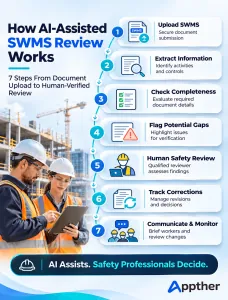
How an AI SWMS Review Workflow Works
A practical system should connect document analysis with human review and site-specific safety processes.
Step 1: Upload the SWMS
A contractor or authorised team member submits a SWMS through a secure portal.
The system records the project, work activity, document version and relevant metadata.
Step 2: Extract and organise information
Document-processing technology identifies the work activities, hazards, control measures and other relevant details.
Unclear or unreadable sections are marked for verification.
Step 3: Evaluate completeness
The system checks for missing information and compares the document against configurable review criteria.
These checks should reflect the relevant jurisdiction and project requirements.
Step 4: Flag potential safety documentation gaps
AI highlights ambiguous wording, missing details or inconsistencies requiring human attention.
Each finding should refer to the relevant passage so the reviewer can verify the source.
Step 5: Conduct human safety review
A competent reviewer examines the findings, assesses relevant project conditions and determines which issues require correction.
The reviewer should be able to dismiss inaccurate AI findings and record the reason.
Step 6: Request corrections and track revisions
Where necessary, the contractor updates the SWMS and submits a revised version.
The system preserves a clear history of changes, reviewer decisions and outstanding actions.
Step 7: Communicate and monitor implementation
Relevant workers are consulted, instructed and informed about the controls and revisions applicable to their work.
The document remains available as required, and the actual work must be performed in accordance with the applicable SWMS.
The review process continues when conditions or risks change.
This approach connects technology with the practical responsibilities of supervisors, contractors and safety professionals.
Practical Example: AI-Assisted SWMS Review for Excavation Work
Consider a hypothetical Australian construction project involving a trench approximately 1.8 metres deep, with powered mobile equipment operating nearby.
The contractor submits a SWMS for review.
The document identifies excavation hazards but contains limited information about ground stability, plant movement and implementation of relevant controls.
An AI-assisted system might flag:
| Potential issue | Suggested reviewer action |
|---|---|
| Unclear trench support arrangements | Verify that appropriate excavation risk controls are specified |
| Limited information about mobile plant separation | Review traffic management and worker separation controls |
| Missing implementation responsibilities | Identify who will implement and monitor the controls |
| Generic descriptions copied from previous work | Check whether controls reflect actual site conditions |
| Revised work method without corresponding SWMS update | Request review and revision as necessary |
A qualified person then determines which findings are relevant, what additional assessments are necessary and whether the documented controls are adequate.
The AI does not determine whether excavation can safely proceed.
That decision must remain within the appropriate site management, engineering and safety processes.
This is the difference between automating document review assistance and automating safety responsibility.
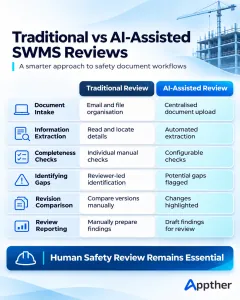
Traditional SWMS Review vs AI-Assisted Review
| Review activity | Traditional approach | AI-assisted approach |
|---|---|---|
| Document intake | Manual collection and organisation | Centralised upload and indexing |
| Information extraction | Reviewer reads and identifies details | Automated extraction with verification |
| Completeness checks | Manual comparison with requirements | Configurable automated checks |
| Gap identification | Reviewer identifies possible omissions | AI flags potential issues for validation |
| Revision tracking | Manual document comparison | Automated change highlighting |
| Review reporting | Manually compiled findings | Draft findings organised for review |
| Safety decisions | Competent human decision | Competent human decision |
| Worker consultation | Required as applicable | Remains necessary |
| Site verification | On-site inspection and supervision | Remains necessary |
The main opportunity is improved document organisation, consistency and review efficiency.
Actual time savings will depend on document quality, review complexity, system accuracy and how effectively the workflow is implemented.
Australian WHS Compliance: What Businesses Must Understand
Introducing AI into a safety management process does not change an organisation’s statutory duties.
Australian construction businesses need to understand which laws and regulator requirements apply to their projects.
Model WHS laws
Safe Work Australia’s model WHS laws provide a framework for workplace health and safety.
The model laws have been implemented across Australian jurisdictions except Victoria, although variations exist between jurisdictions.
Businesses operating in Queensland, New South Wales, Western Australia, South Australia, Tasmania, the ACT and the Northern Territory must consider the legislation and requirements applicable to their location.
Queensland SWMS requirements
In Queensland, duty holders carrying out high-risk construction work have specific obligations concerning preparation, implementation, review, provision and retention of SWMS documents.
A SWMS must be prepared before the relevant work begins.
Where required, it must be provided to the principal contractor before work starts.
If work is not being carried out in accordance with the SWMS, work must stop immediately or as soon as it is safe to do so and cannot resume until the applicable requirements are satisfied.
See WorkSafe Queensland’s guidance on Safe Work Method Statements.
Victoria’s separate OHS framework
Victoria operates under its own occupational health and safety legislation, including the Occupational Health and Safety Regulations 2017.
For high-risk construction work, relevant duty holders must prepare a SWMS before work starts.
Victorian requirements must be assessed independently rather than assuming every detail of the model WHS regulations applies without variation.
See WorkSafe Victoria’s SWMS guidance.
Does AI software make a company WHS compliant?
No.
An AI system can support document administration, identify issues for review and improve the traceability of decisions.
It cannot guarantee compliance with legislation or replace:
- Legal responsibilities of duty holders
- Worker consultation and participation
- Site-specific hazard identification
- Appropriate risk controls
- Competent supervision and inspections
- Required training and instruction
- Monitoring of work activities
- Incident response and regulatory reporting
A product should not claim to certify SWMS documents or guarantee WHS compliance simply because it uses artificial intelligence.
Essential Features of AI SWMS Review Software
Australian construction businesses evaluating an AI-assisted safety platform should prioritise practical workflow capabilities over impressive-looking dashboards.
Document analysis and traceability
The software should allow reviewers to locate the exact document passage behind each AI finding.
A finding without a source reference is difficult to verify and potentially misleading.
Configurable review rules
Projects and jurisdictions have different requirements.
Review criteria should be configurable and maintained by responsible people rather than relying exclusively on a general-purpose AI model.
Human approval controls
The system should clearly separate AI-generated observations from human review outcomes.
Safety-critical approvals should require an authorised person.
Version control and audit history
The platform should record uploads, revisions, findings, reviewer decisions and relevant timestamps.
Multi-project and contractor access
For businesses managing multiple worksites, access should be limited according to project and user responsibility.
Reporting and integration
Review summaries, outstanding actions and document status can be connected with an organisation’s existing safety management systems.
Businesses seeking a tailored solution can explore Appther’s custom software development services for integrating document workflows, dashboards and existing business systems.
Protecting Worker Data When Using AI Safety Software
SWMS documents and site evidence may contain names, signatures, contact details, photographs and information about identifiable workers.
Therefore, AI adoption must also consider privacy and information security.
Australian organisations covered by the Privacy Act 1988 need to assess their Australian Privacy Principles obligations when processing personal information through AI tools.
The Office of the Australian Information Commissioner advises organisations to consider data access, accuracy, security, transparency, vendor suitability and human oversight.
Before introducing AI-based safety document review, businesses should assess:
- Whether sensitive or personal data needs to be included in AI processing.
- Where documents are stored and processed.
- Whether AI providers can retain or use submitted information for model training.
- How information is encrypted and access is controlled.
- How long documents and AI-generated outputs will be retained.
- Whether the system preserves records required by applicable laws.
- How inaccurate or inappropriate AI outputs can be corrected.
Australian data hosting can be an important commercial or contractual consideration, but it is not automatically a universal legal requirement for all SWMS software.
The appropriate hosting and privacy arrangements depend on the business’s circumstances and obligations.
How to Introduce AI SWMS Reviews into Your Business
The safest approach is to start with a limited, well-defined workflow rather than immediately automating every safety process.
Phase 1: Identify review problems
Examine how SWMS documents are currently received, reviewed, revised and stored.
Identify repetitive administrative steps, frequently missing information and common sources of delay.
Phase 2: Define the review criteria
Work with experienced WHS personnel to establish what the system should check.
Define mandatory fields, site-specific information, applicable requirements and escalation conditions.
Phase 3: Test against historical documents
Use appropriately authorised, protected document samples.
Include examples of complete documents, incomplete documents, poor-quality scans and unusual layouts.
Assess whether the AI identifies relevant issues without creating excessive false alerts or overlooking important gaps.
Phase 4: Run a supervised pilot
Allow the AI to assist reviewers while retaining the existing human-led review process.
Measure the results against an agreed baseline.
Phase 5: Improve and integrate
Refine prompts, rules, document extraction and review workflows based on observed errors.
Integrate the solution with existing business processes only after the pilot demonstrates acceptable performance.
Phase 6: Monitor continuously
AI tools and project requirements change.
Continue testing system accuracy, monitoring review outcomes, updating reference materials and maintaining human oversight.
Measuring the ROI of AI-Powered SWMS Review Software
Businesses should evaluate whether AI improves a real operational process rather than purchasing technology simply because it is available.
Useful metrics include:
| Measurement | What to evaluate |
|---|---|
| Average review time | Time spent reviewing each document |
| Reviewer workload | Hours dedicated to repetitive document checks |
| Useful finding rate | Proportion of AI findings confirmed by reviewers |
| Missed critical issues | Important gaps identified in independent reviews but missed by AI |
| Revision turnaround | Time between clarification requests and corrected submissions |
| Document traceability | Ability to locate versions, comments and reviewer decisions |
| Administrative costs | Actual review effort compared with software and operating costs |
A simple financial assessment can compare administrative hours saved against development, licensing, integration, training and maintenance costs.
However, safety performance should never be evaluated only through cost savings.
A system that speeds up reviews but regularly misses important gaps may create more risk than value.
How Appther Helps Australian Businesses Build AI Safety Review Solutions
Building effective AI software for construction safety requires more than connecting a language model to a PDF upload form.
It requires practical document processing, configurable review logic, secure data handling, human approval workflows and reliable integration with existing business operations.
At Appther Technologies, our work includes AI-assisted document review solutions for safety-related use cases, including SWMS and management-plan analysis for an Australian safety consultancy.
Through our AI development services, businesses can explore capabilities such as:
- AI-assisted document extraction and analysis
- Structured safety-review workflows
- Configurable rules and review checklists
- Human-in-the-loop verification
- Findings and corrective-action dashboards
- Role-based document access
- Audit trails and report generation
- Integration with existing business applications
Every implementation should be assessed against its specific documents, users, review procedures and applicable legal obligations.
The objective is not to replace safety professionals. It is to provide them with software that makes important information easier to find, assess and manage.
For Australian construction companies and safety consultancies, this creates an opportunity to modernise document workflows while maintaining appropriate professional control.
The Future of AI in Australian Construction Safety
AI in construction safety extends beyond reviewing documents.
Potential applications include inspection report analysis, incident trend identification, maintenance document processing, hazard reporting and improved access to safety knowledge.
As these technologies develop, businesses will need to evaluate both operational benefits and the risks of inaccurate automated outputs.
A useful long-term approach is to combine reliable software engineering with qualified safety expertise, practical field observations and continuous system evaluation.
The best safety technology should help people make better-informed decisions while preserving accountability.
Conclusion
AI-powered SWMS reviews offer Australian construction businesses a practical opportunity to improve how safety documents are organised, checked and managed.
Automated document extraction, gap identification, revision comparison and structured reporting can help reduce repetitive administrative work.
But AI does not make a construction site safe simply by reviewing a document.
Effective WHS management still depends on appropriate controls, competent people, worker consultation, monitoring and compliance with applicable laws.
For businesses considering AI safety software, the strongest starting point is a controlled pilot built around real documents, measurable review quality and clear human accountability.
Ready to modernise your construction safety document workflow?
Appther Technologies helps Australian businesses explore custom AI document analysis, review portals and workflow automation.
Contact Appther Technologies to discuss your project requirements and an AI-assisted SWMS review solution suited to your organisation.
Frequently Asked Questions
What is AI-powered SWMS review software?
AI-powered SWMS review software uses artificial intelligence to help analyse Safe Work Method Statements, identify possible missing information, highlight inconsistent controls and organise findings for review by a qualified person.
Can AI automatically review SWMS documents in Australia?
AI can automate aspects of document extraction, completeness checking, change detection and issue identification. However, findings require appropriate human verification. AI cannot independently establish that a SWMS is legally compliant or that the work can proceed safely.
Is a SWMS mandatory for all construction work in Australia?
No. SWMS requirements apply to high-risk construction work defined under the applicable jurisdiction’s legislation. Other construction work may still be subject to separate risk-management obligations.
Can AI replace a WHS officer or safety consultant?
No. AI can assist with administration and analysis, but it does not replace professional judgement, duty-holder responsibilities, worker consultation, supervision or site inspections.
What is the difference between SWMS software and WHS management software?
SWMS software primarily supports the creation, management or review of Safe Work Method Statements. WHS management software may also cover inspections, incidents, corrective actions, training, contractor management and other broader workplace safety processes.
Can AI review scanned SWMS PDFs?
Yes, suitable document extraction and AI technologies can analyse many scanned PDF documents. Results depend on scan quality, handwriting, document layout and extraction accuracy. Important findings should be verified against the original document.
How much does AI SWMS review software cost in Australia?
Costs depend on whether an organisation uses an existing platform or develops a custom solution, as well as document volumes, integrations, user permissions, review rules, hosting and ongoing support. A defined pilot is usually more useful than relying on a generic price estimate.
Does AI SWMS software guarantee WHS compliance?
No. Compliance depends on applicable law and the actions of relevant duty holders. Software can support documentation, visibility and review processes, but it cannot guarantee legal compliance or workplace safety.
How can a construction company start using AI for SWMS reviews?
Start by reviewing the current document process, defining requirements with experienced safety personnel, testing AI against representative SWMS documents and conducting a supervised pilot before wider deployment.