A single AI agent can answer a question, search a knowledge base or complete a well-defined workflow. But what happens when a task requires several kinds of reasoning, access to different business systems and checks before an action is approved?
That is where multi-agent AI systems become useful.
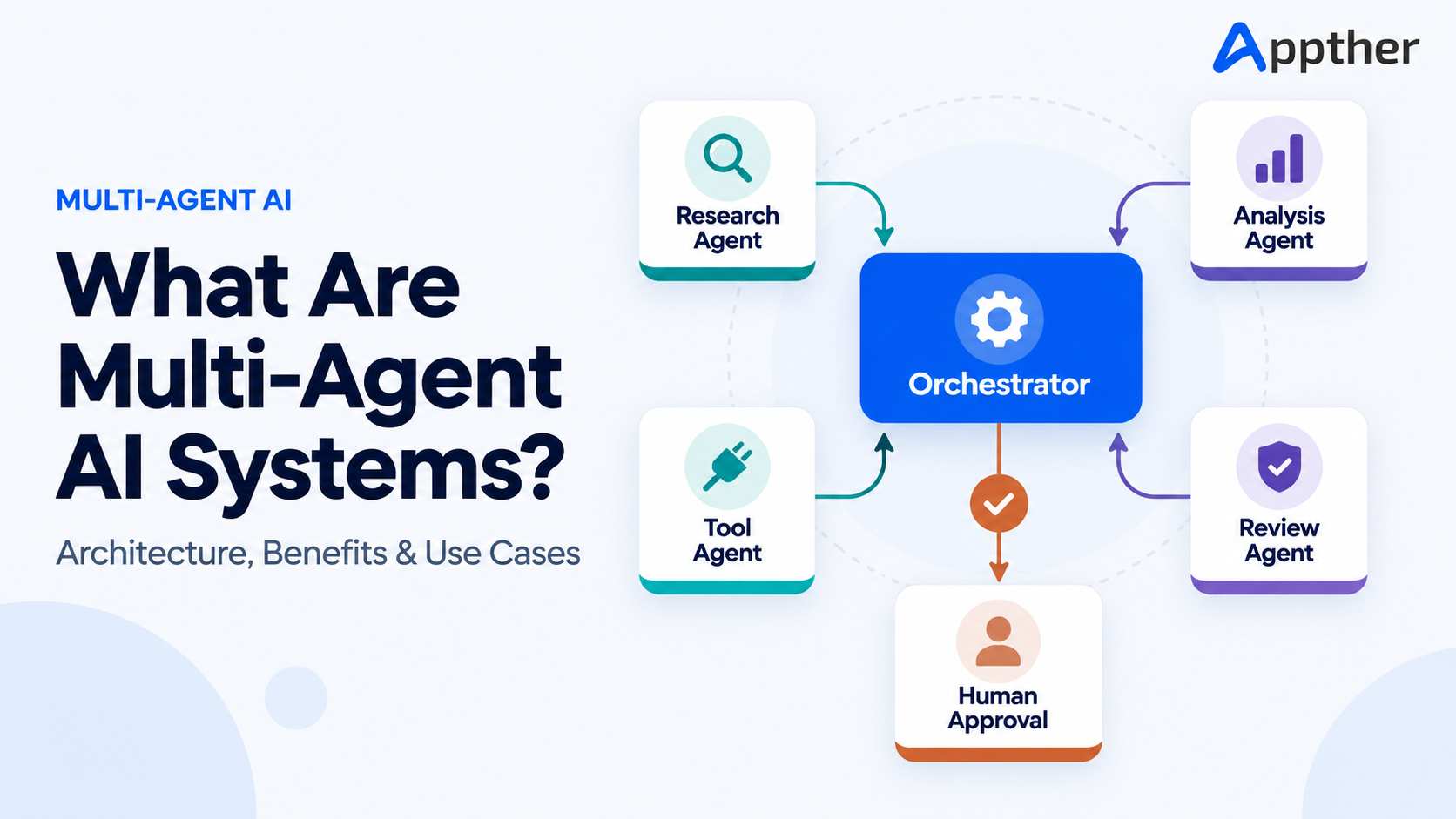
Instead of asking one general-purpose agent to do everything, a multi-agent system divides the work among specialised agents. One may interpret the request, another may retrieve evidence, a third may call business tools and a fourth may review the result. An orchestrator coordinates the sequence, passes context between agents and decides when the work is finished or needs a person.
The idea sounds similar to a human team because, at a high level, it is. A complicated assignment is easier to manage when roles, responsibilities and handoffs are clear. The difficult part is not creating several prompts and calling them agents. It is designing the system so that those agents share the right information, stay inside their permissions, recover from failure and produce a result that can be inspected.
This guide explains what multi-agent AI systems are, how their architecture works, where they offer an advantage over a single agent and which business use cases justify the added complexity.
What is a multi-agent AI system?
A multi-agent AI system is an application in which two or more AI agents collaborate to complete a goal. Each agent has a defined role, its own instructions and access to a limited set of tools or data. The agents communicate through an orchestration layer rather than operating as unrelated chatbots.
For example, imagine a company wants a daily competitor brief. A multi-agent workflow could include:
- A planning agent that breaks the request into research questions.
- Research agents that search approved sources in parallel.
- An analysis agent that compares findings and identifies changes.
- A verification agent that checks whether each claim has evidence.
- A publishing agent that formats the approved report and sends it to the right team.
The value does not come simply from having five agents. It comes from separation of responsibility. The research agent does not need permission to email executives. The publishing agent does not decide whether a claim is true. Each agent handles a bounded part of the workflow, and the system records how the final output was produced.
Multi-agent AI is one form of agentic AI. A single-agent application can also be agentic if it plans steps and uses tools. The “multi-agent” label applies when responsibility is deliberately distributed across multiple agent identities or processes.
Single-agent vs multi-agent AI
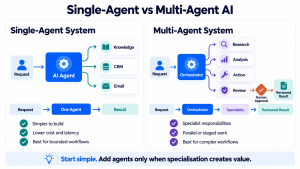
A single agent is often the right place to start. It is simpler to build, less expensive to operate and easier to test. If one agent can reliably complete a task with a small toolset, adding more agents may only introduce latency and new failure points.
A multi-agent design becomes relevant when the work has meaningful specialisation or concurrency. Several agents may need different instructions, security permissions, context windows or models. Some tasks benefit from independent review; others can be divided into parallel branches to reduce turnaround time.
| Area | Single-agent system | Multi-agent system |
|---|---|---|
| Responsibility | One agent handles most steps | Work is divided among specialist agents |
| Coordination | Usually one reasoning and tool loop | Orchestrator manages routing and handoffs |
| Context | One main working context | Context is filtered and passed between roles |
| Tool access | One combined toolset | Tools can be limited by agent role |
| Evaluation | End-to-end task result | Agent-level and system-level evaluation |
| Cost and latency | Usually lower | Often higher due to extra model calls |
| Best fit | Bounded, linear workflows | Complex, parallel or cross-functional work |
The decision should follow the task, not the trend. A reliable single agent with three controlled tools is better than a “team” of agents that repeatedly discuss the problem without improving the answer.
How multi-agent system architecture works
Although implementations vary, production multi-agent architectures usually contain the same core layers.
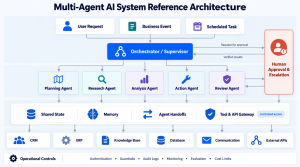
1. User or event trigger
The workflow begins with a request or system event. It might be a customer question, a new support ticket, an uploaded document, a failed payment, an incoming lead or a scheduled report.
The entry layer authenticates the caller, validates the request and gathers essential context. It should also decide whether the task is appropriate for automation. A sensitive request may be sent directly to a person instead of entering the agent workflow.
2. Orchestrator or supervisor agent
The orchestrator is the control point. It understands the overall objective, selects which specialist should act and maintains the state of the job. Depending on the design, it may create a plan, dispatch work in parallel, review intermediate results and stop the process when the exit conditions are met.
Some orchestrators use a language model to choose the next step. Others combine model reasoning with deterministic workflow rules. In enterprise systems, the second approach is often safer: code handles permissions, spending limits and required approvals, while the model handles interpretation and planning within those boundaries.
The orchestrator should not become an all-powerful agent with every permission. It coordinates; specialist services perform the actual work through narrow, validated tools.
3. Specialist agents
Specialist agents have focused roles. Examples include a research agent, customer identity agent, pricing agent, scheduling agent, compliance reviewer or document extraction agent.
Each specialist may have:
- A role-specific system instruction.
- Access to only the tools required for that role.
- A model selected for the complexity of its task.
- Its own evaluation criteria and output schema.
- A defined rule for returning control or escalating.
Narrow roles make behaviour easier to test. If an order-status agent is only allowed to read an order API, it cannot issue a refund by accident. A separate refund agent can enforce the required policy and approval threshold.
4. Agent communication and handoffs
Agents need a structured way to pass work. Sending the entire conversation to every agent is easy, but it is rarely a good production design. It increases token usage, exposes unnecessary data and makes it harder to understand which information influenced a decision.
A handoff should include the minimum context needed by the next agent: the task, verified facts, relevant identifiers, completed actions, unresolved questions and permitted next steps. Structured JSON or another validated schema is usually more reliable than a long free-form message.
Every handoff should also preserve provenance. If one agent states that an invoice is overdue, the receiving agent should know whether that status came from the ERP, an uploaded document or another model’s inference.
5. Shared state and memory
A multi-agent workflow needs a trusted record of progress. Shared state may contain the plan, task status, tool results, approvals, errors and final outcome. This is different from giving every agent unrestricted long-term memory.
Useful memory types include:
- Working state: Data required for the current run.
- Conversation memory: Relevant history from the current user interaction.
- Business memory: Verified facts stored in CRM, ERP or another system of record.
- Long-term agent memory: Selected prior outcomes that may improve future work.
The system of record should remain authoritative. An agent’s remembered summary must not silently override a customer’s current account status or a newly approved policy.
6. Tool and API gateway
Agents become operational when they can retrieve data and take actions. A tool gateway exposes approved functions such as find_customer, check_inventory, create_ticket or schedule_callback.
Good agent tools are narrow, typed and explicit. A general execute_database_query tool gives an agent too much room to make a damaging decision. A specific get_order_status tool can validate its inputs, enforce access rules and return a predictable response.
The gateway is also where the application implements authentication, rate limits, retries, idempotency and rollback. These controls should live in code, not in a prompt asking the model to “be careful.”
7. Guardrails and policy layer
Multi-agent systems need rules that apply across the entire workflow. These may include data minimisation, content filtering, maximum steps, token and cost budgets, approved data sources, prohibited actions and mandatory human approval.
There should be both agent-level and system-level limits. A specialist may be restricted to read-only access, while the complete workflow may also have a maximum number of tool calls. This prevents agents from creating loops that consume time and money without moving the task forward.
8. Evaluation, monitoring and audit logs
When several agents contribute to an outcome, teams need visibility into the entire run. Logs should capture agent decisions, tool inputs and outputs, handoffs, retries, latency, model usage, approvals and final status.
Evaluation must happen at two levels. First, did each specialist complete its responsibility correctly? Second, did the system achieve the business outcome? A research agent may find accurate facts while the overall report still fails because the synthesis agent omitted the most important one.
At Appther, we treat observability and evaluation as part of AI agent development, not as work to add after launch. Without traces and measurable task success, a multi-agent system is difficult to improve and even harder to trust.
Common multi-agent orchestration patterns
There is no single architecture for every workflow. Most systems use one or more of the following patterns.
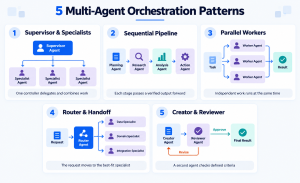
Supervisor and specialists
A central supervisor receives the task, delegates work to specialists and assembles the result. This is the clearest model for customer service, operations and internal assistants because one component owns the workflow.
The risk is supervisor overload. If it plans every detail, rewrites every result and keeps all context, it can become the same general-purpose agent the architecture was meant to avoid.
Sequential pipeline
Agents work in a fixed order. One extracts data, the next validates it, another applies policy and the last prepares an action. This pattern suits document processing, compliance checks and other workflows with stable stages.
It is predictable and easy to audit, but an early mistake can pass down the line. Validation between stages is essential.
Parallel workers
The orchestrator sends independent subtasks to several agents at the same time and combines their outputs. A market research system might assign different competitors or source types to separate workers.
Parallel work can reduce turnaround time and improve coverage. It also increases model usage and requires a reliable method for resolving duplication or contradiction.
Router and specialist handoff
A router classifies the request and transfers control to the best specialist. A support assistant might route billing, technical and account-access enquiries to different agents.
The key challenge is incorrect routing. The design needs confidence thresholds, a clarification path and a safe way to return control when the chosen specialist cannot complete the request.
Debate or reviewer pattern
One agent produces a result while another critiques it against defined criteria. The first agent may then revise the work. This is useful for evidence checking, policy compliance and high-value analysis.
More agents do not automatically make an answer true. If the reviewers share the same missing context or weak assumptions, they can agree on the wrong conclusion. Verification should use external evidence, deterministic rules or human review where the risk warrants it.
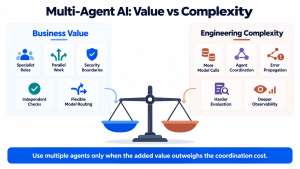
Benefits of multi-agent AI systems
Clear specialisation
A focused agent needs fewer instructions and fewer tools. It can be evaluated on a precise responsibility rather than a vague goal. This makes the system easier to reason about and reduces accidental access to unrelated data.
Parallel execution
Independent tasks can run at the same time. Research, document analysis or multi-system checks that would be sequential for one agent can be distributed among several workers and combined later.
Better control of complex workflows
Long tasks are easier to manage when divided into explicit stages. The orchestrator can retry one failed branch without repeating the entire process, and a human can inspect where a result changed between agents.
Model and cost optimisation
Not every step needs the most capable model. A strong reasoning model may create the plan, while smaller models handle classification, extraction or formatting. Routing models by task can control cost without applying the same compromise to the whole workflow.
Improved security boundaries
Different agents can use separate service identities and permissions. A research agent may have web access but no CRM access; an account agent may read customer records but cannot send an email. Compromise or failure in one role has a smaller blast radius.
Independent checks
A reviewer agent can check evidence, formatting or policy compliance before a workflow reaches a person or triggers an action. It does not remove the need for human accountability, but it can catch routine failures earlier.
Challenges and limitations
The biggest mistake is assuming a multi-agent system is automatically more capable. It may simply be more complicated.
Higher cost and latency
Every handoff and review can create another model call. Parallel workers may finish quickly but consume more tokens. Teams should track cost per successfully completed task, not just API cost per call.
Coordination failures
Agents may duplicate work, pass incomplete context, disagree about the task or repeatedly return control to one another. Clear ownership, typed handoffs and maximum-step limits reduce these loops.
Error propagation
An incorrect output from an early agent can become an accepted input for every later stage. Tool results and model inferences should be labelled differently, and important facts should carry source information.
Difficult evaluation
A fluent final response may hide a broken process. Teams need a test set covering common tasks, edge cases, tool failures, ambiguous requests and prohibited actions. Agent-level metrics are useful, but the main measure is whether the whole job was completed correctly.
Security and privacy risk
More agents and integrations create more routes through which information can travel. Context should be minimised at every handoff. Secrets should never enter prompts, and each agent should have the least privilege required for its role.
Harder debugging
When the output is wrong, the cause may be the plan, routing, a tool response, shared state, a prompt or the final synthesis. Full run tracing is not optional in a production multi-agent system.
Practical multi-agent AI use cases
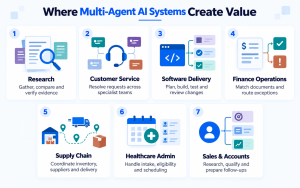
Research and competitive intelligence
A planner can divide a question by market, competitor or source type. Worker agents collect evidence in parallel, an analyst compares it and a reviewer rejects unsupported claims. The system can then prepare a sourced brief for human approval.
This is one of the strongest use cases because the task is naturally divisible. It also shows why provenance matters: the final reader should be able to trace a conclusion back to its source.
Customer service resolution
A front-door agent identifies the customer’s intent. An identity agent verifies access, an order agent checks fulfilment, a policy agent determines available remedies and a communication agent drafts the response. Refunds or account changes can require approval.
The purpose is not to make the customer speak to several bots. The experience should feel like one conversation while specialised agents work behind the scenes.
Software development
A supervisor can divide a development task among agents responsible for repository analysis, implementation, testing, security review and documentation. Work that does not touch the same files may run in parallel, while a human engineer reviews the final change.
This is particularly useful for established codebases with reliable tests and clear contribution rules. It is less suitable for an ambiguous product idea where the main challenge is deciding what to build.
Financial operations
An intake agent can read an invoice, a matching agent can compare it with a purchase order, an exception agent can investigate discrepancies and a policy agent can determine the approval route. The system records each decision and sends unusual cases to finance staff.
Payments should stay behind deterministic controls and human approval thresholds. An agent can assemble and recommend; authority to move money should be deliberately limited.
Supply chain and logistics
Specialist agents can monitor inventory, supplier status, transport events and customer commitments. An orchestrator can identify a likely shortage, ask a planning agent for alternatives and prepare a recommendation for an operations manager.
The benefit is cross-system coordination. The risk is that stale data in one source may distort the entire plan, so timestamps and source reliability must be part of the context.
Healthcare administration
A patient-facing agent may collect the request, an eligibility agent can check coverage, a scheduling agent can find an appointment and a documentation agent can prepare a summary for staff.
Clinical decisions need appropriate professional oversight. The safer early opportunities are administrative: scheduling, intake, document routing and follow-up, with clear escalation when a conversation becomes clinical or urgent.
Sales and account management
A research agent can prepare account context, a qualification agent can assess fit, a CRM agent can update verified fields and a communication agent can draft a follow-up. The salesperson reviews high-value outreach before it is sent.
This reduces preparation work without allowing the system to invent personalisation or overwhelm prospects with automated messages.
Enterprise reporting
Different agents can query approved finance, CRM and operations sources. A synthesis agent combines the results, while a verification agent checks totals and flags inconsistent reporting periods. The final report includes source references and unresolved exceptions.
You can see the wider range of systems and integrations Appther works with in our technology stack and AI project case studies.
When should a business use a multi-agent system?
A multi-agent approach is worth considering when:
- The workflow contains distinct specialist responsibilities.
- Several independent tasks can be completed in parallel.
- Different steps require different permissions or data sources.
- The process benefits from an independent review stage.
- One agent’s context or toolset has become too broad to control.
- Failures need to be isolated and retried by stage.
Stay with a single agent, or conventional workflow automation, when the task is short, linear and deterministic. If the process can be expressed reliably as standard business rules, a language-model agent may not be necessary at all.
A useful test is to map the existing human process. If the work genuinely moves between researchers, analysts, approvers and operators, a multi-agent design may reflect the business well. If one person completes the entire task with a checklist, start with one agent and a controlled set of tools.
How to build a multi-agent AI system
1. Choose one measurable workflow
Begin with a specific outcome, such as resolving order-status enquiries or preparing a weekly competitor brief. Define completion rate, accuracy, turnaround time, escalation rate and cost per task.
2. Map roles and boundaries
Identify which responsibilities require different instructions, tools or permissions. Do not create a separate agent merely because a workflow has another step. Some stages are better implemented as normal code.
3. Select the orchestration pattern
Choose supervisor, sequential, parallel, routing or reviewer patterns based on how the work actually flows. Many production systems combine them: a supervisor may route work to parallel researchers and then send the combined result through a reviewer.
4. Design narrow tools
Expose business capabilities through specific, validated functions. Decide which agent can call each tool, what data it can see and which actions need approval.
5. Define state and handoff schemas
Specify what each agent receives and returns. Keep verified facts, model interpretations and pending questions separate. Include source and timestamp fields where the information may change.
6. Build guardrails in code
Set step limits, budgets, timeouts, retries, allow-listed actions and escalation rules outside the prompt. Protect irreversible or sensitive actions with deterministic checks and human approval.
7. Evaluate before live access
Run the system against a representative task set, including incomplete data, conflicting records, tool outages and malicious input. Score both individual agents and the final business outcome.
8. Launch with limited authority
Start in read-only or recommendation mode. Let the system prepare an action while a person executes or approves it. Expand autonomy only when measured performance supports the change.
Appther builds custom AI and machine-learning solutions around existing business workflows, data and APIs. The right first step is usually a focused pilot, not a platform-wide rollout.
Multi-agent AI system technology stack
A typical implementation may include:
- Models: OpenAI, Anthropic, Google or suitable open-weight models.
- Orchestration: LangGraph, CrewAI, AutoGen or custom state-machine logic.
- Retrieval: PostgreSQL with vector search, Pinecone, Weaviate or OpenSearch.
- Application services: Python, FastAPI, Node.js or existing enterprise APIs.
- State and queues: PostgreSQL, Redis and event or message queues.
- Observability: Agent traces, structured logs, metrics and evaluation dashboards.
- Deployment: AWS, Azure, Google Cloud, private cloud or on-premises infrastructure.
The framework is not the architecture. Long-term reliability depends more on role design, tool contracts, permissions, evaluation data and operational controls than on the orchestration library selected for the first version.
Final thoughts
Multi-agent AI systems are useful when a business task is too broad for one agent but structured enough to divide into clear responsibilities. A well-designed system can research in parallel, apply specialist rules, connect several business tools and check its own work before asking a person to decide.
The benefit comes with a cost. More agents mean more calls, more state, more permissions and more ways for context to be lost. The architecture should therefore begin as small as possible. Add a new agent only when specialisation, independent review, security separation or parallel execution creates measurable value.
The strongest production systems do not imitate an unstructured meeting between bots. They resemble a controlled workflow: defined roles, narrow tools, typed handoffs, visible evidence, clear stopping rules and human authority where the consequence matters.
If you are considering a multi-agent workflow for operations, customer service, software delivery or enterprise research, talk to Appther. We can help you identify the first use case, design the agent architecture and test it against real business outcomes before wider deployment.

Frequently asked questions
What is a multi-agent AI system in simple terms?
A multi-agent AI system is a group of specialised AI agents that work together on one goal. An orchestrator assigns tasks, passes relevant context and combines the results, while each agent handles a defined responsibility.
How is a multi-agent system different from a chatbot?
A chatbot mainly conducts a conversation and provides answers. A multi-agent system can coordinate several specialised agents, use business tools, maintain workflow state and complete multi-step work behind a single user experience.
What are the main components of multi-agent AI architecture?
The main components are an entry channel, orchestrator, specialist agents, shared state, structured handoffs, a tool and API layer, guardrails, monitoring, evaluation and human approval points.
What are the benefits of multi-agent AI systems?
Benefits include specialist behaviour, parallel execution, clearer permission boundaries, better handling of complex workflows, model routing and independent review. These benefits matter only when the task justifies the added complexity.
Are multi-agent systems more accurate than single agents?
Not automatically. Reviewers and specialist agents may improve performance, but they can also repeat or amplify an earlier error. Accuracy depends on good data, reliable tools, structured validation, evaluation and appropriate human oversight.
What are common multi-agent AI use cases?
Common use cases include research, customer service, software development, financial operations, supply-chain coordination, healthcare administration, sales preparation and enterprise reporting.
How much does it cost to build a multi-agent AI system?
Cost depends on the number of workflows, integrations, security requirements, model usage, evaluation scope and deployment environment. A bounded pilot with one orchestrator and a few specialist roles is the best way to establish implementation and operating costs before scaling.
Which framework is best for multi-agent AI?
There is no universal best framework. LangGraph, CrewAI, AutoGen and custom orchestration can all be suitable. The decision should follow the workflow’s state, control, deployment and observability requirements rather than framework popularity.