| Quick Answer
AI integration in ERP systems means embedding machine learning, natural language processing, and generative AI into platforms like Odoo to automate daily work such as invoice processing, demand forecasting, inventory replenishment, and reporting. Adoption is now mainstream. Panorama Consulting’s 2025 ERP Report found that 72% of organizations deploy AI in their enterprise software, up from 53% the year before. Most businesses start with finance automation, prove the ROI, then expand to supply chain and customer service. |
ERP systems have run the back office for decades. They hold your financial, operational, and HR data in one database, and they do it well. But storing data is no longer the hard part. Acting on it fast is.
That is where AI changes the game. Instead of waiting for a human to run a report or key in an invoice, an AI-enabled ERP reads documents, spots patterns, and takes action on its own. The numbers back this up. AI deployment in enterprise software jumped from 53% to 72% of organizations in a single year, according to Panorama Consulting’s 2025 ERP Report. The cloud ERP market is projected to grow from $47 billion in 2025 to $117 billion by 2030.
If your team still spends hours on manual data entry, chases stock-outs, or waits days for financial reports, this guide is for you. We will walk through exactly which daily activities AI can take off your plate, what the technology looks like inside Odoo, and how to roll it out without disrupting your business.
Why Do Traditional ERP Systems Fall Short?
Legacy ERPs run on rigid, rules-based logic. They record what already happened: a sale closed, an invoice got paid, a shipment left the warehouse. They tell you almost nothing about what happens next, and they need constant human input to function.
The gap between a traditional ERP and an AI-enabled one comes down to proactivity. A traditional system waits for you to run a report. An intelligent system monitors data in the background, flags anomalies, and suggests fixes before you even notice the problem.
That shift matters because it frees your leadership team from daily firefighting. When routine decisions handle themselves, managers can focus on growth instead of admin.
What Does AI Actually Do Inside an ERP?
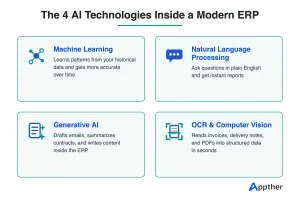
“AI in ERP” is really four technologies working together. Here is what each one handles in a normal workday:
- Machine learning (ML): learns from your historical data. It picks up seasonal sales patterns, typical expense categories, and operational bottlenecks, and it gets more accurate the longer it runs.
- Natural language processing (NLP): lets anyone ask questions in plain English. Type “What were our top-selling products in Q3?” and get an instant chart. No SQL, no report builder.
- Generative AI: creates content instead of just analyzing it. It drafts follow-up emails, summarizes vendor contracts, and writes product descriptions directly inside the ERP.
- OCR and computer vision: read documents. Scanned invoices, delivery notes, and PDFs get converted into structured data in seconds.
How Does AI Streamline Finance and Administration?
Finance teams feel the impact first, because accounting is full of high-volume, low-value tasks that AI handles better than people do.
Accounts payable on autopilot
Think about the traditional invoice cycle. An invoice lands in an inbox. A clerk opens it, checks it against a purchase order, types the data into the system, and routes it for approval. It is slow and error-prone.
An AI-enabled ERP intercepts the email, extracts the vendor, line items, and totals with OCR, then matches everything against your purchase orders and delivery receipts. If it all lines up, the payment gets scheduled automatically. Your team only steps in when the system flags an exception. Clients typically see invoice processing drop from days to minutes after this single change.
The end of manual data entry
The same pattern applies across the back office. The system learns your standard journal entries, auto-categorizes expenses based on past behavior, and reconciles bank statements while your accountants sleep. That frees your finance professionals to do what you actually hired them for: analyzing margins, finding cost savings, and planning growth.
How Does AI Improve Supply Chain and Inventory Management?
Global supply chains are volatile. A disruption in one region can empty shelves in another within weeks. AI gives you the foresight to stay ahead of it.
Smarter demand forecasting
Traditional forecasting uses simple historical averages, which miss sudden market shifts. Machine learning models ingest far more: past sales, economic indicators, weather patterns, even search trends. The result is a forecast that predicts what customers will buy, when, and in what quantity, with far less guesswork.
Inventory that manages itself
Paired with forecasting, AI keeps stock at the sweet spot. Capital is not tied up in excess goods, and stock-outs stop happening. The ERP watches inventory across every warehouse and location in real time. When demand spikes, it generates purchase orders for critical items before they run out. For a step-by-step rollout plan, see our Odoo ERP implementation checklist for manufacturing companies.
A supply chain that spots risk early
Predictive analytics also scores your vendors. The system tracks late deliveries and quality issues over time. If it predicts a key supplier will miss a crucial shipment, it suggests an alternative vendor before your production line feels the impact.
What Is Predictive Maintenance and Why Does It Matter?
For manufacturers, downtime is the enemy. A halted production line burns money every minute in lost output and idle labor.
The old options were both bad. Preventative maintenance meant servicing machines on a fixed schedule whether they needed it or not. Reactive maintenance meant waiting for a breakdown.
Predictive maintenance changes the model. IoT sensors on the factory floor feed vibration, temperature, and energy data straight into the ERP. The AI detects the tiny anomalies that precede a failure, schedules maintenance during off-hours, and checks that spare parts are in stock. Unplanned downtime effectively disappears.
Can AI in ERP Help Customer Service and HR Too?
Yes, and this is where ERPs move from the back office to the front office.
On the customer side, generative AI pulls a customer’s full purchase history, open orders, and past tickets the moment they reach out. It drafts an accurate, personalized response for your agent, or resolves simple issues on its own through a chatbot connected to real ERP data, not canned scripts.
Internally, HR teams use the same tools for onboarding. New hires ask an AI assistant to enroll in benefits, request leave, or explain a policy, without a single email to HR.
Is AI-Powered ERP Only for Large Enterprises?
No, and this misconception costs smaller businesses real money. Cloud computing has made intelligent ERP affordable at any size. In fact, 78.6% of new ERP implementations now choose cloud solutions, and small and mid-sized businesses are the fastest-growing adopter segment.
A 50-person company on a cloud ERP now gets the same forecasting and automation power as a global enterprise, on a monthly subscription. For smaller teams the payoff is even bigger. Without a large admin headcount, AI handling the repetitive work lets a small business serve more customers and process more orders without hiring proportionally.
How Does Odoo Handle AI Integration?
This is where theory becomes practice. Odoo 19 ships with AI built into the core: OCR invoice digitization in Accounting, predictive lead scoring in CRM, automated reordering rules in Inventory, and an AI assistant that drafts content across modules. If you are weighing an upgrade, our Odoo 19 vs Odoo 17 comparison breaks down exactly what the newer AI features deliver.
The native features are the starting point. The bigger wins come from custom AI layers built on top of Odoo. At Appther, we have connected Odoo to AI voice agents that log calls into CRM automatically, built demand forecasting models trained on client sales history, and deployed document intelligence that reads industry-specific paperwork Odoo’s standard OCR cannot handle.
One example from our own delivery work: a trading client with 500+ SKUs across multiple warehouses moved from spreadsheets to Odoo with automated reordering. Purchase orders now trigger themselves when stock falls below threshold, and margins are visible per product, per customer, per location. That is what streamlining day-to-day activities looks like in practice.
Best Practices for Migrating to an AI-Powered ERP
The benefits are clear, but the transition needs a plan. Panorama’s research shows fewer than a third of organizations focus intensely on change management, and that gap is where projects fail. Here are the five practices that separate smooth rollouts from expensive stalls:
- 1. Cleanse your data first. AI is only as good as the data it learns from. Duplicate vendors, stale addresses, and wrong inventory counts just produce inaccurate predictions faster. Audit and standardize before you migrate.
- 2. Define clear business objectives. Do not adopt AI for its own sake. Pick the specific friction points: invoice processing, supply delays, response times. Targeted use cases make ROI measurable.
- 3. Start small and scale. A phased rollout works best. Automate accounts payable first. Once the finance team trusts the system, switch on demand forecasting.
- 4. Invest in change management. Employees may fear automation will replace them. Leadership needs to show, not just say, that AI removes the tedious parts of the job. Budget real time for training.
- 5. Choose the right partner. This is a business transformation, not a software install. Work with a partner experienced in both ERP implementation and AI configuration. The data supports this: implementations guided by experienced consultants succeed at much higher rates, and AI-enabled projects have been shown to cut delivery times by around 25% and operational costs by 15%.
Frequently Asked Questions
What is AI integration in ERP systems?
It is the embedding of machine learning, NLP, generative AI, and OCR into an ERP platform so the system automates daily tasks like invoice matching, forecasting, and reporting instead of just recording transactions.
Which daily activities can AI in an ERP automate?
The most common are accounts payable and invoice processing, bank reconciliation, expense categorization, demand forecasting, inventory reordering, vendor risk scoring, customer service responses, and HR requests like leave and benefits.
Does Odoo have built-in AI features?
Yes. Odoo 19 includes OCR invoice digitization, predictive lead scoring, automated inventory replenishment, and an AI content assistant. Businesses with specific needs can extend these with custom AI models built on top of Odoo.
How much does AI-powered ERP cost for a small business?
Cloud ERP platforms like Odoo start at a per-user monthly subscription, which puts AI features within reach of companies with as few as 10 to 50 employees. Implementation cost depends on modules, data volume, and customization, so a scoping audit is the only way to get a real number.
How long does implementation take?
A standard small or mid-size rollout typically takes four to eight weeks. Complex projects with heavy customization and large data volumes can run three to six months.
What it comes down to
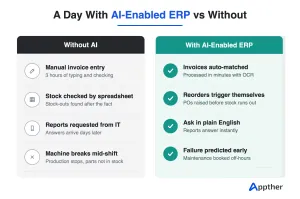
ERP software is moving from systems that record history to systems that shape what happens next. AI integration in ERP systems takes the repetitive work off your team’s plate: invoices match themselves, stock reorders itself, machines flag their own failures, and reports answer plain-English questions.
The businesses adopting this now are building a compounding advantage. Every month of AI-assisted operations generates cleaner data, better forecasts, and faster decisions. Waiting has a cost.
 |