AI voice agents for Australian clinics are becoming a practical solution for healthcare businesses that want to reduce missed calls, automate appointment booking, improve patient intake and support front-desk teams.
Many clinics still depend heavily on phone calls. Patients call to book appointments, reschedule visits, ask basic questions, confirm timings, request follow-ups or speak with reception. When the front desk is busy, calls are missed, patients wait longer and staff become overloaded.
An AI voice agent can help by answering calls, understanding the patient’s request, collecting basic information, checking appointment availability, sending confirmations and creating call summaries for staff.
In Australia, AI is already being used in healthcare to support diagnosis, treatment, patient support and health service operations. The Australian Government also highlights the need for AI to be used safely, fairly and responsibly in healthcare.
This guide explains how AI voice agents work for clinics, where they create value, what should not be automated, privacy considerations, cost estimates and how Australian clinics can start safely.
What is an AI voice agent for clinics?
An AI voice agent is a phone-based virtual assistant that can speak with callers in natural language. It can answer routine calls, understand the caller’s intent and complete predefined tasks.
For clinics, an AI voice agent can support workflows such as:
- Appointment booking
- Appointment rescheduling
- Missed call handling
- Patient intake
- Reminder calls
- Follow-up calls
- Basic FAQ handling
- Call summary generation
- Escalation to clinic staff
Unlike a simple IVR system, an AI voice agent does not only ask callers to “press 1” or “press 2.” It can understand spoken language and respond conversationally.
For example, a patient may say:
“I need to book an appointment with Dr. Smith tomorrow morning.”
The AI voice agent can understand the request, check available slots, confirm patient details and book the appointment if the clinic allows calendar integration.
Why Australian clinics are exploring AI voice agents
Australian clinics face increasing pressure on reception and admin teams. Front-desk staff often manage phone calls, walk-in patients, appointment changes, billing questions, reminders and follow-ups at the same time.
AI voice agents can help clinics handle routine communication more efficiently.
Common challenges include:
- Missed calls during busy hours
- Long patient hold times
- Repetitive appointment booking calls
- Staff burnout
- Manual reminder calls
- After-hours enquiries
- Delayed patient follow-ups
- Incomplete call notes
- Difficulty managing multiple doctors or locations
An AI voice agent does not need to replace reception staff. Instead, it can support them by handling repetitive calls and routing sensitive or complex cases to humans.
This makes AI voice agents useful for medical clinics, dental practices, physiotherapy centres, diagnostic centres, allied health providers and specialist clinics.
Key use cases of AI voice agents for Australian clinics
AI voice agents can support several clinic workflows. The best approach is to start with simple, low-risk use cases and expand gradually.
Use caseHow it helps clinicsAppointment bookingHandles routine booking requests and confirms available slotsMissed call handlingResponds when staff are busy or unavailablePatient intakeCollects basic details before the visitAppointment remindersSends or triggers reminders to reduce no-showsFollow-up callsSupports post-visit communication and feedbackCall summariesCreates notes for clinic staffFAQ handlingAnswers basic clinic questionsUrgent routingEscalates important calls to humans
Let’s understand these use cases in detail.
1. AI appointment booking for clinics
Appointment booking is one of the strongest use cases for AI voice agents in healthcare.
Patients often call clinics to ask:
- Is the doctor available today?
- Can I book an appointment tomorrow?
- Can I reschedule my appointment?
- What time is my appointment?
- Is there an earlier slot?
- Can I cancel my appointment?
An AI voice agent can manage these routine booking conversations.
How it works
The AI voice agent can:
- Answer the patient’s call.
- Ask the reason for calling.
- Collect patient name and contact details.
- Check doctor or clinic availability.
- Offer available appointment slots.
- Confirm the selected slot.
- Send SMS, email or WhatsApp confirmation.
- Update the clinic calendar or booking system.
- Create a call summary for staff.
Why it matters
Manual appointment booking takes time and can create errors. AI appointment booking for clinics helps reduce admin workload and gives patients faster service.
It is especially useful for clinics that receive high call volume during morning hours, lunch breaks or after business hours.
2. AI patient intake automation
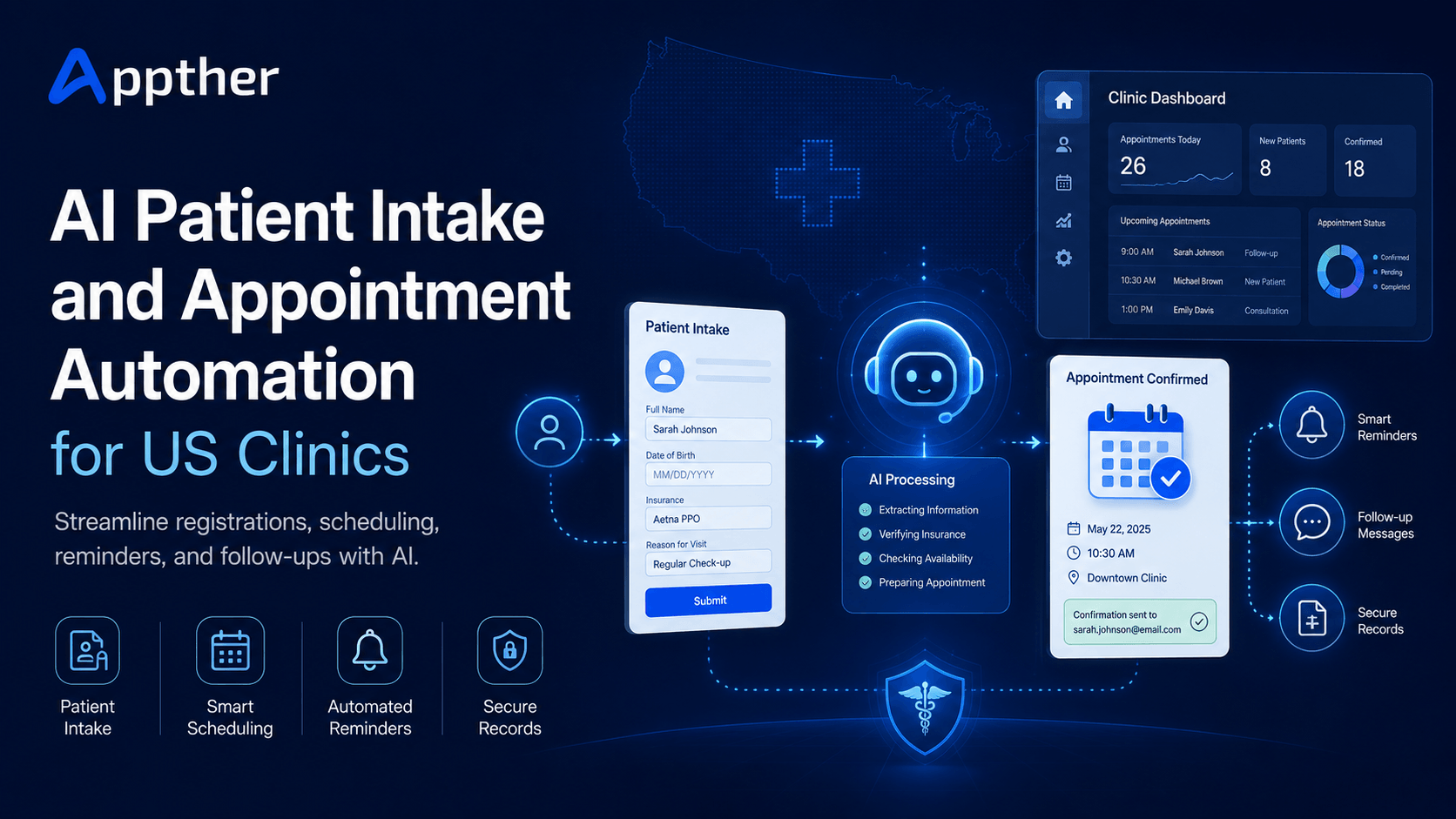
Patient intake is another practical use case. Before an appointment, clinics often need basic patient information such as name, age, contact number, appointment reason and preferred doctor.
An AI voice agent can collect this information in a structured way.
What it can collect
Depending on the clinic’s workflow, the AI voice agent may collect:
- Patient name
- Contact number
- Email address
- Preferred appointment date
- Preferred doctor
- Reason for visit
- New or existing patient status
- Basic insurance or payment information if required
- Consent confirmation where appropriate
Important safety note
AI patient intake automation should be designed carefully. The AI should not collect unnecessary sensitive details. It should also avoid giving clinical advice, diagnosis or medication guidance.
For healthcare providers in Australia, privacy is a major consideration. The OAIC’s health privacy guide helps health service providers understand their obligations under the Privacy Act and embed good privacy practices.
Why it matters
Patient intake automation helps clinics prepare before the patient arrives. It also reduces manual form-filling and gives staff more complete information.
3. Missed call handling
Missed calls are a major issue for clinics. When the reception team is busy, calls may go unanswered. Some patients may call another provider instead of waiting.
An AI voice agent can answer missed calls instantly.
What it can do
- Answer calls when staff are busy
- Capture patient details
- Understand the reason for the call
- Book a callback if needed
- Send call summary to staff
- Route urgent calls to the right person
- Confirm if the patient wants an appointment
Why it matters
Missed call handling can improve patient experience and reduce lost appointments. It also helps clinics respond faster without increasing reception workload.
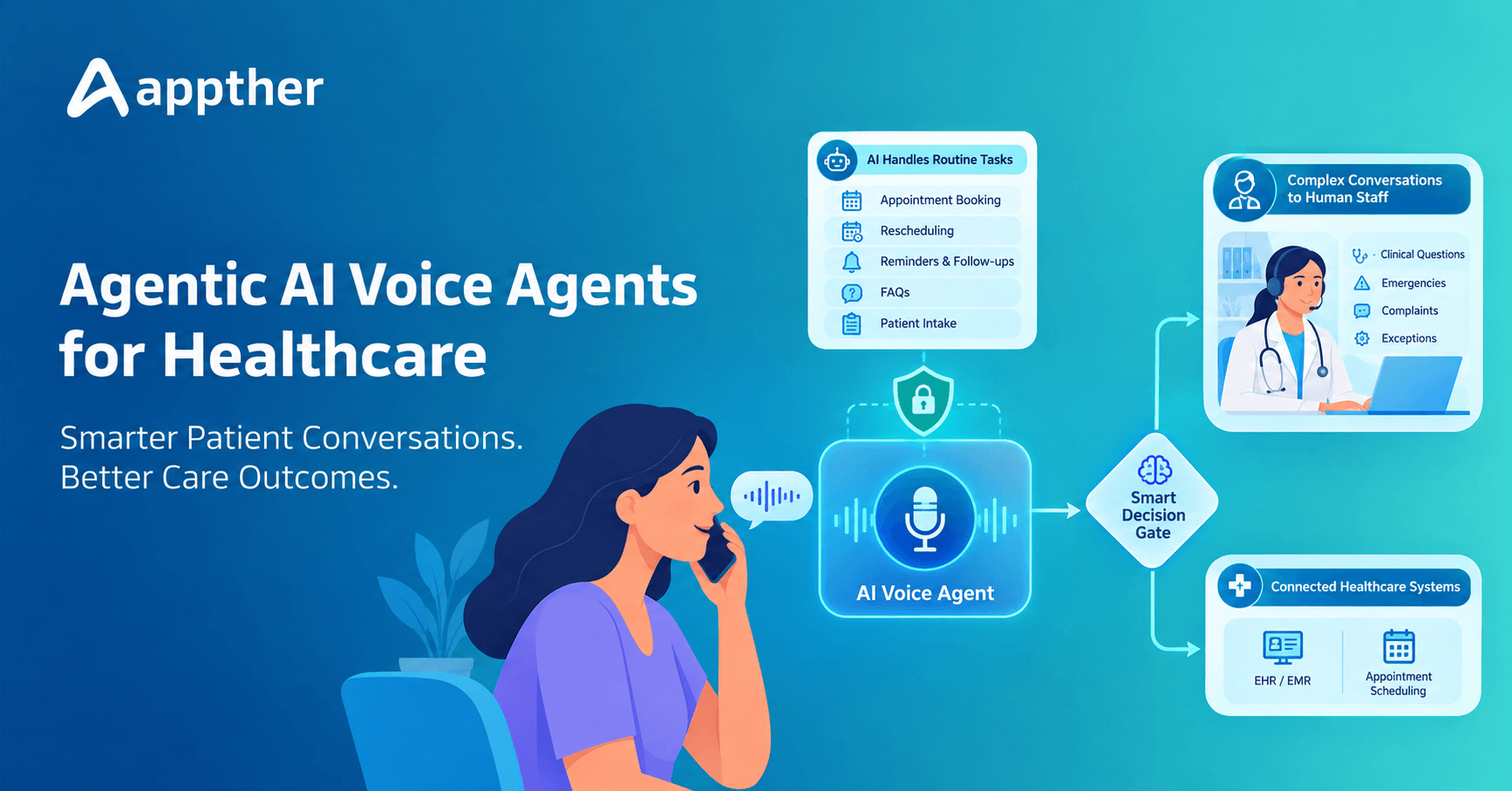
Appther’s AI voice receptionist for healthcare is designed for clinics, hospitals and doctor offices. It can handle inbound patient calls, book appointments, answer FAQs, send reminders and escalate urgent cases to staff.
4. Appointment reminder automation
No-shows create scheduling gaps and revenue loss for clinics. Manual reminders take time, especially when staff need to call many patients every day.
AI voice agents can support appointment reminder automation.
Reminder workflow
The system can:
- Identify upcoming appointments.
- Call or message patients before the appointment.
- Confirm attendance.
- Capture cancellation or reschedule requests.
- Update the clinic team.
- Trigger SMS or email confirmation.
Why it matters
Automated reminders help reduce no-shows and improve schedule utilisation. They also save staff time and make appointment communication more consistent.
5. Follow-up call automation
Clinics often need to follow up with patients after appointments, procedures or consultations. However, front-desk teams may not always have enough time.
AI voice agents can help automate basic follow-up workflows.
Common follow-up use cases
- Post-visit check-in
- Feedback collection
- Appointment follow-up reminder
- Medication pickup reminder where appropriate
- Test report collection reminder
- Next appointment reminder
- Patient satisfaction survey
What should be avoided
AI should not handle sensitive medical conversations without human review. It should not provide diagnosis, treatment decisions or medication instructions.
For sensitive cases, the AI should collect the request and escalate it to clinic staff.
Why it matters
Follow-up automation improves patient communication and helps clinics maintain continuity of care.
6. Clinic FAQ handling
Patients often call clinics for basic questions.
Examples include:
- What are your opening hours?
- Where is the clinic located?
- Is parking available?
- What documents should I bring?
- Do you accept new patients?
- What services do you offer?
- Can I book online?
- What payment methods are accepted?
An AI voice agent can answer these routine questions using a clinic-approved knowledge base.
Why it matters
FAQ automation reduces repetitive phone calls. It also allows staff to focus on in-clinic patients and higher-value tasks.
7. Call summaries and staff handover
A strong AI voice agent should not only handle calls. It should also create structured summaries for staff.
Call summaries may include
- Caller name
- Contact number
- Reason for call
- Appointment request
- Selected slot
- Follow-up requirement
- Escalation note
- Urgency level
- Transcript or recording if enabled
Why it matters
Call summaries improve internal communication. Staff can quickly understand what happened without listening to the full call.
This is especially useful for multi-doctor clinics and multi-location practices.
AI voice agent workflow for a clinic
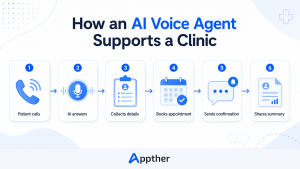
A simple clinic AI voice agent workflow may look like this:
- Patient calls the clinic.
- AI voice agent answers the call.
- AI identifies the purpose of the call.
- AI collects basic patient details.
- AI checks appointment availability.
- AI books, reschedules or cancels the appointment.
- AI sends SMS, email or WhatsApp confirmation.
- AI creates a call summary.
- AI updates the clinic system or dashboard.
- Staff review escalated or sensitive cases.
This workflow helps clinics handle routine calls faster while keeping humans involved for important decisions.
Benefits of AI voice agents for Australian clinics
AI voice agents can create measurable benefits for clinics when implemented properly.
Fewer missed calls
The AI can answer calls when staff are busy, unavailable or outside business hours.
Faster patient response
Patients do not need to wait on hold for simple tasks like appointment booking or basic questions.
Reduced admin workload
Reception staff spend less time on repetitive calls and more time supporting in-clinic operations.
Better appointment management
AI can support booking, rescheduling, cancellations and reminders.
Improved patient experience
Patients get faster responses and clearer communication.
Better follow-up
AI can support reminders, surveys and structured follow-up workflows.
More complete call records
Call summaries and transcripts help staff track patient communication.
24/7 availability
After-hours call handling helps clinics capture requests even when reception is closed.
What should not be automated?
AI voice agents are useful, but they should not automate everything.
Clinics should avoid using AI voice agents for:
- Medical diagnosis
- Emergency triage
- Clinical advice
- Medication decisions
- Treatment recommendations
- Complex patient complaints
- Sensitive mental health conversations without human review
- High-risk clinical decisions
- Any situation requiring professional judgement
The AI should support admin and communication workflows. It should not replace doctors, nurses or trained clinical staff.
For urgent or sensitive cases, the system should escalate the call to a human.
Privacy, consent and safety considerations
Privacy is one of the most important topics for AI voice agents in healthcare.
AI systems may process names, contact details, appointment reasons, call recordings, transcripts and other personal information. Therefore, clinics must plan data handling carefully.
The OAIC advises organisations using commercially available AI products to consider privacy obligations, including whether personal information is being collected, used, disclosed or stored by AI tools.
Australian clinics should consider the following checklist:
- Inform patients when AI is used.
- Collect only necessary information.
- Avoid unnecessary sensitive health details.
- Get consent where required.
- Confirm where data is stored.
- Confirm whether vendors use data for training.
- Use secure APIs and encrypted storage.
- Limit access to authorised staff.
- Maintain audit logs.
- Allow staff to review AI summaries.
- Escalate sensitive cases to humans.
- Define a data retention policy.
- Create a clear AI usage policy.
The Australian Cyber Security Centre also warns that AI adoption can create risks such as data leaks, privacy breaches, reliability issues, manipulation of AI outputs and supply-chain vulnerabilities.
A safe AI voice agent should be designed with privacy, security and human oversight from the beginning.
AI voice agent technology stack
A clinic AI voice agent usually includes several technologies working together.
Speech-to-text
Speech-to-text converts the patient’s voice into text so the AI can understand the caller.
Large language model
The LLM interprets the caller’s intent and generates a suitable response based on clinic-approved workflows.
Text-to-speech
Text-to-speech converts the AI response into natural-sounding voice.
Telephony system
The telephony layer connects the AI with phone calls. This may include phone numbers, call routing and call recording.
Calendar integration
Calendar integration allows the AI to check availability and book appointments.
Practice management or CRM integration
For more advanced clinics, the AI may integrate with a clinic system, CRM, EMR, EHR or internal dashboard.
SMS, email or WhatsApp notifications
The AI can send confirmations, reminders and follow-ups through messaging channels.
Admin dashboard
The dashboard allows clinic staff to review calls, summaries, appointments and escalations.
Security layer
Security should include access control, encryption, logging and compliance-focused data handling.
Appther’s AI development services include LLM applications, AI agents, voice AI, speech systems, RAG pipelines, automation and production-grade AI infrastructure.
Cost of AI voice agents for Australian clinics
The cost of AI voice agents for Australian clinics depends on call volume, integrations, workflows, reporting, security and support needs.
Here is a practical estimate:
Solution typeEstimated setup costBasic AI call assistantAUD 3,000 to AUD 8,000Appointment booking voice agentAUD 8,000 to AUD 20,000Advanced AI receptionist with integrationsAUD 20,000 to AUD 50,000+
There may also be monthly costs for:
- AI model usage
- Call minutes
- Phone numbers
- Text-to-speech usage
- Speech-to-text usage
- Hosting
- SMS or WhatsApp messages
- Calendar or CRM integrations
- Maintenance and support
For a small clinic, a basic AI call assistant may be enough to handle missed calls and simple enquiries. For a multi-doctor clinic, a more advanced AI receptionist may be needed with calendar sync, multiple doctors, call routing, reminders and reporting.
How clinics can start safely with AI voice agents
Australian clinics should not start with a complex AI system on day one. A phased rollout is safer and easier to manage.
Phase 1: Missed call handling
Start by letting AI answer missed calls, capture patient details and create call summaries.
Phase 2: Basic FAQ handling
Add clinic-approved answers for opening hours, location, services, parking and appointment process.
Phase 3: Appointment booking
Connect the AI voice agent with a calendar or booking system to handle appointment requests.
Phase 4: Appointment reminders
Add automated reminder calls, SMS or WhatsApp messages.
Phase 5: Patient intake
Collect basic information before the appointment, with proper consent and privacy controls.
Phase 6: Follow-up workflows
Add post-visit reminders, feedback collection and structured follow-up tasks.
Phase 7: Analytics and optimisation
Review call volume, missed calls, booking rate, escalation rate and patient feedback.
This phased approach helps clinics reduce risk, control cost and improve the system gradually.
AI voice agent implementation checklist
Before launching an AI voice agent, clinics should prepare the following:
RequirementWhy it mattersCall flow designDefines what the AI can and cannot handleClinic FAQ knowledge baseHelps the AI answer approved questionsAppointment rulesPrevents incorrect bookingsEscalation rulesRoutes sensitive or urgent cases to humansConsent languageHelps inform callers about AI usageData storage policyDefines where and how data is storedStaff dashboardAllows review of summaries and callsTesting scenariosHelps validate real-world conversationsSecurity reviewReduces privacy and data risksTraining planHelps staff use the system confidently
A proper launch plan is important because voice AI interacts directly with patients.
AI voice agent vs human receptionist
AI voice agents and human receptionists should work together.
Are a AI voice agentHuman receptionistAvailability24/7Business hours or roster-basedRepetitive callsVery strongCan become overloadedAppointment remindersStrongManual effort requiredSensitive conversationsNeeds escalationBetter suitedComplex judgementNot suitableBetter suitedPatient empathyLimitedStrongerCall summariesAutomatedManualEmergency handlingEscalate onlyHuman decision-making required
AI should handle routine and structured tasks. Humans should handle sensitive, emotional, urgent or complex conversations.
Why choose Appther for AI voice agents in Australia?
Appther helps businesses build AI-powered voice agents, chatbots, automation platforms and healthcare workflow solutions.
Appther’s AI voice receptionist for healthcare supports inbound calls. It handles booking, FAQs, and reminders. It sends WhatsApp or SMS confirmations.
It syncs with your calendar. It provides full transcripts and a clear dashboard. It works for clinics and doctor offices.
For Australian clinics, Appther can support:
- AI voice agent development
- AI receptionist setup
- Appointment booking automation
- Patient intake automation
- Missed call handling
- Reminder workflows
- SMS, email and WhatsApp notifications
- Calendar integration
- CRM or practice management integration
- Admin dashboard development
- Call logs and transcripts
- Human escalation workflows
- Secure AI architecture
- Post-launch support
Appther is also an AI mobile app development company in Australia. It helps businesses build AI software, mobile apps, automation systems, and custom digital platforms. It serves healthcare, real estate, logistics, restaurants, and enterprise sectors.
If your clinic needs a secure, scalable, and practical AI voice solution, Appther can help.
We can plan the workflow, build the system, and launch it in phases.
Final thoughts
AI voice agents for Australian clinics can cut missed calls. They can improve appointment booking. They can support patient intake. They can reduce front-desk workload.
The best use cases to start with are missed call handling, basic FAQs, appointment booking and reminders. You can add more advanced workflows, like patient intake and follow-ups, later.
They will include proper privacy, consent, and security controls.
AI should not replace clinical judgement. It should support clinic teams by automating routine communication and escalating sensitive cases to humans.
With good planning, AI voice agents can help Australian clinics.
They can improve the patient experience.
They can reduce admin work.
They can streamline front-desk workflows.
Ready to automate clinic calls with AI?
Build a secure AI voice agent for appointments, intake and patient follow-ups.
Book a free AI consultation with Appther today.
FAQs
What is an AI voice agent for clinics?
An AI voice agent for clinics is a phone-based virtual assistant. It can answer calls and understand patient requests. It can book appointments and collect basic details. It can send confirmations and create call summaries for staff.
Can AI voice agents book appointments?
Yes. AI voice agents can book appointments when connected with a calendar or booking system. They can check available slots, confirm details and send appointment confirmations.
Can AI voice agents replace receptionists?
AI voice agents should not fully replace receptionists. They are best used to support reception teams by handling routine calls, missed calls, reminders and simple appointment workflows.
Are AI voice agents safe for healthcare?
AI voice agents can be safe when designed with privacy, consent, access control, secure data handling and human escalation. They should not provide diagnosis, treatment advice or medication decisions.
Can AI voice agents handle after-hours calls?
Yes. AI voice agents can answer after-hours calls. They can capture patient requests. They can provide basic, approved information. They can also create follow-up tasks for clinic staff.
How much does an AI voice agent cost for clinics?
A basic AI call assistant may cost AUD 3,000 to AUD 8,000 to set up. A clinic appointment voice agent may cost AUD 8,000 to AUD 20,000. An advanced AI receptionist with integrations may cost AUD 20,000 to AUD 50,000+.
What workflows can AI voice agents automate?
AI voice agents can automate appointment booking, missed-call handling, and patient intake. They can also send reminders, make follow-up calls, answer FAQs, and create call summaries. They can also notify staff.
Can Appther build a custom AI voice agent for Australian clinics?
Yes. Appther builds custom AI voice agents for Australian clinics.
They handle appointment booking and patient intake.
They also send reminders and create call summaries.
They include a dashboard and calendar integration.
They support human escalation workflows.