Agentic AI Voice Agents for Healthcare: Building HIPAA-Compliant AI Voice Automation
A patient calls a medical clinic at 8:30 PM.
They want to reschedule tomorrow’s appointment. They have already tried the patient portal, but the available slot does not work for them. The front desk is closed, so they leave a voicemail and hope someone calls back the next morning.
By then, the patient may have forgotten, the appointment may remain unused, and a member of the administrative team has another message to process.
This is exactly the kind of healthcare communication problem that agentic AI voice agents are beginning to solve.
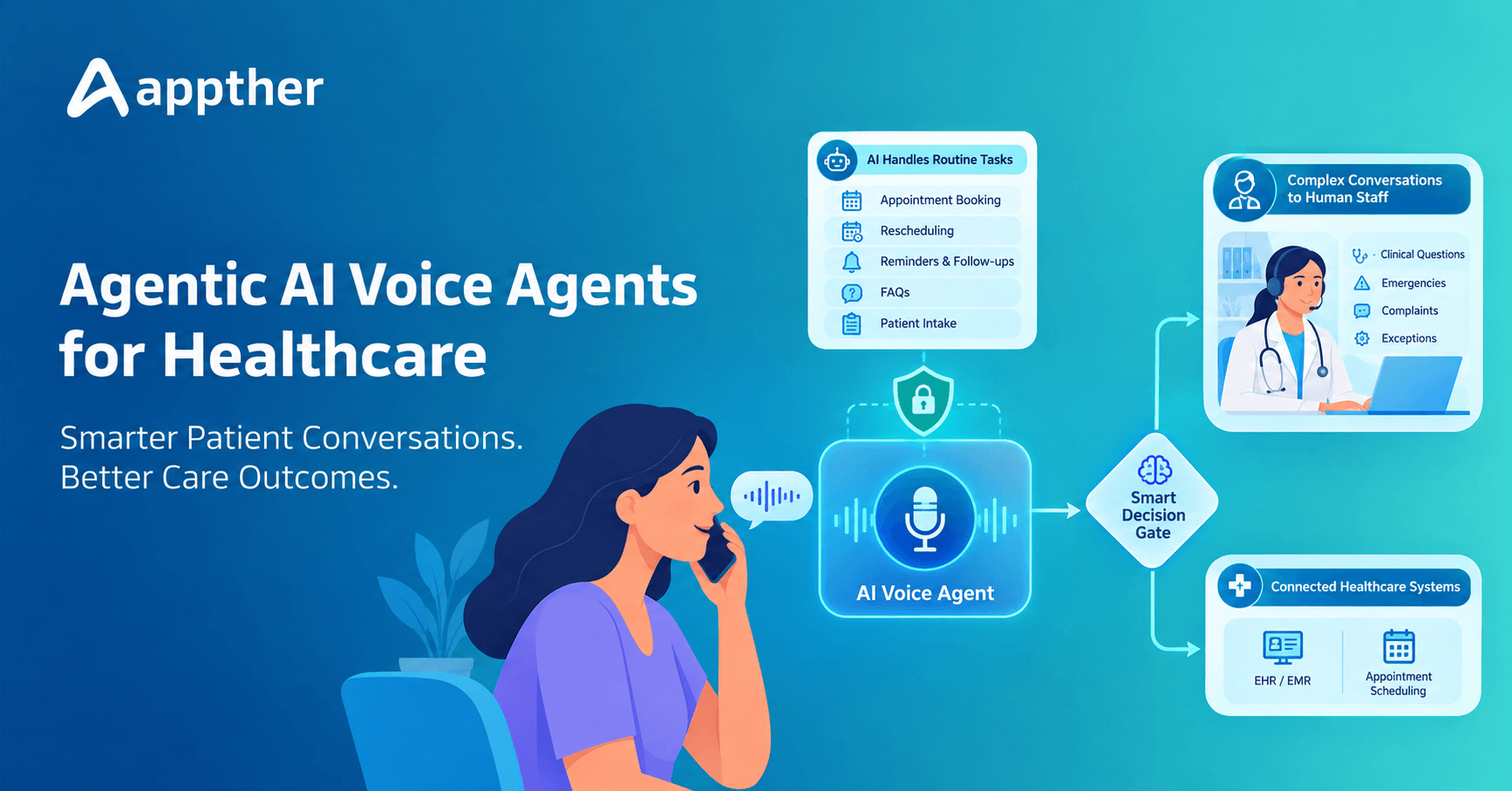
An AI voice agent can answer calls naturally, understand what a patient is asking for, access approved information, interact with business systems, complete specific tasks, and involve a human when a request falls outside its defined boundaries.
But healthcare is different from ordinary customer service.
A healthcare AI voice agent may interact with protected health information (PHI), appointment information, patient identifiers, medical workflows, and other sensitive data. That means organizations cannot simply connect a general-purpose voice bot to an LLM and start taking patient calls.
The system needs to be designed around security, privacy, controlled access, auditability, appropriate vendor relationships, and the organization’s HIPAA obligations.
The result is a new category of healthcare automation: agentic AI voice systems designed not only to converse with patients, but to securely execute healthcare workflows.
What Is an Agentic AI Voice Agent?
The easiest way to understand agentic AI is to compare it with a traditional voice assistant.
A traditional voice assistant might recognize a patient’s words and provide an answer. A traditional IVR might ask the caller to press 1 for appointments, 2 for billing, or 3 for another department.
An agentic AI voice agent works differently.
Instead of forcing the patient into a rigid menu, the patient can explain the request naturally.
For example:
“I have an appointment with Dr. Miller tomorrow, but I won’t be able to make it. Can you move it to sometime next week?”
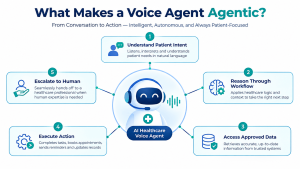
The AI needs to understand the intent behind the sentence. It then needs to determine which workflow applies, retrieve the appropriate information, interact with the scheduling system, offer available options, and complete the requested action.
That makes the voice agent more than a conversational interface. It becomes a workflow execution layer between the patient and the healthcare organization’s systems.
This distinction is particularly important in healthcare because the value of AI does not come from making conversations sound impressive. The real value comes from connecting those conversations with meaningful operational outcomes.
Why Healthcare Is Becoming a Strong Use Case for Voice AI
Healthcare organizations still depend heavily on telephone communication.
Patients call clinics to schedule appointments, change appointments, ask about services, confirm visit details, request follow-ups, obtain directions, ask administrative questions, and reach specific departments.
Many of these conversations are repetitive, but that does not make them unimportant.
For a patient, spending ten minutes waiting for someone to answer the phone can be frustrating. For a healthcare provider, hundreds or thousands of similar calls can consume valuable staff time every month.
This creates an interesting opportunity for AI.
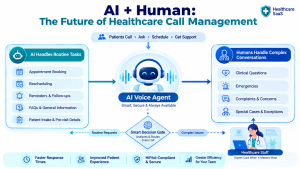
Instead of replacing the human healthcare team, AI can absorb the repetitive communication layer surrounding clinical operations.
A receptionist should not have to spend the entire morning answering the same questions about clinic hours. A scheduling employee should not have to manually process every simple appointment change. A staff member should not have to call every patient individually to confirm routine appointments when an automated workflow could assist with that process.
Agentic AI allows these tasks to become conversational while remaining connected to the organization’s existing workflows.
This is where healthcare voice automation becomes much more valuable than a basic chatbot on a website.
A website chatbot requires a patient to type.
A voice agent allows the patient to simply talk.
And an agentic voice agent can potentially turn that conversation into a completed business action.
The Shift From IVR to Conversational Healthcare Automation
Traditional IVR technology solved an earlier generation of the healthcare call problem.
It helped organizations route calls by asking patients to select options. The model was predictable and relatively easy to implement, but it also introduced friction.
A patient may know exactly what they want, but they still have to navigate the organization’s phone tree.
Imagine saying:
“Press 1 for appointments.”
Then:
“Press 2 to reschedule.”
Then:
“Enter your patient ID.”
Then:
“Press 1 for an existing appointment.”
A conversational AI voice agent approaches the same problem differently.
The caller can explain the problem in one sentence.
The AI interprets it, asks follow-up questions when necessary, and moves through the relevant workflow.
This does not mean traditional IVR will disappear completely. In many healthcare environments, IVR, human staff, and AI agents will coexist.
The difference is that agentic AI can sit above these systems and provide an intelligent conversational layer.
The result is a transition from menu-driven communication to intent-driven communication.
Why HIPAA Matters When Building a Healthcare AI Voice Agent
The conversation becomes more complicated when the system handles patient information.
The HIPAA Security Rule establishes national standards for protecting electronic protected health information and requires appropriate administrative, physical, and technical safeguards to protect its confidentiality, integrity, and availability.
That means healthcare organizations need to think about much more than the AI model itself.
Consider a typical voice interaction.
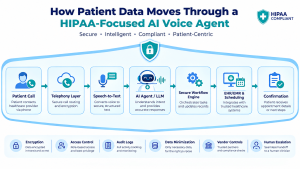
A patient speaks to a phone number. Their voice is converted into text. The AI interprets the request. The agent checks a scheduling platform. Patient information may be retrieved. The appointment may be changed. A confirmation may be sent through SMS.
The data has now moved across multiple components.
That means the architecture must answer important questions.
Where does the conversation data go?
Which systems can access it?
What information is stored?
How long is it retained?
Which vendors process it?
Who can access the resulting records?
What happens if an integration fails?
How are activities logged?
What happens when the AI encounters a request it should not handle?
These questions are not secondary engineering details. They are part of designing a responsible healthcare AI system.
HHS guidance also emphasizes that risk analysis is foundational to identifying and implementing appropriate safeguards for electronic PHI, and organizations should evaluate risks according to their own environment rather than relying on a one-size-fits-all checklist.
HIPAA Compliance Is an Architecture Decision, Not an AI Feature
One of the biggest mistakes companies make when evaluating healthcare AI is asking:
“Is this AI model HIPAA compliant?”
That is usually not the right question.
A language model or voice technology is only one component of a much larger system.
Imagine a healthcare AI voice agent built using a telephony provider, speech recognition service, LLM, cloud infrastructure, database, scheduling API, analytics platform, SMS service, and EHR integration.
Even if one component provides appropriate healthcare-related security controls, the complete system still needs to be evaluated.
This is why HIPAA-focused AI development should begin with data-flow and risk analysis, not simply with choosing a model.
The development team should understand where electronic PHI is created, received, maintained, or transmitted and determine what safeguards are appropriate for the actual environment. HHS identifies risk analysis as the first step in the Security Rule’s security management process.
What Is a BAA and Why Is It Important?
The term BAA, or Business Associate Agreement, becomes especially important when healthcare organizations work with external providers that handle PHI on their behalf.
HHS describes a business associate as an individual or organization that performs certain functions or provides services involving the use or disclosure of PHI on behalf of a covered entity. HIPAA generally requires covered entities and business associates to establish appropriate written arrangements concerning the safeguarding and permitted use of PHI.
This becomes particularly relevant to AI voice systems because a modern healthcare AI stack often depends on multiple technology providers.
For example, a healthcare organization may use separate providers for telephony, speech processing, cloud hosting, AI infrastructure, databases, communications, and integrations.
If those services involve PHI, the organization needs to understand the contractual and compliance implications of each component.
Importantly, a BAA does not magically make a solution HIPAA compliant.
It is one part of the broader compliance relationship.
The system still needs appropriate safeguards, access controls, risk management, secure configuration, policies, monitoring, and operational processes.
HHS specifically notes that cloud services can be used to create, receive, maintain, or transmit ePHI when the appropriate requirements are met, including a BAA with the cloud service provider where applicable and compliance with the HIPAA Rules.
That is why healthcare organizations should evaluate an AI voice solution as a complete ecosystem rather than judging it based on a single technology vendor.
Designing an AI Voice Agent Around the Minimum Necessary Principle
Another important consideration is data access.
An AI appointment agent does not necessarily need access to an entire patient record.
Suppose the only task is rescheduling an appointment.
The AI may need certain identity and scheduling information to complete the workflow, but unrestricted access to unrelated clinical documentation may be unnecessary.
The HIPAA Privacy Rule’s minimum necessary standard generally requires covered entities to take reasonable steps to limit uses, disclosures, and requests for PHI to the minimum necessary for the intended purpose.
This principle can translate into better AI architecture.
Instead of giving an AI agent broad database access, developers can create controlled tools or APIs.
The agent might have one function for checking appointment availability and another function for rescheduling an appointment.
It does not need unrestricted access to the underlying database simply because it is technically possible.
This approach improves both security and system reliability.
What Can an Agentic AI Voice Agent Actually Do in Healthcare?
The most successful healthcare AI voice agents are not designed around a vague promise to “automate everything.”
They are designed around specific workflows.
Consider appointment management.
A patient might call and say that they need to move an appointment. The AI can understand the request, verify what the organization’s workflow requires, retrieve the appointment, identify available slots, and help the patient choose an alternative.
Once the selection is confirmed, the agent can update the scheduling system and provide the appropriate confirmation.
The same concept can be extended to appointment reminders.
Instead of sending a generic reminder that simply says:
“Your appointment is tomorrow.”
A voice agent can engage in a conversation and respond to the patient’s actual situation.
The patient might say:
“I can’t attend tomorrow. Is there anything available next week?”
The system can then move from reminder workflow into rescheduling workflow.
This is where agentic design becomes powerful: one conversation can move through multiple approved actions without forcing the patient to start over.
Healthcare organizations can also use conversational AI for patient intake, administrative FAQs, provider information, clinic directions, routine follow-ups, call routing, and other workflows where the AI can operate within defined boundaries.
The Most Important Feature May Be Knowing When to Stop
A healthcare AI agent should not attempt to answer every question.
In fact, one sign of a mature AI system is that it knows when it should not continue.
If a patient starts asking for medical advice outside the system’s approved scope, the AI should not improvise simply because the underlying language model can generate an answer.
If a caller presents an emergency, the system needs a predefined escalation approach.
If the caller cannot complete identity verification, the agent should not keep revealing sensitive information.
If an integration fails, the agent should provide an appropriate fallback instead of pretending the requested action was completed.
This is why healthcare agentic AI requires a combination of language intelligence and deterministic controls.
The AI can make conversations natural.
The workflow engine controls what actions are actually permitted.
Human staff remain responsible for the situations that require judgment, clinical expertise, empathy, or exception handling.
Building the Architecture Behind a HIPAA-Focused AI Voice Agent
Under the voice conversation is a surprisingly sophisticated technical architecture.
The patient experiences a simple conversation, but several components may work together in real time.
The call first reaches a telephony system. Speech recognition converts the patient’s voice into text. The AI agent interprets the request and determines what information or action is required.
The agent can then use controlled tools to communicate with approved healthcare systems.
If the patient is scheduling an appointment, the agent may call a scheduling API.
If the patient needs information, it may retrieve approved content from a healthcare knowledge base.
If a workflow requires verification, the agent follows the configured verification process.
Once the action is completed, text-to-speech converts the response back into natural speech.
From the patient’s perspective, it is one conversation.
Behind the scenes, it may involve several secure services communicating in milliseconds.
This is why building a production healthcare voice agent requires more than connecting an LLM to a phone number. It requires thoughtful architecture across voice infrastructure, AI orchestration, APIs, databases, security, monitoring, workflow logic, and human escalation.
Where Agentic AI Creates the Biggest Business Impact
The strongest business case for healthcare voice automation is not simply reducing the number of calls answered by humans.
The larger opportunity is to make every interaction more efficient.
Imagine a clinic receiving a large volume of appointment-related calls during working hours. Staff are constantly switching between the phone, scheduling software, patient records, and messaging systems.
An AI agent can absorb a portion of that repetitive workload.
This can allow healthcare employees to spend more time with patients who are physically present or with cases that genuinely require human attention.
The same principle applies outside normal business hours.
A patient who calls after the clinic closes should not necessarily have to wait until the next morning to start a simple administrative process.
A well-designed AI agent can provide a conversational access point around the clock, while following clearly defined workflows and escalation rules.
The result is not simply automation.
It is greater availability of healthcare operations.
AI Voice Agents Can Also Improve the Patient Experience
Healthcare technology often focuses heavily on operational efficiency.
But patient experience matters just as much.
A complicated IVR can make patients feel like they are interacting with a system designed around the organization’s internal structure.
A conversational AI agent can instead begin with what the patient actually wants to achieve.
The patient does not need to know which department manages the request.
They can simply describe the problem.
This makes the interface more human.
The technology disappears into the background, which is often the sign of a good user experience.
The patient’s objective becomes the starting point rather than the organization’s phone-tree structure.
Why Integration Is More Important Than the Voice Itself
A highly realistic AI voice means very little if the agent cannot complete the requested task.
Healthcare organizations should therefore evaluate voice AI based on what happens after the conversation starts.
Can the agent access appointment availability?
Can it update a scheduling system?
Can it send a confirmation?
Can it create a follow-up task?
Can it transfer the conversation to the correct department?
Can staff see what happened?
Can the system maintain an appropriate audit trail?
These are the questions that separate a voice demo from a production healthcare AI platform.
The best implementations connect the conversational interface to the systems that already run the organization.
That may include EHR/EMR systems, scheduling platforms, CRMs, SMS providers, patient portals, billing systems, and internal applications.
Appther’s Approach to Healthcare AI Voice Agents
At Appther, the focus is not simply on building a voice bot that can answer a phone call.
The objective is to connect AI conversation with real operational workflows.
Appther’s healthcare software development solutions cover AI-powered software, healthcare applications, automation, integrations, and custom technology solutions designed around specific healthcare business requirements.
Appther has also developed an AI Voice Agent for Healthcare that demonstrates how voice AI can be connected to healthcare workflows, including appointment-related interactions, identity verification, system integrations, secure infrastructure, and human escalation.
This kind of implementation highlights a crucial lesson for healthcare businesses: the goal should not be to add AI for the sake of AI.
The goal should be to identify high-volume communication problems and build a secure automation layer around them.
That might begin with appointment scheduling and reminders and eventually expand into patient intake, follow-ups, routing, and other administrative processes.
How to Start an Agentic AI Voice Project in Healthcare
The most sensible way to start is not with technology selection.
Start with the phone calls.
Look at the questions patients ask every day.
Identify which conversations are repetitive, which workflows are already standardized, which systems are involved, and which requests frequently require human intervention.
From there, the organization can define a first AI workflow.
For one clinic, the ideal first workflow might be after-hours appointment scheduling.
For another, it might be appointment reminders and rescheduling.
For a healthcare network, it could be intelligent call routing.
Once the first workflow is understood, the technical architecture can be designed around it.
The team can then map data flows, define permissions, identify vendors that handle PHI, evaluate applicable BAA requirements, establish security controls, build the integrations, and test real-world conversations.
This phased approach is usually more practical than attempting to automate every healthcare call from day one.
What the Future of Healthcare Voice AI Looks Like
The next evolution of healthcare voice AI will not simply be more natural speech.
It will be more capable orchestration.
A patient might call once and complete several connected tasks during the same conversation.
They may reschedule an appointment, request a reminder, ask for clinic information, and receive a confirmation without navigating separate systems.
The AI will increasingly act as a bridge between people and healthcare software.
This is the deeper promise of agentic AI.
The AI is not replacing the systems that healthcare organizations already depend on.
It is making those systems easier for people to interact with.
The phone becomes a natural-language interface to scheduling, CRM, patient communication, workflows, and other authorized services.
And because healthcare is highly sensitive, the future will belong to systems that combine intelligence with control.
The winning healthcare AI voice agent will not necessarily be the one that can answer the most questions.
It will be the one that understands what it is allowed to do, accesses only the information it needs, completes authorized actions reliably, records the right information, and knows when a human should take over.
Final Thoughts
Agentic AI voice agents represent a significant shift in how healthcare organizations can manage patient communication.
Instead of forcing patients through rigid IVR menus or making staff manually handle every routine call, organizations can introduce conversational AI that understands intent and connects conversations to real workflows.
But healthcare demands more than conversational intelligence.
A production-grade healthcare AI voice agent needs to be designed around the realities of PHI, HIPAA obligations, security controls, risk analysis, data minimization, vendor relationships, appropriate BAAs where applicable, secure integrations, auditability, and human escalation.
The result can be much more than an AI receptionist.
It can become an intelligent operational layer connecting patients with the systems and people responsible for delivering healthcare services.
For organizations exploring this opportunity, Appther can help design and build custom healthcare AI voice solutions around specific workflows, integrations, security requirements, and operational goals.
Explore Appther’s healthcare technology solutions or see the AI Voice Agent Healthcare case study to understand how conversational AI can be connected to real healthcare workflows.
The future of healthcare communication is not simply voice automation. It is secure, connected, agentic AI that can understand what patients need and help organizations act on it.
Frequently Asked Questions About HIPAA-Compliant AI Voice Agents
What is a HIPAA-compliant AI voice agent?
A HIPAA-compliant AI voice agent is a voice-based AI system designed and operated within an environment that addresses applicable HIPAA privacy and security requirements when handling PHI. Compliance depends on the complete implementation, policies, safeguards, contracts, and operational environment rather than simply the AI model.
Does an AI voice agent need a BAA?
A BAA may be required when a vendor qualifies as a business associate and handles PHI on behalf of a covered entity or another business associate. HHS describes business associate contracts as mechanisms for establishing permitted uses and disclosures and appropriate safeguards for PHI.
Can AI voice agents access patient records?
They can potentially integrate with healthcare systems when the organization has established appropriate technical, security, authorization, and compliance controls. However, the AI should generally receive only the information required for its specific workflow.
Can a healthcare AI voice agent book appointments?
Yes. Appointment scheduling is one of the strongest use cases for conversational healthcare AI because the workflow can be clearly defined and connected to scheduling systems.
Can AI voice agents replace healthcare receptionists?
AI is better viewed as an augmentation layer in many healthcare environments. It can automate repetitive communication while human staff remain responsible for complex, sensitive, clinical, and exceptional cases.
Is encryption enough for HIPAA compliance?
No. Encryption is only one part of a broader security approach. The HIPAA Security Rule includes administrative, physical, and technical safeguards, and HHS emphasizes risk analysis as a foundational step.
What makes agentic AI different from a normal AI voice assistant?
A conventional voice assistant may primarily answer questions. An agentic AI voice agent can interpret intent, reason through an approved workflow, use connected tools, execute authorized actions, maintain conversation context, and escalate to humans when required.
What should healthcare organizations consider before deploying an AI voice agent?
Organizations should evaluate the complete data flow, PHI handling, vendor relationships, applicable BAAs, security architecture, access controls, data retention, integrations, AI guardrails, auditability, human escalation, and operational risks before deployment.