
Short answer: ServiceNow runs the inside of a company: IT service management, HR, security, risk and operational workflows on one platform. Salesforce runs the customer side: sales, customer service, marketing and commerce CRM. In 2026 they overlap more, as Salesforce sells Agentforce IT Service and ServiceNow sells Autonomous CRM, but each is still strongest in its home ground. Choose ServiceNow for IT and operations, Salesforce for revenue and customers, and integrate both if you need both.
ServiceNow and Salesforce are two of the largest enterprise software platforms, and in 2026 they compete more directly than ever. Salesforce now sells an IT service management product, and ServiceNow now sells a CRM. Both have put AI agents at the centre of their platforms.
For most organisations the choice still comes down to one question: is the work you want to improve mainly inside the company, or mainly with customers? This guide explains the difference, compares the two platforms feature by feature, looks at their AI agents, and shows when it makes sense to use both. It was updated in November 2026.
The Main Difference Between ServiceNow and Salesforce
ServiceNow is a workflow platform for running the organisation. It started in IT service management (ITSM) and now covers HR, security operations, risk and compliance, facilities and customer service operations, all on one data model with a configuration management database (CMDB) at its core.
Salesforce is a customer platform. It started in sales CRM and now covers customer service, marketing, commerce, analytics (Tableau), collaboration (Slack) and a customer data platform, built around a single view of each customer.
Put simply: ServiceNow is strongest at resolving requests and running processes, while Salesforce is strongest at winning, serving and keeping customers.
ServiceNow vs Salesforce at a Glance
| ServiceNow | Salesforce | |
|---|---|---|
| Core strength | IT, employee and operational workflows | Sales, service and marketing CRM |
| Typical buyer | CIO, IT operations, HR, risk and compliance | Sales, service and marketing leaders |
| IT service management | Deep, ITIL-aligned ITSM with CMDB, change and problem management | Agentforce IT Service (launched October 2025), conversational and Slack-first, newer and lighter |
| CRM and sales | Autonomous CRM (2026), strongest where sales connects to service and fulfilment | Market-leading Sales Cloud with mature pipeline, forecasting and partner tools |
| Customer service | Customer Service Management, strong at fixing the root cause across teams | Service Cloud, strong at omnichannel engagement and contact centres |
| HR and employee service | Mature HR Service Delivery and employee portal | Available, usually lighter or via partners |
| Security, risk and compliance | Security Operations and integrated risk management built in | Limited native coverage |
| AI | Now Assist, AI agents, Otto interface, AI Control Tower for governance | Agentforce agents built on CRM data and the Data 360 customer data platform |
| Low-code | App Engine and Flow Designer | Lightning Platform, Flow and Apex |
| Pricing model | Quote-based, packaged in tiers, AI usage metered | Per-user licences per Cloud, plus Agentforce usage credits |

Where They Now Overlap
Until recently the two platforms rarely met. That has changed in two places.
Salesforce in IT service management
In October 2025 Salesforce launched Agentforce IT Service, an ITSM product built on Service Cloud. It is designed around conversation: employees report problems in Slack or a portal, and AI agents create, prioritise and often resolve the incident. It appeals most to mid-sized companies that already run on Salesforce and want simpler IT support without a second platform.
ServiceNow in CRM
ServiceNow has pushed into CRM with Autonomous CRM, which links sales, customer service and order fulfilment on the same platform, with AI agents that act on cases and orders. Its pitch is strongest for companies where the hard part is delivering what was sold, such as telecom, utilities and complex B2B services.
In both cases the newcomer is less mature than the incumbent. Salesforce’s ITSM does not yet match ServiceNow’s depth in change management, CMDB, security operations or risk, and ServiceNow’s CRM does not match Salesforce’s depth in sales and marketing.
AI Agents: Agentforce vs ServiceNow AI
Both vendors now describe their platforms as places for AI agents to do work, not only to answer questions.
- Salesforce Agentforce builds agents on your CRM data and Data 360. Agents handle customer conversations, qualify leads, resolve service cases and act in Slack. Agentforce is priced on usage: Flex Credits cost $500 per 100,000 credits, and a standard agent action uses 20 credits, about $0.10 (Salesforce list price, 2026).
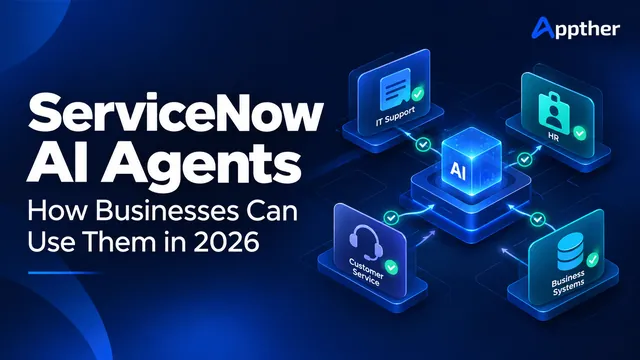
- ServiceNow AI agents work inside ServiceNow workflows: resolving IT and HR requests, triaging incidents, summarising cases and running fulfilment steps. ServiceNow’s Otto interface brings Now Assist and the Moveworks employee assistant (the acquisition closed in December 2025) into one place, and AI Control Tower lets you monitor and govern every AI agent in the company, including agents built on other platforms.
A useful rule: put agents where the data and the process already live. Customer-facing agents usually belong in Salesforce; agents that resolve employee requests or change operational records usually belong in ServiceNow. For a closer look, read our guides to ServiceNow AI agents and AI Control Tower governance.
Pricing: How Each Platform Charges
Neither platform publishes a simple all-in price, and real costs depend on modules, users and negotiation.
- ServiceNow is sold through quotes. Products are packaged in tiers, and AI features are included at higher tiers with usage metered. Expect a minimum annual commitment that suits mid-size and large organisations.
- Salesforce charges per user per month for each Cloud (Sales, Service, Marketing and so on), with list prices on its website, plus Agentforce usage through Flex Credits or per-user add-ons.
For either platform, licences are only part of the cost. Budget for implementation, integrations, data clean-up, training and ongoing administration, which in our experience can add 50 to 100 percent of the first-year licence cost. Our ServiceNow ROI guide shows how to build the business case.
When to Choose ServiceNow
- Your priority is IT service management, IT operations or employee service.
- You need strong change, problem and asset management with a reliable CMDB.
- Security operations, risk and compliance must sit on the same platform as service.
- You want to automate work that crosses IT, HR, finance and facilities.
- You need to govern AI agents across many systems from one place.
When to Choose Salesforce
- Your priority is growing revenue: pipeline, forecasting, marketing and partner sales.
- You run a customer contact centre and need omnichannel service.
- You want customer-facing AI agents that work from a full customer profile.
- Your teams already work in Slack and Salesforce every day.
- You need a large ecosystem of ready-made apps on AppExchange.
Can Salesforce Replace ServiceNow, or the Other Way Round?
For a mid-sized company with simple IT support needs that already runs on Salesforce, Agentforce IT Service can replace a basic ITSM tool. For organisations with mature ITIL processes, regulated change management, a large CMDB or security and risk requirements, ServiceNow remains the stronger choice.
Likewise, ServiceNow’s CRM can replace Salesforce where sales is closely tied to service delivery, but most sales-led and marketing-heavy companies will find Salesforce more complete.
Using ServiceNow and Salesforce Together
Many large organisations run both: Salesforce for customer-facing work and ServiceNow for internal operations. The value comes from connecting them so work flows without re-keying:
- A customer case in Salesforce Service Cloud that needs engineering work creates an incident or change in ServiceNow, and the status flows back to the agent.
- A closed deal in Salesforce triggers onboarding, provisioning and fulfilment tasks in ServiceNow.
- Customer, product and asset records stay in sync so both teams see the same facts.
Integration options include ServiceNow Integration Hub spokes, MuleSoft (owned by Salesforce), and custom REST APIs. AI agents on each side can call the other platform through these connections, with permissions and audit trails.
How Appther Helps
Appther’s ServiceNow team builds ServiceNow AI agents, Now Assist use cases and custom workflows, and you can hire ServiceNow engineers to extend your team. We also connect ServiceNow, Salesforce and other systems through our AI integration services, and build custom CRM solutions where neither platform fits. Talk to our team about your platform decision or integration.
Frequently Asked Questions
What is the difference between ServiceNow and Salesforce?
ServiceNow is a workflow platform for internal operations such as IT service management, HR, security and risk. Salesforce is a customer platform for sales, customer service, marketing and commerce. ServiceNow focuses on resolving requests and running processes; Salesforce focuses on winning and keeping customers.
Are ServiceNow and Salesforce competitors?
Increasingly, yes. Salesforce launched Agentforce IT Service for IT service management in 2025, and ServiceNow sells Autonomous CRM. They are separate public companies; Salesforce does not own ServiceNow. Most large organisations still use each for its core strength.
Can Salesforce Service Cloud replace ServiceNow ITSM?
For simple IT support in a company that already runs on Salesforce, Agentforce IT Service on Service Cloud can be enough. For mature ITIL processes, change management, a large CMDB, or security and compliance needs, ServiceNow ITSM is still the stronger option.
How do Agentforce and ServiceNow AI agents compare?
Agentforce agents are strongest in customer-facing work using CRM data, such as service conversations and lead qualification. ServiceNow AI agents are strongest at resolving employee requests and running operational workflows, and ServiceNow’s AI Control Tower can govern agents across the enterprise. Choose based on where the data and process already live.
Which is more expensive, ServiceNow or Salesforce?
It depends on scope. ServiceNow is quote-based with minimum commitments that suit larger organisations. Salesforce publishes per-user prices for each Cloud, and Agentforce adds usage costs. For both, implementation and integration can add 50 to 100 percent of first-year licence costs.
Can ServiceNow and Salesforce be integrated?
Yes. Common patterns pass customer cases from Salesforce into ServiceNow for fulfilment or engineering work and send status updates back, using ServiceNow Integration Hub, MuleSoft or custom APIs.