A mobile app budget becomes useful when it describes what your business will actually receive. A booking app for a Gold Coast activity operator, an inspection app for a field team and a customer portal may all need logins and notifications. Their development effort can still be very different.
The difference sits in the workflow: who uses the app, what happens when something goes wrong, which systems it connects to and how your team manages it after launch.
This guide explains how to plan a mobile app development budget, compare proposals and define a practical first release for a business on the Gold Coast or elsewhere in Queensland.
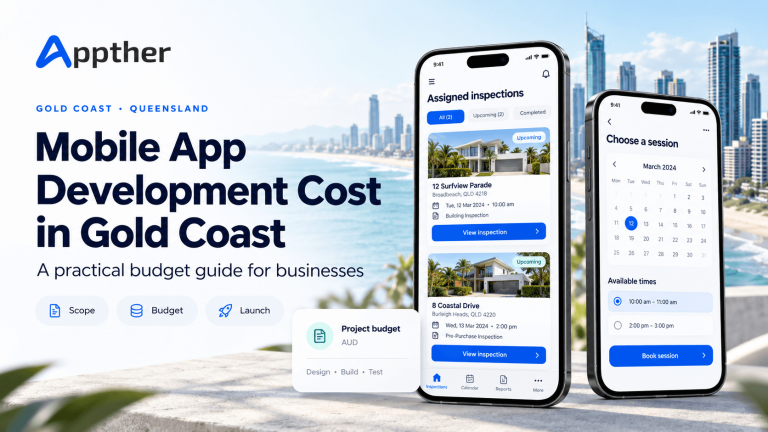
How much does mobile app development cost on the Gold Coast?
For initial planning, a focused custom mobile MVP could be modelled at A$30,000–A$80,000, while a more connected business app could be modelled at A$80,000–A$180,000. These are illustrative budgets, not measured Gold Coast averages or Appther quotes. Your actual estimate depends on the agreed scope, delivery team and commercial terms.
The table makes the assumptions behind those figures visible.
| Project stage | Illustrative effort | Assumed blended rate | Illustrative development budget | Example scope |
|---|---|---|---|---|
| Discovery and clickable prototype | 100–200 hours | A$100/hour | A$10,000–A$20,000 | Requirements, user journeys and interactive designs; no production app |
| Focused custom MVP | 300–800 hours | A$100/hour | A$30,000–A$80,000 | One core workflow, limited roles, shared mobile codebase, basic backend and admin tools |
| Connected business app | 800–1,800 hours | A$100/hour | A$80,000–A$180,000 | More workflows, deeper integrations, expanded administration and testing |
| Complex platform | 1,800+ hours | A$100/hour | A$180,000+ | Multiple applications, demanding offline behaviour, advanced permissions or substantial custom infrastructure |
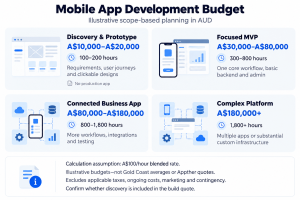
How to read these numbers: A$100/hour is a calculation assumption, not a quoted Appther rate or a Gold Coast market benchmark. Development rows include an assumed allowance for design, engineering, testing and release preparation. They exclude applicable taxes, recurring third-party charges, marketing and contingency. A separate discovery engagement may be included in or additional to a build quote; confirm this to avoid counting it twice.
If the blended rate changes, the same scope costs a different amount. If the workflow changes, the hours change too. That is why two proposals cannot be compared accurately from their headline price alone.
Do you need a mobile app or a mobile-friendly website?
Before setting a development budget, decide whether an installed app is necessary.
A mobile-friendly website may be enough when customers mainly need to discover your business, submit an enquiry or make an occasional booking. An app becomes more compelling when users return frequently, need camera-based workflows, receive useful notifications or work with information when connectivity is unreliable.
For example, a visitor booking one Gold Coast activity may prefer a quick web checkout. A staff member checking bookings throughout the day may benefit from a dedicated mobile tool. These are different audiences and may need different products.
Start with the user’s task. Choosing the channel around that task can prevent an unnecessary app build or reveal why a mobile app is worth funding.
What affects mobile app development cost?
1. The complete workflow
“Add bookings” sounds like one feature. In practice, it may include availability, capacity, cancellations, rescheduling, refunds and staff overrides.
Similarly, an inspection form may need draft saving, photo compression, signature capture and report generation. Each behaviour adds design, engineering and testing work.
Document the main task and its exceptions before estimating. A useful requirement says what happens when a payment fails or a worker loses reception, not just what the successful screen looks like.
2. User roles and permissions
A product with customers, workers, supervisors and administrators requires more than four login screens. Each role needs appropriate access to records and actions.
Clarify who can create a job, reassign it, view customer information, change a completed report and export data. Those decisions shape both the mobile interface and backend.
3. iOS, Android and the development approach
A shared-codebase approach can reduce duplicated work when iOS and Android need similar features. Separate native applications can be appropriate when a product relies heavily on platform-specific capabilities.
Neither choice removes device testing, release management or ongoing updates.
| Approach | Worth considering when | Budget consideration |
|---|---|---|
| Mobile-friendly web application | Users need easy access through a browser | May avoid maintaining two store-distributed applications |
| Cross-platform mobile app | The core experience is similar on iOS and Android | Shared code can reduce duplication; platform-specific work remains |
| Separate native apps | Platform behaviour or hardware integration is central | Separate implementations can add build and maintenance effort |
Ask the development partner to explain the choice against your requirements. Appther’s mobile app development servicescover native and cross-platform development, backend systems and ongoing support.
4. Backend and administration
The customer-facing app is only part of the product. Your staff may need to manage users, edit services, review submissions, handle cancellations and resolve support issues.
Without suitable administration tools, routine changes can become developer requests. Include these tools in the initial scope rather than discovering the gap just before launch.
5. Integrations and data migration
Connecting to a payment provider, booking platform, CRM or ERP requires more than displaying its data. The app must handle authentication, failed requests, duplicate records and updates made in either system.
Ask whether the existing platform has a documented API, whether suitable access is included in your subscription and whether a test environment is available.
If data must move from spreadsheets or another product, define cleaning, field mapping and verification as explicit tasks.
6. Offline use and synchronisation
An app that displays an error when the internet drops is simpler than one that continues working and safely synchronises later.
For a Queensland field team, decide which records must remain available offline, how photos are queued and how conflicting edits are resolved. Budget for tests involving interrupted uploads, repeated submissions and devices reconnecting after a long delay.
7. AI features
AI may be useful for summarising inspection notes, searching documents or assisting customer support. Its cost includes integration, evaluation, usage charges and a way to handle unsuitable output.
Start with one measurable task. Define the expected result and where human review is necessary before adding AI to the estimate.
Three app scopes a Queensland business could consider
The following examples are hypothetical planning scenarios, not claims about completed Appther projects or quoted packages.
Booking app for a Gold Coast activity operator
A focused release could let customers browse activities, see availability, book a session and receive confirmation. Staff would manage capacity and bookings through a web panel.
The main cost questions are whether availability comes from an existing booking platform, whether payments happen inside the workflow and how cancellations are handled.
For the first release, consider postponing loyalty points, marketplace functionality and complex promotional rules. First validate that customers can complete bookings and staff can manage them reliably.
Inspection app for a field service team
A practical scope could include assigned jobs, inspection checklists, photographs, notes, submission status and a supervisor dashboard.
Offline operation, conditional forms and report templates can substantially change the work involved. A simple online checklist should not be priced as though it includes a full offline inspection system.
Useful success measures include time spent preparing reports, incomplete submissions and the amount of information staff must enter twice.
Customer portal for a service business
A first version could offer account access, service requests, document uploads, status updates and notifications.
The largest dependency may be the business system holding the underlying records. Confirm which system owns the customer data and which updates the app can make.
A portal that improves one frequent customer task can be more useful than an extensive feature list with weak integration.
A worked example: turning scope into a budget
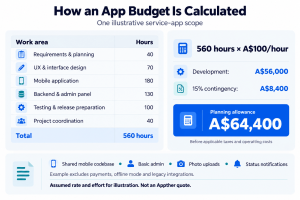
Consider a hypothetical service app with customer registration, a service request form, photographs, status notifications and a basic administrator panel. Assume one shared mobile codebase and no payments, offline mode or legacy integration.
| Work area | Illustrative hours |
|---|---|
| Requirements and planning | 40 |
| User experience and interface design | 70 |
| Mobile application | 180 |
| Backend and admin panel | 130 |
| Testing, fixes and release preparation | 100 |
| Project coordination | 40 |
| Total | 560 |
At the assumed blended rate of A$100/hour, the development model is A$56,000. Adding an illustrative 15% contingency creates a project planning allowance of A$64,400, before applicable taxes and operating costs.
The contingency is a chosen allowance for this example, not a universal rule. It does not mean every new feature is included. Material changes should still be estimated and approved.
At A$80/hour, the same 560 hours would total A$44,800 before contingency. At A$140/hour, they would total A$78,400. Compare delivery capability, scope and responsibility alongside the rate.
What ongoing costs should you budget for?
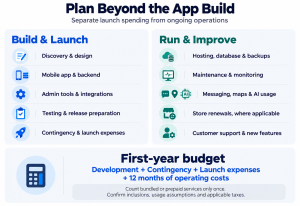
Your launch budget and operating budget should be separate.
| Cost area | What to clarify |
|---|---|
| Hosting and database | Expected usage, storage, backups and recovery requirements |
| Maintenance | Updates, bug fixes, monitoring and included support hours |
| Third-party services | Charges for messages, maps, payments, AI and other APIs |
| Store accounts | Account ownership, registration and renewal charges |
| Customer support | Who handles account access, disputed records and user enquiries |
| Future improvements | A separate allowance for features beyond the agreed release |
Apple lists its Developer Program at US$99 per membership year, with regional pricing shown during enrolment. Google lists a US$25 one-time Play Console registration fee. These are US-dollar figures, not AUD estimates; check the current local checkout amount. Store commissions and payment-processing charges are separate from account fees. Sources: Apple enrolment and Google Play Console registration.
Ask for operating scenarios based on actual usage assumptions. For example, model expected monthly active users, uploaded photos, notification volumes and AI requests. A small user count can still generate substantial storage or processing if each user performs intensive tasks.
How long should you allow for development?
For planning, a focused MVP might use a 10–16-week delivery window, assuming limited integrations, a small dedicated team and timely feedback. This is an illustrative schedule rather than an Appther delivery commitment.
| Stage | Illustrative allocation |
|---|---|
| Discovery and scope | 1–2 weeks |
| User experience and visual design | 2–3 weeks |
| Development and integration | 5–8 weeks |
| Acceptance testing and release preparation | 2–3 weeks |
The stages above are shown sequentially. In a real project, some work may overlap. External approvals, developer account verification and app review can affect the release date independently of development completion.
Agree what “finished” means: ready for acceptance testing, submitted to the stores or available to users. Those are different milestones.
How to compare app developers on the Gold Coast
Give each shortlisted partner the same brief and ask them to identify exclusions.
A useful proposal should answer:
- Which mobile platforms and user roles are included?
- What backend and administrator features will be delivered?
- Which integrations are included, and who supplies access?
- What testing and acceptance criteria apply?
- Who owns the source code, cloud accounts and developer accounts?
- How are scope changes estimated and approved?
- What happens after launch, and what support costs extra?
- Where is the delivery team based, and when can you speak with them?
For a Gold Coast business, local contact can be useful, but confirm the actual working arrangement. A local business presence does not by itself establish where every engineer works or guarantee in-person workshops.
For teams operating across Queensland, agree demonstration times, feedback responsibilities and escalation contacts at the start. Clear delivery arrangements matter throughout the project.
How to reduce cost without weakening the first release
Choose one complete workflow. Let users finish the core task from beginning to end before adding adjacent features.
Separate launch essentials from later improvements. Booking confirmation may be essential; a referral rewards system may be able to wait.
Validate uncertain screens with a prototype. It is easier to change a design before the workflow has been implemented.
Reuse existing systems where they fit. An integration may avoid rebuilding customer records or scheduling logic, provided the existing system supports the required access.
Keep administration in scope. A lower build price can become expensive if staff need developer assistance for routine updates.
Define acceptance criteria early. “Upload photos” should specify file limits, failed-upload behaviour and who can access them.
Reduce unnecessary scope rather than removing the testing or access controls needed for the agreed workflow.
What to prepare before requesting an app development quote
You do not need a full technical specification. A short brief should explain the business problem, intended users, essential tasks, existing systems, target platforms and preferred launch window.
Include any required offline behaviour, sensitive information, hardware connections or migration work. Share the budget range you are considering so the team can propose a realistic first release.
If you have sketches, sample forms or reports, attach them. A current inspection checklist or booking spreadsheet often explains the workflow more clearly than a long list of general features.
Plan your Gold Coast app project with Appther
Appther provides mobile application development and backend services, with an Australian presence listed in Southport, Queensland. Explore our app development services for Australian businesses to see how we can support your project.
Whether you are planning a booking experience, an inspection workflow or a customer portal, the first step is to define the users, essential features and system connections. From there, the scope can be translated into a project-specific estimate.
Build a Mobile App Around Your Business
Discuss your requirements, launch priorities and budget with Appther.

Frequently asked questions
How much does a simple mobile app cost on the Gold Coast?
For planning, this guide models a focused custom MVP at A$30,000–A$80,000, using 300–800 hours at an assumed A$100/hour. This is not a surveyed local average or a fixed Appther quote. A simpler browser-based solution or existing software configuration may require a different budget.
Can I build an app for less than A$30,000?
Potentially, if the scope is narrow or an existing platform meets most requirements. A prototype, small internal tool or limited first release may fit a smaller budget. Confirm whether design, backend, administration, testing and launch support are included before comparing prices.
Is cross-platform development cheaper than separate iOS and Android apps?
It can reduce duplicated work when both platforms share the same experience. Savings depend on the features and platform-specific requirements. Device testing, store releases and maintenance remain necessary, so a shared codebase does not automatically halve the total project cost.
Does the development price include hosting and maintenance?
Only if the proposal explicitly includes them. Ask for separate development, recurring service and support costs, with the included support period and exclusions written down.
Can an app connect to my existing CRM or booking system?
Often, provided the system offers suitable integration access. The estimate should account for available APIs, permissions, data mapping, error handling and testing. Confirm integration feasibility before committing to the final budget.
Do I need an app developer physically based on the Gold Coast?
That depends on how you want to work. If in-person sessions matter, confirm their availability. For remote delivery, agree communication hours, demonstrations, ownership and support responsibilities before starting.
Can Appther help businesses elsewhere in Queensland?
Appther offers services for Australian businesses. If your organisation operates in Brisbane, the Gold Coast or elsewhere in Queensland, share your requirements to discuss delivery arrangements and a project-specific scope.