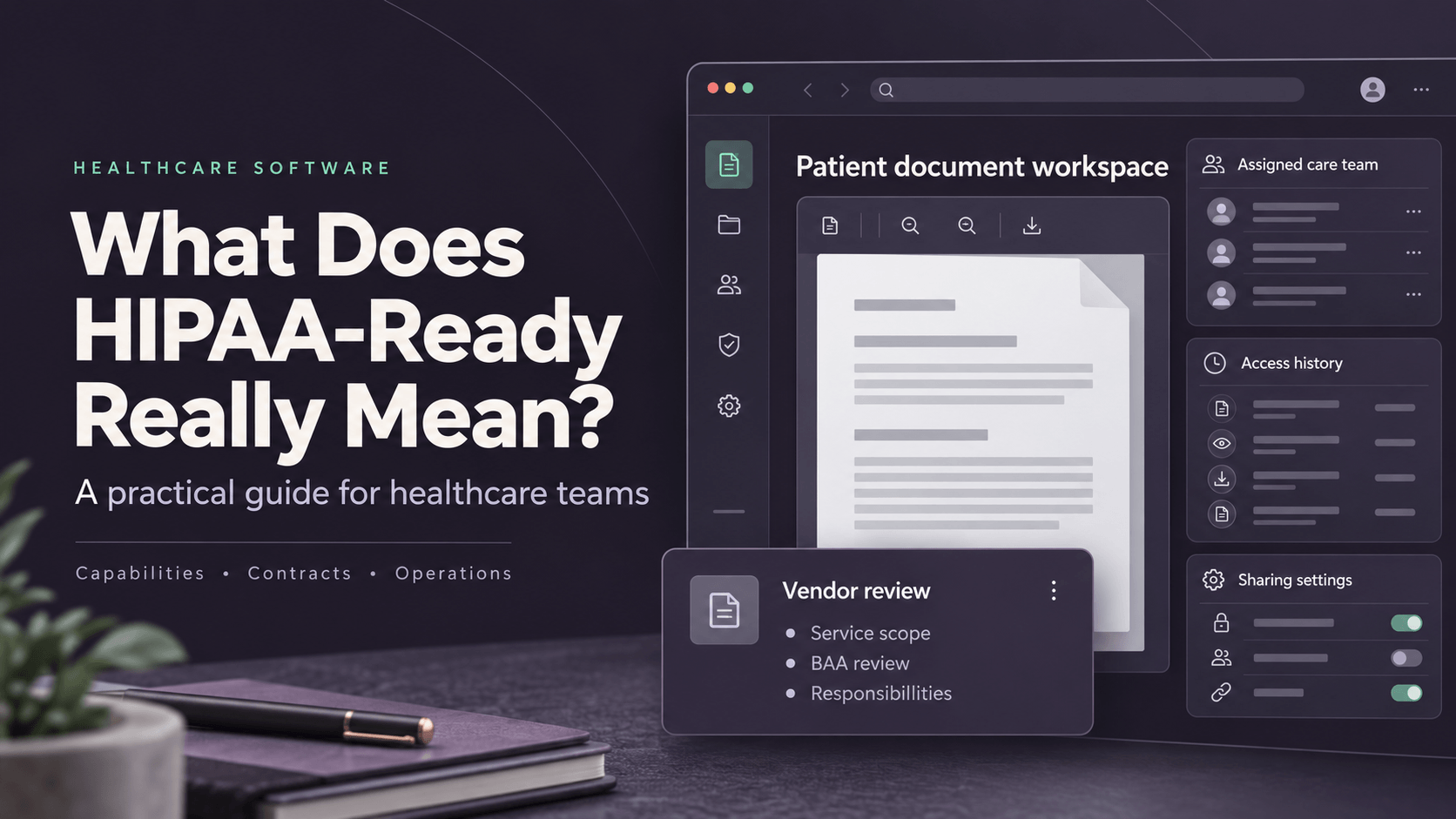
A healthcare software vendor says its platform is “HIPAA-ready.” The demonstration includes a secure login, encrypted storage and a patient dashboard. The product looks suitable, but an important question remains: what does that claim actually cover?
Does it include a business associate agreement? Can the team trace access to patient records? What happens when a developer investigates a production issue, a patient uploads a report or an AI service processes a clinical summary?
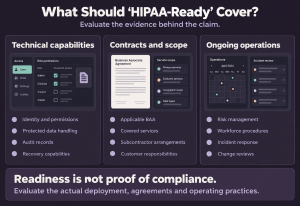
HIPAA-ready healthcare software should be evaluated through its documented capabilities, deployment conditions and operational responsibilities. The label alone does not establish compliance.
This guide explains how to assess the claim, what evidence to request and how to plan software that supports a healthcare organization’s HIPAA obligations.
This is a product and procurement guide, not legal advice or a compliance determination for a particular organization.
What is HIPAA-ready healthcare software?
“HIPAA-ready” is an informal vendor term commonly used to describe software designed to support HIPAA-regulated workflows. A meaningful claim should identify the available safeguards, contractual arrangements, approved services and customer responsibilities. It is not an official government designation, and installing the software does not make an organization HIPAA-compliant.
HHS explains that the Security Rule does not require organizations to obtain compliance certification and that external certification does not remove their legal obligations. See its guidance on Security Rule certification.
A useful vendor statement therefore needs boundaries: which product, which environment, which features and which configuration are covered? A capability available only on an enterprise plan should not be assumed to exist in a basic subscription.
HIPAA-ready vs. HIPAA-compliant: what is the difference?
| Term or claim | How to evaluate it |
|---|---|
| HIPAA-ready | Ask which capabilities support regulated use and what still needs to be configured, contracted and operated. |
| HIPAA-compliant | Ask which entity, activities, systems and period the claim covers, and what evidence supports it. |
| HIPAA-certified | Ask who issued the certification, what was assessed and what its limitations are. Do not interpret it as HHS approval. |
| BAA available | Review the actual agreement, covered services, exclusions and responsibilities. |
| Encrypted | Ask where encryption applies, who controls keys and how access, recovery and operations are protected. |
The distinction matters during procurement. A product may provide access controls that a customer never configures correctly. A strong deployment can later become vulnerable when an integration changes or a departed employee retains access.
For teams planning healthcare software development, the requirements should describe measurable behavior and ownership rather than relying on a single compliance label.
Does HIPAA apply to every healthcare app?
No. HIPAA applicability depends on the entities involved, their activities and their relationships, not simply whether an application contains health-related information.
Covered entities include health plans, healthcare clearinghouses and healthcare providers that conduct specified electronic transactions. Business associates perform certain functions or services involving protected health information on behalf of covered entities. Relevant subcontractors can also be business associates. HHS explains these roles in its covered entities and business associates guidance.
A consumer wellness app operating independently of a covered entity may have a different position from a patient portal supplied to a hospital. An app selected independently by a patient is not automatically a business associate merely because it receives records at that patient’s direction; the relationship matters. See the HHS patient-designated app FAQ.
Being outside HIPAA does not mean being outside health privacy regulation. The FTC’s Health Breach Notification Rule guidance explains its relevance to many health apps and similar technologies. Other federal and state requirements may also apply.
Before defining the architecture, document who operates the service, whom it serves, what information it handles and on whose behalf it acts.
Understand the three HIPAA rules relevant to software planning
Privacy Rule: permitted use and disclosure
The Privacy Rule addresses protected health information, permitted uses and disclosures, and individual rights. It applies more broadly than electronic records. Software should support the organization’s applicable access, amendment and disclosure processes.
The minimum necessary standard also matters, but it has exceptions, including disclosures to or requests by a healthcare provider for treatment. Avoid translating it into an inaccurate rule that every treatment disclosure must always be reduced to the smallest possible dataset. See the HHS Privacy Rule summary.
Security Rule: protecting electronic PHI
The Security Rule requires administrative, physical and technical safeguards for electronic protected health information, or ePHI. Its focus includes confidentiality, integrity and availability.
The HHS Security Rule summary explains the risk-based framework. Under the current framework described there, “addressable” specifications are not simply optional: organizations must evaluate whether they are reasonable and appropriate, document relevant decisions and implement an equivalent alternative where reasonable and appropriate.
Breach Notification Rule: responding to qualifying breaches
The Breach Notification Rule establishes notification duties for breaches of unsecured PHI. A security incident and a reportable breach are not interchangeable terms; organizations need an assessment process.
HHS describes notification responsibilities and applicable deadlines in its Breach Notification Rule guidance. Individual notifications generally must occur without unreasonable delay and no later than 60 days after discovery. Other notification duties vary, and business associate contracts may require much faster reporting to the customer. Do not treat 60 days as permission to delay investigation or escalation.
Start with data flows and risk analysis
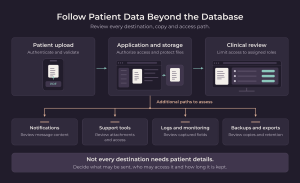
A healthcare application rarely keeps all sensitive information in one database. Patient information can also appear in documents, exports, email, support tools, device caches, backups and diagnostic logs.
HHS describes a thorough risk analysis as foundational and expects consideration of all ePHI an organization creates, receives, maintains or transmits. Its risk analysis guidance does not prescribe one universal methodology.
For a patient report-upload product, a useful engineering exercise is to trace a single report through its complete lifecycle:
| Stage | Design question |
|---|---|
| Upload | How is the patient authenticated, and how is the file validated? |
| Storage | Is the object private, and what authorizes retrieval? |
| Clinical review | Which professional can access the report, and why? |
| Notification | Can a message alert the patient without exposing the result? |
| Support | Can a ticket be resolved without attaching the report? |
| Backup | Can the information be restored, and who can access backup copies? |
| Retention | Which policy determines preservation, deletion and export? |
This exercise should produce a data-flow diagram, asset inventory, identified risks and a remediation plan with named owners. A vulnerability scan contributes useful evidence, but it does not replace the wider analysis.
What security capabilities should buyers evaluate?
The following are recommended engineering capabilities to evaluate against the actual risk analysis and applicable requirements. They are not a claim that HIPAA mandates every named technology or configuration in every system.
1. Identity, access and tenant isolation
Use individual staff accounts and enforce permissions on the server. A receptionist, clinician, support operator and infrastructure administrator should not automatically receive the same record access.
Ask for demonstrations of account suspension, role changes and restrictions between organizations in a multi-tenant product. A hidden navigation item is not an access control if the same user can retrieve the record through an API.
Evaluate multifactor authentication, especially for privileged and workforce access, along with session expiration, recovery procedures and emergency-access handling. Test the forgotten-password journey as carefully as the normal sign-in journey.
2. Encryption and key management
Evaluate encryption for data in transit and at rest, including backups and exports. Document key access, rotation, recovery and separation from application secrets.
Encryption is one layer. It does not stop a legitimate but overprivileged account from downloading records, nor does it repair an authorization flaw.
3. Useful audit records
Define events that investigators need to reconstruct: access, changes, exports, permission updates and administrative actions. Protect those records from ordinary user modification and assign responsibility for reviewing relevant alerts.
Logs should identify events without becoming an unnecessary copy of patient records. Check request-body logging, URLs, exception traces and file names for inadvertent exposure.
4. Controlled files, messages and integrations
Use authorization checks for document retrieval and evaluate short-lived download links where appropriate. Test what happens when a link is forwarded or an account loses access.
Use restrained notification content. A message such as “A new report is available” can direct the patient to an authenticated portal without including the clinical finding in a lock-screen notification.
Review each analytics SDK and support integration before it receives sensitive data. Default telemetry settings should not be assumed suitable for a patient workflow.
5. Recovery and secure delivery
Test restoration rather than only confirming that backups exist. Define recovery objectives that reflect the service’s clinical and operational role.
Use synthetic data in ordinary development and testing. Review production changes, protect secrets, patch dependencies and verify fixes. A release checklist should include authorization and data-flow changes, not only visible user-interface changes.
Why a business associate agreement matters
A business associate agreement, or BAA, establishes required contractual protections where a business associate relationship exists. It addresses matters such as permitted uses, safeguards, incident reporting and relevant subcontractor obligations. HHS provides business associate contract guidance.
Ask vendors which contracting entity signs the BAA and whether the exact services being purchased fall within its scope. Confirm how the agreement works with the service terms, support process and data-return arrangements.
Selling software alone does not necessarily create a business associate relationship. Hosting patient information or accessing it during support can change the analysis, as explained in the HHS software vendor FAQ.
For development contracts, explicitly address production access, troubleshooting, hosting and subcontractors. A promise that engineers “rarely see patient data” is not a substitute for assessing the actual relationship.
Does HIPAA-ready cloud hosting make the application compliant?
No. Cloud infrastructure can support the deployment, but the application and operating organization still need appropriate safeguards and processes.
HHS states that a cloud service provider maintaining ePHI on behalf of a covered entity or business associate is generally a business associate even when it holds only encrypted information and lacks the decryption key. Its cloud computing guidance addresses BAAs, risk analysis and allocation of security responsibilities.
For the proposed deployment, request an inventory of actual services and configurations. Check whether the applicable contract covers each service that handles ePHI, including monitoring, backups and support. Then document which party manages identity, network exposure, patching and recovery.
HIPAA does not categorically require US-only data storage. Location can nevertheless affect risk analysis, other obligations and contractual commitments; the same HHS cloud guidance discusses overseas processing. Treat hosting location as a documented decision rather than a slogan.
What changes when healthcare software uses AI?
AI creates additional processing paths. A voice workflow may involve telephony, recording, transcription, model inference, retrieval, logging and downstream scheduling. Each stage needs its own data and vendor assessment.
For an AI feature handling patient information, ask:
- Which exact service and endpoint receives the information?
- Does the applicable agreement cover this use?
- Are prompts, recordings or outputs retained, and for how long?
- Can the provider use the information for training or human review?
- Do observability tools capture sensitive content?
- Can retrieval return information from another patient or organization?
- Who reviews clinical outputs before they affect care?
“No training on customer data” answers only one question. It does not establish a permitted disclosure, eliminate logging or define the complete service arrangement.
Removing a patient’s name is also not automatically HIPAA de-identification. HHS describes Safe Harbor and Expert Determination methods in its de-identification guidance. Free text, images and combinations of details require careful treatment.
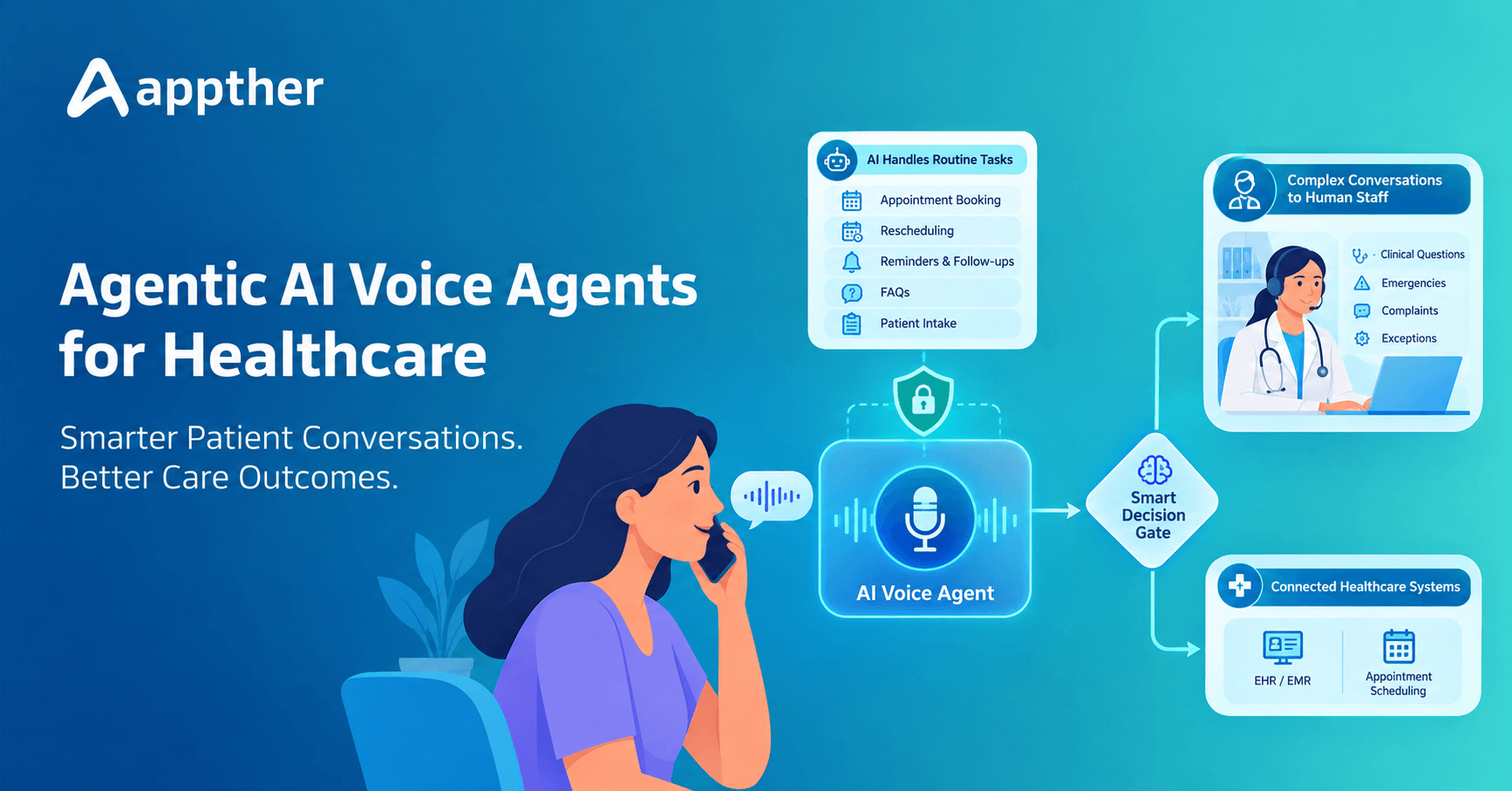
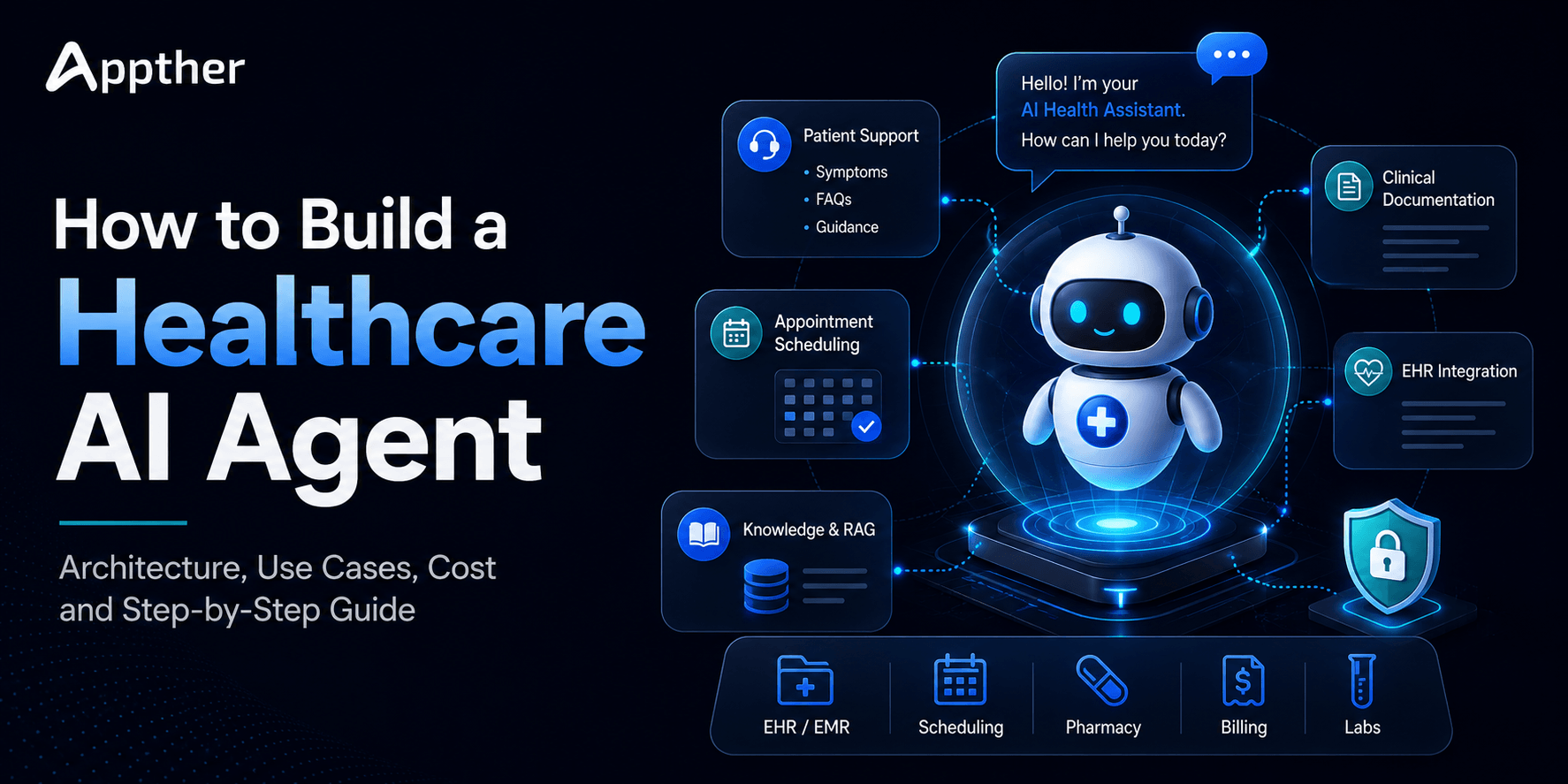
When discussing custom AI development, define privacy controls separately from clinical quality. A protected processing environment does not establish that a generated answer is clinically correct. For voice-based use cases, include the whole call-processing chain when reviewing an AI voice agent healthcare workflow.
Common HIPAA-ready software misconceptions
| Misconception | Better procurement question |
|---|---|
| “The cloud provider handles compliance.” | Which responsibilities remain with the application team and customer? |
| “We signed a BAA, so everything is approved.” | Are the actual data uses, services and configurations covered and appropriate? |
| “Encrypted data no longer needs HIPAA review.” | What protections and contractual obligations still apply? |
| “Only the primary database contains sensitive data.” | What reaches logs, documents, backups, messaging and support systems? |
| “A security test proves ongoing compliance.” | What scope was tested, what remains unresolved and how are changes reviewed? |
| “Deleting the account means deleting every record.” | What retention, access and legal obligations apply to each record type? |
One recurring confusion deserves special attention: HIPAA does not establish a universal six-year retention period for patient medical records. HHS explains that medical-record retention is generally governed by state law and other applicable requirements. See its medical-record retention FAQ. Distinguish record-retention policies from HIPAA documentation requirements.
A practical vendor evaluation checklist
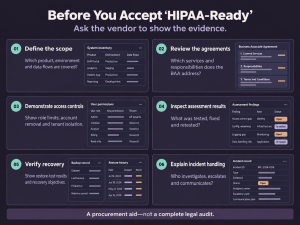
Ask for evidence tied to the product you will use. The following checklist is a procurement aid, not a comprehensive legal audit.
| Area | Evidence to request |
|---|---|
| Applicability and scope | Defined roles, workflows, environments and data categories |
| Contracts | Applicable BAA, service scope and subcontractor information |
| Data flows | Current diagram covering integrations, logs and backups |
| Access | Role matrix, account lifecycle and isolation test results |
| Security assessment | Scope, findings, remediation status and retest evidence |
| Auditability | Sample events, protection measures and review ownership |
| Recovery | Restore-test results and agreed recovery objectives |
| Incident handling | Escalation contacts, reporting process and exercise results |
| Privacy workflows | Support for applicable access, amendment and disclosure processes |
| Exit planning | Export format, transition support and data-disposal arrangements |
A polished questionnaire is useful, but demonstrations often reveal more. Ask the vendor to revoke a user’s access, retrieve an audit event and explain an actual backup-restoration test. Resolve inconsistencies between the sales presentation, documentation and contract before launch.
What affects the cost of HIPAA-ready software development?
There is no universal “HIPAA fee” that can simply be added to an app estimate. Cost depends on the product’s workflow, integrations, risk profile and operational scope.
Budget for identity and permissions, controlled data handling, vendor assessment, security testing, recovery validation and documentation. Include the customer’s own work: defining policies, reviewing agreements, training staff and assigning operational owners.
A patient upload portal, a multi-organization care platform and an AI-enabled call service have different data paths and testing needs. Ask for estimates by workstream, with assumptions about hosting, integrations, support access and ongoing maintenance.
Also separate launch costs from recurring responsibilities. Monitoring, access reviews, incident exercises, vendor changes and software updates continue after the application is released.
A practical implementation roadmap
- Determine scope. Document the entities, workflows, data and applicable obligations with appropriate advisers.
- Map the system. Inventory storage, integrations, user roles and third parties.
- Assess risks. Prioritize remediation and establish accountable owners.
- Define contracts and configuration. Confirm relevant BAAs and deployment boundaries.
- Build and validate. Test access, data handling, recovery and operational workflows.
- Prepare the organization. Establish training, support, incident and privacy processes.
- Review before launch. Evaluate evidence and resolve material gaps.
- Maintain the program. Reassess changes and update documentation as the service evolves.
Do not wait until the final security test to discover that a key integration cannot support the intended data use. Early vendor and data-flow decisions can prevent substantial rework.
Are proposed HIPAA Security Rule changes already requirements?
A proposed rule is not the same as an effective final requirement. At the time these sources were checked, the HHS Security Rule NPRM page continued to describe the cybersecurity changes as proposed and stated that the current Security Rule remains in effect during rulemaking.
Verify the latest official status, effective dates and compliance dates when approving a roadmap. Stronger safeguards can still be sensible design choices, but label them accurately as applicable requirements, risk-based decisions or preparation for possible changes.
Frequently asked questions
Is HIPAA-ready an official certification?
No. Treat it as a vendor claim that needs a defined scope and supporting evidence. Ask what is included, what the customer must do and how the deployment is maintained.
Can healthcare software guarantee HIPAA compliance?
Software can support required workflows and safeguards. Compliance also depends on the regulated organization’s actual activities, contracts, configuration and ongoing practices. A product label cannot establish those facts by itself.
Does every health app need a BAA?
No. First determine whether a business associate relationship exists. The answer depends on the service and relationship, not only on whether the application handles health-related information.
Can AI process protected health information?
Potentially, when the use is permitted and the service arrangements, safeguards and applicable agreements support it. Assess the full processing chain, including retention, logs, subcontractors and human access.
Is HIPAA readiness the same as clinical safety?
No. Protecting information and validating clinical performance are different tasks. A product may need separate clinical, usability and regulatory evaluation depending on its intended use.
How should a buyer compare vendors?
Compare specific evidence: contracts, data flows, access controls, assessment results, recovery tests and operational responsibilities. Ask each vendor to explain exclusions and unresolved issues in writing.
Plan healthcare software around evidence and responsibility
A useful HIPAA-ready claim tells a buyer what the product supports, how it must be deployed and who operates each safeguard. That makes the claim testable and helps identify work that remains before launch.
When planning a new patient portal, healthcare application or AI workflow, define those responsibilities alongside the product features. Appther’s healthcare software development services offer a starting point for discussing the engineering scope with your healthcare, security and compliance stakeholders.