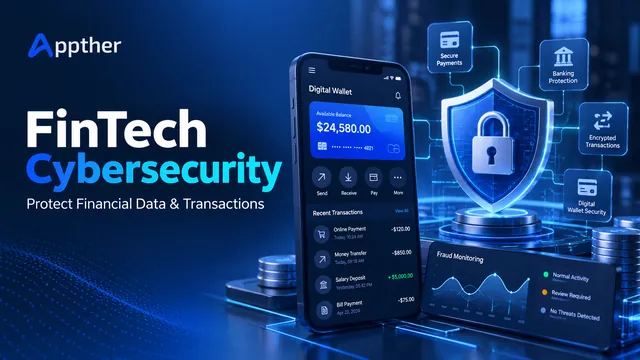
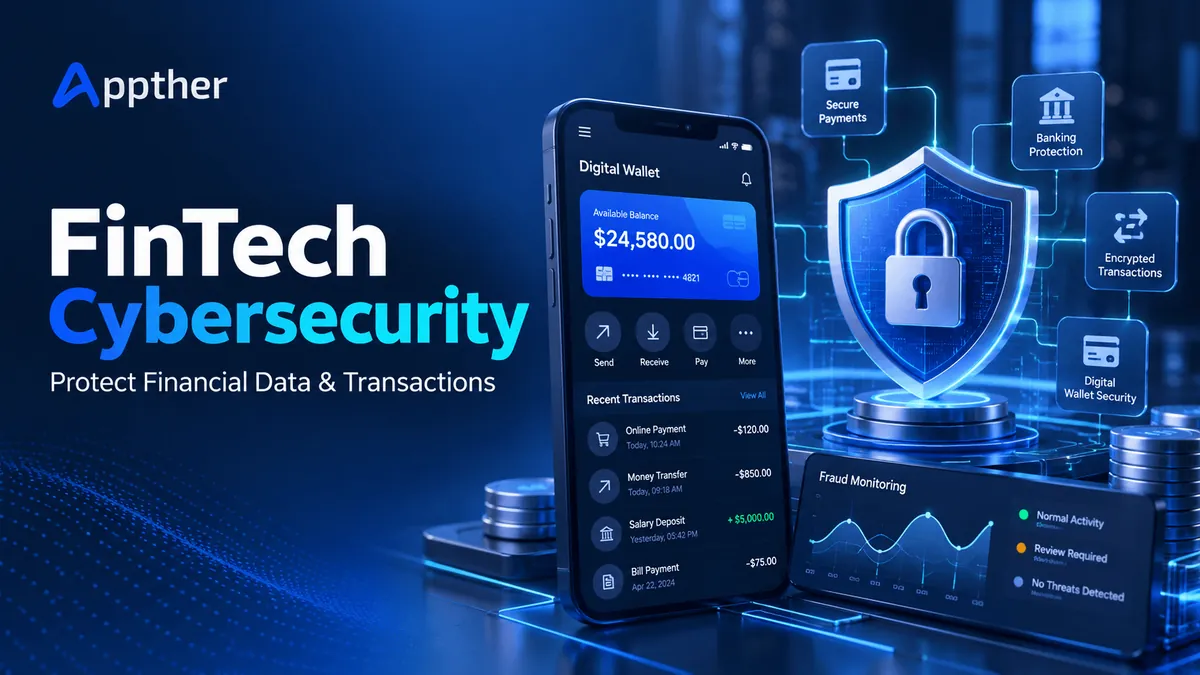
A customer opens a mobile banking app, enters a payment amount, and confirms a transfer. Within seconds, money moves between accounts. The experience looks simple, but behind that transaction is a complex network of identity checks, APIs, payment processors, databases, and fraud-monitoring systems.
Every connection introduces a potential security risk.
For banks, payment companies, digital wallet providers, and fintech startups, cybersecurity is not simply about keeping hackers out. It is about protecting customers’ financial information, preventing unauthorized transactions, maintaining accurate financial records, and ensuring that services remain available when customers need them.
As financial platforms become more interconnected, security must be considered throughout product development and daily operations.
This guide explains the major cybersecurity threats facing fintech companies in 2026 and the practical measures organizations can take to protect financial data and transactions.
What Is FinTech Cybersecurity?
FinTech cybersecurity is the combination of technologies, policies, and security practices used to protect financial applications, customer information, payment systems, and digital transactions against unauthorized access, fraud, theft, and disruption.
It applies to digital banking platforms, payment gateways, mobile wallets, lending applications, trading systems, and other financial technologies.
An effective fintech cybersecurity strategy focuses on five outcomes:
- Confidentiality: Customer information is accessible only to authorized individuals and systems.
- Integrity: Transaction records, balances, and financial information cannot be altered without authorization.
- Availability: Financial services remain reliable and recoverable during incidents.
- Authentication and authorization: Systems verify identities and enforce permissions for each action.
- Fraud prevention: Suspicious financial activity is detected, investigated, and controlled.
A secure financial platform needs all five. Strong encryption alone cannot prevent a fraudulent transfer from an account accessed using stolen credentials.
Why Cybersecurity Is Critical for FinTech Companies
Financial technology platforms store or process information that criminals can exploit directly or use to commit further fraud.
This may include customer identities, bank account details, transaction histories, payment credentials, identity-verification documents, and financial behavior.
A security incident can affect far more than a company’s technology infrastructure.
1. Protecting customer trust
Customers expect a financial application to safeguard their money and personal information. Unauthorized transfers, unexplained account activity, and repeated service outages can cause customers to lose confidence in a provider.
2. Preventing financial losses
Account takeovers, fraudulent payments, payment redirection, and compromised administrative accounts can produce immediate financial consequences.
Security controls must therefore protect the transaction itself, not only the customer’s login session.
3. Meeting regulatory and contractual requirements
Financial businesses may be subject to data protection laws, payment security standards, banking regulations, and contractual security obligations.
The applicable requirements depend on the company’s location, customers, services, regulatory status, and handling of sensitive data.
4. Maintaining business continuity
A ransomware attack or payment infrastructure outage can interrupt account access, transfers, settlement processing, and customer support.
Incident response, secure backups, and tested recovery procedures are essential parts of financial security.
5. Supporting secure product growth
As a fintech platform introduces new payment methods, partners, APIs, and international markets, its security responsibilities expand.
This is why cybersecurity should be built into FinTech app development from the planning stage rather than addressed only before launch.
The Biggest FinTech Cybersecurity Threats in 2026
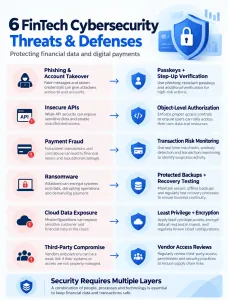
Cybersecurity threats are not limited to sophisticated attacks against bank infrastructure. Many incidents begin with stolen credentials, insecure integrations, or ordinary operational mistakes.
| Cybersecurity threat | Potential business impact |
|---|---|
| Phishing and social engineering | Stolen credentials, account takeover, fraudulent approvals |
| Ransomware | Disrupted operations, unavailable systems, potential data exposure |
| API vulnerabilities | Unauthorized access to account information or transaction functions |
| Payment fraud | Unauthorized transfers, fraudulent refunds, payment redirection |
| Cloud misconfiguration | Exposure of sensitive databases, backups, or application secrets |
| Third-party compromise | Unauthorized access through suppliers or integrated services |
| Insider misuse | Improper access, extraction, or alteration of customer information |
| AI-assisted impersonation | More convincing fraudulent requests and identity deception |
Phishing and account takeover
An attacker may impersonate a bank, support representative, or trusted organization to persuade a customer or employee to reveal credentials.
Once an account is compromised, the attacker may attempt to change beneficiary details, access sensitive records, or initiate payments.
Phishing-resistant authentication, transaction alerts, device risk assessment, and additional verification for sensitive actions help reduce these risks.
Insecure financial APIs
Fintech companies rely on APIs to exchange information with banks, payment processors, identity providers, and external services.
A poorly secured API could expose another customer’s transactions or allow an unauthorized action.
The OWASP API Security Top 10 identifies risks such as broken object-level authorization, broken authentication, and security misconfiguration.
These risks must be addressed through server-side authorization, careful API design, and continuous testing.
Payment and transaction fraud
An attacker does not necessarily need to steal customer records to cause financial damage.
For example, a compromised account might be used to add a new beneficiary and immediately initiate a large transfer.
A secure system should evaluate the beneficiary change, device, account history, transfer amount, and other risk signals before permitting the transaction.
10 FinTech Cybersecurity Best Practices for Protecting Financial Data
No single tool can fully secure a financial platform. Organizations need multiple overlapping controls across identity, applications, infrastructure, operations, and payment workflows.
1. Encrypt sensitive data in transit and at rest
Encryption protects confidential information from unauthorized disclosure.
Fintech platforms should use properly configured TLS for data moving between applications and services, and strong encryption for sensitive stored data.
Encryption keys should be protected using suitable key management services or hardware security modules, with restricted access and documented rotation practices.
Practical example: A digital lending platform stores identity documents in encrypted storage. The application grants temporary, authorized access to approved reviewers instead of making the files publicly accessible.
2. Implement multi-factor and risk-based authentication
Multi-factor authentication (MFA) adds an identity-verification step beyond a password.
For higher-assurance authentication, fintech platforms should evaluate passkeys or FIDO2-based authenticators, particularly for employees, administrators, and high-risk customers.
Risk-based authentication can require additional verification when unusual activity is detected, such as access from an unfamiliar device or a sensitive account change.
Authentication should also protect account recovery processes, which can become a weaker path into an otherwise secure account.
3. Use tokenization to reduce payment data exposure
Tokenization replaces sensitive payment information with a token that has limited usefulness outside its intended context.
For card payments, fintech platforms can use appropriately configured payment processors or tokenization services to avoid unnecessarily collecting and storing cardholder data.
Tokenization can reduce data exposure and potentially reduce the scope of PCI DSS assessments, but it does not automatically eliminate compliance responsibilities.
4. Apply zero-trust access principles
Zero-trust security means access is not granted solely because a user or system is inside a trusted network.
Every request should be evaluated according to identity, device or service trust, authorization, and the sensitivity of the operation.
Fintech businesses should apply least-privilege permissions, service-to-service authentication, and regular access reviews.
For example, a customer support employee may need to view a transaction’s status but should not automatically be able to change its amount or authorize a refund.
5. Secure APIs and third-party integrations
Financial applications commonly integrate with payment gateways, core banking systems, fraud platforms, and identity-verification providers.
Each integration requires appropriate safeguards:
- Strong authentication and granular authorization
- Object-level access checks for every customer resource
- Input validation and safe error handling
- Rate limiting and abuse detection
- Secure management of API keys and secrets
- Validated and replay-resistant payment webhooks
- Dependency monitoring and third-party security reviews
An API gateway or web application firewall can provide useful protective controls, but it cannot replace authorization checks within the application.
6. Protect transaction integrity and prevent duplicate payments
Transaction security involves more than encryption.
A secure payment workflow must prevent unauthorized changes, accidental duplicate processing, and inconsistent financial records.
Fintech systems should use idempotency keys for payment requests, durable transaction-state management, and controlled retry mechanisms.
A financial ledger should provide a traceable record of postings, with corrections handled through authorized adjustments or reversals rather than silently overwriting historical entries.
Example: A customer taps “Pay” twice because the mobile network is slow. With an effective idempotency mechanism, the system recognizes that both requests belong to the same logical payment and avoids executing it twice.
7. Monitor suspicious transactions in real time
Fraud-detection systems can evaluate transaction signals such as payment amount, transaction frequency, device changes, beneficiary details, and unusual account activity.
Rules-based monitoring provides a useful foundation. More advanced platforms may also use machine learning to identify patterns that static rules miss.
However, automated fraud decisions require testing, monitoring, and controls for false positives.
A legitimate customer should not be permanently blocked simply because their spending differs from their normal pattern.
8. Secure cloud infrastructure and databases
Cloud services offer flexibility, but their security depends on correct configuration and ongoing management.
Financial organizations should restrict public access to databases and storage, separate production and development environments, protect secrets, and maintain vulnerability and configuration monitoring.
Cloud administration accounts require particularly strong access controls.
Backups should be encrypted, protected against unauthorized deletion or modification, and tested through recovery exercises.
9. Integrate security into software development
Security testing should begin before a financial application reaches production.
A secure software development lifecycle includes architecture threat modeling, peer code reviews, dependency scanning, static analysis, dynamic testing, and risk-based penetration testing.
Developers should test sensitive business workflows, not just common technical vulnerabilities.
For example, a transfer API must be tested to confirm that one user cannot access another customer’s account or bypass transaction approval limits.
Organizations building custom financial software should treat these controls as part of engineering quality, not as optional finishing tasks.
10. Prepare an incident response and recovery plan
Even mature security programs cannot guarantee that incidents will never happen.
Fintech companies need documented procedures to identify incidents, isolate affected systems, preserve evidence, investigate unauthorized transactions, and restore operations.
A practical response plan should define technical ownership, escalation contacts, payment partner coordination, customer communication, and relevant reporting obligations.
Recovery plans must be tested regularly, including scenarios involving ransomware, compromised cloud credentials, and payment processor outages.
How to Secure Financial Transactions: A Practical Workflow
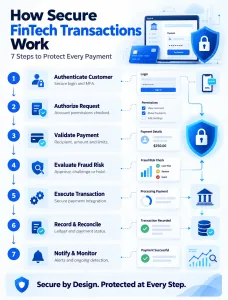
Consider a customer transferring money from a digital wallet to a new recipient.
A secure transaction should pass through several controls before the payment is finalized.
Step 1, Authenticate the customer. Verify the account session and evaluate whether additional authentication is necessary.
Step 2, Authorize the request. Confirm that the customer has permission to use the source account and initiate the requested transfer.
Step 3, Validate transaction details. Verify the recipient, amount, currency, limits, account status, and relevant business rules.
Step 4, Evaluate fraud risk. Check relevant risk indicators and determine whether to approve, challenge, hold, or reject the transaction.
Step 5, Execute through an authorized payment service. Use secure integrations and appropriate payment-processing controls.
Step 6, Record the outcome. Maintain transaction references and durable records that support ledger integrity, reconciliation, and investigation.
Step 7, Notify and monitor. Inform the customer of the transaction status and monitor for subsequent suspicious activity.
Importantly, a timed-out request should not automatically be treated as a failed payment. The system must first determine whether the payment processor accepted or completed the transaction before initiating another attempt.
This distinction is critical when designing reliable digital banking and financial software.
FinTech Cybersecurity Compliance: Standards and Regulations to Know
Different regulatory and security frameworks address different responsibilities. Companies should first determine which requirements apply to their products and jurisdictions.
| Standard or regulation | Main purpose | Who should evaluate it |
|---|---|---|
| PCI DSS v4.0.1 | Security of payment card account data | Organizations within the cardholder data environment or otherwise in PCI DSS scope |
| GDPR | Protection and lawful processing of personal data | Organizations processing personal data within its territorial scope |
| CCPA/CPRA | California consumer privacy rights and business obligations | Businesses meeting applicable California thresholds and conditions |
| DORA | ICT risk management and digital operational resilience | Financial entities and certain ICT providers within its EU scope |
| ISO/IEC 27001 | Information security management systems | Organizations seeking a structured, auditable security management approach |
| NIST Cybersecurity Framework 2.0 | Managing and communicating cybersecurity risk | Organizations developing or improving a risk-management program |
| SOC 2 | Independent reporting on specified service organization controls | Service providers whose customers require assurance reporting |
PCI DSS and payment card security
PCI DSS v4.0.1 is an important standard for organizations that store, process, or transmit payment account data, and certain systems that affect that environment.
Organizations should verify their applicable assessment requirements, particularly the additional requirements that became effective on March 31, 2025.
GDPR, privacy laws, and data minimization
Privacy compliance requires more than encrypting databases.
Organizations must evaluate lawful processing, transparent notices, access controls, retention periods, individual rights, third-party processing, and relevant international data transfers.
A practical first step is to identify which customer information the business genuinely needs and avoid collecting unnecessary data.
DORA and operational resilience
The European Union’s Digital Operational Resilience Act has applied since January 17, 2025.
For covered organizations, its requirements address ICT risk management, incident handling and reporting, resilience testing, and third-party ICT risk.
For an international fintech product, these requirements may influence supplier selection, cloud contracts, system architecture, and operational procedures.
Important: Following security best practices does not automatically mean an organization is compliant or certified. Formal validation, reporting, licensing, and legal responsibilities must be assessed separately.
How AI Helps Improve FinTech Cybersecurity
Artificial intelligence can strengthen security operations by identifying patterns across large volumes of transaction and system data.
Potential applications include fraud anomaly detection, suspicious account activity identification, alert prioritization, and faster investigation support.
For example, a risk engine might identify a new-device login, an unfamiliar beneficiary, and an unusually large transfer occurring in quick succession.
These signals can trigger an additional verification step or a review.
However, AI models can produce false positives, miss unfamiliar fraud patterns, or behave unpredictably when underlying data changes.
They also introduce additional risks, including sensitive-data exposure and manipulation of AI-connected workflows.
Fintech companies adopting AI should use controlled access, data minimization, model monitoring, documented decision logic, and human oversight for high-impact actions.
Appther’s FinTech software development solutions address secure payment integrations, fraud-monitoring workflows, and compliance-conscious financial application architecture.
A 90-Day FinTech Cybersecurity Improvement Roadmap
Financial organizations do not need to replace every system at once. A risk-based roadmap helps prioritize weaknesses that could cause the most damage.
| Timeline | Priority actions | Expected deliverables |
|---|---|---|
| Days 1–30 | Inventory sensitive data, review access permissions, assess critical APIs and third-party dependencies, identify regulatory scope | Risk register, data-flow map, prioritized remediation plan |
| Days 31–60 | Address critical vulnerabilities, strengthen authentication, improve secrets management, verify payment controls, enhance monitoring | Implemented security improvements and validation results |
| Days 61–90 | Conduct targeted penetration testing, exercise incident response, test recovery, review supplier access, establish recurring security metrics | Test reports, remediation evidence, response playbooks, ongoing security plan |
The actual sequence should depend on the company’s risk exposure, product maturity, and legal obligations. An actively exploited vulnerability or confirmed payment compromise requires immediate action rather than waiting for a scheduled roadmap phase.
Common FinTech Cybersecurity Mistakes to Avoid
Several weaknesses appear when teams concentrate on functionality and speed without sufficiently considering security.
Treating login security as transaction security. A valid login does not establish that every subsequent payment is authorized.
Storing more customer information than necessary. Excessive data retention increases the potential consequences of a breach.
Relying entirely on a payment gateway. A gateway does not automatically secure customer accounts, backend APIs, or internal administrative tools.
Skipping reconciliation and transaction-state checks. Duplicate requests and unreliable retry logic can create financial discrepancies even without an external attack.
Overlooking third-party access. A service provider may have access to sensitive systems long after that access is required.
Treating compliance as a one-time milestone. Changes to infrastructure, vendors, payment flows, and regulations may require fresh assessments.
The strongest cybersecurity programs connect engineering practices with operational controls and measurable business risks.
How Appther Supports Secure FinTech Application Development
A financial application needs reliable architecture, carefully controlled data flows, and security measures suited to its business model.
At Appther Technologies, our FinTech App Development Services cover digital banking, wallets, payment applications, lending platforms, and financial integrations.
Our development approach emphasizes early compliance scoping, access control, encryption, secure API integrations, auditability, transaction monitoring, and security testing.
We also help organizations design scalable custom software solutions that connect financial applications with existing business systems.
Regulatory certification, payment scheme approval, and financial licensing remain subject to the applicable assessment and approval processes.
Whether you are planning a new payment platform or modernizing an existing financial application, security requirements are best defined before development begins.
Conclusion
FinTech cybersecurity is about protecting the entire financial journey, from the moment a customer signs in to the point where a transaction is completed, recorded, and reconciled.
Encryption, secure authentication, API protection, transaction monitoring, and regulatory readiness each address a different part of the risk.
Organizations that combine these measures with secure development, employee awareness, third-party oversight, and incident preparedness are better positioned to protect financial data and maintain customer trust.
The most useful starting point is a clear understanding of where sensitive information travels, who can access it, and which transactions could cause the greatest harm if compromised.
For businesses developing financial platforms, that assessment should shape the product architecture from the beginning.
Planning a secure FinTech application?
Contact Appther Technologies to discuss your financial product, integration requirements, security architecture, and development roadmap.
Frequently Asked Questions
What is cybersecurity in fintech?
Cybersecurity in fintech involves protecting financial applications, payment systems, customer data, accounts, and transactions from unauthorized access, cyberattacks, fraud, and operational disruption. It combines technical controls with governance, monitoring, and incident response.
How can fintech companies protect financial data?
Fintech companies can protect financial data through encryption, access controls, multi-factor authentication, data minimization, secure API development, vulnerability management, logging, and regular security testing.
What is the biggest cybersecurity risk in fintech?
There is no single biggest risk for every fintech company. Common high-impact threats include account takeover, phishing, ransomware, insecure APIs, payment fraud, and compromised third-party services. Risk assessments should consider each company’s architecture and transaction model.
How are online financial transactions secured?
Secure financial transactions rely on identity verification, account authorization, validated payment instructions, fraud monitoring, secure processor integrations, idempotency controls, ledger integrity, and transaction reconciliation.
Is PCI DSS mandatory for all fintech companies?
No. PCI DSS applicability depends on the organization’s role and whether its systems store, process, transmit, or can affect the security of payment account data. Companies should confirm their scope with their acquiring bank, payment partners, and qualified assessors when appropriate.
How can AI improve fintech fraud prevention?
AI can detect unusual account behavior, identify suspicious transaction patterns, and help investigators prioritize alerts. It is most effective when combined with rules, monitored performance, escalation procedures, and human oversight.
How often should a fintech company conduct security testing?
Security testing should be continuous throughout development, with additional assessments after significant changes and at frequencies required by applicable standards, contractual commitments, and risk assessments. High-risk payment workflows warrant regular independent review.