Healthcare has never had a shortage of information. A single patient visit can generate consultation notes, prescriptions, diagnostic reports, billing records, and follow-up instructions. The real difficulty is making that information useful without adding more work for doctors, nurses, and administrative teams.
This is where artificial intelligence is beginning to make a practical difference.
Consider a doctor reviewing a patient’s medical history before an appointment. Instead of navigating multiple screens to find recent prescriptions, laboratory reports, and consultation notes, the doctor could receive a concise summary with links to the original records. The information would still need clinical review, but the time spent searching for it could be reduced.
Now consider a hospital managing hundreds of appointments each day. An AI-enabled scheduling system could help identify likely cancellations, organize appointment requests, and suggest ways to use available capacity more effectively.
Neither example requires artificial intelligence to replace a healthcare professional. The technology supports an existing process and helps people make better use of the information already available.
That distinction matters when developing healthcare software.
AI can improve how an application works, but its real value depends on whether it solves a genuine problem, fits into existing clinical workflows, and handles sensitive information responsibly.
What Does AI Actually Do in Healthcare Software?
Artificial intelligence in healthcare software involves using computational models to recognize patterns, interpret information, automate selected tasks, or support decisions.
The underlying technology differs according to the problem being solved.
A medical imaging application may use computer vision to identify areas of interest in an X-ray. A hospital management platform may use machine learning to forecast appointment demand. A patient support assistant may use natural language processing to understand questions and retrieve information from approved hospital resources.
Generative AI has introduced another possibility: software that can interact with users through natural language, summarize documents, and organize unstructured information.
But not every healthcare application needs a generative AI model.
For an appointment reminder, a conventional rules-based workflow may be more predictable and cost-effective. For medical image interpretation, a specialized model validated for the intended clinical purpose may be necessary.
Choosing the right approach is an important part of healthcare software development.
Why Healthcare Organizations Are Investing in AI
The attraction is understandable. Healthcare organizations are expected to deliver timely services while managing complicated workflows, growing amounts of information, and significant operational costs.
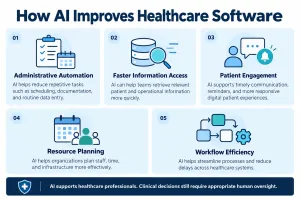
AI may help in several areas.
Less Time Spent on Administrative Work
Administrative responsibilities take up a considerable portion of a healthcare professional’s working day.
An AI-assisted system can help prepare consultation summaries, organize incoming documents, extract information from forms, and categorize patient requests.
Imagine a clinic receiving appointment inquiries through its website, mobile application, and telephone support team.
Instead of manually organizing every inquiry, software could categorize requests by department, identify missing information, and prepare them for staff review.
The benefit comes from reducing repetitive activities, not removing the need for people to verify important information.
Easier Access to Patient Information
Healthcare data often resides in separate systems. A hospital may have one platform for patient registration, another for laboratory testing, and a third for imaging or pharmacy services.
This fragmentation makes it difficult to access a complete patient picture.
AI-assisted search and summarization can help clinicians retrieve relevant information from authorized sources. However, reliable integration and accurate underlying records remain essential.
A sophisticated AI model cannot compensate for missing records or poorly designed data exchange.
More Convenient Patient Services
Patients increasingly expect healthcare applications to provide the same convenience they experience with banking, travel, and other digital services.
They want to book appointments, receive reminders, check reports, and communicate with service providers without unnecessary delays.
AI can make these experiences more responsive.
For example, a hospital assistant could answer questions about visiting hours, explain how to prepare for a scheduled examination, or guide a patient toward the appropriate department.
When questions involve symptoms, medication, or treatment, the system should recognize its limitations and direct patients to qualified healthcare professionals.
Practical Use Cases of AI in Healthcare Software
The most promising applications are not always the most technically complicated. Often, a carefully designed solution addressing a specific workflow creates more value than a platform packed with AI features.
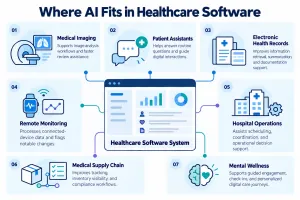
1. AI-Powered Medical Imaging
Medical imaging is one of the more established areas of clinical AI.
Specialized algorithms can examine images, identify patterns, assist with measurements, and highlight findings for medical professionals to review.
Applications may support radiology, ophthalmology, cardiology, and other specialties.
For example, an imaging system could highlight a potential abnormality in a scan so that a radiologist can examine it more closely.
This is not merely a theoretical application. The US Food and Drug Administration maintains a list of AI-enabled medical devices authorized for marketing in the United States.
The important consideration is validation. A model that performs well on one dataset may not perform equally well in a different hospital or patient population.
Healthcare developers must consider clinical evidence, integration requirements, intended use, and applicable medical-device regulations before deployment.
2. Intelligent Patient Support Assistants
Many patient inquiries do not require clinical intervention.
Questions about consultation timings, appointment procedures, available services, document requirements, and hospital locations can often be addressed through a digital assistant.
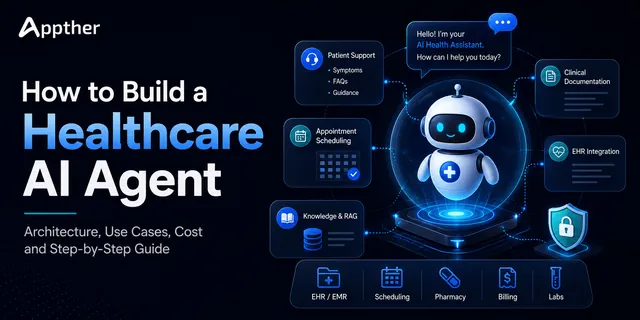
A healthcare chatbot connected to approved information sources could respond to these inquiries at any time.
For more complicated requests, it could create a support ticket or transfer the conversation to an authorized staff member.
One technical approach is Retrieval-Augmented Generation, or RAG. Instead of relying entirely on a language model’s general knowledge, the application retrieves information from approved documents or databases before generating a response.
RAG can help make answers more relevant to an organization, although it does not guarantee accuracy.
The assistant should also be designed to avoid exposing confidential patient records or providing unsupported medical guidance.
3. AI-Assisted Electronic Health Records
Electronic Health Records (EHRs) contain information that is essential to patient care.
Yet reviewing lengthy records can be time-consuming, particularly when a patient has visited several departments or healthcare providers.
AI could help by preparing summaries of relevant medical history, organizing clinical notes, and highlighting recently updated records.
For instance, before a follow-up consultation, a doctor could review a draft summary containing recent test results, prescribed medicines, and previous observations.
The doctor would need access to the original records and would remain responsible for reviewing the information.
From a development perspective, this requires secure system integration, reliable access permissions, and a clear audit trail.
Healthcare interoperability standards such as HL7 FHIR can play a role in exchanging structured information between compatible systems.
4. Remote Patient Monitoring
Connected healthcare applications can collect information from wearable devices, medical equipment, and patient-reported measurements.
These systems may track heart rate, blood pressure, glucose readings, activity, and other relevant indicators.
AI can help organize the incoming information and identify patterns that deserve attention.
For example, a chronic disease management application might display changes in a patient’s recorded measurements over several weeks and bring unusual trends to a clinician’s attention.
The system needs careful design. Incorrect alerts may create unnecessary concern, while missed alerts could create safety risks.
Device accuracy, clinical thresholds, connectivity failures, and escalation procedures therefore matter just as much as model performance.
5. Hospital Operations and Resource Planning
Not every AI healthcare application handles diagnosis or treatment.
Hospitals also manage appointments, staff availability, equipment, inventory, and purchasing.
Predictive analytics can help estimate patient volumes, identify appointment cancellation patterns, and support inventory planning.
Consider a hospital pharmacy where certain medicines experience unpredictable demand.
A forecasting system could analyze previous consumption, seasonal trends, and available stock to help purchasing teams plan replenishment.
The recommendations should be checked against actual clinical requirements and supply constraints.
This is an example of AI supporting operational decisions without being responsible for making medical judgments.
6. AI in Medical Supply Chain Software
The healthcare supply chain presents another opportunity for intelligent software.
Pharmaceutical products and medical supplies move through multiple organizations before reaching hospitals, pharmacies, or patients.
Maintaining visibility across this process can be difficult.
An AI-enabled supply chain platform could help identify unexpected demand changes, detect unusual stock movement, forecast shortages, and prioritize items approaching expiry.
However, AI should not be confused with traceability itself.
Product identification, transaction histories, prescription controls, and audit records need dependable databases, integrations, and business rules.
AI may help analyze those records, but it cannot replace their integrity.
For businesses developing healthcare supply chain platforms, getting the underlying architecture right is often more important than introducing advanced predictive features immediately.
7. Mental Wellness and Patient Engagement Applications
AI can also support certain nonclinical functions within mental wellness applications.
An application might help users maintain journals, organize wellness activities, discover educational content, or follow personalized routines.
A conversational interface may make those features easier to access.
The design becomes more sensitive when users begin discussing emotional distress or mental health conditions.
In these situations, the application needs clear boundaries, appropriate safeguards, and pathways to qualified support where necessary.
Digital wellness tools should not claim to diagnose or treat medical conditions without the relevant evidence and regulatory considerations.
The Security Questions Every Healthcare AI Project Must Answer
Security cannot be treated as a feature to add after development.
Healthcare information may include medical history, diagnostic results, prescriptions, identity details, and other sensitive records. A breach can affect individual privacy and organizational trust.
Introducing AI increases the number of decisions developers must make about where information goes and how it is processed.
Where Does Patient Information Go?
Suppose a healthcare application uses an external language model to summarize a consultation note.
Before building that integration, the development team needs to understand whether the note leaves the organization’s infrastructure, where it is processed, what the service provider retains, and whether any information may be used for model improvement.
These questions should be answered through technical evaluation, contractual arrangements, and applicable legal requirements.
Sending patient records to a third-party AI service without appropriate safeguards is not an acceptable shortcut.
Who Can Access the Information?
Different users require different levels of access.
A doctor may need to examine a patient’s clinical history. A receptionist may only need appointment and registration details. A patient should only be able to access information they are authorized to view.
Strong access controls are essential.
This usually involves role-based permissions, secure authentication, session management, and activity logging.
AI services should operate under similarly restricted permissions. An AI assistant should not gain unrestricted database access simply because doing so makes development easier.
Can the AI Output Be Trusted?
An AI-generated response may sound convincing even when it is incomplete or incorrect.
That creates particular risks in healthcare.
A missing allergy, incorrectly summarized medication, or misleading clinical recommendation could have serious consequences.
Applications should therefore be designed around the risk level of their intended function.
Possible safeguards include checking outputs against source records, requiring human approval, limiting unsupported responses, maintaining model evaluation results, and monitoring performance after deployment.
For clinical uses, suitable validation and applicable regulatory review may also be necessary.
How Is Sensitive Data Protected?
Encryption, controlled access, secure APIs, audit logging, backups, and vulnerability management are fundamental components of healthcare security.
Developers must also consider AI-specific threats, including prompt injection and accidental exposure of confidential information through model responses.
A malicious instruction hidden in a document, for example, should not be able to make an AI assistant ignore its access restrictions.
The architecture should enforce permissions independently of the language model.
What About HIPAA and Other Regulations?
Healthcare software requirements depend on the markets being served and the product’s intended function.
In the United States, HIPAA establishes privacy and security obligations for covered entities and business associates. Its Security Rule addresses administrative, physical, and technical protections for electronic protected health information.
European healthcare applications may need to consider GDPR and, depending on the functionality, relevant provisions of the EU AI Act.
Organizations operating in India must evaluate applicable Indian data protection requirements and their implementation status.
Software intended for diagnosis, treatment, or certain other medical purposes may also fall within medical-device regulations.
A product should not be described as compliant merely because it uses encrypted cloud infrastructure. Compliance requires a broader assessment of technology, policies, processes, legal responsibilities, and actual operating practices.
How Should a Healthcare Business Start an AI Software Project?
One of the biggest mistakes in AI development is starting with the technology instead of the problem.
A healthcare startup might decide it needs a sophisticated AI platform when its immediate challenge is simply organizing patient records and reducing repetitive administrative work.
A better approach begins with a few practical questions.
What problem are users experiencing? How is it handled today? What data is available? What could go wrong if an automated result is incorrect? And how will the organization measure whether the new system actually helps?
Consider a healthcare provider interested in an AI-powered patient assistant.
Rather than immediately developing a system that answers every possible medical question, an initial product could focus on appointment scheduling, hospital information, and administrative support.
This narrower scope has several advantages.
It allows the team to validate user demand, study real interactions, measure response quality, and improve the experience before introducing more sensitive functionality.
Once the foundation is reliable, additional capabilities can be assessed individually.
Technology Decisions Matter
Depending on the requirements, an AI healthcare application may involve several components:
- A web or mobile interface for patients and healthcare professionals
- A secure backend and database
- APIs connecting existing healthcare systems
- A machine learning or language model service
- Authentication and permission controls
- Logging, monitoring, and backup infrastructure
Some projects may benefit from cloud-managed AI services. Others may require a more controlled deployment model because of privacy, latency, contractual, or operational requirements.
The technology stack should support the product’s actual needs rather than follow a particular AI trend.
Why Custom Healthcare Software Development Still Matters
Ready-made software can be effective when an organization has standard requirements.
Healthcare businesses, however, often have workflows that cannot be accommodated easily by generic products.
A specialty clinic may require unusual appointment procedures. A digital health startup may need a distinctive patient experience. A hospital group may need to connect several existing systems that were never designed to work together.
Custom development allows these requirements to shape the application.
It also provides greater flexibility in decisions about interfaces, integrations, deployment architecture, and long-term product development.
AI adds another layer of opportunity, but it does not remove the importance of good software engineering.
A poorly designed application does not become reliable simply because an intelligent model is connected to it.
Building AI Healthcare Applications with Appther Technologies
At Appther Technologies, our work in custom software development, mobile applications, AI integration, and cloud-based systems provides a foundation for businesses exploring digital healthcare products.
Depending on the project, this may involve developing patient-facing mobile applications, building administrative platforms, integrating AI assistants, connecting existing systems, or designing secure backend services.
We believe the starting point should be the business problem.
A healthcare organization considering AI should understand which activities could benefit from automation, which decisions require human involvement, and what technical or regulatory constraints will influence the product.
These considerations help determine a sensible MVP, technology architecture, and development roadmap.
For healthcare solutions, security and reliability should be part of those conversations from the beginning.
Explore our AI Development Services or Mobile App Development Services to learn more about our capabilities.

Frequently Asked Questions
How is AI used in healthcare software?
AI is used to analyze medical images, organize health records, assist with documentation, support patient communication, monitor health-related data, and improve hospital operations. Its role depends on the specific application and the level of clinical risk involved.
What are the biggest benefits of AI in healthcare?
The main opportunities include reducing administrative work, helping professionals access relevant information, improving patient-facing digital services, and supporting operational planning. These benefits depend on the quality and suitability of the implementation.
Is AI healthcare software safe?
It can be developed with appropriate safeguards, but safety must be evaluated for each intended use. Clinical applications may require extensive validation, human oversight, and regulatory review. Data security alone does not establish clinical safety.
Can AI healthcare applications be HIPAA compliant?
Yes, AI healthcare applications can be designed and operated to meet applicable HIPAA requirements. Whether those requirements apply, and what compliance involves, depends on the organizations, services, data flows, vendors, and operational arrangements.
How much does it cost to develop AI healthcare software?
The cost depends on the application’s features, integrations, data requirements, AI architecture, security controls, and any clinical or regulatory validation. An administrative chatbot and a diagnostic medical device have very different development requirements.
Should healthcare startups begin with an MVP?
An MVP can be a practical starting point for validating limited functionality, particularly in administrative or patient engagement applications. However, an MVP must still meet the safety, privacy, and regulatory requirements applicable to its actual use.
Final Thoughts
The most useful applications of AI in healthcare may not be the ones that attract the most attention.
They may be systems that help a doctor locate information more quickly, reduce delays in a hospital’s administrative process, make a patient portal easier to use, or help a pharmacy anticipate inventory shortages.
These improvements can be meaningful without making unrealistic promises about replacing healthcare professionals.
For healthcare businesses, the challenge is deciding where AI adds value and where conventional software, established workflows, and human judgment remain the better choices.
A successful healthcare application needs more than an intelligent model. It needs dependable data, thoughtful engineering, security, and a clear understanding of the people who will use it.
Have an idea for an AI-powered healthcare application?
Connect with Appther Technologies to discuss your product requirements, technical considerations, and development approach.