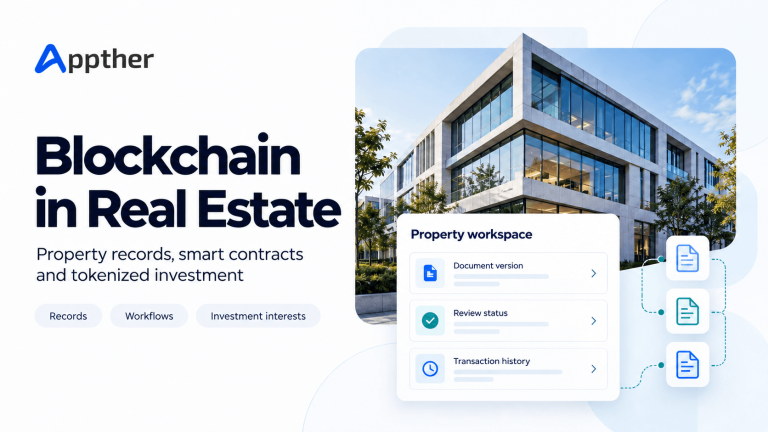
A property transaction brings together information from sellers, buyers, lenders, brokers, legal professionals, and government registries. Each participant may maintain different documents and records, making it difficult to confirm which version is current and which steps have been completed.
Blockchain in real estate can help selected participants share a verifiable history of transactions, document references, and approvals. It can also support programmable investment interests and certain automated workflows.
However, recording something on a blockchain does not make it legally valid or factually correct. A practical solution still needs reliable source data, secure software, clear responsibilities, and integration with the applicable property and financial systems.
For property businesses and technology founders, the opportunity is to identify where a shared ledger adds measurable value to a real operational problem.
What Is Blockchain in Real Estate?
Blockchain in real estate means using a distributed ledger to record and share selected property-related events or represent legally defined investment interests as digital tokens. Applications can include document integrity checks, transaction histories, smart-contract workflows, and tokenized investments.
A blockchain maintains records across participating computers under agreed validation rules. Its design can make historical changes difficult and detectable, although the protections depend on the network and its governance.
For example, a platform might record that an authorized reviewer approved a specific version of a sale agreement. Other permitted participants can then verify that the approval refers to the same document they hold.
Three distinctions matter:
- Record integrity: Has recorded information been altered?
- Source accuracy: Was the submitted information correct?
- Legal effect: Does the recorded action create or change enforceable rights?
Blockchain can support the first. The second and third depend on verification processes, authoritative institutions, and applicable law. NIST’s blockchain overview explains why incorrect information can still enter a blockchain system. [1]
How Does Blockchain Work in a Property Transaction?
A blockchain-enabled property platform usually combines ordinary application software with a ledger. Buyers and sellers use a website or mobile app, while backend services manage documents, approvals, payments, and integrations.
An illustrative workflow could involve:
- Property onboarding: The seller submits property details and supporting documents.
- Verification: Authorized parties check identities, documents, title information, and relevant restrictions.
- Agreement preparation: The parties review and sign the required agreements through an appropriate process.
- Payment or escrow arrangements: The platform coordinates with the relevant payment provider, bank, or escrow service.
- Approval recording: Authorized integrations submit confirmations for conditions the workflow requires.
- Registration and completion: The transaction follows the legally required transfer and registration procedures.
- Record reconciliation: The platform links completion evidence to the transaction and records selected events on the ledger.
The exact sequence varies by jurisdiction and transaction type. Payment, settlement, and registration may be interdependent rather than separate steps completed in a fixed order.
The platform should distinguish statuses such as “agreement signed,” “payment confirmed,” and “registration completed.” A generic “ownership transferred” label can be misleading if only an internal software step has finished.
Seven Practical Applications of Blockchain in Real Estate
1. Property Record Traceability
A blockchain can maintain a history of selected property-related events, such as document submissions, approvals, or references to completed registrations.
For a hypothetical property, the platform might record:
| Event | Associated evidence |
|---|---|
| Property added | Verified property identifier and onboarding record |
| Agreement signed | Reference to the signed document version |
| Transfer registered | Confirmation from the relevant registration process |
| Financing status updated | Authorized lender or registry confirmation |
This can help participants understand what was recorded, when it was recorded, and which authorized account submitted it.
However, the ledger may not contain every historical transaction, restriction, dispute, or lien. Its completeness depends on the sources connected to the platform and the processes used to keep them current.
2. Property Document Integrity Checks
Property transactions involve sale agreements, title documents, approvals, inspection reports, valuations, and insurance records.
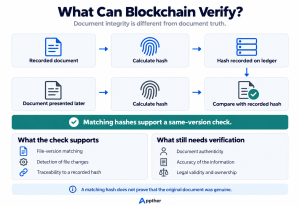
A practical design stores these documents in secure storage and records a cryptographic hash of a particular version on a ledger. A hash is a digital fingerprint calculated from the file’s contents.
When someone later presents a document, the application calculates its hash and compares it with the recorded value. A matching result provides evidence that it is the same file version, assuming a suitable hash function and implementation.
A matching hash does not prove that the document was genuine, accurate, or legally valid when submitted. Issuer checks, signatures, and appropriate due diligence remain necessary.
Even a minor file change can produce a different hash. Platforms therefore need clear versioning rules so that a legitimate update is not confused with fraud.
3. Smart Contracts for Defined Transaction Rules
Smart contracts are blockchain programs that apply predefined rules when invoked through transactions. They can check recorded conditions and perform permitted on-chain actions.
For example, a contract might allow a token transfer only when both accounts are eligible and an authorized approval has been recorded.
External facts require additional infrastructure. A contract cannot independently inspect a building, validate a title, or check a conventional bank account. Authorized services or oracle systems must supply the relevant information. Ethereum’s oracle documentation explains this connection between off-chain data and smart contracts. [2]
Potential uses include transfer restrictions, distribution calculations, and recording approved transaction milestones. Bank payments and legal registration still require their own systems and procedures.
Contracts also need an execution trigger. A monthly deadline alone does not make an Ethereum-style contract run; a user or automation service must submit the transaction.
4. Real Estate Tokenization
Real estate tokenization is the digital representation of a defined property-related asset or investment interest using blockchain tokens.
A token might represent an interest in a company holding property, a debt instrument, or another contractual entitlement. Its meaning comes from the underlying legal structure and documentation.
Tokenization and fractional investment are related but different. Fractional investment allows investors to hold smaller interests. Tokenization is one way those interests can be represented and administered; fractional investment can also operate without blockchain.
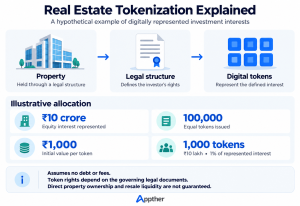
Consider this hypothetical example:
| Assumption | Illustrative amount |
|---|---|
| Equity interest being represented, assuming no debt or fees | ₹10 crore |
| Equal tokens issued | 100,000 |
| Initial illustrative value per token | ₹1,000 |
| Tokens purchased by an investor | 1,000 |
| Initial investment represented | ₹10 lakh |
| Share of the represented interest | 1% |
This does not automatically give the investor direct registered ownership of 1% of the building. Voting, income, redemption, and sale rights depend on the governing documents.
The token’s future price may also differ from its initial value. Property valuation, debt, fees, transfer restrictions, and buyer demand all affect the investment.
US SEC staff guidance illustrates that token structures can provide different rights and exposures, and that tokenizing a security does not remove its securities-law character. This is a US-specific reference, not a universal rule for every country. [3]
5. Shared Transaction Status and Reconciliation
Multiple organizations may spend time comparing records to determine whether a transaction has reached the same stage in every system.
A shared ledger can help establish a common record of agreed events. A broker, transaction coordinator, and investment administrator could reference the same recorded approval instead of repeatedly exchanging copies.
The benefit depends on participation and data quality. If each organization continues to operate independently and does not trust the submitted events, adding blockchain may create another record to reconcile.
Shared APIs and conventional databases can also improve coordination. The architectural question is whether several independent parties need a jointly verifiable record under agreed governance.
6. Rental and Lease Administration
A rental platform could use blockchain to record selected lease events or support distributions associated with a legally structured investment.
Most operational features would still belong in the application: rent reminders, maintenance tickets, tenant communication, accounting, and document access.
For example, the application could receive a payment confirmation, calculate an approved distribution, and record the resulting event. If money moves through a bank, a payment integration must handle that transfer.
Security deposits and deductions also require procedures for disagreements, approvals, and applicable local requirements. Encoding a rule does not resolve a dispute about whether damage occurred or a deduction is justified.
7. Audit Evidence Across Organizations
A shared ledger can provide evidence of selected submissions, approvals, and changes across participating organizations.
Useful records might identify the submitting account, document version, approval status, and reference to supporting evidence.
This can assist an audit, but a wallet address alone does not establish a person’s identity or authority. Account onboarding, access controls, signing permissions, and supporting records remain essential.
What Benefits Can Blockchain Deliver?
The benefits are conditional on the business process and implementation.
| Potential benefit | What must be in place |
|---|---|
| More consistent shared records | Participants agree on event definitions and update responsibilities |
| Stronger traceability | Records link to identifiable sources and retained evidence |
| Less duplicate reconciliation | Organizations actually use the shared record |
| Programmable transfers | Rules, permissions, and external confirmations are dependable |
| Digital investment administration | Token rights and transfer processes are legally defined |
| Better audit visibility | Authorized reviewers can access the required evidence |
Faster transactions and lower operating costs are possible outcomes, not automatic features. Teams should compare them against an ordinary database-and-API implementation before choosing blockchain.
A Documented Example: HM Land Registry’s Digital Street Prototype
In 2019, HM Land Registry described a Digital Street research prototype using the Corda platform to explore a digital property transfer. The project investigated how participating organizations could coordinate the process using distributed ledger technology. [4]
This is a useful example of testing a specific transaction workflow. It should be described as a historical prototype, rather than evidence that the UK’s land-registration system has been replaced by blockchain.
When evaluating similar examples, distinguish research projects, limited pilots, and production services. Their scale, operating responsibilities, and legal arrangements can be very different.
Challenges of Blockchain in Real Estate
Legal Recognition and Investment Rules
Recording a transfer on a blockchain does not by itself establish that all property-transfer requirements have been satisfied.
Before designing a platform, determine what each digital action represents, which institution recognizes it, and what external process remains necessary. For tokenized investments, the analysis also needs to address the instrument’s rights and the rules applicable to its issuance and transfer.
Privacy and Data Exposure
Identity documents, bank details, signatures, and personal information generally belong in controlled storage rather than a public ledger.
Keeping documents off-chain does not solve every privacy issue. Transaction metadata and persistent identifiers can also reveal relationships or activity. The design should minimize what is recorded and define who can access each system.
Smart-Contract and Integration Security
An error in permissions, transfer logic, or an external integration can undermine the whole workflow.
Engineering should cover security review, testing of failure cases, transaction monitoring, and procedures for responding to incidents. Where pause or upgrade mechanisms exist, their authority and limits should be clearly documented.
Key Custody and Recovery
The platform needs a clear answer to who controls signing keys and how access is recovered after loss or compromise.
Business operations may also require staff replacement, separation of duties, and multiple approvals for sensitive actions. These processes should be designed before production use.
Incorrect Records and Disputes
Systems need a controlled way to mark an entry as disputed, superseded, or corrected while preserving the relevant history.
A ledger cannot decide which party is right when the underlying facts are contested. The platform needs an agreed dispute process and a way to reflect its outcome.
Cost, Performance, and Governance
Costs include application development, integration work, security, network operations, and ongoing support. Public networks may add variable transaction fees; permissioned networks add participant and infrastructure management.
Governance must define who can join, validate transactions, change rules, and resolve operational disagreements.
Investment Liquidity
Issuing tokens does not guarantee a functioning resale market. Eligible buyers, transfer permissions, market access, and demand determine whether an investor can exit.
A platform should avoid presenting tokenization as a promise of instant liquidity or guaranteed returns.
Blockchain vs Conventional Real Estate Software
Modern conventional systems already support digital signatures, automated workflows, integrations, and protected audit logs. A fair comparison focuses on how records and responsibilities are shared.
| Area | Conventional digital system | Blockchain-enabled system |
|---|---|---|
| Record management | Database controlled by an operator or shared service | Ledger maintained under network validation and governance rules |
| Automation | APIs, workflow engines, scheduled jobs | Smart contracts combined with integrations and transaction triggers |
| Document integrity | Hashes, signatures, versioning, protected logs | Can additionally anchor selected hashes or events to a shared ledger |
| Fractional investment | Can use legally structured shares or units | Can represent eligible interests as tokens |
| External verification | Depends on sources and integrations | Still depends on sources and integrations |
| Corrections | Managed database updates and audit history | Usually additional events or controlled state updates preserving history |
| Legal effect | Depends on applicable law and process | Also depends on applicable law and process |
What Should a Blockchain Real Estate Platform Include?
A practical platform can use a hybrid architecture with clearly separated responsibilities.
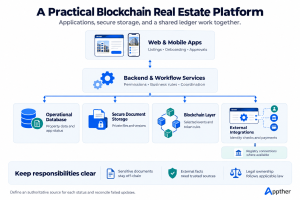
| Component | Responsibility |
|---|---|
| Web and mobile interfaces | Property browsing, onboarding, approvals, account access |
| Backend services | Business rules, authorization, workflow coordination |
| Operational database | Searchable property data, application state, notifications |
| Secure document storage | Controlled access, document versions, retention |
| Integration services | Identity checks, payments, CRM, and registry connections where available |
| Blockchain layer | Selected shared events, token balances, programmed on-chain rules |
| Monitoring and administration | Reconciliation, exception handling, incident response |
The design should identify the authoritative source for each field. A property’s legal status, a bank payment’s settlement status, and a token balance may have different sources of authority.
Synchronization failures also need explicit handling. If a payment succeeds but a ledger transaction fails, the platform should surface the exception and reconcile it safely. It should not silently display the purchase as complete.
When Does Blockchain Make Sense?
Blockchain deserves consideration when several independent organizations need to maintain and verify shared transaction state, and a jointly governed ledger offers an advantage over a single operator’s database.
It may also be relevant when legally defined digital interests need programmable transfer controls across participating systems.
A conventional architecture may be more suitable when one business controls the entire workflow and mainly needs property listings, CRM, document uploads, rental accounting, or maintenance management.
Before committing, ask:
- Which business problem requires a shared ledger?
- Who submits information, and who verifies it?
- What legal or operational effect does each recorded action have?
- Which information must remain private?
- How will mistakes, lost access, and disputes be handled?
- What measurable improvement should the pilot demonstrate?
Useful pilot measures include reconciliation time, duplicated checks, exception rates, and operating cost per transaction. Compare results with a defined baseline.
How AI Can Complement the Platform
AI can assist with extracting fields from documents, summarizing lease terms, identifying missing information, or flagging inconsistencies for review.
Blockchain can record references to the versions and approvals used in that workflow.
The two technologies serve different purposes. An AI result can be inaccurate, and recording its hash does not validate its conclusions. Material decisions should remain connected to source documents and an appropriate review process.
Frequently Asked Questions
Does blockchain prove property ownership?
Not by itself. A blockchain entry can provide evidence of a recorded event, but legal ownership depends on the applicable property laws, documents, and registration framework.
Can smart contracts replace property lawyers or registries?
Smart contracts can apply programmed rules to available data. They do not independently resolve legal issues, verify physical facts, or replace registration requirements.
Is real estate tokenization the same as fractional ownership?
No. Fractional investment involves holding a smaller interest. Tokenization represents an interest digitally on a blockchain. A token may provide economic exposure without direct registered ownership of the property.
Can blockchain prevent property fraud?
It can make some changes to recorded information easier to detect. It cannot prevent false submissions, compromised accounts, forged source documents, or every form of off-chain fraud.
Should property documents be stored on a public blockchain?
Sensitive documents are generally better stored in a secure, access-controlled system. Selected hashes or references may be recorded on-chain after assessing privacy and disclosure risks.
Does a tokenized property investment guarantee liquidity?
No. Resale depends on the investment structure, transfer restrictions, eligible buyers, market access, and demand.
Does a property management app need blockchain?
Many do not. Conventional software can handle listings, leases, payments, reporting, and maintenance. Blockchain should address a specific shared-record or digital-asset requirement.
Conclusion
Blockchain in real estate can support shared records, document traceability, programmable workflows, and tokenized investment administration. Its value depends on accurate inputs, participating institutions, and a clear connection between digital events and their real-world meaning.
For businesses planning a platform, a focused pilot is a practical starting point. Define the problem, establish the sources of authority, and measure whether the shared ledger improves the process enough to justify its additional complexity.
Build Your Real Estate Platform with a Clear Plan
Planning a property marketplace, transaction portal, or tokenized investment platform?
Discuss your requirements with Appther to define user journeys, integrations, document workflows, and the role blockchain should play in your product. Start with a focused scope that your business, engineering team, and legal advisers can evaluate together.