AI is no longer only for large enterprises. SMEs can now use AI chatbots, voice agents, automation tools, smart dashboards and AI-powered mobile apps to solve everyday business problems.
The National AI Centre reported that 43% of Australian SMEs had some level of AI adoption from December 2025 to February 2026, and AI adoption reached 44% in February 2026. This shows that AI is moving from early experimentation to real business adoption in Australia.
However, the biggest question for many business owners is simple: which AI use case should we start with first?
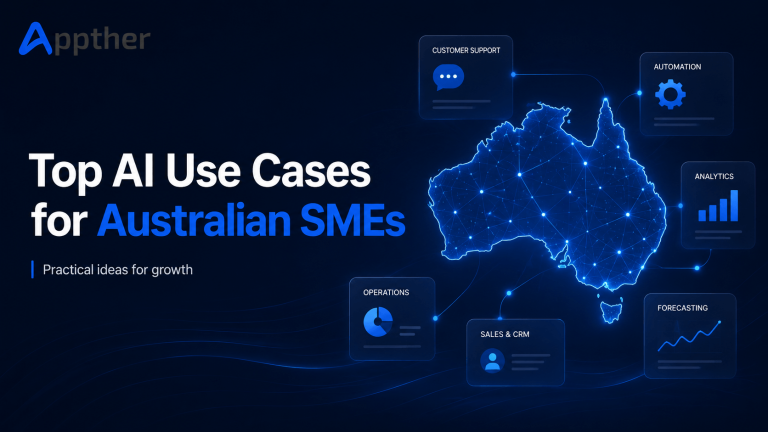
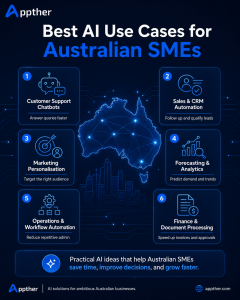
This guide explains the most practical AI use cases for Australian SMEs in 2026, including customer support, voice agents, appointment booking, sales automation, document processing, inventory forecasting, healthcare automation, real estate workflows and AI-powered reporting.
Why Australian SMEs are adopting AI now
Australian SMEs are under pressure to do more with smaller teams. Customers expect fast responses, costs are increasing, and business owners need better visibility across sales, service, finance and operations.
AI can help SMEs by automating repetitive work, improving customer communication and giving teams faster access to useful business insights.
For example, an AI chatbot can answer common customer questions. An AI voice agent can handle missed calls. An AI dashboard can summarise business performance. An AI document processing system can reduce manual data entry.
The Australian Cyber Security Centre also notes that small businesses are using cloud-based AI tools to automate tasks, gain insights and improve customer experience, while also needing to manage cyber security risks such as data leaks, privacy breaches, unreliable outputs and supply-chain vulnerabilities.
Therefore, SMEs should not adopt AI randomly. The best approach is to start with one clear business problem, build a small AI solution, measure the impact and then scale gradually.
1. AI customer support chatbot
An AI customer support chatbot is one of the easiest AI use cases for Australian SMEs to start with. It can answer common questions, capture leads, guide users and reduce the workload on your support team.
A chatbot can work on your website, mobile app, WhatsApp, Facebook Messenger or customer portal. It can also be connected to your CRM, product database, FAQ page or internal knowledge base.
Common use cases
- Website chatbot
- WhatsApp support bot
- FAQ automation
- Product enquiry handling
- Order status updates
- Lead capture
- After-hours customer support
- Support ticket creation
- Customer query routing
Best industries
- eCommerce
- Retail
- Education
- Real estate
- Travel
- Professional services
- Healthcare reception
- Restaurants and hospitality
Example
An Australian eCommerce business can use an AI chatbot to answer product questions, recommend suitable items and provide order updates. A real estate agency can use a chatbot to qualify buyer enquiries and book inspections. A clinic can use a chatbot to answer appointment-related questions before sending complex queries to staff.
Why this matters for SMEs
Many SMEs lose leads because they cannot respond fast enough. An AI chatbot helps your business stay available 24/7. It can also reduce repetitive support queries so your team can focus on complex customer issues.
2. AI voice agent for calls
Many Australian SMEs still depend on phone calls. For clinics, salons, real estate agencies, service businesses and professional firms, every missed call can mean a missed opportunity.
An AI voice agent can answer incoming calls, collect customer information, qualify leads, book appointments and send call summaries to your team.
Common use cases
- Answer incoming calls
- Handle missed calls
- Book appointments
- Qualify leads
- Capture caller details
- Route urgent enquiries
- Send call summaries
- Follow up through SMS or email
- Support after-hours callers
Best industries
- Medical clinics
- Dental practices
- Salons
- Real estate agencies
- Home service businesses
- Legal offices
- Accounting firms
- Consulting companies
Example
A dental clinic can use an AI voice agent to answer calls, check appointment availability and collect patient details. A real estate agency can use it to capture property enquiries and send qualified leads to the right agent.
Why this matters for SMEs
Hiring a full-time receptionist or call centre team may not be practical for every business. An AI voice agent supports your team, reduces missed calls and improves the customer experience.
It does not need to replace humans. Instead, it can handle repetitive call tasks and pass important cases to your staff.
3. AI appointment booking automation
Appointment booking is a repetitive task for many SMEs. It often includes checking availability, confirming details, sending reminders and handling rescheduling requests.
AI appointment booking automation can simplify this process and reduce manual coordination.
Common use cases
- Appointment scheduling
- Calendar availability checks
- SMS confirmations
- Email confirmations
- Reminder automation
- Rescheduling support
- No-show reduction
- Staff allocation
- Booking follow-ups
Best industries
- Healthcare
- Dental clinics
- Salons and spas
- Fitness studios
- Consulting firms
- Education providers
- Repair and maintenance services
Example
A clinic can use AI to collect appointment preferences, check available slots and send confirmation messages. A salon can use AI to handle repeat bookings and reminders. A consulting firm can use AI to schedule discovery calls based on calendar availability.
Why this matters for SMEs
Manual booking takes time and creates errors. AI booking automation helps customers book faster and helps your team avoid repetitive admin work.
It can also reduce no-shows by sending automated reminders before the appointment.
4. AI sales assistant
Small sales teams often lose opportunities because follow-ups are delayed, CRM records are incomplete or leads are not prioritised properly.
An AI sales assistant can help your team manage leads, write follow-ups, update CRM records and identify the next best action.
Common use cases
- Lead scoring
- Sales email drafting
- Follow-up reminders
- Proposal generation
- CRM updates
- Call summaries
- Meeting notes
- Next-best action recommendations
- Customer segmentation
Best industries
- B2B services
- Real estate
- IT services
- Consulting
- Education
- Insurance
- Finance
- SaaS companies
Example
An AI sales assistant can review new leads, score them based on interest level and suggest the next action. It can also draft personalised emails based on previous customer conversations.
Why this matters for SMEs
SMEs usually do not have large sales operations teams. AI helps sales teams stay organised, respond faster and improve conversion without adding extra admin work.
For better results, the AI sales assistant should be connected to your CRM, email, calendar and lead capture forms.
5. AI document processing
Many SMEs still handle invoices, purchase orders, contracts, resumes, customer forms and reports manually. This creates delays and increases the chance of human error.
AI document processing can read, extract, summarise and classify information from documents.
Common use cases
- Invoice extraction
- Purchase order reading
- Contract summarisation
- Resume screening
- KYC document review
- Insurance document processing
- HR document automation
- Supplier document management
- Customer form processing
Best industries
- Finance
- Insurance
- Accounting
- Recruitment
- Logistics
- Legal
- Healthcare
- Enterprise operations
Example
An accounting firm can use AI to extract supplier name, invoice number, due date and amount from invoices. A recruitment agency can use AI to shortlist resumes based on job requirements. A logistics company can use AI to process delivery documents and supplier forms.
Why this matters for SMEs
Document processing reduces manual data entry and helps teams find information faster. It can also improve accuracy and reduce operational delays.
However, businesses should handle personal and sensitive information carefully. In Australia, the Privacy Act includes Australian Privacy Principles that govern how personal information is collected, used, disclosed and managed by covered organisations.
6. AI recommendation engine
An AI recommendation engine helps businesses personalise user experiences. It can suggest products, services, content, courses or offers based on user behaviour and preferences.
This is useful for SMEs that want to increase customer engagement, improve conversion and encourage repeat purchases.
Common use cases
- Product recommendations
- Course recommendations
- Content recommendations
- Personalised offers
- Customer segmentation
- Upsell suggestions
- Cross-sell suggestions
- Next-best product recommendations
Best industries
- eCommerce
- Retail
- EdTech
- Media
- Fintech
- Marketplaces
- Food delivery
- Subscription businesses
Example
An online store can recommend products based on browsing history and previous purchases. An education platform can recommend courses based on learner goals. A marketplace can suggest relevant services based on user interests.
Why this matters for SMEs
Personalisation helps small businesses compete with larger digital platforms. It can improve engagement, average order value and customer retention.
The key is to start simple. You do not always need a complex custom AI model in the first phase. A basic recommendation system can be launched first and improved over time.
7. AI inventory and demand forecasting
Inventory planning is a major challenge for retailers, restaurants, logistics companies and distributors. Overstocking affects cash flow. Understocking leads to lost sales.
AI demand forecasting helps businesses predict future demand based on historical sales, seasonal trends and business patterns.
Common use cases
- Stock prediction
- Demand forecasting
- Supplier planning
- Seasonal demand analysis
- Warehouse optimisation
- Restaurant inventory planning
- Reorder alerts
- Sales trend analysis
Best industries
- Retail
- Restaurants
- Logistics
- Manufacturing
- Wholesale distribution
- Grocery
- eCommerce
Example
A restaurant can use AI to predict ingredient demand based on previous orders and seasonal patterns. A retailer can use AI to identify which products need restocking before demand increases. A distributor can use AI to improve supplier planning.
Why this matters for SMEs
Better forecasting helps reduce waste, avoid stockouts and improve cash flow. It also gives business owners more confidence in purchasing and inventory decisions.
For SMEs, even a simple forecasting dashboard can create strong business value.
8. AI for healthcare and clinics
Healthcare SMEs such as clinics, dental practices, allied health providers and wellness centres can use AI to reduce front-desk workload and improve patient communication.
AI can support appointment booking, patient intake, reminder automation and admin workflows.
Common use cases
- Patient intake
- AI receptionist
- Appointment booking
- Report summarisation
- Patient follow-up
- Reminder automation
- Basic triage support
- Call summary generation
- Admin task automation
Best use cases to start with
- Appointment booking
- Patient intake forms
- Missed call handling
- Reminder automation
- Follow-up messages
Example
A clinic can use AI to collect patient details before an appointment. A dental practice can use an AI voice agent to answer missed calls. A physiotherapy clinic can use AI reminders to reduce no-shows.
Why this matters for SMEs
Healthcare teams spend a lot of time managing calls, forms, appointment changes and follow-ups. AI can reduce admin workload and help staff focus on patient care.
However, healthcare AI should be designed with privacy, security and human review in mind. AI should support clinical and admin workflows, not replace professional judgement.
9. AI for real estate businesses
Real estate businesses receive enquiries from websites, property portals, ads, calls and social media. Managing these enquiries manually can become difficult.
AI can help real estate teams respond faster, qualify leads and automate follow-ups.
Common use cases
- Property enquiry chatbot
- Buyer qualification
- Tenant enquiry handling
- Rental application screening
- Inspection booking
- Lead follow-up
- Property matching
- CRM updates
- Agent notifications
Best users
- Real estate agencies
- Property managers
- Brokers
- Developers
- Rental management firms
Example
An AI assistant can ask buyers about their budget, preferred location, property type and purchase timeline. It can then send qualified leads to the right agent.
A rental agency can use AI to answer common tenant questions and schedule inspections.
Why this matters for SMEs
Speed matters in real estate. A fast response can increase the chance of booking an inspection or winning a client.
AI helps real estate businesses respond quickly even when agents are busy.
10. AI business reporting and dashboards
Many SMEs have useful data inside spreadsheets, CRMs, accounting tools, eCommerce platforms and support systems. However, business owners often do not have time to analyse everything manually.
AI reporting tools can turn raw data into useful insights.
Common use cases
- Sales summary
- Customer behaviour analysis
- Campaign performance reporting
- Financial forecasting
- Operational alerts
- Team productivity reports
- Customer support analysis
- Management dashboards
Best industries
- Retail
- SaaS
- Professional services
- Finance
- Logistics
- eCommerce
- Manufacturing
- Education
Example
An AI dashboard can show which marketing campaigns are generating leads, which products are performing well and which customers need attention. It can also highlight unusual activity or trends.
Why this matters for SMEs
AI reporting helps business owners make faster decisions. It also reduces dependency on manual reports and spreadsheets.
Instead of waiting for weekly reports, teams can get instant summaries and alerts.
Cybersecurity and privacy checklist for Australian SMEs
AI can create strong business value, but it must be used safely. Before adopting AI, Australian SMEs should review security, privacy and governance requirements.
Use this checklist before starting an AI project:
- Do not upload sensitive customer data into public AI tools.
- Check whether the AI vendor uses your data for training.
- Confirm who owns the data and AI output.
- Review where the data is stored.
- Use role-based access control.
- Add human review for important decisions.
- Keep audit logs for AI activity.
- Review AI output before customer-facing use.
- Train staff on safe AI usage.
- Use secure APIs and approved tools.
- Create an AI usage policy for your team.
- Review third-party AI tools before connecting them to business systems.
The ACSC highlights AI adoption risks for small businesses, including data leaks, privacy breaches, reliability and manipulation of AI outputs, and supply-chain vulnerabilities.
Therefore, AI should not be treated only as a productivity tool. It should be implemented with proper security, privacy and operational controls.
How to choose the right AI use case
Not every workflow needs AI. The best use case should be practical, measurable and low-risk.
Before investing in AI, ask these questions:
| Question | Why it matters |
|---|---|
| Is the task repetitive? | Repetitive tasks are easier to automate |
| Does it save time or cost? | ROI becomes easier to measure |
| Does it improve customer experience? | Better impact on revenue and retention |
| Is sensitive data involved? | Needs privacy and security planning |
| Can a human review the output? | Makes rollout safer |
| Can it be launched as an MVP? | Helps validate faster |
| Does it connect with existing tools? | Improves operational value |
For many SMEs, the best first AI use case is usually customer support, appointment booking, sales follow-up, document processing or reporting.
These use cases are easier to measure and can often be launched faster than complex AI platforms.
Build vs buy: what should Australian SMEs choose?
Some AI needs can be solved with ready-made tools. Others require custom AI development.
The right decision depends on your workflow, data, integration needs and long-term goals.
Choose a ready-made AI tool when:
- The process is simple
- You do not need deep customisation
- No sensitive business data is involved
- You only need basic productivity support
- Your team can use the tool without integration
- You do not need ownership of the platform
Choose custom AI development when:
- You need AI connected to your CRM, ERP or database
- You handle sensitive customer data
- Your workflow is unique
- You need custom user roles
- You want full ownership of the system
- You need AI inside a mobile or web app
- You want long-term scalability
- You need business-specific automation
For example, a small team may start with a ready-made AI writing tool. However, a clinic, logistics company or real estate agency may need a custom AI workflow connected to its calendar, CRM, customer data and internal systems.
Suggested AI roadmap for Australian SMEs
A successful AI project does not need to start big. It should start with a clear business problem.
Here is a simple roadmap:
Step 1: Identify repetitive workflows
List the tasks your team repeats every week. These may include answering questions, creating reports, updating CRM records, handling appointments or processing documents.
Step 2: Choose one high-value use case
Select one workflow that saves time, improves customer experience or reduces cost. Avoid starting with too many AI ideas at once.
Step 3: Build a small AI MVP
Start with a small version of the solution. For example, launch a chatbot for your top 20 FAQs before building a full AI support system.
Step 4: Test with real users
Test AI responses, workflows, accuracy and edge cases before a full launch. Collect feedback from your team and customers.
Step 5: Add security and governance
Define access controls, data handling rules, logs and human review steps. Make sure sensitive data is protected.
Step 6: Scale gradually
Once the first use case works, add more automation, integrations, analytics and AI capabilities.
This phased approach helps SMEs control cost and reduce risk.
Why choose Appther for AI solutions in Australia?
Appther helps businesses build AI-powered apps, automation platforms, chatbots, voice agents and intelligent digital products.
Appther’s AI development services include custom ML models, LLM applications, autonomous AI agents, computer vision and generative AI solutions for healthcare, finance, manufacturing and enterprise. Appther also highlights PoC delivery in 2 to 4 weeks and experience across 12+ countries.
For Australian SMEs, Appther can support:
- AI use-case discovery
- AI strategy consulting
- AI chatbot development
- AI voice agent development
- RAG-based knowledge systems
- Mobile app development
- Web app development
- CRM and ERP integration
- Cloud and DevOps
- UI/UX design
- Post-launch support
Appther also builds custom mobile apps, AI-powered systems, voice agents, chatbots, ML pipelines, enterprise software, web platforms and IoT solutions from MVP to production scale.
With the right AI partner, SMEs can move from idea to MVP faster and avoid unnecessary technical complexity.
Final thoughts
AI use cases for Australian SMEs are becoming more practical and business-focused in 2026. The best AI project is not always the most advanced one. It is the one that solves a real business problem.
For many SMEs, the first AI project should focus on customer support, appointment booking, lead follow-up, document processing or reporting. These use cases are easier to measure and faster to launch.
AI can help Australian businesses save time, improve customer service, reduce manual work and make better decisions. However, it should be implemented with the right planning, data security and human oversight.
Start small. Measure the impact. Then scale your AI roadmap step by step.
Ready to automate your business with AI?
Find the right AI use case, roadmap and budget for your Australian business.
Book a free AI consultation with Appther today.
FAQs
What are the best AI use cases for Australian SMEs?
The best AI use cases for Australian SMEs include customer support chatbots, AI voice agents, appointment booking automation, sales assistants, document processing, recommendation engines, inventory forecasting and business reporting.
How can AI reduce business costs?
AI can reduce business costs by automating repetitive tasks, reducing manual data entry, improving customer support efficiency, reducing missed calls, improving stock planning and helping teams make faster decisions.
Is AI safe for small businesses in Australia?
AI can be safe when implemented with proper data handling, access control, human review, vendor checks and cyber security planning. Businesses should avoid uploading sensitive customer data into public AI tools without approval.
What is the easiest AI use case to start with?
The easiest AI use cases to start with are usually customer support chatbots, appointment reminders, internal document search, sales follow-up automation and AI reporting.
How much does AI automation cost for a small business?
The cost depends on the use case, integrations and complexity. A simple AI automation project may start with a small MVP, while a custom AI platform with integrations, dashboards and security controls will cost more.
Can Appther build AI chatbots and voice agents for Australian SMEs?
Yes. Appther builds AI chatbots, voice agents, LLM applications, AI agents and custom AI-powered products for businesses across different industries.
How long does it take to launch an AI automation project?
A simple AI proof of concept can often be launched in a few weeks. A production-ready AI automation project may take longer depending on integrations, data quality, user workflows and security requirements.

Written by
Vipin Pachauri
Vipin Pachauri is the Founder and Director of Appther Technologies. He has spent more than a decade building software for businesses, working across AI, CRM, DevOps, cloud architecture and digital transformation. He stays close to the technical detail rather than working only at the strategy level, and spends most of his time helping companies decide what to automate, how to connect the systems they already run, and what is actually worth building.