Custom AI built for Los Angeles operators, not demos. We ship LLM applications, autonomous agents, computer vision and predictive models into the systems your team already runs, working Pacific hours from first call to handover.
From Pilot to Production: Our Complete Suite of AI Development Services
Los Angeles runs on media libraries, freight, patient records and customer conversations, all of it data that people still process by hand. Six service lines cover the work end to end, from the first evaluated prototype to the model your team operates without us.
Our Services
01 · Service line
LLM & Generative AI Applications
Retrieval-augmented generation over your own content
Drafting, summarising and Q&A inside existing tools
Guardrails, evaluation sets and hallucination testing
A demo that impresses in a meeting is the easy part. The return comes from what changes in the working day afterwards, so here is where custom AI actually pays for itself.
Hours back, every week
The work that quietly eats a team is reading, sorting and re-typing. Models take the first pass, and your people review the exceptions instead of processing everything.
Documents read, classified and routed
Drafts prepared, not written from scratch
People review, the model does the typing
Decisions made on evidence
Forecasting, scoring and anomaly detection turn the history you already hold into a number someone can act on this week, not a report nobody opens.
Demand and revenue forecasting
Churn and lead scoring that ranks honestly
Anomalies surfaced before they compound
Systems that survive contact
A pilot that works on one laptop and a system that runs on Monday morning are different builds. We design for the second one from the start.
Evaluation sets, so quality is measured
Drift monitoring and scheduled retraining
Cost and latency tracked per workload
A better experience to sell
Answers in seconds instead of a ticket queue, and personalisation that reflects what a customer actually did rather than the segment they landed in.
Support answered around the clock
Recommendations grounded in real behaviour
New AI-led tiers your competitors lack
AI That Earns Its Place in the Work
We do not ship a chatbot and call it transformation. Six engineering disciplines turn your own data into decisions, backed by our wider AI development and cloud teams. Want agents that take action rather than answer questions? See AI agent development.
[1]Retrieval-Augmented Generation
Answers grounded in your own documents and data, with citations, so the model cannot invent a policy that does not exist.
[2]Autonomous AI Agents
Agents that plan a task, call your tools and finish it, with a person approving anything that costs money or leaves the building.
[3]Predictive Modelling
Forecasting, scoring and ranking trained on your history, benchmarked against a simple baseline so the gain is provable.
[4]Computer Vision
Tagging, inspection and document understanding across images, video and scans, deployed at the edge when latency matters.
[5]Conversational & Voice AI
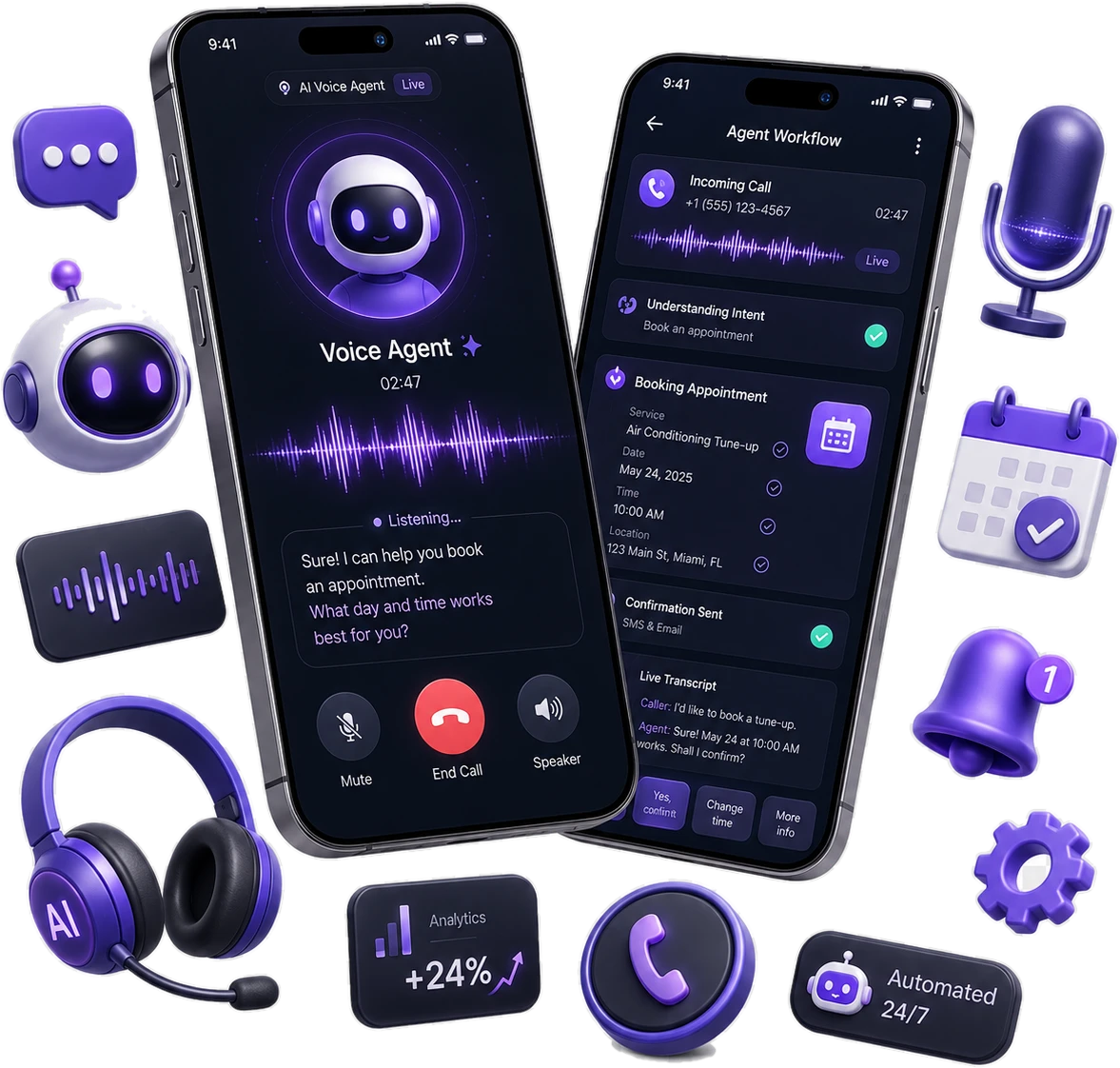
Assistants that hold a real conversation over chat or phone, grounded in your knowledge base and escalating cleanly to a person.
[6]MLOps & Evaluation
Versioning, drift monitoring, retraining and cost dashboards, so quality is a number you watch rather than a feeling.
Technologies
The AI Stack We Build On for Los Angeles Teams
The techniques we reach for when a model has to do more than sound convincing. Pick one to see where it earns its place in a build.
Large Language Models
GPT, Claude, Gemini, Llama and Mistral, chosen per workload rather than per press release. We benchmark cost, latency and accuracy on your own tasks, and will tell you when a smaller model does the same job for a tenth of the spend.
Retrieval & Vector Search
Your contracts, scripts, tickets and wikis made searchable by meaning rather than keyword, then fed to the model as grounded context with citations. Built on pgvector, Pinecone or OpenSearch depending on where your data already lives.
AI Governance & Guardrails
Input and output filtering, PII redaction, refusal handling and an audit log of every prompt and response. Under CCPA and CPRA this is not optional polish, it is how you answer a regulator without guessing.
Fine-Tuning & Distillation
When prompting stops improving, we fine-tune on your labelled examples or distil a large model into a smaller one you can run cheaply. Only after retrieval and prompting have been exhausted, because they usually win on cost.
Evaluation & Observability
A held-out test set, automated scoring and regression checks on every prompt or model change. Quality becomes a number on a dashboard instead of an argument about whether last week felt better.
Vision & Multimodal Models
Models that read images, video and scanned paper as fluently as text. In Los Angeles that most often means media libraries, claims documentation and inspection footage that nobody has time to tag by hand.
Private & Self-Hosted Deployment
Open-weight models running inside your own VPC or on-prem, so regulated data never leaves your tenancy. The right call for healthcare and finance, and increasingly for anyone with a strict DPA.
Weighing Up an AI Project? Get a Free Use-Case Audit.
One call about your data, your workflow and what you are trying to change tells you which use case is worth funding first, what it will realistically cost and where AI is the wrong tool. So your first dollar goes somewhere that pays back.
Six sectors that shape the LA economy, from studio back catalogues to freight moving through the ports. See our healthcare and real estate practices for deeper detail, or enterprise software when the AI has to reach the rest of the business.
[01]Media & Entertainment
Back catalogues that finally become searchable, and the tagging nobody has time to do.
Delivered since 2018 across AI, mobile, cloud and enterprise builds.
80%
Calls handled by AI
Share of inbound calls resolved end to end by the AI voice agent we built for a healthcare client.
60%
Fewer missed calls
Drop in missed patient and enquiry calls after the voice agent went live.
15+
Countries served
Client operations running on Appther-built platforms worldwide.
Case Studies
Work We've Shipped
AI builds we can point at: a 24/7 voice agent handling patient calls, a WhatsApp assistant carrying frontline support, and a routing engine trained on live logistics data.
Why Los Angeles Teams Pick Appther for Custom AI Development?
Plenty of agencies can demo a chatbot. Fewer will run your own data through an evaluation set in week one and tell you plainly what a model can and cannot do for you. As a custom AI development company we cover the whole connected stack in house, alongside our AI development and cloud infrastructure teams.
01
One team, whole stack
Data pipeline, retrieval, model and interface under one roadmap, through to the APIs your other systems consume. No three-vendor standoff when an answer goes wrong somewhere between the data and the interface.
02
Measured, not demoed
Every model ships with a held-out test set and a baseline to beat. If the AI does not outperform the simple approach, we say so rather than shipping it anyway.
03
Built into the work, not beside it
As an AI-first company we put the model where the work is: inside the CRM, the helpdesk and the back office, rather than behind a separate login, so the answer shows up where the work happens, backed by our AI engineering practice.
04
Fixed scope, fixed price
Discovery ends with a written scope and a fixed quote. You own 100% of the code, prompts, fine-tuned weights and documentation, with an NDA signed up front.
Security & Compliance
How Does Appther Secure Your AI Data?
Training and prompting put your data somewhere new, which carries real obligations. Here is how we handle each category, and only what we can honestly claim.
Prompts and training sets contain personal data more often than teams expect. We design around minimisation first, so compliance is a property of the architecture rather than a later retrofit.
GDPRLawful basis mapped per data type, EU residency options, and working export and deletion endpoints built in from the first sprint.
CCPA / CPRACalifornia disclosure, opt-out and deletion workflows wired through the prompt log, the vector store and the training set, not just the CRM.
India DPDP ActConsent capture and notice flows for deployments serving Indian users, with purpose limitation on training data.
Data minimisationWe send the model the fields the task needs and redact the rest before it leaves your systems, which cuts both risk and token cost.
A model is only as safe as the weakest path into it. Identity, transport and prompt handling are treated as one system, not three separate features.
Tenant isolationPer-tenant keys and namespaces so one customer’s documents can never surface in another customer’s retrieval results.
Encrypted transportTLS on every model call, AES-256 at rest for embeddings and prompt logs, and private networking to the inference endpoint.
Prompt-injection defenceUntrusted content treated as data, never as instructions, with tool access allow-listed and output filtered before it reaches a user.
Least-privilege toolsAgents get the narrowest scope that does the job, and anything that spends money or leaves the building needs a human approval.
The controls below describe how we build and review code. They are engineering practices we apply on every project, not certifications we hold.
OWASP Top 10 for LLMsReviewed against every release, covering prompt injection, insecure output handling and excessive agency.
ISO/IEC 27001 alignedAccess control, change management and audit logging modelled on the standard's technical controls.
Secure coding & reviewPeer review on every merge, dependency scanning in CI, and secrets management outside the repository.
Penetration testingThird-party testing arranged before launch on request, with findings tracked to closure.
To be explicit: Appther is not a certification body. Formal ISO, SOC 2 or HIPAA attestation of your finished product sits with your compliance team and its auditor. We build and document so that audit is straightforward.
Regulated sectors change the architecture, not just the paperwork. We scope these constraints during discovery so they never surface late.
HIPAA-ready buildsFor clinical workloads we architect to the technical safeguards: access control, audit logs and BAA-compatible model endpoints.
PCI DSS scope reductionCard data redacted before any prompt leaves your environment, so the model never widens your compliance scope.
Model transparencyDecisions that affect a person come with the retrieved evidence attached, so a reviewer can see why the model said what it said.
Data residencyUS-only or in-tenancy inference where contracts demand it, flagged in discovery rather than discovered at security review.
AI features fail review and user trust for predictable reasons. We build against the rules and expectations that trip up AI products specifically.
Disclosure of AI usePeople are told when they are talking to a model and how to reach a person, which is both good practice and increasingly required.
Human escalation pathsEvery assistant has a clean handover to a person, with the conversation context carried across so nobody repeats themselves.
WCAG 2.2 AAContrast, focus order and screen-reader labelling checked on the AI interface, not just the marketing site.
Failure statesWhen the model is unsure it says so and offers a route forward, instead of inventing an answer with full confidence.
From the model that answers to the pipeline that keeps it honest, grouped by the layer it belongs to.
OpenAI
Anthropic Claude
Google Gemini
Meta Llama
Mistral
DeepSeek
Qwen
Hugging Face
LangChain
LangGraph
CrewAI
PyTorch
TensorFlow
FastAPI
Python
Node.js
pgvector
Milvus
Qdrant
Redis
MongoDB
TimescaleDB
InfluxDB
Grafana
AWS Bedrock
Azure OpenAI
Google Vertex AI
Docker
Kubernetes
Terraform
React
Twilio
Feature Set
Key Features We Deliver in AI Applications
The building blocks that show up in most AI platforms we ship, from the first retrieval query through to production monitoring.
Document Q&A Over Your Own Data
Autonomous Task Agents
Scheduled Model Retraining
Streaming Responses & Live Transcription
Forecasting & Churn Prediction
Model Quality & Cost Dashboards
End-to-End Encryption
Per-Tenant Isolation & Access Control
Multi-Model Routing (GPT, Claude, Gemini, Llama)
ERP, CRM & Helpdesk Integrations
Role-Based Access Control
Alerts & Human Escalation
Prompt & Model Versioning
Computer Vision & OCR
Evaluation & Drift Analytics
Token & Inference Cost Tuning
Architecture
AI Architecture, Layer by Layer
A production AI system is ten layers that have to agree with each other. Get one wrong and the symptom shows up somewhere else, usually as an answer nobody trusts, which is why we design them together rather than in sequence.
Data Sources
The systems the answers have to come from: your CRM, document store, data warehouse, ticket history and whatever still lives in a shared drive.
01
Ingestion & Cleaning
Parsing, de-duplication and chunking. Most disappointing AI projects are a data problem wearing a model problem’s clothes.
02
Embeddings
Text, images and audio turned into vectors so meaning, not keywords, decides what the model is shown.
03
Vector Store
pgvector, Qdrant or Milvus, sized for your corpus and partitioned per tenant so retrieval can never cross a customer boundary.
04
Retrieval
Hybrid search and re-ranking that puts the right passages in front of the model, with citations carried through to the answer.
05
Model Layer
The model itself, hosted or self-run, chosen per task against cost, latency and accuracy rather than reputation.
06
Orchestration
Prompts, tools, memory and multi-step plans. Where an agent decides what to do next and which system it is allowed to touch.
07
Guardrails
Input and output filtering, PII redaction and refusal handling, plus the audit log that lets you answer a CCPA request honestly.
08
APIs & Integration
The answer delivered into Salesforce, the helpdesk or your own product, because a model behind a separate login gets used twice.
09
Evaluation & Monitoring
Held-out test sets, drift detection and cost dashboards, so quality is a number you watch rather than a feeling you have.
10
Data Sources
The systems the answers have to come from: your CRM, document store, data warehouse, ticket history and whatever still lives in a shared drive.
01
Ingestion & Cleaning
Parsing, de-duplication and chunking. Most disappointing AI projects are a data problem wearing a model problem’s clothes.
02
Embeddings
Text, images and audio turned into vectors so meaning, not keywords, decides what the model is shown.
03
Vector Store
pgvector, Qdrant or Milvus, sized for your corpus and partitioned per tenant so retrieval can never cross a customer boundary.
04
Retrieval
Hybrid search and re-ranking that puts the right passages in front of the model, with citations carried through to the answer.
05
Model Layer
The model itself, hosted or self-run, chosen per task against cost, latency and accuracy rather than reputation.
06
Orchestration
Prompts, tools, memory and multi-step plans. Where an agent decides what to do next and which system it is allowed to touch.
07
Guardrails
Input and output filtering, PII redaction and refusal handling, plus the audit log that lets you answer a CCPA request honestly.
08
APIs & Integration
The answer delivered into Salesforce, the helpdesk or your own product, because a model behind a separate login gets used twice.
09
Evaluation & Monitoring
Held-out test sets, drift detection and cost dashboards, so quality is a number you watch rather than a feeling you have.
Which one fits is decided by your data, latency budget and accuracy bar, not by what is trending. See our AI agent development and AI development services for the layers either side of the model.
Our Process
End-to-End AI Development Process
Thirteen stages take an AI idea from first conversation to a system your team runs without us. Model work punishes guesswork, so the risky parts get proven against your own data early and you see a measured result at the end of every stage.
Week 1
Discovery
Use-case analysis, constraints and success criteria before any model or platform is chosen.
1
What we doSit with the people doing the work today, find where the hours actually go, and check whether your data can support the use case at all. Existing tools and contracts get reviewed here, not later.
What you getA written problem statement, the metric that decides success, and a shortlist of use cases ranked by return rather than novelty.
Week 1–2
Business Case
What the AI has to be worth before it is worth building.
2
What we doModel the hours or revenue the deployment is meant to produce, size the token and infrastructure cost at launch and at scale, and agree the number we will be judged on.
What you getA business case with the arithmetic behind it, and a scope you can hold us to.
Week 2–3
Data Readiness
An honest look at whether your data can carry the use case.
3
What we doAudit coverage, labelling quality and access. Build the ground-truth set now, because without one there is no honest way to say later whether the model improved.
What you getA data assessment, a cleaned evaluation set, and a plain answer on anything that needs fixing first.
Week 3–5
Prototype & Evaluation
A working prototype measured against a baseline, not a demo video.
4
What we doBuild the simplest thing that could work, score it against the held-out set, then try the more expensive approach and see whether it actually wins.
What you getA prototype running on your data, a scorecard against the baseline, and a recommendation you can act on.
Week 4–7
Model Selection
Choosing the model against cost, latency and accuracy on your own tasks.
5
What we doBenchmark candidate models head to head, including the small cheap ones. Decide hosted or self-run based on your data constraints rather than preference.
What you getA documented model choice with the benchmark behind it, and the cost per thousand requests you should expect.
Week 5–10
Retrieval & Data Pipeline
The plumbing that decides what the model gets to see.
6
What we doChunking, embedding, hybrid search and re-ranking, with per-tenant partitioning so retrieval cannot cross a customer boundary.
What you getA retrieval layer with measurable recall, and pipelines your own team can rebuild without us.
Week 7–13
Orchestration & Agents
Prompts, tools and multi-step plans wired to real systems.
7
What we doDefine which tools the agent may call, what needs a human approval, and how it behaves when a step fails or the answer is not in the data.
What you getWorking agent flows with an audit trail of every action taken.
Week 8–14
Guardrails & Compliance
The safety layer, designed in rather than bolted on.
8
What we doInput and output filtering, PII redaction, refusal handling and prompt-injection defence, mapped to CCPA and CPRA obligations and your own DPA.
What you getA documented guardrail layer and an audit log that answers a regulator without guesswork.
Week 9–16
Integration
Getting the output into the tool your team already uses.
9
What we doConnect to Salesforce, HubSpot, NetSuite, SAP, Odoo, Snowflake or your own product through secure, versioned APIs.
What you getAI in the daily workflow rather than behind a separate login nobody opens twice.
Week 10–17
Interface & UX
The part your people actually touch.
10
What we doDesign for the moment the model is unsure: show the evidence, offer a route forward, and make escalation to a person one click rather than a dead end.
What you getAn interface people trust enough to keep using in week six.
Week 14–20
Evaluation & Hardening
Proving it holds up before anyone depends on it.
11
What we doRegression testing on every prompt and model change, adversarial testing, load testing, and cost profiling at production volume.
What you getA quality baseline you can regress against, and known behaviour under load.
Week 18–22
Deployment
Production rollout, staged so a bad change never reaches everyone.
12
What we doCanary release behind a feature flag, monitoring on quality, latency and spend from day one, and a documented rollback.
What you getA live system, runbooks, and a team trained to operate it.
Ongoing
Monitoring & Retraining
The years after launch, which is where most of an AI system’s life happens.
13
What we doWatch for drift as your data and language change, retrain on a schedule, and re-benchmark when a materially better model ships.
What you getQuality that holds up over time instead of quietly decaying, with a monthly report you can read.
Client Voices
Trusted By Teams Who Ship
“Appther built our student competition app exactly the way we envisioned it: easy registration, smooth judging, and real-time results that keep participants engaged.”
Dionna MilemOwner · My BOB Team LLC
“Building a mental health app means every detail has to be handled with care, and Appther got that from day one. The product feels warm, simple, and genuinely helpful.”
Bob SinghalProfessor of Joy · Joyscore Inc
“Appther exceeded every expectation, on time and on budget, and the final product has been instrumental in scaling our business. A rare engineering partner.”
Johnathan PefferCEO · Bull's Eye Technologies Inc
“Implementing an ERP across our operations felt daunting at first, but Appther made the transition seamless. Every department now works off a single source of truth.”
Pushpender KumarGeneral Manager · AB Sugar Ltd
Latest Insights
Notes From Real AI Builds
Field notes from real builds. No hype, just what worked and what didn't.
It depends on scope. A focused pilot, one use case with a working model and a real integration, usually starts in the low five figures. Production platforms with several models, MLOps and enterprise integrations run higher. You get a fixed-price quote after a free scoping call, with no open-ended billing.
A proof of concept running against your own data typically takes 4 to 6 weeks. A production system with monitoring, retraining and integrations usually lands in 3 to 6 months, depending on how ready your data is. Data readiness moves that timeline more than model choice does.
Yes. Our US-facing team covers Pacific hours, so stand-ups, demos and escalations happen inside your working day rather than overnight. Delivery runs as a distributed team with a named senior engineer as your point of contact, not a rotating support queue.
GPT, Claude, Gemini, Llama and Mistral, deployed on AWS Bedrock, Azure OpenAI, Google Vertex AI or self-hosted, using LangChain, LlamaIndex and Hugging Face. We pick per use case and tell you plainly when a cheaper or smaller model would do the same job.
California's CCPA and CPRA shape how a model may use personal data, so we design for it from the start: data minimisation, documented retention, deletion paths that actually reach the training set, and the option to keep everything inside your own cloud tenancy. We sign an NDA before discovery and can work under your DPA.
Yes, and that is usually where the value is. We connect models to Salesforce, HubSpot, NetSuite, SAP, Odoo, Snowflake and in-house databases through secure APIs, so the output lands in the tool your team already uses instead of another dashboard nobody opens.
It depends on your data sensitivity, volume and cost profile. Commercial APIs get you to production fastest and suit variable workloads. Self-hosted open models make sense at high, steady volume or where data cannot leave your tenancy. We model both costs during discovery and show you the crossover point.
Yes. You own 100% of the code, prompts, fine-tuned weights and documentation we produce, along with the training pipelines. Nothing is locked to a platform only we can operate, and we hand over runbooks so your team can take it on.
That is what we recommend. A fixed-price pilot proves the use case against your real data and gives you a measured result before anyone signs off on a platform build. If the numbers do not hold up, we will tell you, and you have not spent a production budget finding out.
Media and entertainment, logistics and freight around the ports, healthcare, fintech, real estate, aerospace suppliers and direct-to-consumer commerce. The common thread is not the sector but the shape of the problem: large volumes of messy documents, media or operational data that people currently process by hand.
An Engineer Replies Within One Business Day
Let's Build Your AI Product
Tell us what you want to automate, predict or answer. No sales pitch, just a straight answer on approach, scope, timeline and cost. Prefer email? Use our contact page.
Free 30-min strategy callScoping and honest, practical advice.
Fixed-price quoteDetailed scope and price after discovery, no surprises.
NDA on requestYour idea, designs and code always stay yours.