Case Study · HealthTech & Telecardiology
Telecardiology that brings cardiologist ECG review to anyone, anywhere
How Appther designed and built KALBI, a store-and-forward telecardiology platform that turns an ECG photo into a cardiologist-signed, plain-language report, with a patient iOS app and a clinician reading portal sharing one secure backend.
✓ HIPAA-ready architecture
✓ iOS app + web portal
✓ Cardiologist-signed reports
< 24h
Report turnaround target
25+
Screens designed & built
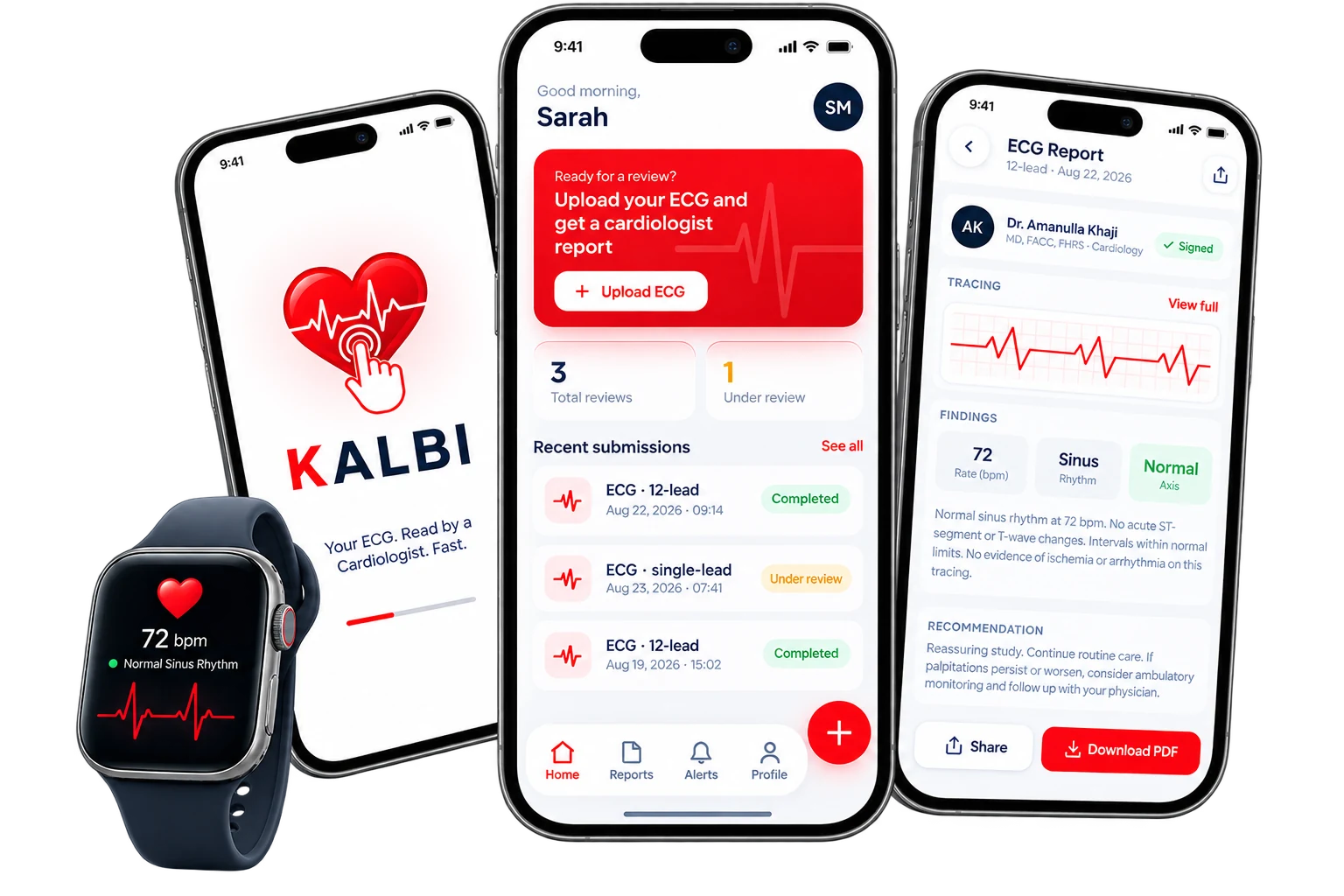
Trusted by healthcare and enterprise teams worldwide







 CLIENT KALBI Health
INDUSTRY Telecardiology
SCOPE iOS app · Web portal · API
STAGE MVP, 2026
TEAM 6 specialists
CLIENT KALBI Health
INDUSTRY Telecardiology
SCOPE iOS app · Web portal · API
STAGE MVP, 2026
TEAM 6 specialists
< 24h
Report turnaround the platform is built to hit
2
Products, one shared backend
100%
Reports written and signed by a cardiologist
HIPAA
Compliance designed in from day one
01 · The Challenge
Specialist ECG review is slow, and access to it is uneven
Someone with palpitations or chest tightness can often get an ECG recorded quickly. Getting a cardiologist to actually read it is the bottleneck, and in many regions there simply are not enough specialists within reach. KALBI Health came to Appther with one goal: let a patient capture an ECG at home and get a trustworthy, signed interpretation back fast, without a clinic visit.

Specialist review is the step KALBI compresses from weeks into hours.
Days
Between the symptom and the specialist read
A referral, an appointment, a trip to a clinic. Every step adds delay to a question that is frightening to sit with, and the tracing itself is often ready long before anyone qualified looks at it.
PHI
Every step has to satisfy HIPAA
Tracings, symptoms, identity and reports are all protected health information. Storage, transport, access control and audit logging had to be settled in the architecture before a single screen was designed.
2
Very different users, one product
An anxious, often older patient on a phone, and a time-pressed cardiologist between clinics on a desktop. Designing one interface for both would have failed both, so each surface was built for its own user.
Trust
A report a patient can actually act on
Clinical language is precise but rarely reassuring. The report had to carry the cardiologist's signature and credentials, and still read clearly enough for a patient to understand what to do next.
THE BRIEF
Build a compliant store-and-forward telecardiology platform: a patient uploads an ECG with their symptoms in under a minute, a board-certified cardiologist reads and signs it on a purpose-built portal, and a plain-language report returns to the patient as a shareable PDF inside 24 hours.
02 · The Solution
One platform, two purpose-built surfaces
A consumer iOS app for patients and a clinical web dashboard for cardiologists, sharing a single secure backend, so a submission flows straight into a doctor's worklist.
Patient iOS App
Consumer-grade, built for calm
Sign in with Apple or Google, capture or import an ECG, add what you are feeling, and get back a plain-language signed report with alerts and a secure history. Designed to stay legible and unhurried for older, non-technical users.
Onboarding & consent
ECG upload
Symptom capture
Signed reports
Push alerts
Clinician Web Portal
A focused reading workstation
A prioritized worklist, a full-resolution zoomable ECG viewer, voice dictation that the doctor edits, and a locked, digitally-signed report. Every view, edit and signature is written to an immutable audit log.
Worklist & SLA
Read & sign
Voice dictation
2FA login
Patient records
The Patient App
A minute to upload, hours to an answer
We designed the patient journey to feel calm and effortless, with four clear steps from first launch to a signed result and no medical jargon in the way.
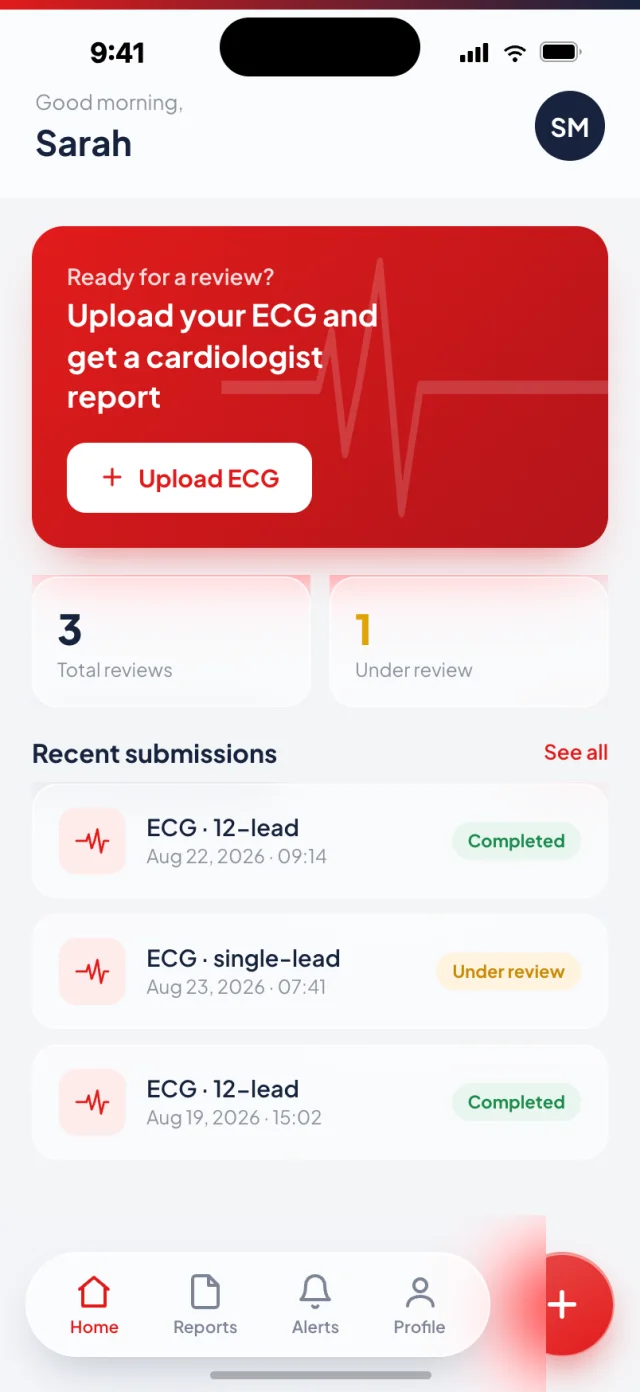
Home
One-tap upload, and the status of every past review at a glance.
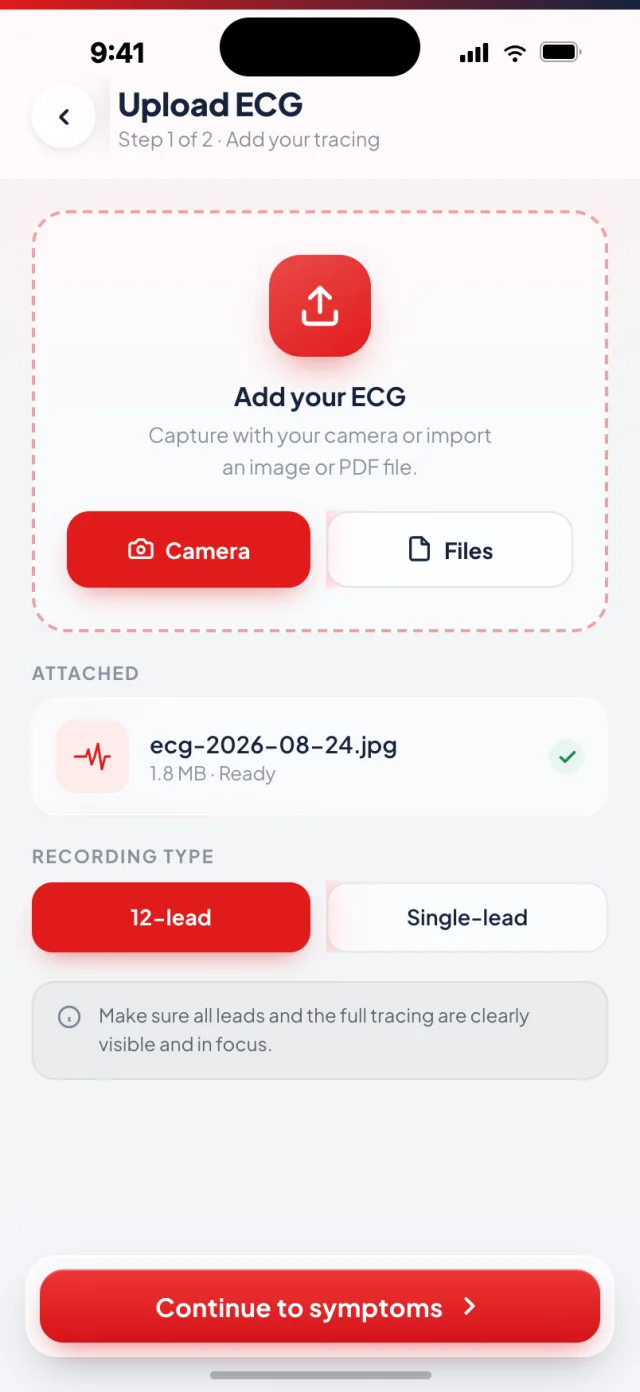
Upload ECG
Photo or file import, with quality guidance so the tracing is readable.
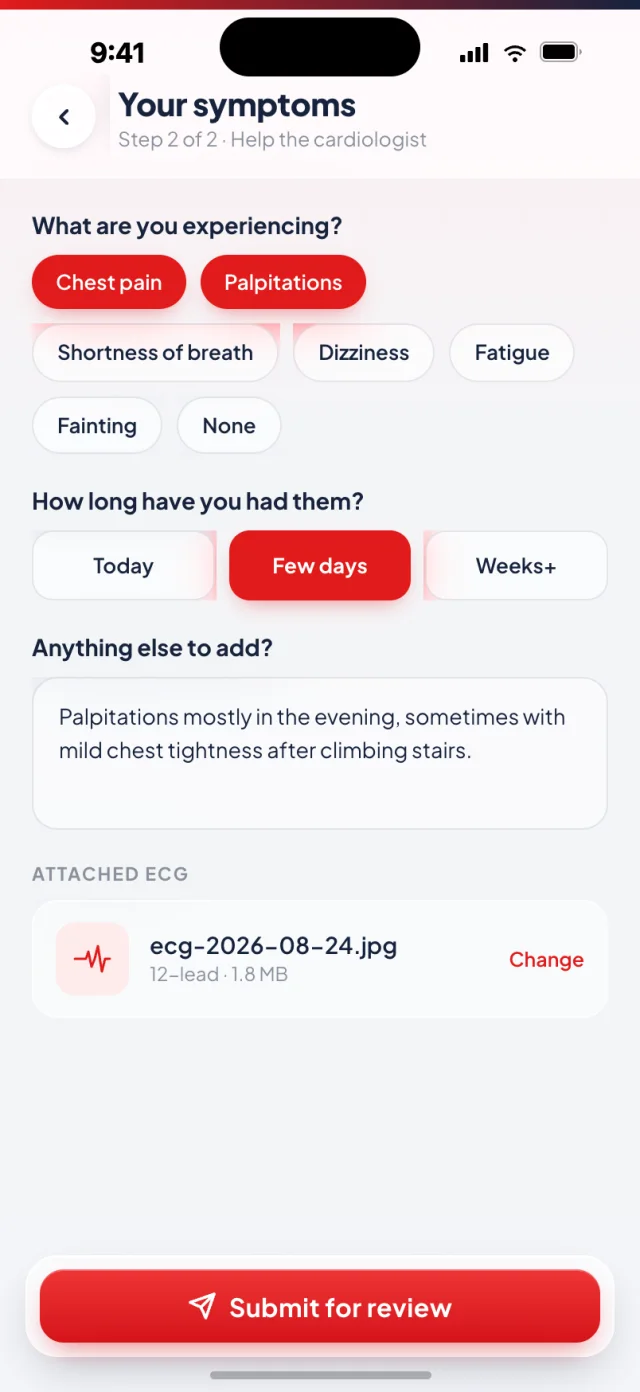
Symptoms
The context that lets a cardiologist read the tracing faster.
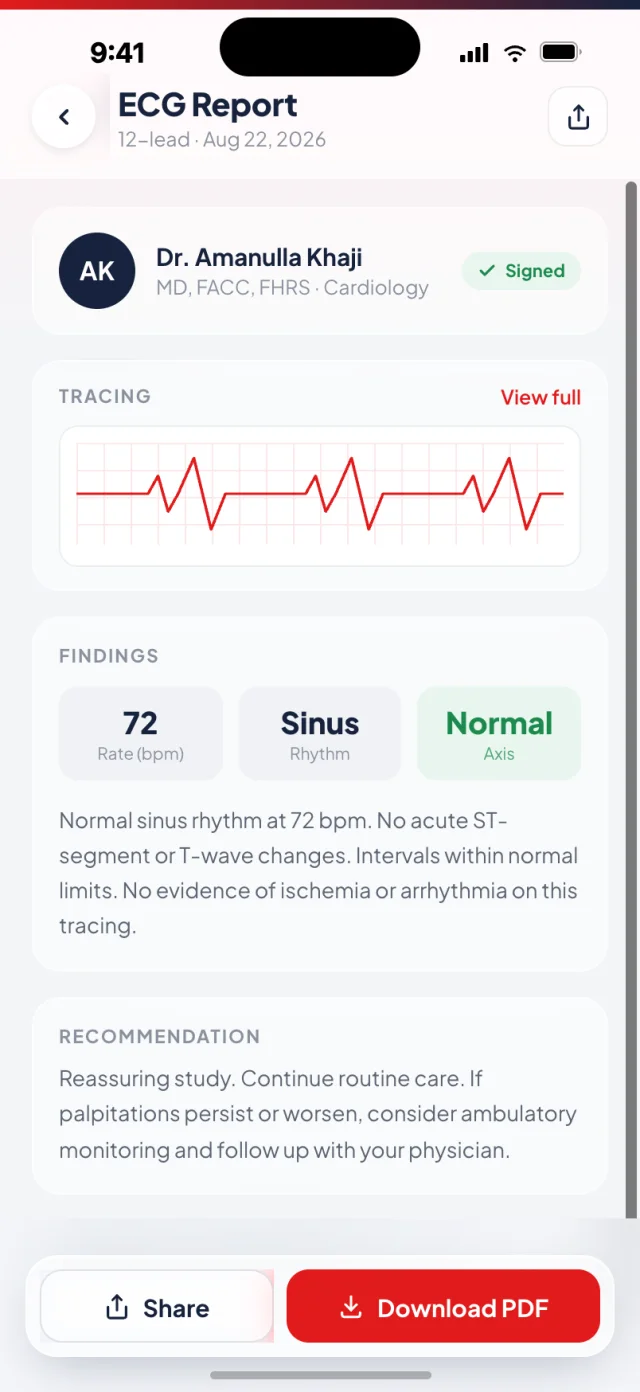
Signed report
Plain-language findings, signed, shareable and downloadable as a PDF.
The Clinician Portal
Built for the way cardiologists actually read
Cardiologists read on large screens, between clinics, on whatever machine is in front of them, so the doctor tool is browser-based with nothing to install. Dictation becomes editable text, and signing locks the report and writes to the audit log.
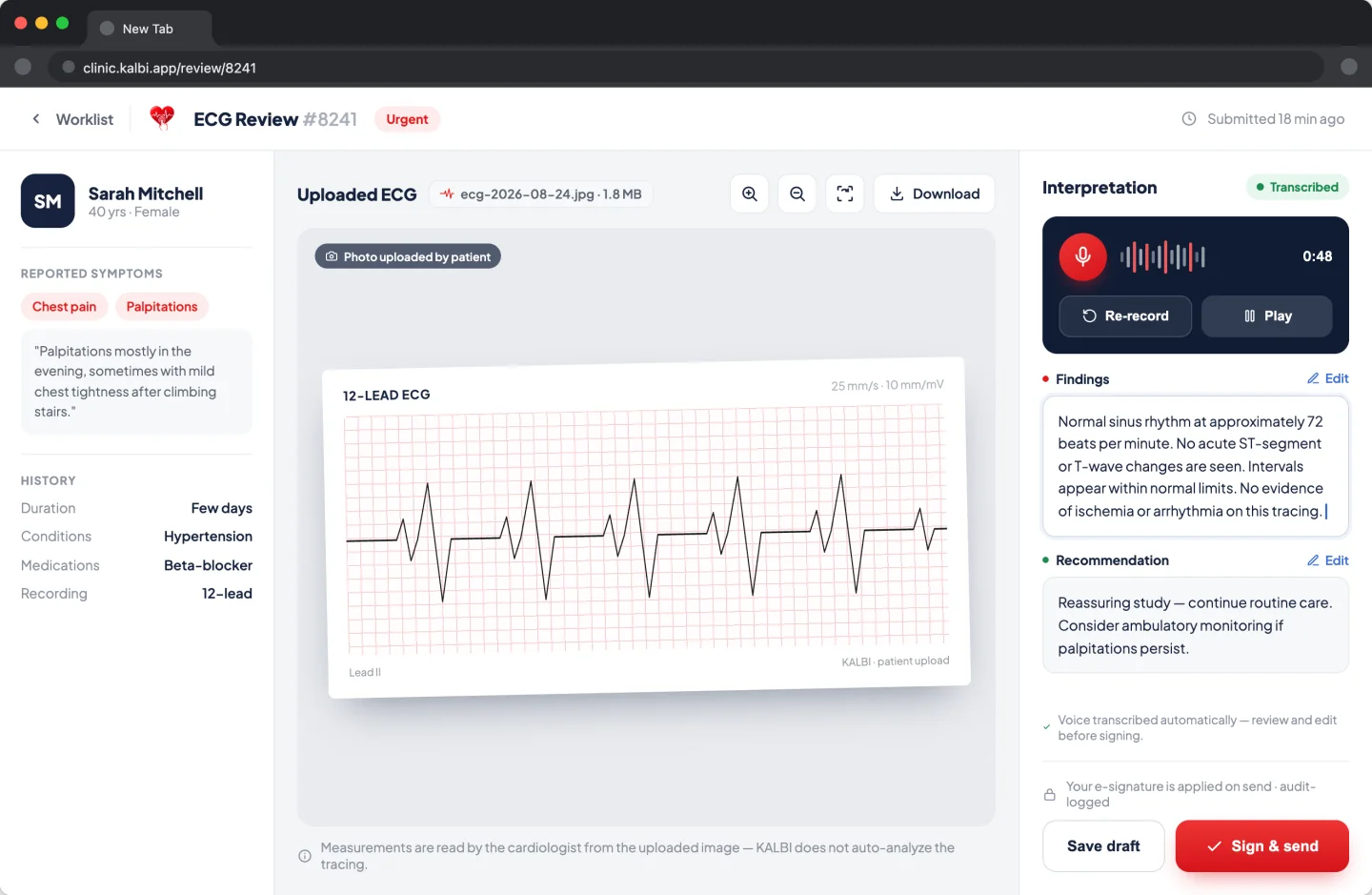
Scroll the image to see the full screen
Read & sign
The uploaded tracing, the patient's reported symptoms and history, and voice-dictated findings the cardiologist edits before signing. Measurements are read by the doctor, never auto-generated.
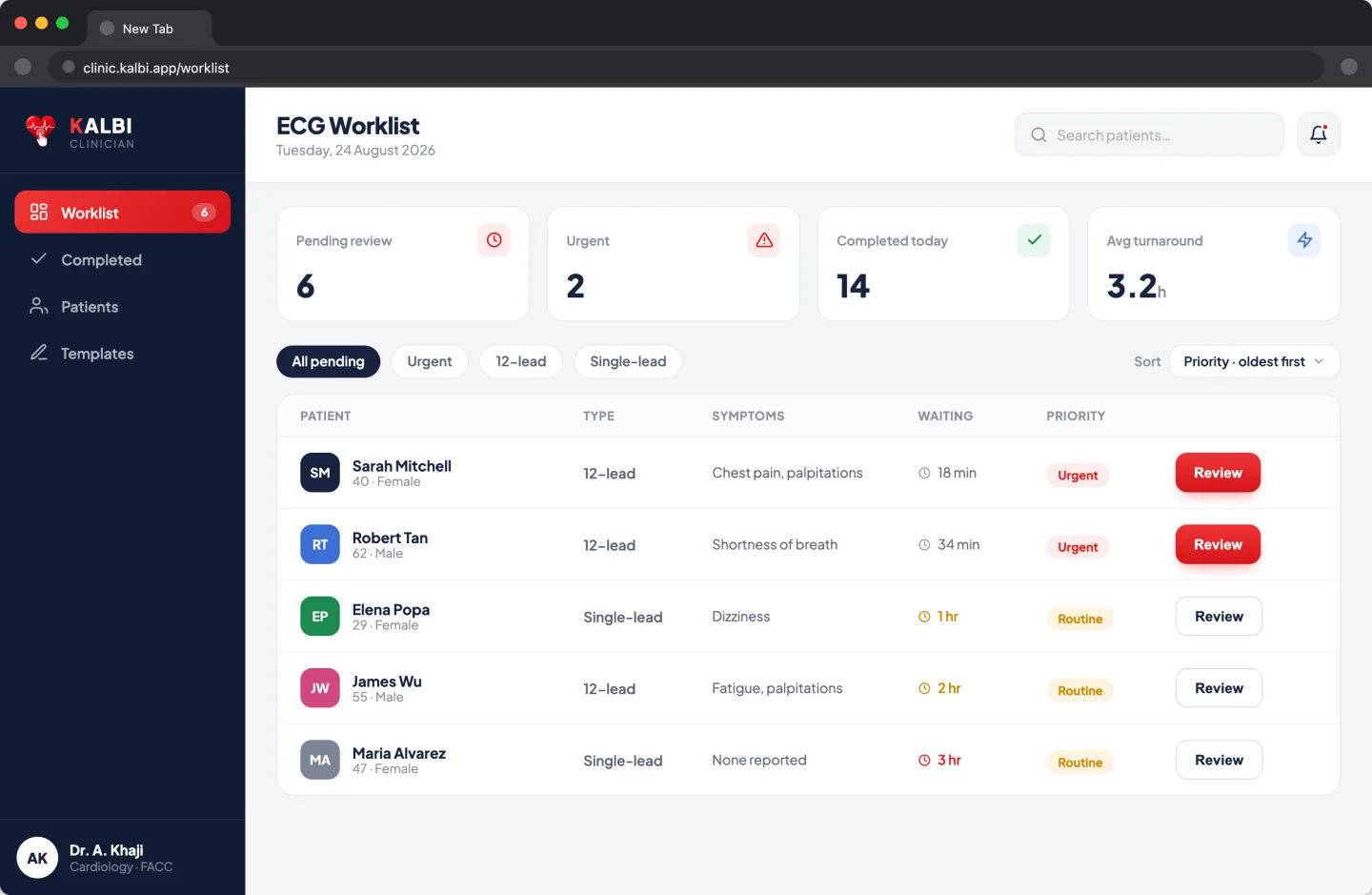
Scroll the image to see the full screen
Prioritized worklist
Urgent cases and ageing submissions surface first, with turnaround tracked against the 24-hour target.
How It Works
From a photo on the kitchen table to a signed report
Five steps take a tracing from a patient's phone to a cardiologist's signature, with every clinical action logged along the way.
01
Onboard & consent
Sign in with Apple or Google, confirm identity and basics, and accept the consent and privacy terms before any health data is collected.
Patient iOS App02
Capture the ECG
Photograph the printout or import an image or PDF. On-screen guidance checks that every lead and the full tracing are in frame and in focus.
Patient iOS App03
Add symptoms
Symptoms, how long they have lasted, and anything the patient wants to add. The submission lands encrypted in the clinician worklist.
Patient iOS App04
Cardiologist reads
The doctor opens the case from a priority-sorted worklist, zooms the full-resolution tracing, and dictates findings that transcribe into editable text.
Clinician Portal05
Sign & deliver
Signing locks the report, applies the e-signature, writes the audit entry, and pushes the plain-language PDF back to the patient's app.
Both surfaces03 · Key Features
What the platform had to get right
Six capabilities that turn a photo of a tracing into clinical evidence a patient and a doctor can both rely on.
12-lead & single-lead
Guided ECG capture
Camera or file import with framing and focus guidance, so the tracing that reaches the cardiologist is actually readable the first time and does not have to be resubmitted.
Structured intake
Symptom & history capture
Selectable symptoms, duration, conditions and medications travel with the tracing, giving the reviewing cardiologist the clinical context to interpret it properly.
Priority sorted
Clinician worklist
Urgent presentations and ageing submissions rise to the top, with waiting time, recording type and reported symptoms visible before the doctor opens a single case.
Doctor-edited always
Voice dictation to report
Cardiologists speak their findings and recommendation; speech-to-text drafts the wording. The doctor reviews and corrects every line before it can be signed.
Locked on signature
Signed, shareable reports
Signing applies the cardiologist's e-signature and credentials and locks the record. The patient gets a plain-language PDF they can keep or hand to their own physician.
AES-256 at rest
Compliance & audit trail
Minimum-necessary PHI, TLS in transit, AES-256 at rest, role-based access, two-factor clinician login, and an immutable log entry for every clinical action.
Our Approach
Compliance-first, patient-simple
Three decisions shaped everything else about how this healthcare product was built.
HIPAA from day one
Minimum-necessary PHI, encryption in transit and at rest, role-based access and full audit logging on every clinical action. Retrofitting compliance is expensive; designing for it costs almost nothing.
Two clients, one API
An API-first backend lets the iOS app and the web portal evolve on their own release cycles while sharing data, auth and audit. Adding a third client later is a client build, not a rewrite.
Voice-driven reads
Typing a report costs a cardiologist minutes per case. Dictation drafts it in seconds, and the clinician still edits and signs, so speed never comes at the expense of clinical accountability.
Tech Stack
What the platform is built on
Chosen for camera quality on iOS, a fast reading experience in the browser, and a backend that can carry PHI safely. The same healthcare app development and AI engineering stack Appther builds across regulated industries.

Swift & SwiftUI
Patient iOS app

React
Clinician reading portal

Node.js
API, worklist & reporting

PostgreSQL
Clinical records & audit log
AWS S3 & KMS
Encrypted tracing storage

Firebase
Push alerts to patients

Sign in with Apple
Patient auth, with Google
Speech-to-text
Dictated findings, doctor-edited

04 · The Outcome
A complete MVP, ready for its first cardiologists
The platform is built and ready for clinical onboarding. Here is what it is engineered to deliver against a conventional referral pathway. For related work, see our AI voice agent for healthcare and DeepRest wellbeing app case studies.
Time to a specialist read< 24h
REFERRAL
KALBI
Target: submission reaches a priority worklist immediately instead of waiting on an appointment
Patient effort per submission~1min
CLINIC VISIT
KALBI
Target: two guided steps, capture the tracing and describe the symptoms, then done
How each report gets writtenVoice-first
TYPED
DICTATED
Target: speech-to-text drafts the findings, the doctor edits and signs, accountability unchanged
Clinical actions audit-logged100%
PAPER
KALBI
Built in: every view, edit and signature writes an immutable audit entry
“
Appther understood both sides of this product, the anxious patient and the busy cardiologist, and built something that respects both. It feels effortless to a patient and fast to a doctor, and the compliance work was there from the first architecture conversation rather than an afterthought.
MD
Consultant Cardiologist & Founder
KALBI Health, preparing for clinical onboarding
FAQ
Questions healthcare founders ask us
Our Blog
Latest insights
Fresh thinking on AI, automation, and building software that ships, straight from the Appther team.
Talk to us about your health product
Tell us what you want to put in patients' hands and which regulations you have to meet. We will come back within 24 hours with an approach and a fixed-price estimate.
4.9★★★★★
Verified client reviews
4.9★★★★★
Top app developers, USA
5.0★★★★★
Accredited agency
100%JOB SUCCESS
Top-rated agency