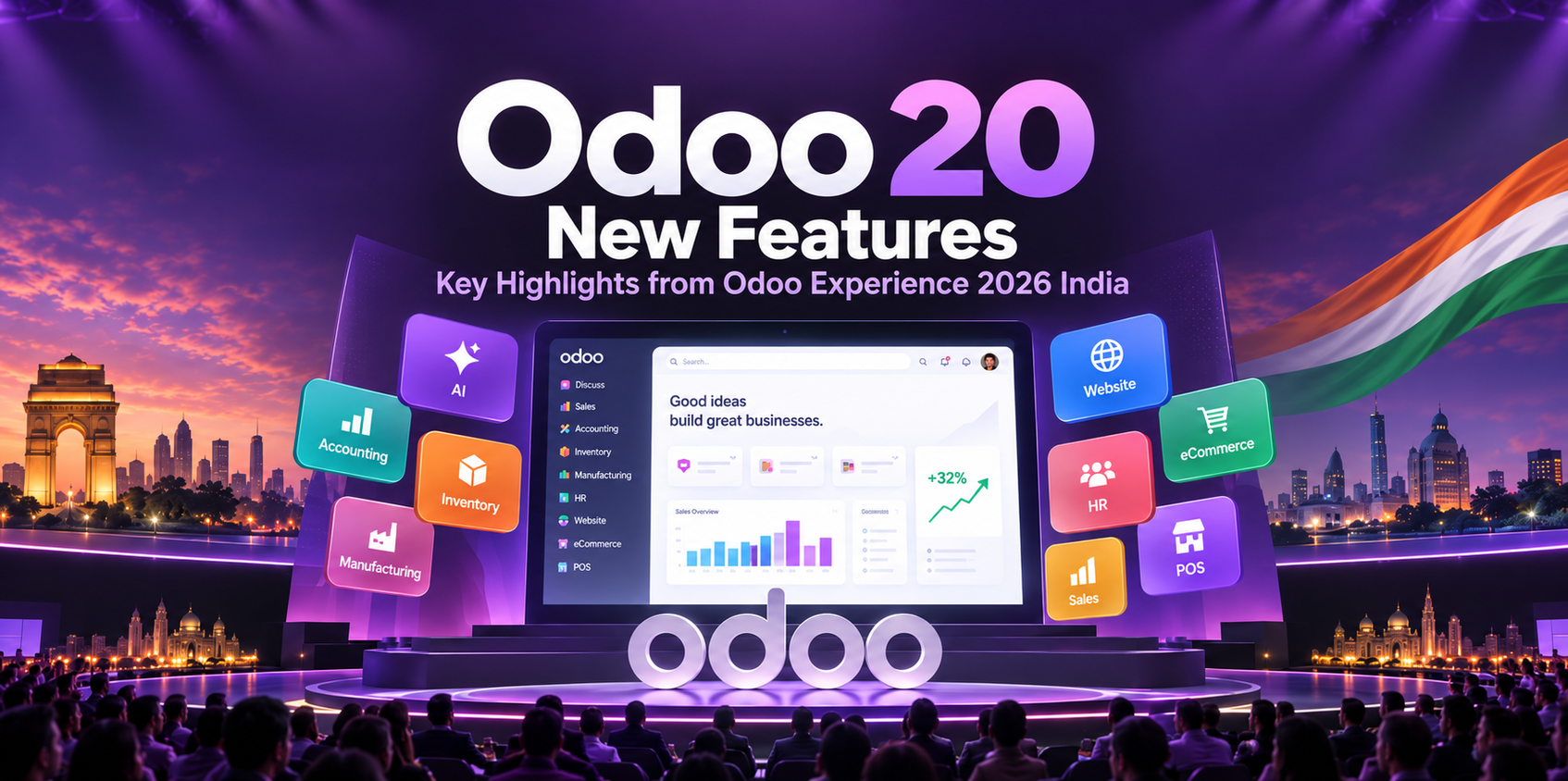
The Appther team recently attended Odoo Experience 2026 India, where Odoo 20 was unveiled alongside major updates across AI, Accounting, Inventory, Manufacturing, Website, eCommerce, HR, POS, and other core business applications.
For us, this was more than just another technology event.
As a company working closely with businesses on digital transformation, software development, and ERP implementation, we wanted to understand one important question:
Where is Odoo heading next?
After attending the event, exploring product demonstrations, and following the discussions around the new release, one thing became very clear:
Odoo 20 is not simply about adding more ERP features. It is about making ERP more intelligent, automated, and conversational.
AI was one of the strongest themes of the event, but the improvements extend far beyond AI. Odoo 20 introduces meaningful enhancements across Accounting, Inventory, Logistics, Manufacturing, Website, eCommerce, HR, Sales, POS, and several other business functions.
The official Odoo Experience India program also featured dedicated Odoo 20 sessions covering AI, Accounting, Logistics, Website, eCommerce, POS, Manufacturing, HR, Sales, and other key areas.
In this article, we’ll share the key highlights from Odoo Experience 2026 India, explore the most important Odoo 20 new features, and explain what these updates could mean for businesses evaluating Odoo or planning their next ERP upgrade.
What Is Odoo 20?
Odoo 20 is the latest major release of Odoo’s integrated ERP and business application platform.
Odoo brings multiple business functions into one ecosystem, including:
- CRM and Sales
- Accounting and Finance
- Inventory and Warehousing
- Purchasing
- Manufacturing
- Website and eCommerce
- Point of Sale
- Human Resources
- Marketing
- Projects and Services
- Documents
- Reporting and analytics
Instead of operating these functions through disconnected applications, Odoo’s value proposition is that information can flow through one connected system.
The official Odoo Experience India event promoted the new version across key areas including Accounting, Website, Inventory, HR, MRP, eCommerce, CRM and Sales.
With Odoo 20, however, another layer is becoming increasingly important:
AI working directly inside business workflows.
Odoo 20 New Features at a Glance
Here are some of the most important areas to watch in Odoo 20:
| Odoo 20 Area | What Businesses Should Watch |
|---|---|
| AI & AI Agents | AI that can move beyond answering questions and perform actions |
| Accounting | More financial automation and AI-assisted predictions |
| Inventory | Ministock, improved allocations, labels and intercompany flows |
| Logistics | Smarter and more connected warehouse operations |
| Manufacturing | Better traceability, maintenance and production visibility |
| Website | New website experience and stronger integrated digital workflows |
| eCommerce | AI-assisted content, catalog, checkout and omnichannel capabilities |
| POS | Enhanced retail and restaurant operations |
| HR | AI-assisted recruitment and connected employee management |
| Studio & BI | Low-code customization, dashboards and spreadsheets |
Let’s look at the areas that stood out most.
1. Odoo 20 AI: From AI Assistant to AI Agents
For me, AI is the most important story in Odoo 20.
Most software platforms have already added some form of AI assistant. You ask a question, and the AI gives you an answer.
Odoo is taking the concept further.
The direction with Odoo 20 is toward AI agents that can actually perform work inside the ERP.
Odoo’s official Odoo 20 AI material describes agents moving beyond simply answering questions to actions such as creating records, updating records and generating images. It also introduces document interaction, voice dictation and access through MCP, Model Context Protocol.
That distinction matters.
Traditional ERP interaction
A salesperson may need to:
Open CRM → Find customer → Check opportunity → Create quotation → Select products → Add pricing → Save → Send
Agent-driven ERP interaction
The future workflow could increasingly resemble:
“Create a quotation for this customer using the products from their latest discussion and prepare it for approval.”
Instead of clicking through several menus, the user communicates an objective.
The AI helps execute the workflow.
That can fundamentally change how employees interact with ERP systems.
What Is New in Odoo 20 AI?
Some of the capabilities Odoo has highlighted include:
- AI agents capable of taking actions
- Creating Odoo records
- Updating existing records
- AI-generated images
- Asking questions about documents
- Uploading and linking documents inside agent conversations
- Using updated versions of source documents
- Voice dictation
- More transparent agent activity
- MCP connectivity
Odoo describes this evolution as AI agents moving from answering questions to doing the work.
That is an important shift.
Why this matters for businesses
Imagine using an AI agent for requests such as:
- Summarize overdue customer invoices.
- Create follow-up activities for high-value leads.
- Analyze a document and attach it to the relevant record.
- Prepare information for a sales quotation.
- Help employees locate operational information.
- Update selected business records based on a defined workflow.
This doesn’t mean every ERP workflow should suddenly be handed over to AI.
Human approval, permissions, validation and governance remain important.
But Odoo 20 shows where ERP interfaces are moving:
from navigation-driven software toward intention-driven software.
2. Odoo 20 Accounting: More Automation, Less Manual Work
Accounting is another area where Odoo 20 is pushing further into automation.
Odoo demonstrated an Odoo 20 financial workflow around:
- Deferred entries
- Loans
- Fixed assets
- AI account predictions
- AI analytic predictions
- Faster reconciliation
Odoo describes the objective as reducing manual financial work and accelerating reconciliation through automation and AI-assisted predictions.
This can be important for finance departments because repetitive accounting processes consume a significant amount of operational time.
Why Odoo 20 Accounting Is More Interesting When It Is Connected
The strength of an ERP accounting system isn’t only what happens inside the Accounting module.
It is what happens around it.
For example:
CRM → Sale → Delivery → Invoice → Payment → Accounting
or:
Purchase → Goods Receipt → Vendor Bill → Payment → Accounting
or:
eCommerce Order → Inventory → Shipping → Payment → Accounting
When all these activities are connected, businesses can reduce duplicate data entry and improve financial visibility.
Potential benefits include:
- Reduced manual reconciliation
- Faster accounting workflows
- Better visibility into receivables and payables
- More consistent financial information
- Improved connection between operations and finance
- Better management reporting
Odoo Experience India also included dedicated sessions addressing Accounting as well as Indian finance requirements such as GST and TDS.
3. Odoo 20 Inventory: Smarter Warehousing and Logistics
Inventory is another major area of improvement.
Odoo has officially highlighted several new Odoo 20 Inventory capabilities, including:
- Ministock management
- New label design
- Integrated CMR documents
- Improved allocation reports
- Enhanced intercompany flows
- Enhanced interbranch flows
These may sound like individual operational enhancements, but together they address a much bigger issue:
inventory visibility.
A growing company needs to know more than simply how many units are theoretically in stock.
It needs to understand:
- Where the product is
- Whether it is allocated
- Whether it can be sold
- Which warehouse holds it
- Whether another branch needs it
- Which order requires it
- When new inventory will arrive
- How inventory should be moved
That is what effective warehouse management is really about.
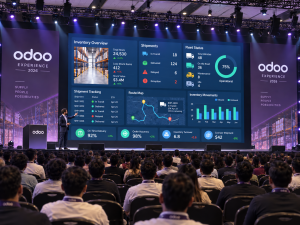
4. Better Intercompany and Interbranch Operations
One Odoo 20 Inventory improvement I believe could be particularly valuable for expanding businesses is the focus on intercompany and interbranch flows.
Consider an organization with:
- Three warehouses
- Multiple branches
- Two legal entities
- Online sales
- Retail stores
Inventory movement becomes complicated very quickly.
A system must understand which company owns an item, where that item physically exists and which operation caused it to move.
Odoo 20’s enhanced intercompany and interbranch capabilities are therefore especially relevant to companies scaling beyond a single-location operation.
5. Odoo 20 Manufacturing: Traceability Becomes Even More Important
Manufacturing businesses require even deeper operational visibility.
With Odoo 20, Odoo is emphasizing improved product traceability across the supply chain, including better visibility into products, lots and serial numbers.
For manufacturers, traceability matters for:
- Quality control
- Product recalls
- Compliance
- Warranty tracking
- Component tracking
- Supplier analysis
- Production investigations
If a finished product develops a quality issue, businesses may need to determine:
Which lot produced it?
Which components were used?
Which supplier delivered those components?
Which other finished products used the same components?
ERP traceability can make these answers significantly easier to obtain.
6. Odoo 20 Maintenance: Moving Toward Predictive Operations
Another interesting development within manufacturing is Odoo’s approach to maintenance.
Odoo 20 material highlights:
- New maintenance UX improvements
- Interactive Gantt planning
- Fleet and Maintenance integration
- AI-assisted troubleshooting suggestions for operators
This is particularly interesting because maintenance has traditionally been highly reactive.
A machine stops.
Production is interrupted.
Someone reports the problem.
A technician investigates.
The business loses productive hours.
The goal of smarter maintenance software is to move businesses increasingly toward:
Prevent → Predict → Maintain
rather than:
Break → Report → Repair
That can be extremely important in high-volume manufacturing environments where equipment downtime directly affects production capacity.
7. Odoo 20 Website: A More Integrated Digital Experience
Odoo Experience India featured a dedicated session called “A New Website Experience in Odoo 20.”
Website improvements inside Odoo are strategically important because an Odoo website isn’t necessarily an isolated marketing site.
It can be connected directly to:
- CRM
- eCommerce
- Events
- Sales
- Email marketing
- Forms
- Customer accounts
- Products
- Payments
For a business, that can create a very different website architecture.
Instead of:
Website → Integration → CRM → Integration → ERP
you can potentially have:
Website ↔ CRM ↔ Sales ↔ Inventory ↔ Accounting
within the same ecosystem.
8. Odoo 20 eCommerce: Built for Growth
eCommerce also received dedicated attention at Odoo Experience 2026 India.
Odoo’s India eCommerce program highlighted areas such as:
- No-code online store creation
- Product catalog management
- Inventory management
- Streamlined checkout
- Delivery workflows
- Click & Collect
- Multi-website management
- Multi-language stores
- SEO and digital marketing
- AI-powered content creation
- Product recommendations
- Upselling
- Promotions
For eCommerce companies, the interesting part isn’t simply having another storefront platform.
It’s what happens after a customer presses Buy Now.
The Real Power of Integrated eCommerce
Imagine a customer places an order.
The ERP can connect that order to:
Customer → Payment → Sales Order → Inventory → Warehouse → Shipping → Invoice → Accounting
This is particularly valuable for:
- D2C brands
- Retailers
- Manufacturers selling online
- B2B distributors
- Multi-location businesses
- Companies operating both physical stores and eCommerce
9. Odoo 20 POS: Retail and Restaurant Operations
Another area highlighted during Odoo Experience India was Odoo 20 Point of Sale.
The agenda included a dedicated session on the future of restaurant management with Odoo 20 POS, alongside retail, restaurant and integrated sales topics.
For retailers and restaurants, POS becomes much more valuable when it doesn’t exist in isolation.
A connected platform can bring together:
POS + Inventory + Purchasing + Accounting + CRM + eCommerce
This is especially useful for omnichannel businesses.
A customer might:
- Discover a product online.
- Check availability.
- Buy in a physical store.
- Join a loyalty program.
- Purchase online later.
- Request a return through another channel.
A connected ERP can give the company a more complete view of that customer journey.
10. Odoo 20 HR: AI Is Entering Recruitment Too
AI isn’t limited to finance or sales.
Odoo Experience India also included sessions around AI-enabled hiring and HR operations, including “Hire Smarter, Onboard Faster: The AI Advantage in HR.”
Odoo’s connected HR environment can cover areas such as:
- Recruitment
- Employee information
- Attendance
- Time Off
- Appraisals
- Expenses
- Skills
- Referrals
- Onboarding
The interesting question going forward will be how AI helps HR teams manage repetitive processes while leaving important human decisions with the people responsible for them.
11. Odoo Studio and Low-Code Customization
Another thing I like about Odoo’s direction is that not every business change needs to become a software development project.
Using Odoo Studio, organizations can adapt parts of the platform through low-code or no-code capabilities.
Odoo Experience India included sessions around customization without code, while its master classes covered Studio, dashboards and spreadsheets.
Businesses may be able to configure:
- Custom fields
- Forms
- Views
- Automated actions
- Reports
- Approval flows
- Dashboards
without writing custom modules for every requirement.
For more sophisticated business logic, integrations or industry-specific functionality, traditional Odoo development still has an important role.
The ideal approach is usually:
Configure when possible. Customize when necessary.
12. Odoo 20 and the Rise of Conversational ERP
One of my most important takeaways from Odoo Experience India is something bigger than an individual feature.
We’re entering a period where ERP software is becoming conversational.
Traditional ERP systems require employees to learn how the software thinks.
They need to know:
Which menu? Which module? Which field? Which report? Which filter?
AI changes that relationship.
Increasingly, software can start understanding how the user thinks.
Instead of locating a specific reporting menu, a manager might ask:
“Which customers have overdue invoices above ₹5 lakh?”
Instead of manually analyzing opportunities:
“Show me our highest-value opportunities that have had no activity this week.”
Instead of searching documents:
“Summarize this supplier agreement and tell me the payment terms.”
Odoo’s work around conversational AI and agent-driven actions suggests that this type of interaction will become increasingly important.
13. What Odoo 20 Means for Indian Businesses
Odoo Experience 2026 India was particularly interesting because the program wasn’t limited to generic global ERP use cases.
Sessions also addressed areas relevant to Indian companies, including:
- GST
- TDS
- Indian accounting
- Aadhaar eSign
- Manufacturing
- Retail
- eCommerce
- Logistics
- HR
That local context matters.
An ERP implementation can only succeed when it fits both the technology requirements and the real operating environment of the business.
For Indian organizations, that can include:
- Taxation
- Compliance
- Accounting
- Local payment workflows
- Warehousing
- Multi-branch operations
- Manufacturing
- Payroll
- Digital signatures
- Local integrations
14. Odoo 20 for UAE and Saudi Arabia Businesses
Odoo 20 can also be highly relevant for businesses in growing Middle Eastern markets such as the UAE and Saudi Arabia, particularly organizations investing in digital transformation.
Companies operating across multiple locations may benefit from an integrated platform for:
- Finance
- CRM
- Procurement
- Inventory
- Manufacturing
- eCommerce
- HR
- Multi-company operations
Odoo is also actively promoting Odoo 20 internationally as an AI-driven release with stronger CRM, Sales, Inventory and Manufacturing capabilities.
For companies operating across India, UAE and Saudi Arabia, a particularly important consideration is designing the ERP architecture around each country’s accounting, taxation, operational and localization requirements.
15. Odoo 19 vs Odoo 20: Should You Upgrade?
One question existing Odoo users will naturally ask is:
Should we upgrade to Odoo 20?
My answer is:
Evaluate first. Upgrade second.
Having the latest version isn’t automatically a business case.
Before an Odoo 20 migration, I would assess:
- Your current Odoo version
- Custom modules
- Third-party applications
- API integrations
- Accounting setup
- Database size
- Custom reports
- Website customizations
- Business-critical workflows
- Localization requirements
- Downtime tolerance
- Testing requirements
The more heavily customized an Odoo environment is, the more important proper migration analysis becomes.
When an Odoo 20 Upgrade May Make Sense
An upgrade becomes more compelling when:
- New Odoo 20 capabilities solve existing operational problems.
- Your current version is approaching technical or functional limitations.
- You want access to newer AI capabilities.
- New Accounting or Inventory capabilities can eliminate manual work.
- Existing customization can be replaced with standard Odoo functionality.
- Your organization is already planning wider process improvements.
The goal shouldn’t be:
“We’re upgrading because version 20 exists.”
It should be:
“We’re upgrading because Odoo 20 can create measurable business value.”
16. My Biggest Takeaways from Odoo Experience 2026 India
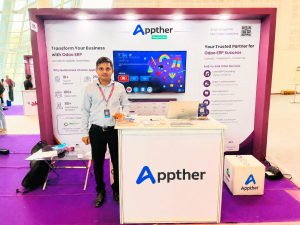
After attending the event, these were my biggest takeaways.
AI is becoming part of ERP, not an add-on
The move toward actionable AI agents could fundamentally change how users interact with business software.
Automation is becoming increasingly important
ERP is no longer just about recording business transactions. Businesses expect their software to eliminate repetitive processes.
Integration remains one of Odoo’s biggest strengths
CRM, Sales, Accounting, Inventory, Manufacturing, Website and HR become significantly more useful when they share information.
User experience matters
ERP systems have traditionally been considered complex. Conversational interfaces, AI and better UX can lower the barrier for everyday users.
Odoo is moving beyond traditional ERP
Odoo 20 increasingly looks like a connected business operating platform rather than simply an ERP database.
17. Which Businesses Should Evaluate Odoo 20?
I would particularly recommend evaluating Odoo 20 if your company is currently dealing with:
- Disconnected software
- Heavy spreadsheet dependency
- Duplicate data entry
- Manual approvals
- Poor inventory visibility
- Separate CRM and accounting systems
- Multiple warehouses
- Multi-company operations
- Manufacturing complexity
- Disconnected online and offline sales
- Limited business reporting
- Repetitive administrative work
- Legacy ERP software
The more fragmented your technology environment becomes, the more valuable an integrated ERP can potentially be.
18. Odoo 20 Implementation: Technology Is Only Half the Project
One important lesson from ERP projects is that installing software is the easy part.
The difficult part is understanding the business.
Before implementing Odoo 20, companies should map:
Current Process → Problems → Desired Process → Odoo Configuration → Customization → Integration → Data Migration → Testing → Training → Go-Live
A technically perfect ERP implementation can still fail if employees don’t understand the process or the software doesn’t reflect how the business actually operates.
That’s why we believe ERP implementation should always begin with business analysis.
How Appther Can Help You Implement Odoo 20
At Appther, our goal isn’t simply to install Odoo.
We work with businesses to understand their processes and determine how Odoo can be configured, customized and integrated to support their operations.
Our Odoo services can include:
- Odoo implementation
- Odoo consulting
- Odoo customization
- Odoo development
- Odoo migration
- Odoo integrations
- Odoo CRM
- Odoo Accounting
- Odoo Inventory
- Odoo Manufacturing
- Odoo eCommerce
- Odoo Website
- Odoo HR
- Custom dashboards
- Reporting
- Workflow automation
- AI integrations
Whether you’re considering a new Odoo implementation or evaluating an upgrade from an earlier version, the first step should be understanding where Odoo can create measurable operational value.
Final Thoughts: Odoo 20 Signals the Future of ERP
My biggest takeaway after attending Odoo Experience 2026 India is that Odoo 20 represents more than another annual software update.
It gives us a glimpse into where ERP software is heading.
For decades, ERP systems primarily helped companies record what had already happened.
A customer ordered something.
A warehouse shipped something.
A supplier sent an invoice.
An accountant recorded a transaction.
The next generation of ERP is becoming different.
It can increasingly help businesses understand:
What is happening?
Why is it happening?
What should happen next?
And eventually:
Can the system safely take action?
That is what makes Odoo 20 particularly interesting.
With the evolution of AI agents, stronger automation and continued improvements across Finance, Inventory, Manufacturing, Website, eCommerce and other applications, Odoo is pushing ERP toward a more intelligent and connected future.
Having had the opportunity to see this direction first-hand at Odoo Experience 2026 India, I believe Odoo 20 is a release businesses should pay close attention to.
Frequently Asked Questions About Odoo 20
What is Odoo 20?
Odoo 20 is the latest major release of Odoo’s integrated business management platform, covering applications such as CRM, Sales, Accounting, Inventory, Manufacturing, Website, eCommerce, HR and POS.
What are the biggest new features in Odoo 20?
Some of the most notable areas include AI agents, accounting automation, new Inventory capabilities, improved intercompany operations, manufacturing traceability, maintenance improvements, Website and eCommerce changes and continued enhancements across other Odoo applications.
Does Odoo 20 include AI agents?
Yes. Odoo has highlighted AI agents capable of taking actions such as creating and updating records, interacting with documents and connecting with Odoo data through MCP.
What is new in Odoo 20 Inventory?
Odoo has highlighted ministock management, new label designs, integrated CMR documents, improved allocation reports and enhanced intercompany and interbranch flows.
What is new in Odoo 20 Accounting?
Odoo 20 includes additional accounting automation around deferred entries, loans and fixed assets, alongside AI-assisted account and analytic predictions designed to speed up reconciliation.
Should I upgrade from Odoo 19 to Odoo 20?
That depends on your custom modules, integrations, business requirements and the value the new functionality can provide. A technical and functional upgrade assessment should be performed before migrating.
Can Odoo 20 be customized?
Yes. Odoo can be configured through standard functionality and Odoo Studio, while more complex requirements can be handled through custom modules, APIs and integrations.
Is Odoo 20 suitable for manufacturing companies?
Yes. Odoo 20 continues to expand manufacturing-related capabilities, including production traceability and maintenance workflows.
Can Appther help with Odoo 20 implementation?
Yes. Appther can support businesses with Odoo consulting, implementation, customization, migration, integration, automation and ongoing development.
Ready to Explore Odoo 20 for Your Business?
Don’t upgrade your ERP just because a new version has arrived. Upgrade when the new version can improve your business.
If you’re evaluating Odoo 20 implementation, migration, customization or AI automation, our team can help you assess the right approach.