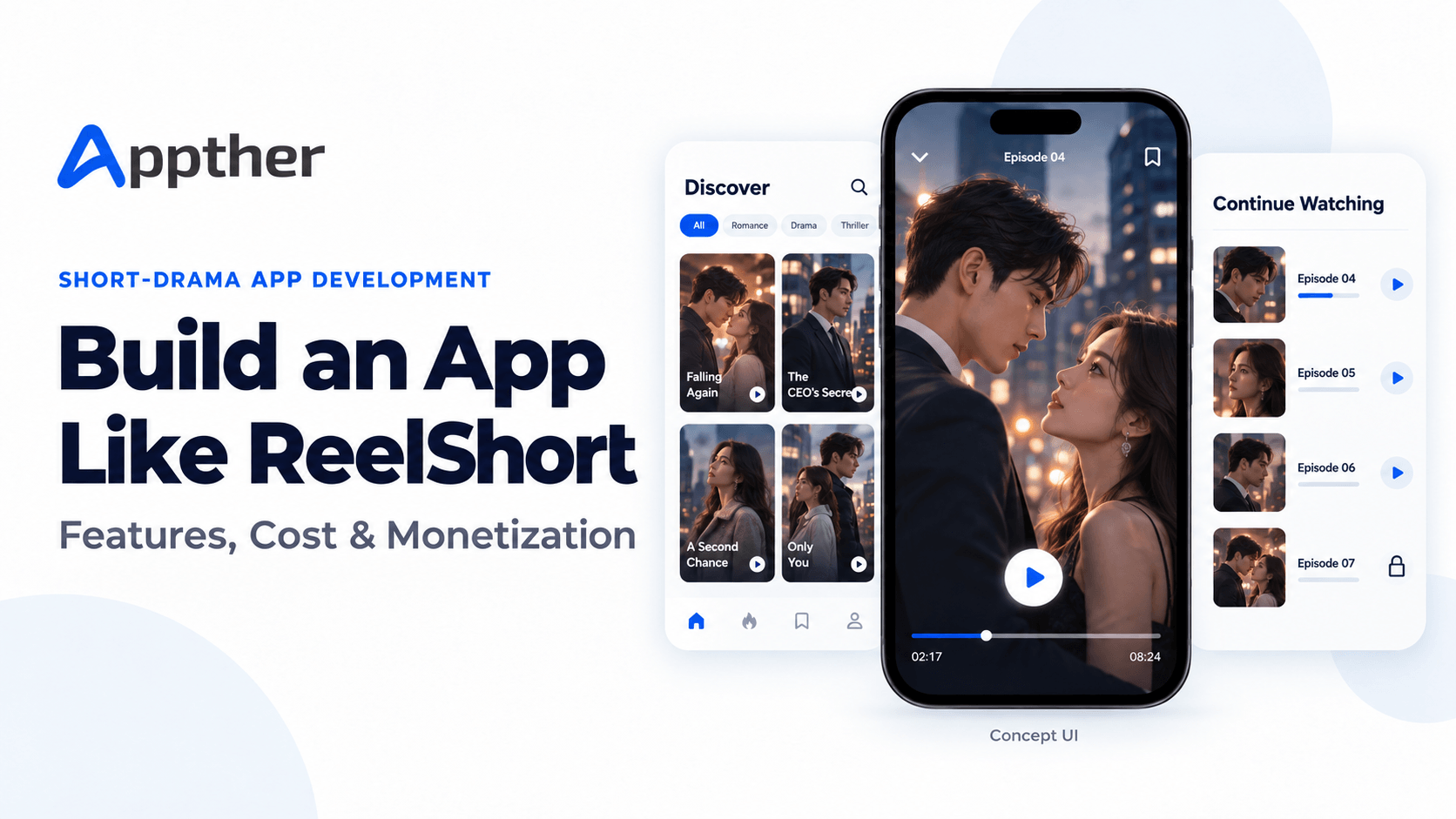
A viewer discovers a dramatic scene in a social media ad. They want to know what happens next, install the app and start watching. A few short episodes later, they reach an unlock screen.
That moment tells you a lot about the business behind a short-drama app. The story has to earn the viewer’s attention. The player has to keep it. The payment experience has to make the next step clear.
If any part fails, a good trailer can turn into an expensive install that never becomes a returning customer.
For US founders and production companies, building an app like ReelShort means bringing content, mobile software and monetization together. A vertical video player is only one part of the work. You also need an episode catalog, publishing tools, reliable access controls, payment handling and a way to understand which stories bring viewers back.
This guide explains how to plan a short-drama app, choose an MVP scope, estimate development and operating costs, and prepare for a US launch.
Quick answer: What does it take to build an app like ReelShort?
You need a viewer-facing mobile app, a content management panel, a backend that controls accounts and episode access, and a video delivery pipeline. Add a clear monetization model, analytics, customer support tools and content that you have the appropriate rights to distribute.
For a focused MVP, an illustrative development budget is $42,000–$100,000, based on 1,400–2,000 delivery hours at assumed blended rates of $30–$50 per hour. An experienced team working in parallel might plan approximately 14–20 weeks, depending on scope and decisions.
These are planning assumptions explained later in this article. They are not ReelShort’s actual development costs, a US agency pricing benchmark or an Appther quotation. Content production, licensing, marketing and ongoing video delivery require separate budgets.
What is ReelShort, and what can founders learn from it?
ReelShort is a short-form drama platform built around episodic stories designed for mobile viewing. Its own overview of the service discusses vertical dramas and options such as coins and subscription plans. Specific offers can vary by product, platform and market.
The broader product lesson is straightforward: the viewer arrives for a particular story and needs an easy route to the next episode.
That differs from building a general-purpose social video feed. A drama platform must preserve episode order, remember viewing progress, manage series-level discovery and explain access rules. A viewer who unlocks an episode expects it to remain available under the stated terms, including after changing devices or reopening the app.
ReelShort, DramaBox and DramaWave can provide useful competitive references. Review their discovery screens, episode navigation and access explanations, but develop your own brand, interface and content proposition. This article describes a proposed product architecture, not ReelShort’s proprietary systems.
Start with the audience and content proposition
Before listing features, decide what your platform will give viewers that they cannot easily find elsewhere.
A studio with an existing catalog faces different decisions from a startup that still needs to commission its first series. A platform focused on one genre also has a different discovery problem from a service with hundreds of titles.
Answer four questions before development begins:
- Who is the first audience? Define a specific viewer group, language and genre preference rather than targeting everyone who watches video.
- Where will the content come from? Identify whether you will commission original productions, license a catalog or partner with creators.
- How often can you publish? The release calendar should reflect actual production capacity.
- Why will viewers return? Consider continuing stories, recognizable creators, a reliable release schedule or a distinctive editorial focus.
Interview viewers and test real trailers where you have permission to use them. A polished app prototype cannot validate demand for stories people have not seen.
Appther’s mobile app development services can help turn the validated viewing journey into a defined mobile product scope.
Essential features for a short-drama app MVP
The first version should let a viewer discover a series, watch smoothly, understand the access rules and resume later. It should also let your team publish content without depending on a developer for every update.
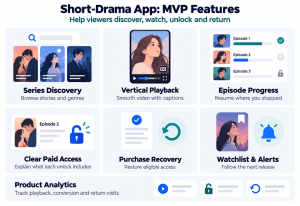
1. Home screen and series discovery
Start with a manageable set of editorial collections, genre filters and series pages. Include a synopsis, cover artwork, episode count and relevant content information.
Do not assume advanced machine learning is necessary on day one. A small catalog can begin with curated recommendations, recently added titles and continue-watching rows.
2. Vertical video playback
The player should support the intended portrait format, captions, pause and resume, and reliable switching between episodes. Controls must be understandable without covering important parts of the scene.
Test interruptions, weak connections, headphones disconnecting and the app returning from the background. Those situations happen during everyday viewing and should be part of the release criteria.
3. Episode lists and watch progress
Clearly show completed, available and locked episodes. Save progress frequently enough to make resume useful, while avoiding unnecessary requests on every playback tick.
Design account-based synchronization carefully. A viewer moving from one phone to another should see consistent progress and access.
4. Free previews and paid access
Define where previews end and what the viewer receives after paying. Explain whether an unlock applies to one episode, a series or a period of access.
Avoid ambiguous wording such as “full access” when some content remains excluded. Confusing access rules create support tickets and refunds even when the payment integration works correctly.
5. Account and purchase recovery
Include sign-in, account recovery, purchase restoration where applicable and clear support routes. Test successful purchases when the app closes before the confirmation screen appears.
The backend should reconcile purchase events and access rights. A screen that says “payment successful” is not enough if the episode remains locked.
6. Watchlist and release notifications
Let viewers save a series and choose whether to receive release reminders. Start with notifications connected to a demonstrated interest, such as a new episode in a followed series.
Measure whether reminders lead to useful viewing sessions rather than judging success by message volume.
7. Product analytics
Track the path from discovery to viewing, then from viewing to payment or return visits. Define events before implementation so the team can answer questions consistently.
For example, distinguish a playback request from a successful video start. Otherwise, technical failures may look like viewers abandoning content.
The admin panel is part of the product
A short-drama platform needs more than a video upload button.
Your content team should be able to create series, arrange episodes, manage artwork and captions, schedule publication and preview changes before they become visible.
| Admin capability | Why it matters |
|---|---|
| Series and episode management | Keeps ordering, metadata and artwork consistent |
| Upload and processing status | Shows whether a file is ready, processing or failed |
| Captions and language tracks | Supports accessible viewing and localization |
| Availability windows | Helps manage release dates and licensed territories |
| Access rules | Defines previews, episode unlocks and eligible plans |
| Role-based permissions | Separates publishing, support and finance responsibilities |
| Audit history | Records who changed content or commercial settings |
| Support lookup | Helps investigate access and payment problems |
Appther’s web development services are relevant to building these browser-based operational tools alongside the mobile app.
Use a draft, review and publish workflow. A misplaced episode or incorrect paywall setting can affect every viewer, so routine publishing needs an understandable approval path and a way to correct mistakes.
How a short-drama streaming architecture works
A useful design separates content preparation from viewer playback.
Content preparation: an authorized editor uploads a source video, the system processes it into streaming formats, checks the output and makes it available for publication.
Viewer playback: the app requests an episode, the backend checks availability and access, and the player receives authorized streaming information.
AWS’s video-on-demand reference architecture illustrates a common delivery pattern: media files are transcoded into adaptive streaming outputs and distributed through a content delivery network. The application still needs its own catalog, payments and access logic around that pipeline.
A proposed MVP could use the following components:
| Layer | Proposed approach | Responsibility |
|---|---|---|
| Mobile app | React Native or native iOS and Android | Discovery, playback, purchases and watch history |
| Backend API | Node.js or Python | Accounts, catalog, entitlements and admin operations |
| Application database | PostgreSQL | Series, episodes, users and transaction references |
| Source storage | Private object storage | Original videos and supporting assets |
| Media processing | Managed transcoding service | Streaming renditions and packaging |
| Delivery | CDN with controlled access | Distribute video segments efficiently |
| Background jobs | Queue and workers | Upload processing, retries and notifications |
| Observability | Playback, error and cost monitoring | Detect quality problems and operating risks |
This is a reference design rather than a mandatory stack. Appther’s React Native development services can support a shared mobile codebase, but validate the player, billing and any protection requirements on real devices before committing.
Keep video bytes off the main application server where possible. Let the CDN serve media while the backend handles business decisions. Limit preloading to an intentional amount; downloading multiple episodes that a viewer never watches increases delivery costs.
If licensed content requires digital rights management, select the player, packaging and license-service approach early. Temporary playback links control access but should not be treated as a substitute for DRM where it is contractually required.
How should an app like ReelShort make money?
Choose a primary monetization model before development. Each model changes the viewer experience, backend logic and support requirements.
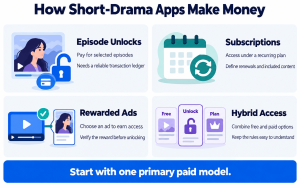
Episode unlocks through coins or credits
A viewer purchases a balance and spends it to unlock eligible episodes. This can offer flexible access, but it requires reliable accounting.
Maintain a server-side transaction ledger. Each purchase, promotional credit and episode debit should be traceable. Handle duplicate payment notifications and repeated unlock requests without charging twice.
Make the price visible before an unlock and distinguish promotional credits from purchased balances if their terms differ.
Subscriptions
Subscriptions provide access under a defined plan. Specify included content, renewal periods and what happens when access expires.
The implementation must handle renewals, cancellations, refunds and delayed billing updates. Viewers should not lose access because one notification arrived late or out of sequence.
Rewarded advertising
A viewer can choose to watch an advertisement in exchange for a clearly described benefit, such as an episode unlock. The experience needs a fallback when no ad is available or playback fails.
Confirm rewards through the ad provider’s supported verification mechanisms rather than trusting an editable client-side flag.
A hybrid model
A hybrid can offer free episodes, paid unlocks and subscriptions. It can also become difficult to explain.
For an MVP, start with one main paid model and add another only when it addresses a demonstrated viewer need. A smaller access-rule system is easier to test and support.
For a US launch, check current Apple App Review Guidelines and Google Play payments policies while designing billing. Rules and available payment routes can differ by storefront, distribution and applicable program. Do not apply a single checkout assumption to every market.
Content production and licensing need their own plan
Software makes the catalog accessible. It does not create the catalog.
Decide whether your launch relies on commissioned series, licensed productions or creator partnerships. For each title, have qualified advisers confirm the rights and commercial terms relevant to the planned distribution.
The operational requirements to capture may include territories, languages, start and end dates, promotional clip permissions, exclusivity, music and contributor clearances, and any protection requirements. These decisions should inform the admin panel and playback rules.
Plan what happens when a title’s availability ends. The product may need to stop new purchases, change discovery listings and apply the agreed treatment to existing viewers. That should be addressed before the first license expires.
Budget separately for production or licensing, editing, captions, localization, artwork and promotional materials. A software estimate that excludes these items should say so clearly.
How much does it cost to build an app like ReelShort?
The clearest estimate starts with a defined release, not a promise to copy every feature of an established platform.
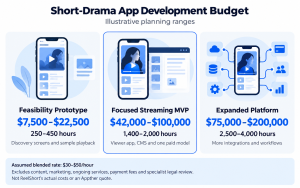
The following figures are illustrative development models. They use assumed blended delivery rates of $30–$50 per hour, with estimated team hours covering discovery, design, engineering, project coordination and QA. They are not published Appther prices or measured US market averages.
| Product scope | Illustrative effort | Budget range | Scope assumption |
|---|---|---|---|
| Feasibility prototype | 250–450 hours | $7,500–$22,500 | Limited discovery screens, sample playback and technical validation; not a production service |
| Focused streaming MVP | 1,400–2,000 hours | $42,000–$100,000 | Cross-platform viewer app, basic CMS, managed video pipeline, one primary paid model, analytics and support tools |
| Expanded platform | 2,500–4,000 hours | $75,000–$200,000 | Broader monetization, more languages, deeper reporting and additional operational workflows |
The lower bound multiplies the lower effort estimate by $30; the upper bound multiplies the higher effort by $50. Actual proposals depend on the approved requirements and delivery team.
These estimates exclude content production and licensing, advertising, ongoing cloud charges, payment fees and specialist legal review. Offline downloads, connected-TV apps, a public creator marketplace, complex rights management or extensive DRM integrations require additional scoping.
A useful discovery exercise is to document the viewer’s first ten minutes and the editor’s first upload. Those two workflows reveal more about the real MVP than a long list of competitor features.
For systems that connect the app, operations and commercial rules, explore Appther’s custom software development services.
What will the platform cost to run each month?
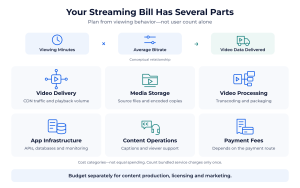
Video delivery depends heavily on how much people watch and the effective bitrate delivered. A user count alone is not enough to size the bill.
Consider this illustrative scenario:
| Input | Assumption |
|---|---|
| Daily active viewers | 5,000 |
| Average viewing time per viewer per day | 20 minutes |
| Planning month | 30 days |
| Monthly viewing time | 3,000,000 minutes |
| Average delivered bitrate | 1.5 megabits per second |
| Approximate video data delivered | 33,750 GB, or 33.75 decimal TB |
The calculation is viewing minutes × 60 × bitrate ÷ 8 ÷ 1,000. It estimates media payload and excludes protocol overhead, unused prefetching and other traffic.
If an assumed delivery rate were $0.03–$0.09 per GB, that payload would imply roughly $1,013–$3,038 per month for delivery alone. This is a sensitivity example, not a current AWS or other vendor quotation. Replace the rate with your selected provider’s regional pricing, included usage and negotiated terms.
Other operating costs include source and encoded-file storage, transcoding, API and database capacity, monitoring, captioning, support and payment-related fees. Some managed video platforms charge by stored or delivered minutes instead of GB, so avoid counting the same delivery cost twice.
Track cost by viewing hour and acquisition cohort. Growth can increase revenue and expenses at different rates, particularly when free viewers watch heavily without converting.
How long does development take?
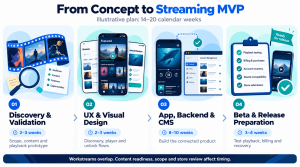
A focused MVP could be planned over approximately 14–20 calendar weeks, assuming an experienced team works in parallel and the first licensed or owned content is ready for testing.
| Workstream | Illustrative duration | Main output |
|---|---|---|
| Discovery and technical validation | 2–3 weeks | Scope, content plan, playback prototype and billing approach |
| UX and visual design | 2–3 weeks | Discovery, player, unlock and publishing flows |
| Mobile, backend and CMS build | 8–10 weeks | Connected product and operational tools |
| Beta, hardening and release preparation | 3–4 weeks | Device validation, purchase recovery and release candidate |
The workstreams overlap; their durations should not simply be added. Store review, content delays and changes to the commercial model can extend the schedule.
Set acceptance criteria around outcomes. For example: an editor can publish a processed episode, an eligible viewer can play it, and a returning purchaser can recover access after reinstalling the app.
What to test before launch
Test complete viewing and payment journeys, not only individual screens.
For playback, check time to first frame, buffering, audio synchronization, caption timing and resume behavior. Test weak networks and representative low- and mid-range devices as well as flagship phones.
For commerce, test interrupted purchases, repeated callbacks, refunds, plan changes and simultaneous unlock attempts. Verify that a viewer cannot access a locked episode just by modifying the app’s local state.
For publishing, test failed uploads, wrong episode ordering, scheduled releases, changes to availability and rollback after an incorrect update.
Useful launch metrics include:
- Successful video starts as a share of playback attempts.
- Median and slower-end startup times.
- Buffering time relative to playback time.
- Episode completion and next-episode continuation.
- Paywall-to-purchase conversion by series and cohort.
- Seven-day viewer retention.
- Refunds and access-related support requests.
Define how each metric is calculated before comparing results. A completion event fired when playback starts will make a dashboard look encouraging while hiding the real problem.
Launching a short-drama app for US viewers
Start with a coherent catalog and a credible release schedule. A smaller collection with complete stories may create a better pilot than many unfinished series, but test that assumption with your intended audience.
Match acquisition creative to the content viewers actually receive. When someone arrives from a scene, use supported linking mechanisms to take them to the relevant series instead of making them search a generic home screen.
Measure acquisition quality beyond installs. Compare channels by retained viewers, paying viewers and net revenue after refunds, fees and delivery costs. Account for content costs in the wider business model as well.
Review paywall placement with care. The first unlock is an opportunity to explain value, and it is also where unclear pricing can lose trust. Test the wording and access rules with real people before scaling paid acquisition.
Localize more than subtitles when expanding to another audience. Artwork, descriptions, support and content availability may also need attention.
Where AI can help and where it can wait
AI can assist with drafting synopses, suggesting content tags, preparing caption or translation drafts and identifying support themes. Human review remains important for character names, plot meaning, sensitive content and final publishing decisions.
Personalized recommendations become more useful when there is enough catalog depth and reliable behavior data to evaluate them. Begin with an editorial baseline and measure whether a more complex system improves meaningful viewing and retention.
Appther’s AI development services can be considered for these targeted workflows after the core streaming experience is reliable. Avoid making an expensive recommendation engine a prerequisite for testing a small catalog.
Build your short-drama platform with Appther
A successful first release connects the viewer experience with the work happening behind the scenes: publishing episodes, maintaining access, reconciling purchases and monitoring playback.
Appther provides mobile, web, custom software and AI development services. If you are planning a short-drama platform, bring a clear audience, sample content and your intended monetization model to the initial discussion. Those details help define the scope, identify integration risks and prepare a useful estimate.
Explore our app and AI development case studies to understand our wider product work, then discuss the specific requirements of your streaming project.
Frequently asked questions
How much does an app like ReelShort cost to develop?
The focused MVP model in this guide is $42,000–$100,000, based on 1,400–2,000 delivery hours at assumed blended rates of $30–$50 per hour. It includes a viewer app, basic CMS, managed streaming integration and one primary paid model. Content, marketing and ongoing operations are separate.
Can I launch without producing original dramas?
A launch can use licensed content or creator partnerships, provided the arrangements support your planned distribution and monetization. Confirm the relevant terms before using the catalog in the app or promotional materials.
Should I choose subscriptions or episode unlocks?
Subscriptions suit a clear recurring access proposition. Episode unlocks allow viewers to pay for selected content but introduce balance and transaction logic. Test the audience’s preferences and choose one primary model for the initial release.
Do I need AI recommendations in the MVP?
Not necessarily. Curated collections, genre filters and continue-watching features can support an early catalog. Introduce more complex recommendations when you have enough data and content to evaluate the improvement.
Can one codebase support iOS and Android?
A cross-platform framework can share much of the application code. Player integrations, purchases, protection requirements and device behavior still need platform-specific validation. The final choice should follow a technical prototype.
Can I add offline viewing and smart-TV apps later?
Yes, but plan them as separate capabilities. Offline playback introduces download management and access-expiry behavior, while TV apps need different navigation and testing. Rights and protection requirements may also affect both features.
What should I prepare before requesting a quotation?
Share your target audience, launch platforms, sample catalog, intended territories, monetization rules and required admin workflows. Include any licensing or DRM requirements already agreed with content partners. Contact Appther to discuss the scope.