| Quick answer
Building an app like Noon Minutes means building a full quick-commerce system, not a single app. You need a customer app, a rider app, a dark-store operations app and an admin dashboard, all wired to real-time inventory, payments and delivery logistics. In Dubai, an MVP in one delivery zone typically costs from around AED 110,000 to AED 220,000 (roughly USD 30,000 to USD 60,000) and takes about 12 to 20 weeks. A multi-store, AI-driven platform costs and takes considerably more. The smart move is to launch a focused MVP in one high-density zone, prove the unit economics, then scale technology and fulfilment together. |
You run out of milk mid-breakfast. You need two things for dinner. You forgot the nappies. A few years ago that meant a supermarket run, a car park and a checkout queue. Today you open an app and the order lands at your door in minutes.
That is the whole idea behind quick commerce, or q-commerce. Noon Minutes made it a normal part of daily life in the UAE, with 15-minute delivery across groceries, fresh produce, dairy, beverages, household items and personal care.
For founders and retailers in Dubai, this opens a real opportunity. The question is not how to copy Noon Minutes. The question is how to build a better platform for a specific customer, and make the operations behind it actually work.
This guide walks through the business model, the apps you need, the features, the UAE-specific design choices, the licensing rules, the technology stack, the AI opportunities, the cost and the timeline. It is written for people who want to launch, not just read.
The UAE quick-commerce opportunity in 2026
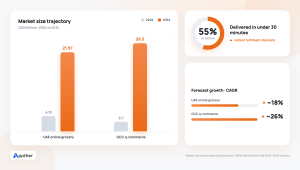
The UAE grocery-delivery market is not slowing down. It is maturing, and new categories keep moving online.
| Market | Size and forecast | Source |
|---|---|---|
| UAE online grocery | USD 4.13bn in 2025, projected to reach about USD 21.97bn by 2034 (CAGR 19.7%) | IMARC Group |
| GCC quick commerce | USD 2.7bn in 2025, projected to reach about USD 26.5bn by 2034 (CAGR 27.9%) | IMARC Group |
| UAE quick commerce | About USD 187m in 2026, with roughly 55% of orders promising delivery under 30 minutes | Mordor Intelligence |
A few patterns matter for anyone building here:
- Convenience becomes a habit. Once people get used to 15-minute delivery, they rarely go back.
- Sub-10-minute delivery is the fastest-growing segment, and fresh produce and dairy are growing faster than the market overall.
- Younger, dual-income, urban households in Dubai and Abu Dhabi will pay a premium for speed.
- Smaller emirates like Sharjah, Ajman and Ras Al Khaimah are less saturated, with lower rents and underserved customers.
The takeaway is simple. This is one of the strongest consumer-internet categories in the region, and there is still room for focused, well-run entrants.
What is Noon Minutes, and how does the model work?
Noon Minutes is a quick-commerce service for groceries and everyday essentials. It promotes 15-minute delivery, and its catalogue spans fruit and vegetables, meat and seafood, bakery, dairy and eggs, beverages, snacks, beauty and personal care.
The important part is what sits behind the app. Noon Minutes is not a supermarket website with a delivery button. It runs on automated micro-fulfilment centres, known as dark stores, positioned close to the customers they serve.
A typical q-commerce journey looks like this:
Every step has to happen fast and reliably. The difference between quick commerce and normal grocery delivery is proximity. A traditional service ships from a warehouse kilometres away. A q-commerce operator holds stock in a dark store minutes away, chosen by delivery radius, customer density and travel time.
That is why your software and your physical operations have to be designed together. One without the other fails the 15-minute promise.
Noon Minutes versus other UAE quick-commerce players
Noon Minutes does not operate alone. Before you build, understand who else is fighting for the same cart.
| Platform | Model | Key strength |
|---|---|---|
| Noon Minutes | Dark store, own inventory | 15-min delivery, tied to Noon.com, Noon One loyalty and Noon Pay |
| Talabat Mart | Dark store, own inventory | Under-20-min grocery delivery inside a large delivery ecosystem |
| Careem Quik | Partner stores, super-app | Grocery delivery inside the Careem super-app and driver network |
| InstaShop | Multi-retailer marketplace | Access to many nearby stores, under-30-min fulfilment |
| Deliveroo Hop | Supermarket partnership | Curated quick delivery via chains like Choithrams |
| Amazon / Carrefour | Retail-led e-commerce | Huge assortment and established fulfilment |
Here is the lesson from that table: speed alone is not a moat. When every platform promises 15 minutes, the winners compete on consistency, accurate ETAs, order accuracy, product range and loyalty.
So do not try to reproduce every feature these giants offer. Pick a specific opening instead. For example:
- Premium or imported groceries
- Organic and health-focused products
- Baby products, pet supplies or specialist categories
- A single high-density neighbourhood served extremely well
- B2B urgent supplies for restaurants, salons and small offices
A narrower, more efficient launch usually beats a broad one that spreads your operations too thin.
Choose your business model before you build anything
Most founders jump straight to features. That is the wrong order. Your model decides your operations, your unit economics, your tech architecture and even your hiring. There are four common shapes.
1. Own-inventory dark store (like Noon Minutes)
You buy, hold and sell your own stock from micro-fulfilment centres. Best control over speed, availability and margin. Highest upfront capital for inventory, rent and staff.
2. Marketplace / aggregator
You connect customers with nearby stores and take a commission. Lighter on capital, faster to list products, but less control over stock accuracy and delivery speed.
3. Retail-partner model
You fulfil from an existing supermarket or retail partner. A good way to validate demand before committing to your own dark stores.
4. Hybrid
Own dark stores in your busiest zones, partners everywhere else. Most large operators end up here as they scale.
How these platforms make money is worth studying too. Revenue rarely comes from one place. Expect a mix of product margin, delivery and small-basket fees, surge or peak-hour fees, subscriptions and loyalty, featured listings and brand advertising, and potentially B2B supply.
The core apps you actually need
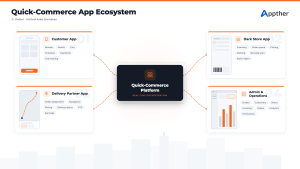
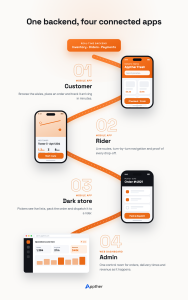
A Noon Minutes-style platform is not one app. It is a set of connected systems working in real time.
- Customer app to browse, order, pay and track.
- Rider app to receive, navigate and confirm deliveries.
- Dark-store app for picking, packing and stock control.
- Admin dashboard to run orders, catalogue, pricing, staff and analytics.
Underneath sit the shared services: inventory, order management, payments, notifications, delivery routing, backend APIs, cloud infrastructure and AI. Let us go through the parts that matter most.
Customer app features
The customer app is the front door. Keep it simple, because people open a q-commerce app with a specific need and no patience.
Fast sign-up
Mobile number and OTP, email, or social login. Every extra step costs you conversions.
Location detection
Detect the address, confirm it is inside your delivery zone, then set available inventory, the nearest dark store, the fee and the ETA.
Search that forgives typos
People type milk, bread, eggs, coke, nappies, shampoo. Add typo tolerance, synonyms and personalised suggestions so search never returns nothing.
Categories, product detail and cart
Clear categories, rich product pages (image, price, discount, size, brand, availability, variants) and a checkout built for speed with saved addresses, ETA, itemised totals and one-tap reorder.
Payments
Support cards, Apple Pay, Google Pay, digital wallets, buy-now-pay-later and cash on delivery. More on the UAE payment mix below.
Real-time tracking and notifications
Show a live status line: confirmed, preparing, out for delivery, delivered, with a map view where useful. Notify on confirmation, rider assigned, rider approaching, delivered, plus reorder nudges.
Smart substitution: the feature grocery apps cannot skip
Grocery has a problem ordinary e-commerce does not. A product can go out of stock after the customer orders it.
Instead of cancelling the item, your system should suggest an alternative of similar brand, size and price, ideally one the customer has bought before. This protects revenue and satisfaction. AI can make these swaps smarter over time by learning individual preferences.
Dark-store operations and real-time inventory
Your customer app can be beautiful, but if the dark store is slow, the 15-minute promise dies. This is the operational heart of the platform.
A dark-store system manages store locations, catalogue and SKU mapping, stock levels, batches and expiry, picking and packing queues, staff assignments, barcode scanning, replenishment and low-stock alerts. The single goal is to find, pick, pack and dispatch as fast as possible.
Inventory accuracy is critical. If the app shows a product as available and the shelf is empty, the experience breaks. A robust system handles:
- Real-time stock updates across reserved, available, damaged and expired stock
- Stock transfers and adjustments
- Multi-location inventory across several dark stores
- Routing each order to the fulfilment location that can serve it fastest
Rider app and smart assignment
The rider app connects fulfilment to the customer. It needs rider onboarding and verification, availability status, order assignment, pickup instructions, navigation, OTP or photo proof of delivery, earnings and performance. Give riders clear instructions and nothing that distracts them mid-delivery.
Assignment should not just mean ‘nearest rider’. A better engine weighs rider distance, current workload, store prep time, customer location, traffic and estimated travel time. That opens the door to route optimisation and machine-learning ETAs.
Do not neglect the rider experience. Confusing screens, unclear earnings or slow navigation push riders offline at peak times, and riders are your supply. Treat their app as seriously as the customer app.
Admin dashboard
Your operations team needs one command centre with live visibility across:
- Orders: new, active, completed, cancelled, failed
- Customers: profiles, history, addresses, loyalty, support tickets
- Products: catalogue, pricing, discounts, availability
- Inventory: stock levels, low stock, transfers, expiry
- Stores: order volume, picking and packing times
- Riders: availability, performance, earnings
- Marketing: coupons, promotions, campaigns, personalised offers
- Analytics: revenue, average order value, retention, delivery time, cancellation rate
UAE-specific design: Arabic, localisation and culture
This is where many international founders slip. They launch a ‘global’ product in the UAE without localising it properly, and it shows. Build these in from day one, not as an afterthought.
Full Arabic and right-to-left
Adding Arabic text is not enough. You need proper RTL layouts, Arabic typography, dual-language switching and real localisation testing across both directions.
Halal and dietary filters
A Halal filter is a hard requirement for a large part of your audience. Standardise dietary labels (vegetarian, vegan, organic, nut-free) during product onboarding.
Ramadan mode
A big opportunity. Adapt during Ramadan with Iftar and Suhoor categories, prayer-aware scheduling and extended hours. Demand and spend spike, so plan inventory and riders for it.
UAE payment preferences
Do not launch without cash on delivery. UAE shoppers expect cards, Apple Pay, wallets and buy-now-pay-later options like Tabby and Tamara. Every missing method is a silent checkout abandonment.
Landmark-based addresses
Many UAE areas rely on landmarks rather than structured postal addresses. Support map-pin selection, saved building and tower references, and location sharing. A precise pin is worth more than a street name here.
AI features for a modern q-commerce app
AI should solve operational problems, not decorate the app with a label. The useful applications are concrete.
Demand forecasting
Analyse historical orders, time of day, day of week, weather, seasonality and promotions to predict what each zone will need. Stores can pre-position stock before demand arrives.
Personalised recommendations
Use past purchases, current cart and similar customers to personalise the shop, not just show generic products.
AI customer support
An assistant wired into the order system can answer ‘where is my order’ ‘can I cancel’ ‘an item is missing’ with real-time facts, and escalate the hard cases to a human.
Accurate ETA prediction
Instead of a flat ’15 minutes’ calculate the most accurate achievable ETA from rider location, store workload, traffic, distance and time of day. Honest ETAs beat optimistic ones.
Inventory optimisation and fraud detection
Flag slow and fast movers, stockout and overstock risk, and location-specific demand. Separately, spot refund abuse, coupon abuse and multi-account fraud, tuned carefully so you do not block genuine customers.
Done well, AI touches the whole operation: customer experience, inventory, logistics, support and marketing. That is far more valuable than an ‘AI-powered’ badge.
Technology stack
A scalable architecture might look like this. Treat it as a starting point, not a rule. The right stack depends on order volume, budget, team skills and integrations.
| Layer | Common choices |
|---|---|
| Mobile apps | React Native or Flutter |
| Backend | Node.js or Python |
| Web admin | React or Next.js |
| Database | PostgreSQL, with Redis for caching |
| Real-time | WebSockets; Kafka or RabbitMQ for order bursts |
| Search | Elasticsearch or OpenSearch |
| Maps | Google Maps or Mapbox |
| Cloud | AWS or Azure, hosted in the UAE or Bahrain region |
| Payments | UAE-supported gateway (Checkout.com, PayTabs, Stripe) |
| AI / ML | LLM and ML services for forecasting, support and ETAs |
| Infra | Docker and Kubernetes |
The development process, step by step
Once the model, features and audience are clear, here is roughly how the build runs.
- Discovery: business model, target zones, must-have features, technical constraints.
- UX and UI design: map every journey, including Arabic RTL, Halal filters and UAE payment screens.
- Architecture: choose native or cross-platform on the frontend, and a modular backend that can split high-traffic services later.
- Core development: build the four apps in parallel, wire up real-time tracking, payments, wallets and rider logistics.
- Security and compliance: encrypt data end to end, role-based access, and align with UAE data rules (more below).
- QA and testing: peak-load performance, tracking accuracy, payment flows and RTL checks on iOS and Android.
- Launch: staging review, app store submission with Arabic ASO, then go live in one zone.
- Post-launch: the first 30 to 60 days are intense. Monitor, fix, and plan the next phase.
How much does it cost to build an app like Noon Minutes in Dubai?
There is no single price, because a basic MVP and a multi-store platform are different projects. Use these as indicative software-development ranges, not fixed quotes.
| Build stage | What it includes | Estimated cost | Timeline |
|---|---|---|---|
| Basic MVP | Customer app, rider app, store app, basic admin, payments, tracking | AED 110,000 to 220,000 (USD 30k to 60k) | 12 to 20 weeks |
| Mid-scale platform | Loyalty, wallet, multi-zone delivery, richer analytics and dashboards | AED 220,000 to 440,000 (USD 60k to 120k) | 4 to 8 months |
| Advanced ecosystem | Multi-store AI routing, forecasting, subscriptions, deep integrations | AED 440,000 to 920,000+ (USD 120k to 250k+) | 8 months and up |
One warning. These are software figures only. The full business investment also includes dark-store rent, warehouse equipment, inventory, staff, riders, packaging, licensing, insurance, marketing, cloud and payment processing. Budgeting only for the app is the classic mistake. In quick commerce, technology is one part of the system.
What moves the number most: how many apps, how many dark stores, real-time tracking depth, inventory and SKU complexity, payment integrations, AI functionality, third-party integrations and the scale you design for. A platform built for 500 orders a day is a different animal from one built for 100,000.
UAE licensing and legal requirements
Most blogs skip this. They should not, because for a grocery q-commerce business that holds perishable stock, compliance is not optional. Treat the points below as a checklist to raise with a UAE legal advisor, not as legal advice.
Mainland or free zone
You generally choose between a mainland licence through the relevant Department of Economic Development, or a free zone such as DIFC or ADGM. Mainland gives operational flexibility to trade across the local market and deal with local logistics partners. Free zones can offer ownership and tax benefits but may limit some activities. Confirm the structure before you commit.
Activity classification and food permits
A delivery platform can fall under e-commerce, logistics or technology categories, and that affects licensing, VAT and labour requirements. Crucially, if you hold inventory in a dark store, you will need food-handling and storage permits from the relevant municipality or food authority, for example Dubai Municipality or the Abu Dhabi Agriculture and Food Safety Authority.
Riders and labour
If you manage riders directly, road-transport and labour rules apply, including RTA approvals in Dubai and MOHRE employment compliance. Gig-worker classification has become more nuanced, so get this right early.
Data protection (PDPL)
The UAE Personal Data Protection Law governs consent and data handling. Build clear consent, a data-processing record and sensible retention from the start, and hosting in the UAE or Bahrain region keeps you on safer ground.
VAT
If platform revenue exceeds AED 375,000 a year, you must register for VAT. Delivery businesses generate a lot of accounting complexity, so build this into the financial model early.
Common mistakes to avoid
The same errors sink q-commerce launches again and again.
Launching everywhere at once
Dubai feels obvious, but it is also the most expensive and competitive. A single dense, well-served zone beats a thin presence across the whole city. Sharjah and the northern emirates are often underserved.
Skipping Arabic and localisation
RTL is a rebuild of your layout, not a flip. Half-hearted localisation costs you a large slice of the market.
Under-budgeting infrastructure
Live tracking looks trivial in a demo. Every active order holds a live connection, and at peak that is a lot of concurrent load. Budget for keeping tracking fast under stress.
No loyalty or subscription
Noon One and Talabat Pro lock users in. Without something similar you compete on discounts alone, which is expensive and disloyal. Loyalty is cheaper to build at launch than to retrofit.
Promising a time you cannot keep
The fix for slow delivery is not always faster delivery. It is accurate promises and reliable execution. A dependable 20 minutes beats an unreliable 15.
The metrics that show if the business is healthy
Downloads tell you nothing. Watch these instead:
- Average delivery time and order accuracy
- Cancellation rate and stockout rate
- Average order value and repeat purchase rate
- Customer acquisition cost and lifetime value
- Delivery cost per order and rider utilisation
- Inventory turnover
Every one of these should be visible in your admin and analytics from day one.
How to make your app different from Noon Minutes
This is the most important strategic question, so do not answer it with ‘the same but faster’. Find a niche or an operational edge:
- Hyperlocal: serve one area extremely well
- Premium or imported groceries
- Organic and health-focused ranges
- B2B quick commerce for restaurants, salons and offices
- AI-powered personal shopping and smart baskets
- Subscription-based household essentials
- Community-based, neighbourhood-specific offers
The goal is not to become the next Noon. It is to be the better choice for a specific customer segment.
Build an MVP before a full clone
The biggest trap is trying to ship every feature on day one. Start lean instead.
A practical MVP covers: customer sign-up, location, catalogue, search, cart, checkout, payment, tracking and notifications; a store app for inventory, order queue, picking, packing and status; a rider app for login, availability, assignment, navigation and confirmation; and an admin panel for products, customers, orders, stores, riders and basic analytics.
Once that is validated, layer on AI recommendations, demand forecasting, advanced routing, loyalty, subscriptions and multi-store intelligence. This keeps early risk low and lets real customer data shape the roadmap.
Build your quick-commerce app with Appther
Launching a q-commerce platform is not about copying screens. It is about connecting customers, inventory, dark stores, riders and operations in real time, and doing it in a way that survives UAE conditions and regulations.
At Appther, we help turn a quick-commerce idea into a scalable platform, from product discovery and UI/UX through mobile and backend engineering, logistics, payments, integrations and AI. As an AI-first software company, we build the intelligence into the operation, not just the marketing.
Tell us your target zone, delivery model, product categories and launch area. We will help define the MVP, the architecture, the feature roadmap and the development plan for your Dubai q-commerce business.

Frequently asked questions
How much does it cost to build an app like Noon Minutes?
A basic MVP typically starts from around AED 110,000 to 220,000 (about USD 30,000 to 60,000). A mid-scale platform runs higher, and an advanced multi-store, AI-driven platform can exceed AED 900,000. The final figure depends on the number of apps, integrations and operational complexity.
How long does it take to build a quick-commerce app?
An MVP usually takes about 12 to 20 weeks, covering discovery, design, development, testing and launch. A larger multi-store platform takes several months more.
Do I need a dark store to launch?
Not necessarily. You can start with a marketplace or retail-partner model. A dark store gives the most control over stock and speed, but it needs more capital and the right permits.
Can AI be added to a grocery delivery app?
Yes. AI supports demand forecasting, personalised recommendations, customer support, ETA prediction, inventory optimisation and fraud detection.
Does a UAE q-commerce app need Arabic?
Yes, from day one. Proper Arabic and right-to-left support is a requirement, not a nice-to-have, and skipping it loses a large share of users.
What is the difference between Noon Minutes and a model like Talabat?
Talabat is largely a restaurant aggregator that connects customers with third-party restaurants for a commission. Noon Minutes runs closer to a quick-commerce model, holding its own grocery inventory in dark stores for fast delivery. The model you choose shapes your tech stack and your licensing.
Can Appther build a quick-commerce app for Dubai?
Yes. Appther can design and build the customer app, rider app, dark-store and inventory systems, admin dashboard, real-time tracking, payment integrations, AI features and backend infrastructure for a scalable platform.
Conclusion
Building an app like Noon Minutes in Dubai takes more than a fast-delivery button. The real product is the whole system behind the customer: app, inventory, dark store, order management, delivery, data, AI and operations.
The strongest approach is to start with a focused MVP, launch in one clearly defined zone, measure the customer and operational data, then scale technology and fulfilment together.
The goal is not to promise faster delivery than everyone else. It is to deliver the right product, from the right location, at the right time, with the lowest practical friction. That is where technology becomes a genuine advantage.
