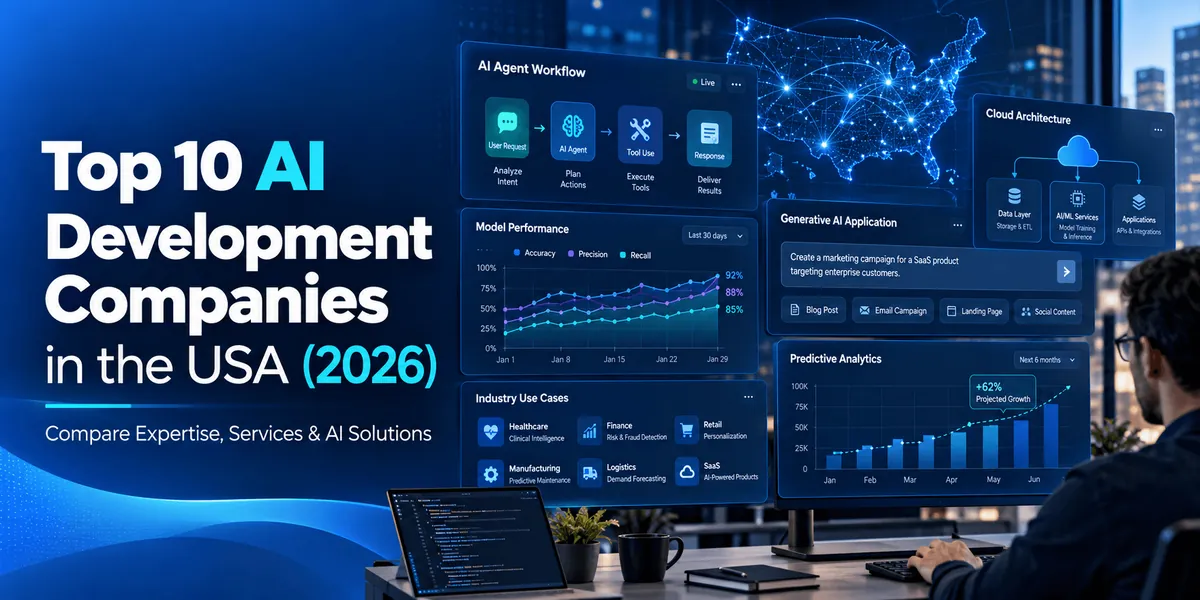
Artificial intelligence has moved beyond experimental chatbots and isolated proof-of-concept projects. Businesses across the United States are investing in AI systems that automate operations, analyze business data, improve customer experiences, and introduce intelligent capabilities into existing software.
For businesses planning to develop intelligent applications, choosing the right technology partner involves evaluating AI expertise, software engineering capabilities, system integration experience, and long-term support.
Companies offering custom AI development services can help organizations move from initial concepts to production-ready applications, including AI agents, generative AI platforms, machine learning solutions, and intelligent business automation.
This guide compares ten AI development companies serving businesses in the United States and explains how to evaluate their services, technical expertise, development costs, and suitability for different projects.
What Is an AI Development Company?
An AI development company designs, builds, integrates, and maintains software that uses artificial intelligence to solve business problems.
Unlike traditional software development, AI engineering may involve machine learning models, large language models (LLMs), retrieval-augmented generation (RAG), natural language processing, computer vision, predictive analytics, and autonomous agents.
For example, an AI development company might build:
- A customer support agent connected to a company’s CRM.
- A document-processing system that extracts information from invoices.
- A healthcare application that assists clinicians with administrative workflows.
- An AI-powered mobile application offering personalized recommendations.
- A predictive analytics platform for inventory or demand forecasting.
- An internal knowledge assistant that retrieves information from company documents.
- A voice AI agent that answers calls, qualifies inquiries, and creates service requests.
The strongest development approach starts with the business problem, not the model.
A successful AI product must work with the organization’s data, users, applications, security requirements, and operational processes.
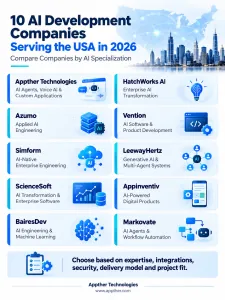
Quick Comparison: 10 AI Development Companies Serving the USA
The following companies offer AI development, AI consulting, or AI-enabled software engineering services to US businesses.
This is a curated shortlist, not an independently audited performance ranking. The numbering is for navigation and does not represent a verified order of quality.
| Company | Key AI capabilities | Particularly relevant for |
|---|---|---|
| Appther Technologies | AI agents, voice AI, RAG, AI-powered applications, enterprise integration | Startups and businesses needing custom AI products and workflow automation |
| HatchWorks AI | AI strategy, AI-native products, agentic automation, data modernization | Enterprise AI transformation |
| Azumo | Generative AI, AI software development, embedded AI engineering teams | Businesses seeking hands-on AI engineering |
| Vention | AI product development, enterprise AI, machine learning, AI integration | Scaling engineering teams and enterprise platforms |
| Simform | Agentic systems, AI-native engineering, enterprise AI adoption | Organizations modernizing software and operating models |
| LeewayHertz | Generative AI, multi-agent systems, enterprise AI integration | Complex AI applications and enterprise workflows |
| ScienceSoft | AI transformation, software engineering, data analytics | Established businesses with broader IT modernization needs |
| Appinventiv | AI-powered digital products, generative AI, agentic AI | Mobile applications and enterprise digital products |
| BairesDev | Custom AI, machine learning, AI agents, predictive analytics | Organizations seeking AI development and engineering capacity |
| Markovate | AI agents, workflow automation, decision intelligence | Business process automation and agent-based systems |
Location note: This list includes both US-based firms and internationally headquartered companies serving US clients. Businesses requiring a US-incorporated vendor, domestic-only engineering, or specific data-residency arrangements should verify those requirements directly.
How Were These AI Development Companies Selected?
Choosing an AI development partner requires more than reviewing a company’s website or counting the technologies listed on its services page.
For this shortlist, we considered publicly described service capabilities across six areas.
1. AI engineering capabilities
Does the company offer relevant expertise in machine learning, generative AI, AI agents, RAG, computer vision, or predictive analytics?
2. End-to-end software development
Can the company handle architecture, frontend and backend development, API integration, deployment, and maintenance?
3. Enterprise integration capabilities
Can the proposed solution connect with existing CRM, ERP, databases, cloud infrastructure, and business applications?
4. Production readiness
Does the company discuss evaluation, monitoring, security, error handling, scalability, and ongoing operations?
5. Relevant business applications
Are its services applicable to identifiable business problems rather than only experimental demonstrations?
6. Delivery model
Can the company support the required engagement, whether that involves a focused MVP, a dedicated engineering team, or an enterprise transformation program?
The descriptions below are based primarily on the companies’ published services. They are not substitutes for independent technical due diligence, reference checks, or a project-specific proposal.
Top 10 AI Development Companies in the USA for 2026
1. Appther Technologies, Custom AI Applications and Business Automation
Best suited for: Startups, growing businesses, and organizations seeking AI-powered applications, conversational AI, and enterprise workflow automation.
Appther Technologies provides AI development services for businesses looking to integrate artificial intelligence into digital products and operational workflows.
Its capabilities include AI agents, generative AI applications, retrieval-augmented generation, voice AI, document intelligence, and predictive analytics.
Alongside AI engineering, Appther offers custom software development, enabling businesses to combine intelligent functionality with web applications, APIs, cloud infrastructure, and enterprise platforms.
This combination is particularly relevant when an AI application must interact with existing customer records, business databases, operational workflows, or third-party software.
Potential fit: AI-powered MVPs, customer-service automation, voice agents, internal knowledge assistants, document processing, and intelligent enterprise applications.
Key AI development services
- Custom AI application development
- AI agent development and workflow automation
- Generative AI and LLM applications
- Retrieval-augmented generation (RAG)
- Voice AI and conversational assistants
- Document AI and intelligent data extraction
- Predictive analytics and machine learning
- CRM, ERP, and enterprise system integration
- AI-enabled web and mobile applications
Why businesses may consider Appther
For organizations that need AI functionality inside an existing product or business process, full-stack development capability matters.
A customer support agent, for example, is more useful when it can securely retrieve customer information, create support tickets, and escalate unresolved cases than when it only generates conversational responses.
Similarly, an AI document-processing application needs reliable storage, validation rules, exception handling, and integration with the destination system.
Appther’s service portfolio addresses these broader software engineering requirements alongside AI development.
Potential fit: AI MVPs, customer-service automation, voice agents, internal knowledge assistants, document workflows, and AI-enabled business applications.
Company website: Appther Technologies
Explore: AI Development Services
2. HatchWorks AI, Enterprise AI Transformation
Best suited for: Enterprises looking to move from AI experimentation into operational deployment.
HatchWorks AI is based in Atlanta, Georgia, and focuses on AI strategy, AI-native product development, agentic automation, and data modernization.
Its approach emphasizes connecting AI investment with business outcomes.
The company offers AI strategy and roadmap development, engineering services, and organizational adoption support.
Key capabilities
- Enterprise AI strategy
- AI-native product development
- Agentic workflow automation
- Data modernization
- Model optimization
- Machine learning and analytics
- AI adoption and change management
Why businesses may consider HatchWorks AI
Organizations with several potential AI use cases often struggle to decide which projects should receive investment first.
HatchWorks AI’s focus on strategy, implementation, and adoption may be particularly relevant when the challenge extends beyond software development into organizational change.
Potential fit: Enterprise AI roadmaps, intelligent workflow transformation, and AI-native business products.
3. Azumo, Applied AI Engineering and Development Teams
Best suited for: Companies seeking practical AI development and engineers who can work closely with internal teams.
Azumo provides AI development services covering generative AI, software engineering, model selection, and production deployment.
Its published approach includes embedded engineering teams and support for the complete development process.
Key capabilities
- Custom AI software development
- Generative AI applications
- AI model integration
- AI-powered business workflows
- Cloud deployment
- Embedded AI engineering teams
- Production support and optimization
Why businesses may consider Azumo
Businesses with existing engineering teams may not need to outsource an entire product.
Instead, they may require specialists to design an AI component, integrate a language model, or help operationalize an AI feature.
Azumo’s engineering engagement model may suit that requirement.
Potential fit: AI features for existing software, generative AI applications, and dedicated engineering support.
4. Vention, AI Software Development and Engineering at Scale
Best suited for: Startups and enterprises that require AI expertise alongside broader software development capacity.
Vention provides AI software development services spanning product engineering, enterprise AI, machine learning, and integration.
Its offerings include proof-of-concept development, AI-enabled product development, and the addition of AI functionality to existing software.
Key capabilities
- AI product development
- Enterprise AI engineering
- Machine learning
- Natural language processing
- Computer vision
- Predictive analytics
- AI integration
- AI consulting and workshops
Why businesses may consider Vention
An AI initiative may require backend engineering, cloud architecture, frontend development, data engineering, and testing.
For businesses seeking to scale these capabilities together, a provider with broader engineering services can be useful.
Potential fit: Enterprise platforms, AI-enabled SaaS products, predictive applications, and complex integration projects.
5. Simform, AI-Native Engineering and Enterprise Modernization
Best suited for: Organizations looking to modernize applications and redesign workflows around AI.
Simform provides digital engineering services with a focus on AI adoption, agentic systems, and enterprise transformation.
Its published offerings emphasize combining AI capabilities with software engineering, workflow design, and operational governance.
Key capabilities
- Enterprise AI adoption
- Agentic workflows
- AI-native software engineering
- Cloud and application modernization
- Data engineering
- Enterprise platform development
- AI-enabled software delivery
Why businesses may consider Simform
Many organizations already have substantial investments in applications, infrastructure, and data systems.
Their AI challenge is not necessarily building a new product from scratch. It may involve adding intelligence to existing workflows without disrupting business operations.
Simform’s broader engineering and modernization capabilities are relevant to these projects.
Potential fit: Enterprise modernization, agentic automation, and AI integration into existing platforms.
6. LeewayHertz, Generative AI and Enterprise AI Systems
Best suited for: Businesses planning complex AI applications, multi-agent systems, and enterprise integrations.
LeewayHertz provides AI development services covering AI strategy, proof-of-concept development, generative AI, machine learning, and agent-based systems.
The company also describes capabilities in integrating AI with ERP, CRM, IT service management, and other enterprise applications.
Key capabilities
- Generative AI development
- AI agents and multi-agent systems
- Custom LLM applications
- RAG and enterprise knowledge systems
- Machine learning
- AI strategy consulting
- AI integration
- Data engineering
Why businesses may consider LeewayHertz
Building a production-ready AI system often requires more than connecting an application to an LLM.
Organizations may need controlled access to internal data, evaluation frameworks, tool permissions, monitoring, and governance.
LeewayHertz’s enterprise AI service portfolio addresses these areas.
Potential fit: Enterprise knowledge assistants, intelligent automation, agentic workflows, and custom generative AI systems.
7. ScienceSoft, AI Transformation and Enterprise Software Engineering
Best suited for: Established organizations requiring AI alongside enterprise software, data, and IT modernization.
ScienceSoft offers AI transformation, custom software development, data analytics, and related technology consulting services.
Its broader technology portfolio may be relevant to organizations where AI implementation depends on upgrading existing applications or data infrastructure.
Key capabilities
- AI transformation
- Custom software development
- Data analytics
- Enterprise application development
- IT consulting
- System integration
- Application modernization
Why businesses may consider ScienceSoft
For some organizations, the biggest obstacle to AI adoption is not the AI model itself.
Legacy applications, fragmented databases, inconsistent processes, and integration constraints can prevent otherwise promising initiatives from reaching production.
A provider with broader enterprise software capabilities may help address those dependencies.
Potential fit: Enterprise AI adoption, data-driven applications, and modernization programs.
8. Appinventiv, AI-Powered Digital Products and Mobile Applications
Best suited for: Businesses developing customer-facing applications, digital platforms, and enterprise AI products.
Appinventiv provides digital product engineering and AI development services, including generative AI, agentic AI, and AI integration.
Its published portfolio combines AI engineering with mobile application development and broader software product delivery.
Key capabilities
- AI application development
- Generative AI solutions
- AI agents
- AI-powered mobile applications
- Enterprise AI integration
- Machine learning
- Digital product engineering
Why businesses may consider Appinventiv
A consumer-facing AI product must deliver more than accurate model outputs.
The user experience, performance, onboarding, backend architecture, security, and scalability all influence product adoption.
Appinventiv’s combination of product engineering and AI services may be useful for organizations building such applications.
Potential fit: AI-enabled mobile applications, digital products, and enterprise platforms.
9. BairesDev, Custom AI Engineering and Development Capacity
Best suited for: Organizations seeking AI development expertise within broader engineering engagements.
BairesDev offers AI development services covering agentic systems, custom LLM projects, machine learning, predictive analytics, and business process automation.
Its published capabilities also include AI-powered data analysis, NLP, and integration with enterprise systems.
Key capabilities
- AI agents and custom LLMs
- Machine learning
- Predictive analytics
- Natural language processing
- Business process automation
- Generative AI product development
- AI-enabled enterprise applications
Why businesses may consider BairesDev
Some AI projects require additional engineering capacity rather than a standalone AI consulting engagement.
For organizations with existing product teams, access to developers with both AI and conventional software engineering experience may help accelerate delivery.
Potential fit: AI product engineering, enterprise automation, and scaling development teams.
10. Markovate, AI Agents and Intelligent Workflow Automation
Best suited for: Organizations interested in AI agents, decision intelligence, and automated business processes.
Markovate provides AI development services with a focus on agentic systems and workflow automation.
Its published offerings cover AI agent consulting, multi-agent architectures, enterprise integrations, and intelligent process orchestration.
Key capabilities
- AI agent development
- Multi-agent systems
- Workflow automation
- Decision intelligence
- Enterprise AI integration
- Generative AI applications
- Human-in-the-loop workflows
Why businesses may consider Markovate
AI agents can be useful when a business process requires several coordinated steps.
For example, a system might retrieve information, evaluate business rules, draft a response, update an application, and request human approval before completing a consequential action.
Markovate’s emphasis on workflow-oriented agents makes it relevant to these use cases.
Potential fit: Agentic automation, intelligent operations, and multi-step enterprise workflows.
Which AI Development Company Is Right for Your Business?
The best AI development company depends on the type of product you want to build.
A startup developing an AI mobile application may need different expertise from a financial institution implementing document intelligence or an enterprise deploying AI agents across internal systems.
Use the following decision guide to narrow your shortlist.
| Your requirement | Capabilities to prioritize |
|---|---|
| AI-powered mobile app | Mobile engineering, backend development, LLM integration, product design |
| Enterprise AI transformation | Strategy, data architecture, governance, change management |
| AI customer support agent | Conversational AI, CRM integration, tool calling, escalation workflows |
| AI voice agent | Speech recognition, text-to-speech, telephony integration, latency management |
| RAG knowledge assistant | Document processing, vector search, access controls, retrieval evaluation |
| Predictive analytics | Data engineering, model development, monitoring, explainability |
| AI document automation | OCR, extraction, validation, workflow integration |
| Agentic business automation | Tool permissions, orchestration, monitoring, human approval |
| AI MVP development | Rapid prototyping, full-stack engineering, scalable architecture |
Instead of selecting a provider solely because it appears on a “top companies” list, compare two or three relevant vendors against the same written project requirements.
What AI Development Services Do US Businesses Need in 2026?
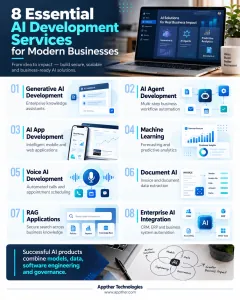
Generative AI Development
Generative AI systems create or transform content, including text, images, code, and structured responses.
Businesses use generative AI for knowledge assistance, document drafting, customer communication, internal search, and product features.
Production systems need output validation, access controls, cost monitoring, and appropriate human review.
AI Agent Development
AI agents can coordinate tasks, interact with connected tools, and execute actions within defined permissions.
Examples include customer support workflows, sales qualification, IT ticket routing, and back-office process automation.
The design should specify what the agent may do independently and which actions require approval.
AI App Development
AI application development combines machine learning or generative AI capabilities with user-friendly web and mobile software.
Businesses building AI-powered applications need expertise in user experience, backend development, authentication, API integration, cloud infrastructure, and application performance.
For example, an AI-powered healthcare application may require secure user accounts, document processing, clinician workflows, and integration with existing systems.
Appther’s mobile app development services support iOS, Android, and cross-platform applications, while its AI engineering capabilities can be incorporated into the broader product architecture.
Retrieval-Augmented Generation
RAG connects language models with relevant external information, such as internal documents or knowledge bases.
It can help businesses create assistants that answer questions using authorized company information.
However, retrieval quality, document permissions, source freshness, and evaluation remain essential.
Voice AI Development
Voice AI combines speech recognition, language processing, dialogue management, and speech synthesis.
Common applications include appointment scheduling, inbound call handling, customer support, and lead qualification.
Businesses should evaluate response latency, transcription quality, interruption handling, escalation, and call recording requirements.
Machine Learning and Predictive Analytics
Machine learning can support forecasting, classification, anomaly detection, and recommendations.
Examples include customer churn prediction, demand forecasting, fraud detection, and equipment maintenance planning.
These systems require suitable data, meaningful performance metrics, and ongoing monitoring.
How Much Does AI Development Cost in the USA in 2026?
AI development costs vary substantially by project scope, data readiness, integration complexity, model requirements, and security expectations.
A simple AI feature integrated into an existing application is different from a production-grade enterprise AI platform.
The following figures are illustrative budgeting scenarios in US dollars. They are not verified market averages, standardized industry prices, or fixed Appther quotations.
| Project type | Illustrative planning budget |
|---|---|
| AI discovery and focused proof of concept | $3,000–$12,000 |
| Basic AI chatbot or knowledge assistant | $5,000–$20,000 |
| AI-powered MVP application | $15,000–$50,000 |
| Custom AI agent with business integrations | $20,000–$75,000 |
| Predictive analytics or ML application | $25,000–$100,000+ |
| Complex enterprise AI platform | $75,000–$250,000+ |
Actual proposals may fall outside these ranges.
What influences AI development pricing?
1. Project complexity
A single-purpose document assistant usually requires less engineering than a multi-agent system integrated with several enterprise applications.
2. Data preparation
Poorly structured or incomplete data can increase development time.
3. Model strategy
Using an existing foundation model, fine-tuning a model, and training a specialized model have different cost profiles.
4. Integrations
Connecting AI to Salesforce, Odoo, SAP, healthcare platforms, payment systems, or proprietary databases requires additional engineering.
5. Security and compliance
Projects involving sensitive data may require stronger controls, documentation, testing, and infrastructure.
6. Production operations
Model usage, cloud infrastructure, monitoring, logging, maintenance, and ongoing evaluation contribute to total cost of ownership.
When comparing proposals, request a breakdown of implementation costs and recurring operating expenses.
How to Choose the Best AI Development Company in the USA
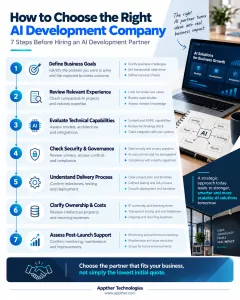
Step 1: Define the business outcome
Start by identifying the problem you want to solve.
For example:
“We want to reduce the time our support team spends answering repetitive order-status inquiries.”
This is more useful than simply asking a vendor to “build an AI chatbot.”
Step 2: Check relevant project experience
Look for evidence that the development team understands the type of workflow, application, or industry involved.
A company with experience building document intelligence may not automatically be the best choice for real-time voice AI.
Step 3: Evaluate technical architecture
Ask how the solution will handle data access, APIs, authentication, model selection, error handling, and scalability.
For RAG systems, discuss retrieval evaluation and document-level permissions.
For AI agents, discuss tool access, approval boundaries, and recovery from failed actions.
Step 4: Review data security
Clarify where data is stored, which services process it, who can access it, and how long it is retained.
If the project involves regulated information, determine which specific contractual and technical requirements apply.
Do not assume that using a cloud provider or an established AI model automatically makes the application compliant.
Step 5: Understand the development process
A practical AI development process typically includes:
- Discovery and requirements analysis
- Data and technical feasibility assessment
- Solution architecture
- Proof of concept, where appropriate
- MVP or application development
- Testing and AI evaluation
- Deployment
- Monitoring and optimization
Step 6: Clarify ownership and documentation
The agreement should address source-code ownership, intellectual property, repositories, third-party services, documentation, and handover responsibilities.
Step 7: Evaluate post-launch support
AI systems require maintenance.
Model behavior, API pricing, integrations, user requirements, and business data can change.
Ask how the vendor handles monitoring, incidents, model updates, and improvements after launch.
Questions to Ask Before Hiring an AI Software Development Company
Before choosing an AI development partner, ask:
- Have you delivered a production application similar to our requirements?
- Which AI models or frameworks would you consider, and why?
- How will our business data be protected?
- Can the solution integrate with our existing applications?
- What will the proof of concept demonstrate?
- How will you evaluate AI output quality?
- What happens when the model produces an incorrect response?
- Which actions require human approval?
- Who owns the source code and project documentation?
- What are the expected recurring cloud and model costs?
- How will the application be monitored after launch?
- What support is included after deployment?
The answers should be specific to your project.
A credible development partner should also explain when a conventional software solution would be more appropriate than AI.
AI Development Trends Shaping US Businesses in 2026
AI Agents Connected to Business Systems
Businesses are increasingly interested in agents that work with CRM, ERP, service management, and internal applications.
The challenge is designing safe, reliable actions rather than simply generating conversational responses.
Smaller, Task-Specific AI Systems
Not every application needs the largest available language model.
For some workflows, a smaller model or a combination of rules and machine learning may offer a more economical solution.
Enterprise RAG and Knowledge Assistants
Organizations want AI systems that can use internal information while respecting user permissions and data governance requirements.
Voice AI for Customer Operations
Voice-based automation is relevant to customer service, appointment scheduling, lead qualification, and support operations.
AI Evaluation and Governance
As AI systems become operationally important, businesses need clearer methods for measuring output quality, tracking failures, and reviewing sensitive decisions.
AI Embedded in Existing Software
Rather than replacing every application, many organizations are introducing AI into the platforms employees already use.
This makes integration engineering a central part of AI adoption.
Why Consider Appther for Custom AI Development?
Building a useful AI application requires a combination of software engineering, business analysis, system integration, and AI expertise.
Appther’s development services cover custom AI solutions alongside mobile, web, and enterprise software development.
This is relevant for businesses that need AI to operate within an existing application or workflow rather than as a standalone demonstration.
AI agents and workflow automation
Develop AI-enabled workflows that interact with business systems through controlled APIs and defined approval processes.
Conversational and voice AI
Build assistants for customer communication, service workflows, and information retrieval.
Generative AI and RAG
Create applications that use language models with business-specific information and retrieval systems.
AI-powered web and mobile applications
Combine AI features with application design, backend engineering, authentication, and user-facing functionality.
Enterprise AI Integration
For established businesses, AI implementation often depends on connecting intelligent applications with existing CRM, ERP, databases, and operational platforms.
These integrations require secure APIs, reliable data exchange, access controls, error handling, and monitoring.
Businesses modernizing their internal systems may also need enterprise software development to support custom CRM applications, workflow automation, analytics dashboards, and integrations with third-party platforms.
A well-designed architecture allows AI capabilities to operate within existing business processes instead of creating another disconnected application.
Deployment and ongoing improvement
Support the transition from initial development to a maintainable production application.
Businesses can explore Appther’s AI development services to discuss requirements, technical feasibility, and suitable delivery approaches.
Frequently Asked Questions
1. What is the best AI development company in the USA?
There is no single best company for every project. The right choice depends on the required AI capabilities, industry experience, integration needs, budget, security requirements, and delivery model. Compare vendors using a project-specific evaluation checklist.
2. Which companies develop AI-powered mobile applications?
Several software development companies, including Appther and Appinventiv, offer AI development alongside mobile application engineering. Buyers should confirm experience with their target platforms, model integrations, and backend requirements.
3. How much does it cost to hire an AI development company?
Costs vary widely. A focused proof of concept may require a relatively modest budget, while an enterprise AI platform can require substantial investment. Request a detailed estimate covering development, infrastructure, model usage, and support.
4. What is the difference between an AI development company and an AI consulting company?
An AI consulting company primarily helps organizations evaluate opportunities, define strategy, and plan adoption. An AI development company builds and deploys software. Many firms provide both services.
5. How long does it take to develop an AI application?
A focused proof of concept may take a few weeks. A more complete AI-powered MVP can take several months, depending on scope. Complex enterprise systems may require phased delivery over a longer period.
6. Can AI development companies integrate AI with existing software?
Yes. AI can be integrated with CRM, ERP, web applications, mobile applications, and internal systems through supported APIs, middleware, and custom development.
7. What technologies do AI development companies use?
Common technologies include Python, machine learning frameworks, language model APIs, vector databases, cloud infrastructure, data pipelines, and conventional web or mobile development frameworks. The appropriate stack depends on the application.
8. Should startups hire an AI development company or build an internal team?
Outsourcing may help startups access specialized engineering skills without immediately building a complete internal team. In-house development can provide greater day-to-day control. A hybrid approach is also possible.
9. Can an international AI development company serve US businesses?
Yes. International companies can provide AI development services to US clients. Buyers should verify contracting arrangements, communication coverage, security controls, data residency, and any requirements for domestic delivery.
10. What should an AI development contract include?
A contract should define scope, deliverables, milestones, acceptance criteria, intellectual property, confidentiality, security obligations, third-party costs, change requests, support, and termination arrangements.
Looking for an AI Development Company for Your Next Project?
Whether you’re planning an AI-powered mobile application, developing intelligent agents, building an enterprise knowledge assistant, or automating business operations, choosing the right technical approach is essential.
Appther Technologies helps businesses evaluate requirements, design software architectures, and develop AI-enabled applications tailored to their operational needs.
Explore our AI development services to learn more about our capabilities.
Ready to discuss your requirements?