| Quick answer
IoT app development cost in 2026 typically runs from $5,000 to $30,000 for a proof of concept, $30,000 to $100,000 for a consumer IoT MVP with a device app and cloud backend, $80,000 to $150,000 for a full consumer product with ecosystem integrations, and $150,000 to $500,000 or more for industrial IoT platforms. On top of the build, plan for recurring cloud costs that scale with your device fleet and maintenance of roughly 15 to 25% of the build cost per year. Hardware choices, connectivity, and real-time data needs are the biggest levers. |
The Internet of Things has transformed the modern business landscape, bringing intelligence, automation, and connectivity to everyday physical objects. But building a connected product is a multi-layered investment, and most budget surprises come from layers founders did not know existed.
Whether you are designing a consumer fitness tracker or an automated factory floor, the overall cost spans hardware, software, connectivity, and years of operations after launch. This guide breaks the budget down phase by phase, with real planning ranges at every step, so you can forecast the full picture before you commit.
IoT app development cost at a glance: 2026 price bands
| Project type | Typical cost range | What it covers |
|---|---|---|
| Proof of concept | $5,000 – $30,000 | Feasibility, dev-kit hardware, basic app and cloud demo |
| Consumer IoT MVP | $30,000 – $100,000 | Device app, cloud backend, one core device integration |
| Full consumer product | $80,000 – $150,000 | Polished UX, HomeKit/Alexa/Google integrations, OTA updates |
| Industrial IoT platform | $150,000 – $500,000+ | Ruggedised fleet, SCADA/PLC integration, real-time analytics |
Treat these as planning ranges rather than quotes. Two projects with the same one-line description can land far apart once sensor choices, connectivity, and data volumes are scoped, which is exactly what the six phases below unpack.
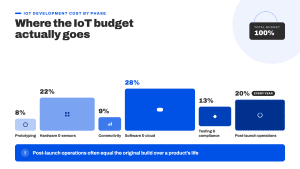
Phase 1: Planning and prototyping ($5,000 to $30,000)
Before writing production code or manufacturing hardware, idea validation is critical. A proof-of-concept phase tests technical viability without draining the budget upfront.
Costs here accumulate through feasibility studies, UX/UI wireframes, hardware mock-ups on commercial dev kits, and early user testing. A focused PoC typically lands between $5,000 and $30,000 depending on how much custom firmware the demo needs.
This is the highest-return money in the whole project. A well-executed prototype surfaces architectural flaws while they cost hundreds to fix instead of hundreds of thousands, and it gives you something real to put in front of users and investors.
Phase 2: Hardware, sensors, and connectivity
IoT is the bridge between physical devices and digital dashboards, and the physical half of that bridge drives a large share of the budget.
Hardware and sensors
Sensor pricing swings widely with precision, durability, and type. A basic temperature sensor costs a few dollars per unit; industrial-grade optical or chemical sensors can run into the hundreds. Custom firmware, and the engineering work of keeping physical devices and apps perfectly in sync under real-world conditions, adds $10,000 to $50,000 to most serious builds. Designing and fabricating custom circuit boards adds more, which is why smart teams stay on commercial microcontrollers as long as possible.
Connectivity: the recurring decision
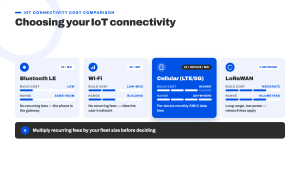
Devices need a reliable way to transmit data, and your network choice shapes both the build cost and the monthly bill forever after. Bluetooth Low Energy is the cheapest to implement, often $5,000 to $15,000 of integration work, with no recurring network fees, but it is limited by range. Wi-Fi sits in the middle. Cellular (LTE/5G) and LoRaWAN unlock wide-area coverage but add per-device SIM or network costs, commonly $1 to $5 per device per month, which at fleet scale becomes one of your largest recurring lines. Match the network to the physical environment, then multiply the monthly fee by your device forecast before you commit.
Phase 3: Software, platform, and cloud infrastructure
How much does it cost to build an IoT platform? The answer depends on one early fork in the road and one recurring bill.
Build versus buy
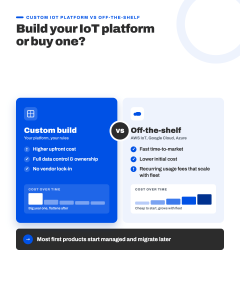
Custom-built platforms require a larger upfront engineering investment, commonly $60,000 to $150,000 for a serious foundation, but offer complete data control, bespoke features, and freedom from vendor lock-in. Off-the-shelf platforms such as AWS IoT Core or Google Cloud’s IoT services cut initial build time dramatically and speed up time-to-market, in exchange for recurring usage fees that grow with your fleet. For most first products, starting on a managed platform and migrating later is the capital-efficient path.
Cloud hosting and real-time data
Managing thousands of devices requires scalable cloud infrastructure, and telemetry volume is the meter that runs it. Budget a rough planning figure of $0.50 to $2 per device per month for typical telemetry loads, then stress-test that figure against your update frequency. Real-time demands change the math entirely: if your application needs split-second analytics, autonomous robotics, critical health monitors, high-volume streaming ingestion and premium compute can multiply the cloud bill several times over compared with a system that reports once an hour.
Phase 4: Consumer versus industrial: why the industry multiplies the price
Your final cost is intrinsically tied to your use case, because consumer and enterprise products carry very different requirements.
Consumer IoT
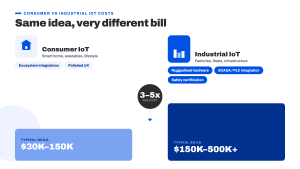
For smart home and wearable products, the financial focus is a flawless, intuitive interface and seamless integration with ecosystems like Apple HomeKit, Google Home, and Amazon Alexa. Each ecosystem integration and certification typically adds $10,000 to $30,000, and design polish takes centre stage because consumer patience is short.
Industrial IoT
Industrial architecture is substantially more complex, and the budget reflects it. IIoT demands ruggedised hardware that survives extreme environments, integration with legacy manufacturing systems such as SCADA and PLC controllers, and ultra-reliable low-latency networks. Safety certification and reliability requirements routinely make an industrial deployment three to five times the cost of a comparable consumer build, which is why the industrial band in the table starts at $150,000.
Phase 5: Team and talent: the biggest financial lever
Who builds your product moves the budget as much as what you build. Specialised embedded engineers, cloud architects, and hardware designers are among the most expensive talent in software: in Western markets, senior embedded rates commonly run $100 to $180 per hour.
- In-house teams guarantee dedicated attention and knowledge retention, but carry recruitment fees, competitive salaries, and long-term benefit costs across several rare specialisations at once.
- Outsourcing to a specialised agency means paying only for the hours and expertise you need, often at a third to a half of in-house Western rates for equivalent seniority.
Many companies land on a hybrid: core product management stays in-house while the heavy engineering is delivered by an external team. If you take that route, vet the partner’s embedded and cloud depth the same way you would evaluate any development team’s technical expertise, and secure full IP ownership in the contract.
Phase 6: After launch: security, maintenance, and the real total cost
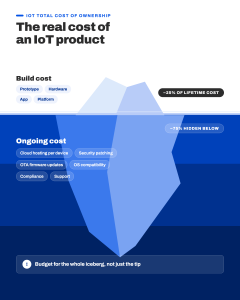
A common pitfall is budgeting only to launch day, when a massive share of the lifecycle budget lies beyond it.
Ongoing operations include over-the-air firmware updates, growing server capacity, bug fixes, and keeping the companion app compatible with each new iOS and Android release. Plan 15 to 25% of the original build cost per year for this upkeep, and treat it as a permanent line, not a contingency.
Security is its own ongoing commitment. IoT fleets are prime attack targets, and retrofitting protection after an audit or a breach costs far more than building it in: robust encryption, secure boot, and multi-factor authentication belong in the first sprint. Regulated products add continuous compliance investment for standards like GDPR, HIPAA, or SOC 2.
Put together, the total cost of ownership spans the prototype, hardware manufacturing, cloud hosting, security patching, and team maintenance across the product’s whole operational life. The build cost you see above the waterline is often matched by what sits below it.
Seven ways to keep your IoT budget under control
- Start with an MVP: launch a minimum viable product to test core functionality with real users before investing in advanced analytics or machine learning features.
- Use existing APIs: third-party APIs for standard functionality like mapping, weather data, or authentication save costly custom development hours.
- Standardise hardware early: stay on commercially available microcontrollers and developer kits until the product is proven, and delay custom PCB fabrication as long as you can.
- Model recurring costs before signing anything: multiply per-device cloud and connectivity fees by your three-year fleet forecast. At scale, the recurring bill dwarfs the build.
- Start on a managed platform: buy the platform for version one, and only build custom once your data volumes and feature needs justify it.
- Design security in from sprint one: encryption, secure boot, and MFA cost a fraction upfront of what an emergency retrofit costs after a breach.
- Choose the talent model deliberately: a hybrid of in-house product ownership and outsourced engineering is the budget sweet spot for most first IoT products.
Frequently asked questions
How much does it cost to develop an IoT app?
A proof of concept runs $5,000 to $30,000, a consumer IoT MVP $30,000 to $100,000, a full consumer product $80,000 to $150,000, and industrial IoT platforms $150,000 to $500,000 or more. Add recurring cloud and connectivity fees plus 15 to 25% of the build cost per year in maintenance.
What is the biggest cost driver in IoT development?
Hardware and connectivity choices, and whether the system needs real-time data processing. Custom sensors, cellular connectivity, and split-second analytics each multiply the budget, while dev-kit hardware, Bluetooth, and hourly reporting keep it lean.
Should I build a custom IoT platform or use AWS IoT?
For a first product, a managed platform like AWS IoT Core or Google Cloud is usually the capital-efficient choice: faster to market with lower upfront cost. Custom platforms make sense once fleet scale, data ownership, or unique features justify the $60,000 to $150,000 foundation investment.
How much does IoT maintenance cost after launch?
Plan 15 to 25% of the original build cost per year, covering OTA firmware updates, cloud scaling, security patching, and app compatibility with new OS releases. Regulated products add ongoing compliance costs on top.
Why is industrial IoT so much more expensive than consumer IoT?
Industrial deployments need ruggedised hardware, integration with legacy SCADA and PLC systems, ultra-reliable networks, and safety certification. Those requirements routinely make an industrial build three to five times the cost of a comparable consumer product.
Final takeaway
Bringing a connected product from concept to market is a multi-layered investment, but it is a forecastable one. Anchor your plan in the price bands, model the recurring costs as carefully as the build, prioritise security from the first sprint, and choose the talent model that fits how you want to operate. Do that, and the budget stops being a source of surprises and becomes a tool you steer with.
Planning a connected product? Appther builds IoT-connected mobile apps, cloud platforms, and AI-powered analytics for connected devices. Book a free consultation and we will map your hardware, connectivity, and data needs to a phase-by-phase budget you can take to your board. [PENDING: link this paragraph to the IoT services page if one exists, see pre-publish notes.]