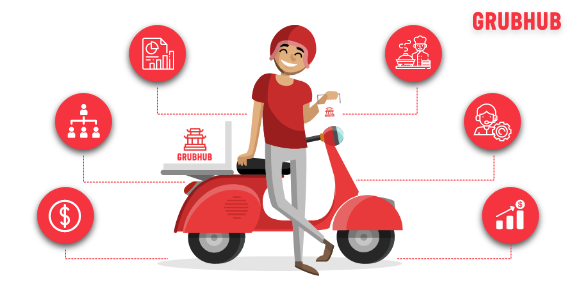
Grubhub earns money through merchant commissions and related fees, applicable diner charges, paid Grubhub+ subscriptions and advertising. Corporate and campus dining extend its ordering business. However, not every order carries every fee: membership benefits, merchant arrangements and offers affect what is charged.
Understanding the Grubhub business model means separating the value of food ordered from the money the platform earns, and separating that revenue from profit.
For businesses planning a delivery platform, the useful lessons are how to connect customers, restaurants and couriers, price the service and operate deliveries sustainably.
What is Grubhub, and who owns it?
Grubhub is a US ordering and delivery marketplace connecting diners with restaurants and other merchants. Depending on the merchant and order, customers can use platform delivery, restaurant-managed delivery or pickup.
Grubhub is part of Wonder. It was previously owned by Just Eat Takeaway.com. Grubhub’s official integration announcement confirms that Wonder completed its acquisition in January 2025. A June 2026 announcement describes further Grubhub integrations under Wonder.
The distinction matters: an article describing Just Eat Takeaway.com as Grubhub’s current parent would be outdated.
How the Grubhub marketplace works
- Discovery: A diner browses available merchants and menus through a supported ordering channel.
- Checkout: The diner selects items, chooses fulfilment and reviews the applicable total before paying.
- Preparation: The restaurant receives and prepares the order.
- Fulfilment: A courier delivers it, the restaurant uses its own delivery team, or the diner collects it.
- Settlement and support: Payments, merchant charges, delivery compensation and any adjustments are handled under the relevant arrangements.
This is a multi-sided marketplace. Restaurant selection attracts diners, while order demand makes participation more useful to merchants and delivery partners. That network still needs reliable operations to create value.
How does Grubhub make money?
1. Restaurant marketing commissions
Restaurants pay marketing commissions on marketplace orders. On the official pricing page reviewed for this article, the advertised tiers are Basic at 5%, Plus at 15% and All-access at 20%.
These are marketing rates, not all-inclusive costs. Processing charges, delivery services, market-specific terms and individual agreements may affect the total.
2. Merchant delivery and processing charges
Grubhub separately advertises merchant delivery fees starting at 10% when its delivery network is used. Self-delivery uses the restaurant’s own drivers; processing charges can still apply.
Do not confuse this merchant-side delivery charge with a delivery fee shown to the diner. They are separate parts of the commercial model.
3. Diner fees, where applicable
Orders can include delivery, service or small-order charges, depending on the circumstances. Grubhub’s fee explanationdescribes service fees and situations where additional charges may apply.
An important 2026 change needs to be included: Grubhub announced the removal of delivery and service fees on eligible restaurant orders of $50 or more, subject to terms. Its April 2026 announcement documents this offer.
That does not mean every order, charge or category is fee-free. Readers should check the current offer terms and checkout total rather than apply one blanket rule.
4. Grubhub+ subscriptions
Grubhub+ offers benefits on eligible orders, including delivery savings and other member perks. Grubhub’s April 2026 membership announcement lists the then-standard monthly rate as $9.99 plus tax, while also describing a temporary promotion.
Membership is also offered through the US Amazon Prime partnership, as described in Grubhub’s published partnership updates. Such access should not be counted as though every member personally pays Grubhub the retail subscription price. The sources reviewed do not establish a per-member payment from Amazon.
The business rationale is that membership can encourage repeat use. Its financial value also depends on the cost of benefits and the behaviour of participating customers.
5. Advertising and sponsored placements
Grubhub offers merchants paid visibility, including placements in discovery areas such as search and the homepage. Its advertising announcement describes merchant ads charged by the click, alongside post-checkout advertising opportunities for consumer brands.
Paid advertising should be distinguished from the marketing commission already attached to marketplace orders. The reviewed sources do not establish advertising’s current share of total revenue or its profit margin.
6. Corporate and campus dining channels
Grubhub also operates corporate meal programmes and campus ordering. These offerings connect the platform to employers and universities rather than relying only on individual consumer discovery. Grubhub describes both businesses in its acquisition announcement.
They can support recurring ordering opportunities, but programme volume is not an extra revenue stream to add on top of the same underlying transactions. Without a detailed financial breakdown, avoid double-counting commissions, fees and programme revenue.
The Grubhub business model at a glance
| Element | Role in the model |
|---|---|
| Participants | Diners, merchants, couriers and institutional partners |
| Diner value | Food discovery, ordering convenience and fulfilment options |
| Merchant value | Access to demand, ordering tools and optional delivery support |
| Monetisation | Merchant charges, applicable diner fees, paid membership and advertising |
| Delivery channels | Consumer marketplace, corporate and campus programmes, partner integrations |
| Operating costs to consider | Delivery compensation, technology, support, promotions and payment-related costs |
Revenue is not the same as order value or profit
A customer’s checkout total includes money associated with the food purchase and potentially taxes, tips and fees. It should not be treated as platform revenue in its entirety. Nor should every dollar charged by the platform be treated as profit.
For a new delivery business, a useful operating model is:
Order contribution = platform revenue attributable to the order − variable costs attributable to fulfilling and supporting it.
Define the accounting treatment consistently. Delivery compensation, payment costs, incentives, refunds and support can materially change the result. Fixed overhead remains to be covered after order contribution.
Is Grubhub profitable in 2026?
The official materials reviewed for this article do not provide sufficient current standalone financial information to establish Grubhub’s 2026 net profitability.
Avoid treating historical losses, adjusted EBITDA, transaction volume or an ownership change as proof of current net profit or loss. A reliable claim needs a dated financial disclosure and a clearly identified measure.
What challenges does this model face?
For anyone analysing a delivery marketplace, four operating questions matter:
- Can it fulfil orders economically? Distance, restaurant preparation delays and courier availability affect delivery costs.
- Do customers return without constant discounts? Acquisition incentives can generate orders without sustainable contribution.
- Do merchants receive enough value? Fees need to be assessed against incremental demand and fulfilment support.
- Can operations handle exceptions? Missing items, cancellations, refunds, payment disputes and failed deliveries require clear processes.
Local operating requirements also need review before launch. Do not assume one fee structure or courier arrangement can be applied unchanged across every market.
What should you build in a food delivery MVP?
Begin with a defined market and fulfilment model. A restaurant’s own ordering app has different requirements from a marketplace that recruits merchants and manages couriers.
A marketplace commonly needs four connected interfaces, although some can be delivered as web panels:
| Interface | Essential first-release capabilities |
|---|---|
| Customer app or web experience | Menus, cart, checkout, address selection, order status and support |
| Restaurant panel | Menu availability, order acceptance, preparation updates and transaction records |
| Courier app, if operating your own fleet | Task acceptance, navigation handoff, delivery status and completion confirmation |
| Admin panel | Merchant onboarding, order oversight, fee configuration, refunds and reporting |
Using an external delivery provider may reduce the need for a separate courier app, but creates integration and operational dependencies. Start with the workflows required to complete and support orders reliably before adding subscriptions, advertising or complex dispatch automation.
How much does it cost to build a food delivery app?
For an Appther planning discussion, use scope-based estimates in USD:
| Scope | Indicative budget | Indicative timeline |
|---|---|---|
| Limited restaurant-ordering MVP with a narrow fulfilment model | $15,000–$40,000 | 8–12 weeks |
| Focused marketplace with customer, merchant, courier and admin workflows | $40,000–$100,000 | 3–6 months |
| Complex platform with advanced dispatch and extensive integrations | $100,000–$250,000 | 6–12 months |
| Enterprise-scale requirements | $250,000+ | 9–18 months |
These are indicative planning bands, not fixed quotes or Grubhub’s development costs. Geography alone does not determine complexity. Confirm platforms, design, payment and payout flows, tracking, integrations, testing and release scope before estimating.
Hosting, maps, messaging, payment processing, delivery operations, promotions, maintenance and applicable taxes require separate budgeting unless expressly included. See the food delivery app cost guide for related planning considerations.
Frequently asked questions
What is Grubhub’s revenue model?
It combines merchant charges, applicable diner fees, paid subscriptions and advertising. Corporate and campus programmes broaden the ordering business. The sources reviewed do not establish the current percentage contributed by each activity.
Who owns Grubhub now?
Wonder acquired Grubhub in January 2025. Official 2026 announcements continue to describe Grubhub within Wonder’s business.
Does Grubhub charge fees on every order?
No single fee rule applies to every order. Merchant arrangements, memberships, eligibility and promotions affect charges. The 2026 offer discussed above removes delivery and service fees on qualifying restaurant orders of $50 or more, subject to terms.
Does free delivery mean the platform makes no money?
No. Removing a diner-facing charge does not necessarily remove merchant charges or other revenue sources. Profitability still depends on the revenue and costs associated with serving that order.
Can I build an app like Grubhub?
You can build a delivery product using a similar marketplace structure, but matching a national platform’s operations and scale is a much larger undertaking. Define the launch geography, merchant supply, fulfilment model and support responsibilities before selecting features.
Plan your food delivery platform with Appther
Appther’s restaurant and food delivery app development services can help translate your operating model into customer, merchant, delivery and administration workflows.
Begin with a clear scope, a realistic delivery operation and an understanding of the economics of each order.