| Quick answer
Agentic AI in Odoo means autonomous AI agents that work inside your Odoo ERP to complete tasks on their own, such as raising purchase orders, matching supplier invoices, and flagging anomalies, instead of waiting for staff to act. For Australian businesses, it turns Odoo from a system that records work into one that does the work, while keeping a human in the loop and staying aligned with local rules like GST, BAS, and Single Touch Payroll. |
Most Australian businesses already use their ERP as a careful record keeper. Odoo logs the sale, the invoice, and the stock movement, and then waits for a person to act on it. That person chases the approval, raises the purchase order, and reconciles the numbers at month end.
Agentic AI changes that arrangement. Instead of waiting to be told, an agent watches your data, decides what needs doing, and does it within rules you set. The work that used to sit in someone’s queue simply gets handled.
This guide explains what agentic AI in Odoo actually looks like, where it fits across your modules, what it means for Australian compliance, and how to roll it out safely.
What agentic AI in Odoo actually means
It helps to separate two ideas. A traditional ERP is a system of record. It stores what happened. An agentic ERP becomes a system of action. It carries out the next step on its own.
Odoo already has automation rules, which fire a set action when a set condition is met. Agentic AI goes further. An agent reasons about a goal, weighs the options, and completes a multi-step task, adapting when something does not go to plan.
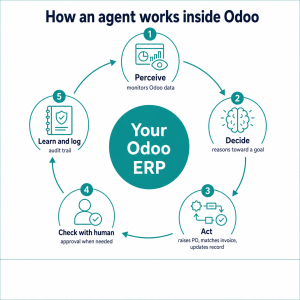
Take procurement. A standard rule might email a buyer when stock runs low. An agent does the whole job. It spots the low stock, checks supplier pricing and lead times, drafts the purchase order, routes it for approval under your policy, and then tracks the confirmation and updates the delivery date in Odoo. Analysts at Gartner expect roughly a third of enterprise software to include this kind of agentic capability within a few years, so this is a shift, not a fad.
Agentic AI versus a simple chatbot in Odoo
It is worth clearing up a common mix-up. A chatbot bolted onto Odoo answers questions. You ask it for last month’s sales and it tells you. An agent is different. It does not wait to be asked, and it does not stop at an answer.
It takes the action the answer implies. Ask a chatbot about low stock and it reports the number. An agent sees the low stock and orders more. That gap, between informing and acting, is the whole point of agentic AI, and it is why the payoff is so much larger.
Where agentic AI fits across your Odoo modules
Agents earn their keep on high-volume work full of small exceptions. Here is where Australian businesses get the most value inside Odoo.
Procurement and inventory
An agent monitors stock across your warehouses, predicts shortages from real demand, and raises purchase orders before you run out. It can compare suppliers on price and reliability, then route the order for sign-off. Your buyers stop firefighting and start managing exceptions.
Accounting and accounts payable
This is often the fastest win. An agent reads incoming supplier invoices, matches each one against the purchase order and the goods received, and flags anything that does not line up. Clean invoices move toward payment, and your team only touches the ones that need a human eye.
Sales and CRM
Agents qualify and route incoming leads, draft quotes from your price lists, and chase overdue invoices with polite, timely follow-ups. They can also surface at-risk customers before they churn, so your sales team acts early instead of late.
Manufacturing and operations
On the production side, an agent watches work orders, flags material shortages that threaten a schedule, and suggests adjustments to keep the line moving. It can also predict maintenance needs before a breakdown stops the floor.
Field service
For services businesses, agents schedule jobs, optimise technician routes, keep customers updated, and reconcile timesheets back into Odoo. The admin that used to eat an afternoon happens quietly in the background.
A closer look: the purchase order that raises itself
Here is what the shift feels like in practice.
Today, a stock item dips below its minimum. Odoo flags it. A buyer notices the alert, opens a few supplier records, compares prices, checks who delivers fastest, raises a purchase order, and emails it for approval. Then they chase the confirmation. That is twenty minutes, repeated dozens of times a week.
With an agent, the same event unfolds on its own. The agent sees the dip, reviews supplier pricing and lead times from your Odoo data, drafts the order to the best option, and sends it for one-click approval under your policy. Once approved, it tracks the confirmation and updates the expected delivery date.
Your buyer did not disappear. They simply stopped doing the mechanical part, and now spend that time on supplier relationships and the exceptions that need real judgement.
What agentic AI in Odoo means for Australian businesses
This is where a local lens matters. Generic AI advice ignores the rules every Australian business actually has to follow. Done well, agents do not just respect those rules, they help you meet them.
GST and BAS preparation
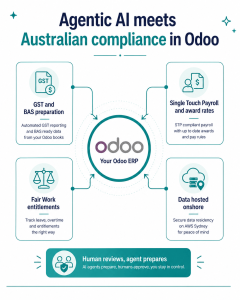
An agent can compile the GST collected and paid straight from your Odoo transactions, prepare your draft Business Activity Statement figures, and flag anomalies before lodgement. You still review and lodge with the ATO, but the slow gathering and checking is done for you.
Single Touch Payroll and award rates
Payroll is a high-risk area in Australia, where underpayment carries real consequences. An agent can validate each pay run against the correct award and penalty rates, flag anything that looks off, and prepare Single Touch Payroll data for reporting. That extra check protects both your staff and your business.
Fair Work and entitlements
Agents help keep leave balances, penalty rates, and entitlements correct as they flow through Odoo, so compliance is built into the daily run rather than chased at audit time.
Data sovereignty and local hosting
For many Australian organisations, where the data lives is not a detail, it is a deal breaker. You can host Odoo and its AI layer in an Australian region such as AWS Sydney, keep customer and payroll data onshore, and align with the Australian Privacy Principles. A well-built agent also keeps your private data out of public AI models. If you serve government, health, or finance clients, this onshore posture is often what wins the deal.
Australian industries seeing the fastest gains
Some sectors are moving quicker than others, usually because they run high transaction volumes or thin margins. If you work in one of these, the case is strong.
- Construction and trades: agents handle subcontractor invoices, progress claims, and project cost tracking, an area you know well if compliance and paperwork already slow your jobs.
- Retail and wholesale distribution: automated reordering, supplier management, and multi-channel stock control across locations.
- Professional services: automated time capture, invoicing, and client follow-up that frees billable hours.
- Agriculture and agribusiness: demand-led ordering, seasonal forecasting, and supplier coordination.
- Mining services and logistics: maintenance prediction, parts procurement, and route and job scheduling.
In each case, the pattern is the same. The agent absorbs the repetitive, exception-heavy work, and your people focus on judgement and customers.
How to add agentic AI to Odoo safely
Autonomy without control is a liability, not an asset. The businesses that succeed treat this as controlled autonomy, not a free-for-all. A few principles keep it safe.
- Start with reversible, low-risk tasks. Begin with work that can be reviewed or undone, like drafting purchase orders, not irreversible financial posting.
- Keep a human in the loop. Critical actions, like approving payments or lodging a BAS, should pass through a person until trust is earned.
- Ground the agent in your own data. Retrieval-augmented generation keeps answers tied to your real Odoo records, which cuts mistakes and hallucinations.
- Log everything. Every agent action should leave an audit trail, so you can see what happened and why.
- Expand as trust grows. Prove value on one workflow, then widen the agent’s remit step by step.
The technical side matters too, and it is where many in-house attempts stumble. Industry research from Forrester suggests most organisations that try to build production AI agents alone struggle to get them live. A guided build avoids that. For the architecture and integration detail, see our companion guide on how to integrate agentic AI into your ERP, and our Odoo services for the implementation side.
Common concerns, answered honestly
Australian business owners tend to raise the same fair questions. They deserve straight answers.
Will it make mistakes? It can, which is exactly why you start with reversible tasks and keep approvals on the critical ones. The audit trail means you always see what it did and can step in.
Will it replace my staff? Not in the way people fear. It removes routine work, not roles. Most businesses redeploy people to higher-value tasks rather than cut them, because there is always more useful work than hands to do it.
Is it expensive to set up? Less than you might think, especially next to hiring. You can start with one workflow and a modest budget, prove the return, then expand. The cost grows with the value, not ahead of it.
The payoff for Australian businesses
The return shows up in three places. First, reclaimed hours, since the routine procurement, invoicing, and reporting work shrinks dramatically. Second, fewer costly errors, because an agent that checks every invoice and pay run does not get tired or distracted. Third, faster decisions, as the work that used to wait in a queue now happens in near real time.
For a lean Australian SME, that combination is powerful. You get the operational muscle of a much larger team without the headcount, and your existing people move up to work that actually needs a human.
Your first agentic project in Odoo
If you are convinced but unsure where to begin, keep it simple. Pick one workflow that is high in volume and low in risk. Accounts payable invoice matching and automated procurement are the two most popular starting points, because the work is repetitive and the wins are obvious.
Run it for a few weeks alongside your team. Measure the hours saved, the errors caught, and how often the agent needs a human. Once it proves itself, add the next workflow. This steady, evidence-led approach is what turns a small pilot into a genuinely autonomous operation.
Frequently asked questions
What is agentic AI in Odoo?
It is the use of autonomous AI agents inside your Odoo ERP that complete tasks on their own, such as raising purchase orders, matching invoices, and preparing reports, within rules you define and with human approval for critical actions.
How is it different from Odoo’s existing automation?
Odoo automation rules fire a fixed action when a condition is met. An agent reasons toward a goal and completes a multi-step task, adapting when conditions change, rather than following one preset rule.
Can it handle Australian GST and BAS?
Yes. An agent can compile GST figures from your Odoo data and prepare draft BAS numbers for review. A person still reviews and lodges with the ATO, so compliance stays under human control.
Is my data safe and kept in Australia?
It can be. You can host Odoo and the AI layer in an Australian region like AWS Sydney, keep data onshore under the Australian Privacy Principles, and ensure the agent does not send private data to public AI models.
Do I need to replace Odoo to use agents?
No. Agentic AI sits on top of your existing Odoo as an action layer. You keep Odoo as your system of record and add agents to handle the work around it.
The bottom line
For Australian businesses, agentic AI in Odoo is the difference between an ERP that remembers and an ERP that acts. It takes the repetitive, exception-heavy work off your team, helps you stay on top of GST, BAS, and payroll obligations, and keeps your data where it belongs.
The smart way in is to start small, keep a human in the loop, and grow the agents’ role as they earn your trust. Done right, you end up with a leaner operation and people freed for the work that matters.
Want to see what an autonomous Odoo would look like for your business? Book a free consultation with Appther, and we will map your Odoo workflows, your compliance needs, and your data to a clear, safe rollout plan.